











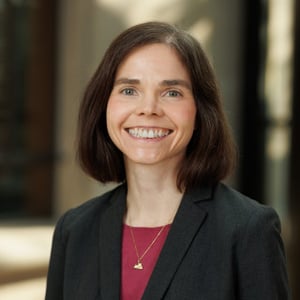
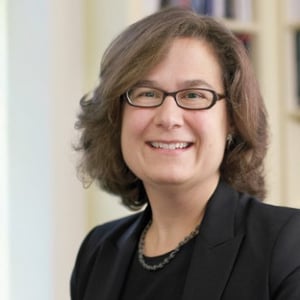
Tara Leigh Grove is the Vinson & Elkins Chair in Law at the University of Texas School of Law. Grove graduated summa cum laude from Duke University and magna cum laude from Harvard Law School, where she served as the Supreme Court Chair of the Harvard Law Review. Grove clerked for Judge Emilio Garza on the U.S. Court of Appeals for the Fifth Circuit, and then spent four years as an attorney for the U.S. Department of Justice, Civil Division, Appellate Staff, where she argued fifteen cases in the courts of appeals.
Grove’s research focuses on the federal judiciary, interpretive theory, and the constitutional separation of powers. She has published with such prestigious law journals as the Harvard Law Review, the Yale Law Journal, the Columbia Law Review, the University of Pennsylvania Law Review, the New York University Law Review, the University of Chicago Law Review, the Virginia Law Review, the Texas Law Review, the Cornell Law Review, the Northwestern University Law Review, and the Vanderbilt Law Review. Grove has received awards for both her research and her teaching.
In 2021, Grove served on the Presidential Commission on the Supreme Court of the United States, a bipartisan commission created by President Biden and charged with examining proposals for Supreme Court reform. Since 2022, Grove has worked on the Princeton Initiative on Reclaiming the Constitutional Powers of Congress, which brings together former members of Congress, political scientists, and law professors. Grove serves as the Co-Chair of the section on the Appointments Process for the Princeton Initiative. Grove is a co-author of Low & Jeffries' Federal Courts and the Law of Federal-State Relations, a leading federal courts casebook, and she has served as the Chair of the Federal Courts Section of the Association of American Law Schools. Grove has been a visiting professor at both Harvard Law School and Northwestern Pritzker School of Law.


















Checks and Balances: Deregulation Based on Supreme Court Rulings
Craig E. Leen, John Lewis, Jonathan Wolfson
Among the points emphasized by the second Trump administration has been a major push for...
Courthouse Steps Decision: Seven County Infrastructure Coalition v. Eagle County, Colorado
Austin M. Lipari, Mario Loyola
This case concerned the question of whether the National Environmental Policy Act (NEPA) requires an...
Courthouse Steps Decision: FDA v. Wages and White Lion Investments, L.L.C.
Jonathan H. Adler, Kristin E. Hickman, Eli Nachmany, Richard J. Pierce
Under the Family Smoking Prevention and Tobacco Control Act, the FDA must approve new tobacco...
Unleashing American Energy at CEQ
Edward Boling, Garrett Kral, Mario Loyola
On his first day back in office, President Trump issued Executive Order 14154 (Unleashing American...
Panel: The Future of Administrative Statutes
Eric R. Bolinder, Tara Leigh Grove, Joshua Kleinfeld, Brian Gary Slocum, Ilan Wurman
This panel will explore the Court’s recent decision in Loper Bright as well as its...
Luncheon Panel: Abortion Law After Dobbs
Stephanie Barclay, Sherif Girgis, Rachel Rebouché, Stephen E. Sachs, Mary Ziegler
Featuring: Prof. Stephanie Barclay, Professor of Law, Georgetown University Law Center Dean Rachel Rebouché,...
Does President Trump Have the Authority to Pause and Modify the Medicare Drug Price Negotiation Program?
John Shu, Jeff Stier, Dan Troy
Since its inception, the Inflation Reduction Act’s (IRA) Medicare Drug Price Negotiation Program has been...
Department of Government Efficiency: Opportunities and Challenges (Part I)
Nicholas Bagley, Susan E. Dudley, Christopher J. Walker
President-elect Trump has announced that entrepreneurs Elon Musk and Vivek Ramaswamy will lead a new...
Administrative Law and Regulation: What Is the Future of Administrative Law?
Paul D. Clement, Cary Coglianese, Philip A. Hamburger, Kathryn Kimball Mizelle, Neomi Rao
The Supreme Court's latest term was one of its most significant for administrative law. The...
How Does AI Affect Rulemaking?
John Kennerly Davis, Daniel M. Flores, John Nay, Catherine M. Sharkey
A panel of experts will engage in a legal discussion about the implications of using...