

Senior Fellow in Constitutional Jurisprudence, Independence Institute
Professor Robert G. Natelson is a constitutional scholar and author.
Rob’s constitutional scholarship has been cited repeatedly by justices and parties at the U.S. Supreme Court—as well as by federal appeals courts, and at least 18 state supreme courts.
Rob’s research into the Constitution’s original meaning has carried him to libraries throughout the United States and in Britain, including four months at Oxford University. His books and articles span many different parts of the Constitution, including groundbreaking studies of the Necessary and Proper Clause, the Indian Commerce Clause, federalism, Founding-Era interpretation, regulation of elections, and the amendment process of Article V. He created the first-ever online bibliography for 18th century materials used in constitutional research. He is a contributing author to the Encyclopedia of the Supreme Court of the United States (on Magna Carta). He contributed eight essays to the third edition of the Heritage Guide to the Constitution: five on the amendment procedure and one each on the Guarantee Clause, the Postal Clause, and the Recess Appointments Clause.
U.S. Supreme Court justices have relied explicitly on Rob’s research in 41 citations in 13 separate cases.

CEO, Catawba Digital Economic Zone
Joseph McKinney launched his career in electoral politics by participating in local, state and national political campaigns. In 2014, Joseph entered the blockchain space and was shortly thereafter introduced to key leaders in the Zone development sector.
In 2015, Joseph founded the Startup Societies Foundation, a nonprofit Zone policy think tank, the mother organization of the Institute for Competitive Governance. He also serves as CEO of Nuhanse Network and is currently writing his first book on innovative Zones.

Co-Director, IBM PolicyLab
Ryan Hagemann is a Technology Policy Executive at IBM. He was previously a senior policy fellow at the International Center for Law & Economics. Before joining the International Center for Law & Economics, he was a senior fellow at the Niskanen Center, where he also served as the senior director for policy and director of technology policy. His policy expertise focuses on regulatory governance of emerging technologies, as well as a broader research portfolio that includes genetic modification and regenerative medicine, bioengineering and healthcare IT, artificial intelligence, autonomous vehicles, commercial drones, the Internet of Things, and other issues at the intersection of technology, regulation, and the digital economy. His work on “soft law” governance systems, autonomous vehicles, and commercial drones has been featured in numerous academic journals, and his research and comments have been cited by The New York Times, MIT Technology Review, and The Atlantic, among other outlets. He has been published in The Wall Street Journal, Wired, National Review, The Washington Examiner, U.S. News & World Report, The Hill, and elsewhere.
Ryan graduated from Boston University with a B.A. in international relations, foreign policy, and security studies and holds a Master of Public Policy in science and technology policy from George Mason University.

Principal, Spero Law LLC
Christopher Mills is the founder of Spero Law LLC. He was previously a partner at a national law firm and a Constitutional Law Fellow at the Becket Fund for Religious Liberty. He served as a law clerk to Justice Clarence Thomas on the U.S. Supreme Court during October Term 2018. He also clerked for the Honorable David B. Sentelle, then-Chief Judge of the U.S. Court of Appeals for the D.C. Circuit. He has authored briefs and motions in the Supreme Court, courts of appeals, and trial courts, and successfully argued before the D.C. Circuit. He has served as special counsel to South Carolina Governor Henry McMaster, and is an Adjunct Professor at the Charleston School of Law.
A 2012 magna cum laude graduate of Harvard Law School, Christopher was a senior editor of the Harvard Law Review, an editor of the Harvard Journal of Law and Public Policy, and served on the Executive Board of the Harvard Federalist Society. In 2009, he graduated Phi Beta Kappa and summa cum laude with a degree in economics from Furman University.
Christopher lives in Charleston, South Carolina with his wife, children, and golden retriever.
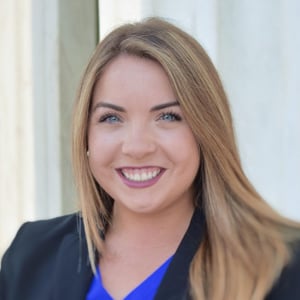
Legal Fellow, Spero Law LLC
Anna Edwards graduated magna cum laude from Regent University School of Law where she was named the 2022 Most Outstanding Graduate and where she served as the Executive Editor of Regent Law Review. During her time in law school she has worked as a legal intern for the U.S. Department of Justice Office of Legal Policy, as law clerk on the U.S. Senate Judiciary Committee, and as a legal fellow at Spero Law, LLC. Following graduation, Anna is completing several federal clerkships. Specifically, Anna will serve as a law clerk for the Honorable Paul B. Matey of the U.S. Court of Appeals for the Third Circuit during the 2024-2025 term. Anna is a native of South Carolina and received her B.S. in Economics from Clemson University in 2019.

Senior Attorney, Institute of Justice
Kirby Thomas West is a senior attorney at the Institute for Justice, where she is also the co-director of IJ’s National Initiative to End Forfeiture Abuse. She joined IJ in 2018 and litigates cases defending property rights, free speech, and educational choice.
In her time at IJ, Kirby has launched challenges to unconstitutional civil forfeiture and impoundment schemes. She has also litigated educational choice cases, including as part of the IJ team that litigated Carson v. Makin, a landmark educational choice case decided in 2022.
In 2024, Kirby was a Wasserstein Public Interest Fellow at Harvard Law School.
Before joining IJ, Kirby Was an attorney at Baker Botts LLP, in Washington D.C. She clerked for Judge Dennis Shedd of the U.S. Court of Appeals for the Fourth Circuit.
Kirby received her law degree cum laude from Harvard Law School in 2015.

Topics
Bipartisan Opportunities to Improve Government Accountability
In the recent election, Americans elected a narrowly divided Congress. That means that lawmakers will...
Topics
Rights to Privacy and Life Were Compatible until Roe
Half a century ago, the U.S. Supreme Court held that a federal constitutional right...
Topics
Response to The Original Understanding of the Indian Commerce Clause: An Update
I thank the Federalist Society for the opportunity to briefly respond to Robert Natelson’s recent...
Topics
Religious Liberty Update on Congressional and Executive Branch Actions
Congress SENATE On September 29, 2022, Sen. Lindsey Graham (R-SC), with 16 cosponsors, introduced S.Res....
The Original Understanding of the Indian Commerce Clause: An Update
Robert G. Natelson
The Congress shall have Power . . . To regulate Commerce with foreign Nations, and...
Topics
Religious Liberty Update on Congressional and Executive Branch Actions
Congress 1. In the wake of the unprecedented leak of the draft Dobbs decision on...
Tech Roundup Episode 16 – The Catawba Digital Economic Zone
Joseph McKinney, Ryan Hagemann
In February 2022, the Catawba Nation of South Carolina voted to approve the first tribal...
State Court Docket Watch: Wilson v. City of Columbia
Christopher E. Mills, Anna Edwards
In Wilson v. City of Columbia,[1] the South Carolina Supreme Court held that a city...
Learning to Change: New Takes on Education Reform
Kirby Thomas West
A Review of: The Choice We Face: How Segregation, Race, and Power Have Shaped America’s...
Topics
The Forgotten History of the Intellectual Property Clause
The Intellectual Property (IP) Clause of the U.S. Constitution, which empowers Congress to enact both...