
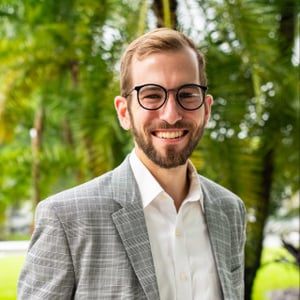
AI Innovation and Law Fellow, University of Texas School of Law
Kevin Frazier is an AI Innovation and Law Fellow with University of Texas School of Law.

Executive Director, Engine
Kate has been at Engine since 2017 and has served as Engine’s Policy Director since 2019, working on privacy, intermediary liability, and telecommunications issues.
Prior to joining Engine, Kate worked on surveillance reform issues at the Electronic Frontier Foundation. Before joining the advocacy community, Kate spent years as a technology policy reporter in D.C., including at Politico, The Hill, and Communications Daily. She is a graduate of Hamilton College.
Deputy Secretary, Pennsylvania Department of Environmental Protection
Mr. Perry is the Deputy Secretary in the Department of Environmental Protection’s newly created Office of Oil and Gas Management. Prior to becoming Deputy Secretary, Scott was the Director for the Bureau of Oil and Gas Management for almost two years. Scott was also an Assistant Counsel with DEP's Bureau of Regulatory Counsel where he advised the Department’s Office of Energy and Technology Deployment, Bureau of Oil and Gas Management, Bureau of Radiation Protection, Bureau of Laboratories, Division of Residual Waste, Division of Municipal Financial Assistance and Division of Source Water and Groundwater Protection. He earned his B.A. from Penn State in 1995 and his J.D. from Willamette University, College of Law in Salem, Oregon, in 2000. Mr. Perry lives in Camp Hill, Pennsylvania with his wife June, and son Nickolas.
Partner, Bracewell & Giuliani LLP
Jason Hutt advises energy companies, manufacturers, project developers, investor groups and financial institutions about environmental risks and liabilities associated with regulatory compliance, project development, congressional investigations, internal investigations and corporate transactions. He also assists in the defense of administrative, civil and criminal proceedings involving environmental enforcement agencies at the federal and state levels.
Mr. Hutt counsels clients on current and upcoming regulatory developments at the nexus of environmental and energy policy, with focused attention on natural gas development (including hydraulic fracturing), responses to the Deepwater Horizon incident, and climate change. He is nationally recognized for his work on shale gas issues on behalf of producers, oil field services companies, hedge funds and technology developers.
Mr. Hutt routinely is involved in identifying, evaluating and managing environmental risks and opportunities associated with corporate acquisitions, divestitures and financings, including environmental due diligence, purchase and sale agreement negotiation, and post-closing integration efforts. Within the energy sector, his representative experience includes transactions involving petroleum refineries, liquefied natural gas (LNG) import terminals, renewable energy projects (e.g., wind, biofuels and geothermal), natural gas processing plants, cogeneration facilities, oil and gas wells, pipelines, propane retailers and synfuel facilities.
Representative work in other sectors involves operations and industries such as chemical manufacturers, oil field services, independent tank terminal operators, glass manufacturing, textiles manufacturing, uranium mining, industrial cleaning operations, hazardous waste management facilities, paper and plastic manufacturing facilities, and medical equipment manufacturing facilities.
Mr. Hutt performs environmental risk evaluations and advises on permit strategy and contract negotiation in relation to project development. His most recent work has involved onshore and offshore LNG import terminals, highway expansions, coal-fired power plant siting on tribal lands, utility privatizations at military bases, international undersea pipelines, interstate undersea electric transmission cables and a pump-storage project.
Associate Attorney, Sierra Club Environmental Law Program
Craig Segall started at the Sierra Club in 2008 as an environmental law fellow. Before coming to the Club, Craig was a law clerk to the Honorable Marsha S. Berzon of the U.S. Court of Appeals for the Ninth Circuit. He is a graduate of the University of Chicago and of Stanford Law School, where he spent most of his time in the basement working with Stanford's environmental law clinic. When not practicing law, Craig keeps busy outdoors. In recent years, he has barely beaten a 12-year-old to the top of Mount Whitney, accidentally driven transmission-deep into a salt lake, and, on an ill-advised hike in South Africa, provoked a surprisingly aggressive ostrich.
Professor of Law, Willamette University College of Law
 Jeffrey Standen joined the Willamette University College of Law faculty in 1990 after serving as deputy general counsel to the U.S. Sentencing Commission. He earned tenure at the college in 1996. Professor Standen has been a visiting professor at the University of San Diego and a scholar in residence at the University of Virginia. He serves as international advisor to the Philippines Court of the Sandiganbayan, the tribunal that adjudicates public corruption cases.
Professor Standen was graduated from the University of Virginia Law School in 1986. He was editor of the Virginia Law Review and articles editor of the Virginia Tax Review. After graduation, he served as law clerk to the Honorable Robert Chapman of the U.S. Court of Appeals for the Fourth Circuit. He entered private practice as an associate with the law firm of Hunton & Williams.
Professor Standen is an active scholar and lecturer and has published articles in prestigious periodicals, such as the California Law Review, the Iowa Law Review and the Washington University Law Quarterly, among others. At Willamette’s College of Law, he teaches Remedies, Evidence, Criminal Law and Procedure, and Sports Law. His Web site, http://thesportslawprofessor.blogspot.com/, is “dedicated to the complete integration of sports and law.”
Professor Standen received the Robert L. Misner Award for Excellence in Scholarship and was WUCL Professor of the Year in 2004. He serves as chair of the 2007 WUCL Self-Study Committee and as faculty advisor to the Willamette Law Review. Professor Standen is a member of the state bars of Virginia and Oregon. He is a cum laude graduate of Georgetown University, where he earned an A.B. in Political Philosophy in 1982; he studied at the London School of Economics in 1981.

Law for Little Tech: Part 6 - Does the Little Tech Agenda Work for Startups?
Kevin Frazier, Kate Tummarello
Startups often struggle to balance financial constraints with the pursuit of innovation, raising questions about...
An Evening with David W. Reinhard
Portland Lawyers Chapter
Portland, ORDrilling and Fracking: Who Regulates? - Podcast
Scott R. Perry, Jason B. Hutt, Craig Segall, Joel Burcat
The techniques of directional drilling and hydraulic fracturing for oil and natural gas have been...
American Needle v. NFL - Post-Decision SCOTUScast
Jeffrey Standen
On May 24, 2010, the Supreme Court announced its decision in American Needle v. NFL....