

Partner, Jackson Walker
Arthur offers clients a winning combination of trial and appellate experience gained as a federal prosecutor and more than 20 years of experience in handling patent, copyright, trademark, and trade secrets litigation.
While his practice concentrates on intellectual property litigation, Arthur also has significant experience in internal investigations, False Claims Act suits, partnership and breach of fiduciary duty, breach of contract, and employment litigation. Arthur also has represented clients testifying before Congressional committees.
Arthur writes and speaks frequently on topics ranging from the case against Boston bomber Dzhokhar Tsarnaev to patent litigation reform.
Prior to joining Michael Best, Arthur served as an Assistant United States Attorney in the Southern District of New York, where he was the lead prosecutor in criminal trials, including federal intellectual property crimes. He also argued numerous appeals.

Professor of Law, University of Baltimore School of Law (on leave); Senior Counsel, U.S. Department of Justice
Professor Dolin’s scholarship centers on patent law with a specific focus on how the patent regime affects innovation, especially in bio-pharmaceutical areas. His work in these areas includes a number of scholarly articles, presentations, amicus briefs, and congressional testimony.
Dr. Dolin is currently on leave from his academic duties while he serves as Senior Counsel in the Civil Rights Division of the United States Department of Justice.
From January 2020 to January 2022, Professor Dolin served as a resident Associate Justice of the Supreme Court of the Republic of Palau. In this role, he (together with other members of the Court) heard appeals in civil, criminal, administrative, and constitutional law matters.
Prior to joining the University of Baltimore School of Law, Professor Dolin held visiting appointments in other law schools. He also served as a law clerk to the Hon. Pauline Newman, of the U.S. Court of Appeals for the Federal Circuit and the late Hon. H. Emory Widener Jr., of the U.S. Court of Appeals for the Fourth Circuit.
Rumors that he has a real Russian bear in his office are entirely true.
*Dr. Ron D. Katznelson is the President of Bi-Level Technologies, a signal processing technology startup company in Encinitas, CA. He is a technologist, an inventor named on 23 U.S. patents, entrepreneur, an intellectual property development and management expert, and an independent scholar of the patent system. He serves on the IP Committee of IEEE-USA and is a member of the San Diego Intellectual Property Association. He can be reached at ron@bileveltech.com.

Laurence A. Tisch Professor of Law and Director, Classical Liberal Institute, New York University School of Law; Senior Fellow, The Civitas Institute, University of Texas at Austin
Richard A. Epstein is the inaugural Laurence A. Tisch Professor of Law at NYU School of Law. Prior to his joining the faculty, he was a visiting law professor at NYU from 2007 through 2009. He served as the Peter and Kirstin Bedford Senior Fellow at the Hoover Institution from 2000 to 2024. Since 2024 to the present he is a senior lecturer at the Civitas Institute at the University of Texas—Austin. Epstein is also the James Parker Hall Distinguished Service Professor of Law Emeritus and a senior lecturer at the University of Chicago. His initial law school appointment was at the University of Southern California from 1968 to 1972. Epstein received an LL.D., h.c. from the University of Ghent, 2003. He has been a member of the American Academy of Arts and Sciences since 1985 and was a Senior Fellow of the Center for Clinical Medical Ethics at the University of Chicago Division of Biological Sciences, also from 1983. to 2022 He served as editor of the Journal of Legal Studies from 1981 to 1991, and of the Journal of Law and Economics from 1991-2001. From 2001 to 2010 he was a director of the John M. Olin Program in Law and Economics at the University of Chicago.
His newest book, The Myth of Birthright Citizenship: What the Fourteenth Amendment Really Says was published in 2026 (Encounter Books). Prior to that he has published many books including, The Dubious Morality of the Modern Administrative State (Roman & Littlefield 2020).Earlier he published th Classical Liberal Constitution: The Uncertain Quest for Limited Government (Harvard 2014) iHis previous books include Design for Liberty: Private Property, Public Administration and the Rule of Law (Harvard 2011); The Case Against the Employee Free Choice Act (Hoover 2009); Supreme Neglect: How to Revive the Constitutional Protection of Property Rights (Oxford 2008); Antitrust Decrees in Theory and Practice: Why Less is More (AEI 2007); Overdose: How Excessive Government Regulation Stifles Pharmaceutical Innovation (Yale University Press. 2006); How Progressives Rewrote the Constitution (Cato 2006); Cases and Materials on Torts (Aspen Law & Business; 8th ed. 2004); Skepticism and Freedom: A Modern Case for Classical Liberalism (University of Chicago, 2003); Torts (Aspen Law & Business 1999); Principles for a Free Society: Reconciling Individual Liberty with the Common Good (Perseus Books, 1998): Mortal Peril: Our Inalienable Rights to Health Care (Addison-Wesley, 1997); Simple Rules for a Complex World (Harvard, 1995); Bargaining With the State (Princeton, 1993); Forbidden Grounds: The Case Against Employment Discrimination Laws (Harvard , 1992); Takings: Private Property and the Power of Eminent Domain (Harvard, 1985); and Modern Products Liability Law (Greenwood Press, 1980). He has also edited(with Catherine M. Sharkey) Cases and Materials on the Law of Torts (10th edition 2012).
Professor Epstein has written numerous articles on a wide range of legal and interdisciplinary subjects. He has taught courses in administrative law, antitrust law, civil procedure, communications, constitutional law, contracts, corporations, criminal law, employment discrimination law, environmental law, food and drug law health law and policy, legal history, labor law, property, real estate development and finance, jurisprudence, labor law; land use planning, patents, individual, estate and corporate taxation, Roman Law; torts, and workers' compensation.
Professor Epstein also writes a regular column for Civitas Institute, which also sponsors his podcast, The Libertarian with Charles C.W. Cooke, and Law Talk, with Cooke and John Yoo. He also does a podcast with John Batchelor. And appears regularly on the Freedom File with Judge Andrew Napolitano.

Professor of Law, Antonin Scalia Law School, George Mason University
Adam Mossoff is Professor of Law at Antonin Scalia Law School, George Mason University. He has published extensively on why patents, copyrights, and other intellectual property rights have been—and should be—legally secured to innovators and creators as property rights. His scholarship has been relied on by the United States Supreme Court, by lower federal courts, and by U.S. federal agencies. He has been invited to testify numerous times before the U.S. Senate and the House of Representatives on intellectual property legislation. His writings on intellectual property policy have also appeared in the Wall Street Journal, New York Times, Forbes, Investors Business Daily, and in other media outlets. His journal articles can be downloaded here.
Professor Mossoff is a longstanding member of the Executive Committee of the Intellectual Property Practice Group of the Federalist Society, on which he served as Chairperson from 2016-2018, and he is Chair of the Intellectual Property Working Group of the Regulatory Transparency Project of the Federalist Society. He is a Senior Fellow and Chair of the Forum for Intellectual Property at the Hudson Institute, a Visiting Intellectual Property Fellow at the Heritage Foundation, and a member of the Board of Directors of the Center for Intellectual Property Understanding. He is a member of the Intellectual Property Rights Policy Committee of ANSI and he has served as Chair and Vice-Chair of the Intellectual Property Committee of the IEEE-USA, on which he remains a member in good standing.

Executive Vice President, The Federalist Society
Dean Reuter is Executive Vice President at the Federalist Society for Law and Public Policy Studies. He has served in two federal government agency Offices of the Inspector General, as Counsel to the Inspector General and Deputy Inspector General, responsible for policing the use of federal funds granted and contracted through those agencies. As such, he helped conduct and oversee criminal investigations across the country. He is the principal author of the non-fiction book, The Hidden Nazi: The Untold Story of America's Deal with the Devil, and editor of Liberty’s Nemesis: The Unchecked Expansion of the State and Confronting Terror: 9/11 and the Future of American National Security. He was appointed by the President and served as Vice-Chairman of the Board of Directors of the Corporation for National and Community Service, and recently served as an appointee on the U.S. Commission on Presidential Scholars. He is a graduate of Hood College (BA with Honors) and the University of Maryland School of Law.

Partner, Crowell & Moring LLP, Crowell & Moring LLP
Trevor K. Copeland is a partner in the law firm of Crowell & Moring LLP (formerly Brinks Gilson & Lione PC).
His patent prosecution experience includes work on medical devices, sunglasses, footwear, sprinklers and irrigation equipment, decorative statuary and water gardens, biotechnology and general mechanical arts. He works closely with clients having products in these areas to develop intellectual property acquisition and management strategies, as well as to protect new ideas and products while respecting the rights of others.
Mr. Copeland's further practice includes design protection, whereby clients are able to protect the unique and valuable ornamental designs of their products using patent, copyright, and/or trademark. He has also litigated utility patents on clients' behalf, and has worked on preliminary injunction lawsuits for both design and utility patents, including winning a preliminary injunction against a foreign company preparing to launch an infringing laser-level device with a suction base.
Mr. Copeland has former experience as a high school biology and chemistry teacher, and as a visiting scientist with a Fungal Biochemistry and Molecular Genetics Laboratory Group.
Partner, Jackson Walker
Arthur offers clients a winning combination of trial and appellate experience gained as a federal prosecutor and more than 20 years of experience in handling patent, copyright, trademark, and trade secrets litigation.
While his practice concentrates on intellectual property litigation, Arthur also has significant experience in internal investigations, False Claims Act suits, partnership and breach of fiduciary duty, breach of contract, and employment litigation. Arthur also has represented clients testifying before Congressional committees.
Arthur writes and speaks frequently on topics ranging from the case against Boston bomber Dzhokhar Tsarnaev to patent litigation reform.
Prior to joining Michael Best, Arthur served as an Assistant United States Attorney in the Southern District of New York, where he was the lead prosecutor in criminal trials, including federal intellectual property crimes. He also argued numerous appeals.
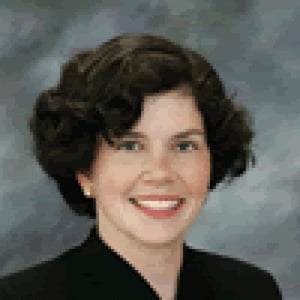
Assistant Professor, The Catholic University of America Columbus School of Law
Professor Winston came to the Columbus School of Law at The Catholic University of America in 2006, having previously been Director of the Center for Intellectual Property Law and assistant professor of law at Whittier Law School. She currently teaches Contracts, Patent Law and Trademarks and Unfair Competition. In 2007, the students at the law school voted Professor Winston the Outstanding Professor of First Year Classes, and again in 2009.
A frequent speaker on a variety of intellectual property topics, Professor Winston has spoken at the Federal Circuit Judicial Conference, the Intellectual Property Owners Association’s Annual Meeting, the Joint Department of Justice and Federal Trade Commission and United States Patent and Trademark Office Seminar Series, the Western Regional Meeting of the American Chemical Society, and the Music Library Association’s Annual Meeting. She has addressed audiences at the University of Akron, American University, DePaul University, George Washington University, University of Maryland University College, Michigan State University, Texas Wesleyan University, Tulane University, and Washington University in St. Louis.
Professor Winston earned her J.D. at University of Virginia School of Law, and an S.B. from the Massachusetts Institute of Technology. While in law school, she was managing editor of The Journal of Law and Politics. Two clerkships followed upon her graduation, first with the Honorable James T. Turner of the United States Court of Federal Claims, followed by two years with the Honorable Paul R. Michel of the United States Court of Appeals for the Federal Circuit. After her clerkships, Professor Winston spent three years in private practice as an associate with Covington & Burling in Washington, D.C.
Professor of Law, Antonin Scalia Law School, George Mason University
Adam Mossoff is Professor of Law at Antonin Scalia Law School, George Mason University. He has published extensively on why patents, copyrights, and other intellectual property rights have been—and should be—legally secured to innovators and creators as property rights. His scholarship has been relied on by the United States Supreme Court, by lower federal courts, and by U.S. federal agencies. He has been invited to testify numerous times before the U.S. Senate and the House of Representatives on intellectual property legislation. His writings on intellectual property policy have also appeared in the Wall Street Journal, New York Times, Forbes, Investors Business Daily, and in other media outlets. His journal articles can be downloaded here.
Professor Mossoff is a longstanding member of the Executive Committee of the Intellectual Property Practice Group of the Federalist Society, on which he served as Chairperson from 2016-2018, and he is Chair of the Intellectual Property Working Group of the Regulatory Transparency Project of the Federalist Society. He is a Senior Fellow and Chair of the Forum for Intellectual Property at the Hudson Institute, a Visiting Intellectual Property Fellow at the Heritage Foundation, and a member of the Board of Directors of the Center for Intellectual Property Understanding. He is a member of the Intellectual Property Rights Policy Committee of ANSI and he has served as Chair and Vice-Chair of the Intellectual Property Committee of the IEEE-USA, on which he remains a member in good standing.

Stevenson Bernard Professor, George Washington University Law School
The Honorable F. Scott Kieff is the Stevenson Bernard Professor at George Washington University Law School and a Visiting Fellow at Stanford University’s Hoover Institution.
He served as Commissioner of the U.S. International Trade Commission from 2013-2017. He also served during the Bush, Obama, and Trump Administrations in the part-time leadership of the national security defense-intelligence community.
He was previously a professor of law and medicine at Washington University in Saint Louis and a Senior Fellow at Hoover. A former law clerk to U.S. Circuit Judge Giles S. Rich, he is a graduate of Penn Law School and MIT, where he studied molecular biology and microeconomics. He was elected to the European Academy of Sciences and Arts in 2012 and the Academia Europaea in 2024.
His private sector work through Kieff Strategies LLC (www.kieffstrategies.com) provides neutral services including mediation and compliance, and expert services including crisis management, advising, and testimony.
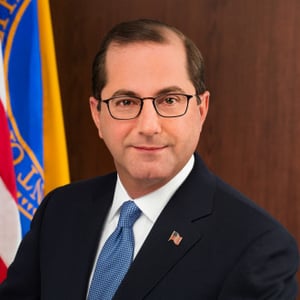
Secretary, U.S. Department of Health & Human Services
Alex M. Azar II was sworn in as the Secretary of Health and Human Services on Jan. 29, 2018. Azar has spent his career working in both the public and private sectors, as an attorney and in senior leadership roles focused on advancing healthcare reform, research and innovation.
From 2001 to 2007, Azar served at the U.S. Department of Health and Human Services – first as its General Counsel (2001–2005) and then as Deputy Secretary. During his time as Deputy Secretary, Azar was involved in improving the department’s operations; advancing its emergency preparedness and response capabilities as well as its global health affairs activities; and helping oversee the rollout of the Medicare Part D prescription drug program.
In 2007, Azar rejoined the private sector as senior vice president for corporate affairs and communications at Eli Lilly and Co. From 2012 to 2017, he served as president of Lilly USA LLC, the company’s largest affiliate.
Azar clerked for U.S. Supreme Court Justice Antonin Scalia prior to practicing law for several years.
Azar graduated summa cum laude with a bachelor’s degree in economics and government from Dartmouth College and earned his law degree from Yale University.
For the past 10 years, Azar has lived in Indiana with his wife and their two children.

A Look Back at the Supreme Court’s 2013-14 Term—Is More “Reform” Needed?
Arthur Gollwitzer
Note from the Editor: This article reviews the Supreme Court’s patent decisions from the 2013-14...
The Costs of Patent Reform: Early Data and Abuses in the Uneven Playing Field of Post-Issuance Review
Gregory Dolin
Note from the Editor: This article is a critical examination of patent reform. As always,...
The America Invents Act May Be Constitutionally Infirm if It Repeals the Bar Against Patenting After Secret Commercial Use
Ron Katznelson
Note from the Editor: This paper analyzes the constitutionality of the new conditions for patentability...
Patent Rights: A Spark or Hindrance for the Economy? - Podcast
Richard A. Epstein, Adam Mossoff, Dean Reuter
Innovation and entrepreneurship are integral to America’s economic strength, and the U.S. patent system has...
Just a Minor Fix in Patent Reform? Qui Tam Actions and the False Marking Statute
Trevor K. Copeland, Arthur Gollwitzer, Elizabeth I. Winston, Adam Mossoff
The false marking statute of the Patent Act (35 U.S.C. § 292) prohibits marking as...
"Promoting the Progress" or Paying for Delay? Balancing Patent and Antitrust Law in the Age of Health Care Reform
Robert G. Pluta
In patent litigation valued between $1 million and $25 million, a patent owner should expect...
IGWG: Beyond its Mandate?
John S. Gardner
Letter from the Editor . . . The Federalist Society takes seriously its responsibility as...
How Patents Can Help Those Interested in the Environment and World Health
F. Scott Kieff
It has become fashionable to argue that patents frustrate important social goals like protecting the...
Does IP Harm or Help Developing Countries?
Bruce A. Lehman, Robert Sherwood, Jerome H. Reichman, Graeme B. Dinwoodie, Alex M. Azar
Introduction: My name is Bruce Lehman. I’m at Akin Gump Strauss Hauer & Feld. I’m...
Intellectual Property in an Era of Intellectual Renaissance
Gerald J. Mossinghoff
The remarks of the Hon. Gerald J. Mossinghoff to the Keio University International Extension Program...