
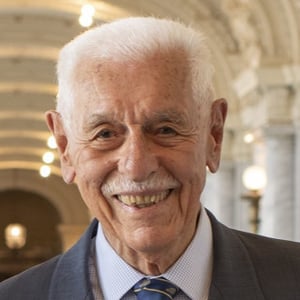
Judge, United States Court of Appeals, Ninth Circuit
Judge Carlos Bea serves as a judge on the United States Court of Appeals for the Ninth Circuit. He received his Bachelor's Degree from Stanford University in 1956 and his J.D. from Stanford Law School in 1958. Judge Bea was born in San Sebastian, Spain, and immigrated with his family to Cuba in 1939. In 1952, he represented Cuba on the Cuban National basketball team in the Helsinki Olympics. Judge Bea became a naturalized citizen of the United States in 1958. He engaged in private practice in San Francisco, principally in the area of civil trials (jury and non-jury), from 1959-75 at Dunne, Phelps & Mills and from 1975-90 at Carlos Bea, A Law Corporation. He taught courses in civil litigation advocacy at Hastings College of Law and Stanford Law School. From 1990 to 2003, Judge Bea served as a judge of the San Francisco Superior Court. He was nominated by President George W. Bush to the United States Court of Appeals for the Ninth Circuit and was confirmed in 2003.
Judge Bea and his wife Louise reside in San Francisco, where they raised their four sons, Sebastian, Alexander, Nicholas, and Dominic.
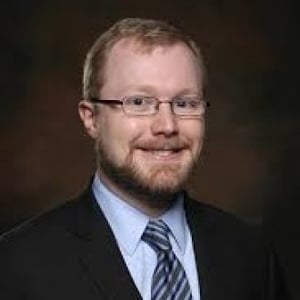
Senior Attorney, Institute for Justice
Paul Sherman is a senior attorney at the Institute for Justice.
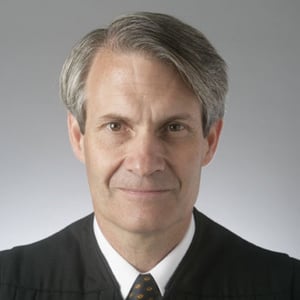
Special Counsel, Hunton Andrews Kurth
After serving on the United State Court of Appeals for the D. C. Circuit from 2005, Judge Griffith stepped down from the bench in 2020. Currently he is a Lecturer on Law at Harvard Law School, a Fellow at the Wheatley Institute at Brigham Young University, and Special Counsel in the Washington, DC office of the law firm of Hunton Andrews Kurth. Most recently, he was a member of President Biden's Commission on the Supreme Court. He is the author of Civic Charity and the Constitution , and the co-author, along with former judges Michael Luttig and Michael McConnell, of Lost, Not Stolen: The Conservative Case that Trump Lost and Biden Won the 2020 Presidential Election. https://lostnotstolen.org/ . Before being appointed to the D. C. Circuit, Judge Griffith was the General Counsel at BYU; Senate Legal Counsel, the non-partisan chief legal officer of the U. S. Senate; and a partner at Wiley, Rein & Fielding. Long active in rule-of-law programs in former communist nations, Judge Griffith is a member of the international advisory board of the CEELI Institute in Prague. He is a graduate of BYU and the University of Virginia School of Law and is a member of the American Law Institute.
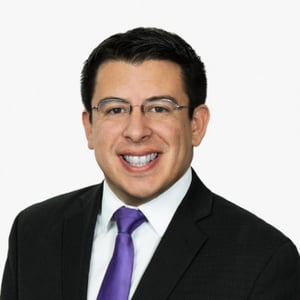
Counsel, McDermott Will & Emery
Joe Bishop-Henchman counsels clients on tax compliance, policy and controversy matters.
Prior to joining McDermott, Joe spent 14 years at the Tax Foundation, directing its state policy and legal programs, and where he most recently served as executive vice president. He has worked with elected officials and stakeholders to achieve major state-level tax changes, advised on the interplay between federal and state tax policy changes, and assisted nonprofits and business groups in studying and developing tax proposals.
A distinguished thought leader in his industry, Joe frequently comments on state tax policy, compliance and controversies in various major news publications. He has testified or presented to officials in 36 states, has testified to Congress six times, and authored multiple amicus curiae briefs on key tax law cases
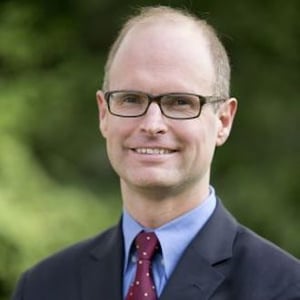
Professor of Law, Temple University Beasley School of Law
Professor Craig Green has taught and written in the fields of Administrative Law, American Legal History, Civil Procedure, Constitutional Law, and Federal Courts; he has also taught in the field of Reproductive Rights. Other teaching interests include Conflicts of Law, Remedies, Civil Procedure II, Complex Civil Litigation, Civil and Political Rights, First Amendment, Separation of Powers, Legislation, Federalism, Constitutional History, History of American Judging, and Sentencing. In 2009 and 2015, Green received Temple Law School’s George P. Williams Award as “Outstanding Professor of the Year,” and in 2010 he received Temple University’s Lindback Award for Distinguished Teaching.
Green’s research has addressed the role of federal courts in overseeing the executive branch, and the significance of iconic cases like Erie v. Tompkins in legal discourse. He has published articles concerning wartime detention, federal common law, judicial activism, precedential interpretation, equal protection, the federal sentencing guidelines, constitutional history, the economic recession of 2008, and customary international law. He has been invited to present research to the Sentencing Commission’s legal staff, as a keynote speaker at the Japanese-American Society for Legal Studies Annual Meeting in Kyoto, as a participant in the Turkish Institute for Justice’s conference “The Balance Between Freedom and Security in Fighting against Terrorism,” and as an organizing panelist for the British Association of Nineteenth-Century Americanists at the University of Warwick. In 2012, Green received Temple Law School’s Friel-Scanlan Award for Outstanding Scholarship.
In 2018, Green received a Ph.D from Princeton University’s History Department for completing his dissertation, “Creating American Land: A Territorial History from the Albany Plan to the U.S. Constitution.” The dissertation seeks to explain (1) how the United States’ imperial legal structure emerged from Revolution’s anti-imperial moment, (2) how American states and statehood emerged from the legal destruction of British colonies, (3) how Native American ideas about territory influenced and were affected by the law of Britain and the United States, and (4) what “law” meant in a context where institutional enforcement was most often impossible.
Green has an active interest in appellate litigation, and has served on moot courts for Supreme Court advocates at the University of Pennsylvania’s Supreme Court Institute, the Georgetown Law Center’s Supreme Court Institute, the National Association of Attorneys General, and law firms in Washington D.C.
Editorial Board Member and Senior Economics Writer, The Wall Street Journal
 Stephen Moore is Senior Economics Writer for the editorial page of The Wall Street Journal and a member of theJournal's editorial board. He is also an economic commentator for CNBC TV, where he appears twice weekly, and for FOX News Channel, where he comments regularly on economic and fiscal policy issues. He is a frequent lecturer before business, investment, and university audiences around the world on the U.S. economic and political outlook in Washington, D.C.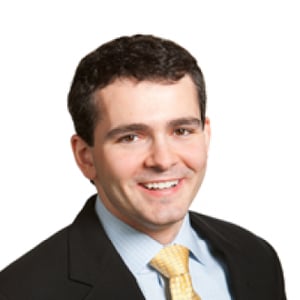
President, The Ethics and Public Policy Center
Ryan T. Anderson, Ph.D., is the President of the Ethics and Public Policy Center. In May 2025, Anderson was appointed by President Trump to the Religious Liberty Commission.
He is the author or co-author of five books, including the just-released Tearing Us Apart: How Abortion Harms Everything and Solves Nothing. Previous books include When Harry Became Sally: Responding to the Transgender Moment, Truth Overruled: The Future of Marriage and Religious Freedom, What Is Marriage? Man and Woman: A Defense, and Debating Religious Liberty and Discrimination. He is the co-editor of A Liberalism Safe for Catholicism? Perspectives from “The Review of Politics.”
Anderson’s research has been cited by two U.S. Supreme Court justices, Justice Samuel Alito and Justice Clarence Thomas, in two Supreme Court cases.
He received his bachelor of arts degree from Princeton University, graduating Phi Beta Kappa and magna cum laude, and he received his doctoral degree in political philosophy from the University of Notre Dame. His dissertation was titled: “Neither Liberal Nor Libertarian: A Natural Law Approach to Social Justice and Economic Rights.”
Anderson has made appearances on ABC, CNN, CNBC, MSNBC, and Fox News. His work has been published by the New York Times, the Washington Post, the Wall Street Journal, Oxford University Press, Cambridge University Press, the Harvard Journal of Law and Public Policy, the Harvard Health Policy Review, the Georgetown Journal of Law and Public Policy, First Things, the Claremont Review of Books, and National Review.
He is the John Paul II Teaching Fellow in Social Thought at the University of Dallas, a member of the James Madison Society at Princeton University, and a Fellow of the Institute for Human Ecology at the Catholic University of America, as well as the Founding Editor of Public Discourse, the online journal of the Witherspoon Institute of Princeton, New Jersey.
For 9 years he was the William E. Simon senior research fellow at The Heritage Foundation, and has served as an adjunct professor of philosophy and political science at Christendom College, and a Visiting Fellow at the Veritas Center at Franciscan University. He has also served as an assistant editor of First Things.
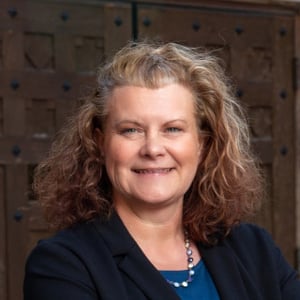
Associate Dean for Academic Affairs, Austin E. Owen Research Scholar & Professor of Law, The University of Richmond School of Law
Dean Kristen Jakobsen Osenga teaches and writes in the areas of patent law, antitrust, and legislation and regulation. Some of her recent scholarship focuses on standard development organizations, patent eligible subject matter, patent licensing firms, litigation and remedies for patent infringement, and patent law reform. She has written numerous law review articles on these and other topics, as well as book chapters and op eds on various aspects of patent law. Additionally, she has spoken on these issues at many academic conferences and bar events. Dean Osenga is Chief Policy Counselor for the Inventors Defense Alliance, as well as an active member of the Federal Circuit Bar Association and the American Intellectual Property Law Association.
Dean Osenga received a B.S. degree in Biomedical Engineering from the University of Iowa, an M.S. degree in Electrical Engineering from Southern Illinois University – Carbondale, and a J.D. from the University of Illinois College of Law, where she graduated magna cum laude. After law school, she practiced at the law firm of Finnegan, Henderson, Farabow, Garrett, & Dunner LLP, (now Finnegan) where she did patent prosecution and litigation. She then clerked for the Judge Richard Linn of the U.S. Court of Appeals for the Federal Circuit. After clerking, she entered academia, teaching first at Chicago-Kent College of Law and then at the University of Richmond, where she has been since 2006. She has also been a Visiting Professor at Emory University School of Law and at William & Mary School of Law.

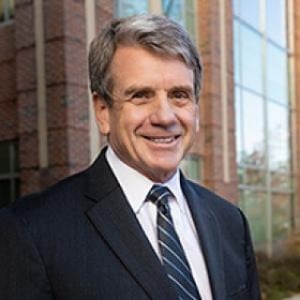
Immigration Policy
Statutory Interpretation: More or Less?
Seattle, WashingtonRegulating 'Speech-Based' Professions
What Does it Mean to be a Conservative Judge?
New York, New YorkTax Reform: Growth or Redistribution?
Indianapolis, IndianaTeva Pharmaceuticals USA, Inc. v. Sandoz, Inc. - Post-Decision SCOTUScast
Kristen Osenga
On January 20, 2015, the Supreme Court issued its decision in Teva Pharmaceuticals USA, Inc....
Wealth of States
Marriage at the U.S. Supreme Court – Round II: A Debate
Philadelphia, PennsylvaniaConvention of States: Is It Time for an Updated Constitution?
Spring Social