
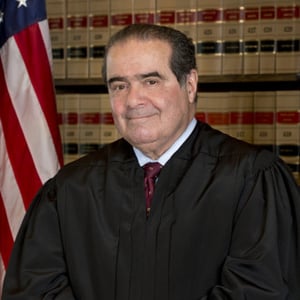
Associate Justice, United States Supreme Court
Antonin Scalia, Associate Justice, was born in Trenton, New Jersey, March 11, 1936. He married Maureen McCarthy and has nine children- Ann Forrest, Eugene, John Francis, Catherine Elisabeth, Mary Clare, Paul David, Matthew, Christopher James, and Margaret Jane. He received his A.B. from Georgetown University and the University of Fribourg, Switzerland, and his LL.B. from Harvard Law School, and was a Sheldon Fellow of Harvard University from 1960-1961. He was in private practice in Cleveland, Ohio from 1961-1967, a Professor of Law at the University of Virginia from 1967-1971, and a Professor of Law at the University of Chicago from 1977-1982, and a Visiting Professor of Law at Georgetown University and Stanford University. He was chairman of the American Bar Association's Section of Administrative Law, 1981-1982, and its Conference of Section Chairmen, 1982-1983. He served the federal government as General Counsel of the Office of Telecommunications Policy from 1971-1972, Chairman of the Administrative Conference of the United States from 1972-1974, and Assistant Attorney General for the Office of Legal Counsel from 1974-1977. He was appointed Judge of the United States Court of Appeals for the District of Columbia Circuit in 1982. President Reagan nominated him as an Associate Justice of the Supreme Court, and he took his seat September 26, 1986.
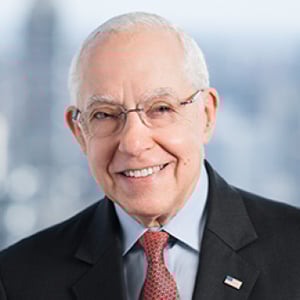
Former United States Attorney General
Michael B. Mukasey is the former Attorney General of the United States, the nation’s chief law enforcement officer. As Attorney General from November 2007 to January 2009, he oversaw the U.S. Department of Justice and advised on critical issues of domestic and international law.
From 1988 to 2006, Judge Mukasey served as a district judge in the United States District Court for the Southern District of New York, becoming Chief Judge in 2000.
From 1972 to 1976, Judge Mukasey served as an Assistant United States Attorney for the Southern District of New York, and as Chief of the Official Corruption Unit from 1975 to 1976. His practice consisted of criminal litigation on behalf of the government, including investigation and prosecution of narcotics, bank robbery, interstate theft, securities fraud, fraud on the government and bribery. From 1976 to 1987 and from 2006 to 2007 he was in private practice.
Judge Mukasey has received numerous honors, including the Federal Bar Council’s Learned Hand Medal for Excellence in Federal Jurisprudence. He served as Chairman of the Committee on Public Access to Information and Proceedings of the New York Bar Association from 1984 to 1987. He served on the Federal Courts Committee of the Association of the Bar of the City of New York from 1979 to 1982 and its Communications Law Committee from 1983 to 1986. Judge Mukasey was also a part-time lecturer at Columbia School of Law from January 1993 to May 2007, teaching trial advocacy.
He received his LL.B. from Yale Law School in 1967 and his B.A. from Columbia College in 1963.
Senior Judge, United States District Court for the Southern District of New York
Loretta A. Preska is a senior judge for the United States District Court for the Southern District of New York. She joined the court in 1992 after being nominated by President George H.W. Bush. Preska became the chief judge of the court in May of 2009 when Kimba Wood assumed senior status. She served as chief judge of the court for a seven-year term from 2009 to 2016, and took senior status in 2017.
Preska graduated from the College of St. Rose with her Bachelor's degree in 1970 and also graduated from Fordham Law with her Juris Doctor Degree in 1973. She graduated from NYU Law with her Master of Laws degree in 1978.
Former Adjunct Professor of Law; former Special Counsel to the President; former federal prosecutor, Georgetown Law (ret.)
Bill Otis is a former Adjunct Professor of Law at Georgetown University, a one-time federal prosecutor, and a former Special White House Counsel for President George H. W. Bush. After graduating from Stanford Law School, he started his career in the Criminal Division of the Justice Department, then became chief of appeals for the US Attorney's Office for the Eastern District of Virginia. In the 1980's he served on the Department's "Train the Trainer" team, which taught US Attorneys Offices across the county how to implement the then-new Sentencing Reform Act. He has held several posts in the federal government, including Special Assistant to the Secretary of Energy and Counselor to the head of the Drug Enforcement Administration, in addition to the White House post. He has testified before Congress on issues in criminal procedure, illegal drugs, the US Sentencing Commission, and the death penalty, and has given numerous media interviews on those and other subjects. He currently teaches a seminar at Georgetown Law titled "Conservatism in Law in America" with his wife, Federalist Society co-founder Lee Liberman Otis.
Emeritus Professor of Criminal Justice, University of Nebraska at Omaha
Professor Samuel Walker is a widely quoted expert on issues of civil liberties, policing and criminal justice policy. He is Emeritus Professor of Criminal Justice at the University of Nebraska at Omaha, where he taught from 1974 to 2005. He received a Ph.D. in American history from Ohio State University in 1973.
Prof. Walker is the author of 14 books on those subjects, which have appeared in a combined total of 32 editions. He has been interviewed in every major media outlet in the United States and around the world, including The New York Times, The Washington Post, PBS/Frontline, CNN and others. His book, Presidents and Civil Liberties From Wilson to Obama, won the Langum Prize for the Best Book in American Legal History for 2012.
Prof. Walker is perhaps best known for his work on police accountability (including two books and two reports on “Driving While Female”) and for his definitive history of the American Civil Liberties Union, In Defense of American Liberties, which was first published in 1990 and issued in a revised edition in 2000 by Southern Illinois University Press. He is currently a member of the International Association of Chiefs of Police’s National Working Group on Sexual Offenses by Police Officers.
Emeritus Professor of Criminal Justice, University of Nebraska at Omaha
Professor Samuel Walker is a widely quoted expert on issues of civil liberties, policing and criminal justice policy. He is Emeritus Professor of Criminal Justice at the University of Nebraska at Omaha, where he taught from 1974 to 2005. He received a Ph.D. in American history from Ohio State University in 1973.
Prof. Walker is the author of 14 books on those subjects, which have appeared in a combined total of 32 editions. He has been interviewed in every major media outlet in the United States and around the world, including The New York Times, The Washington Post, PBS/Frontline, CNN and others. His book, Presidents and Civil Liberties From Wilson to Obama, won the Langum Prize for the Best Book in American Legal History for 2012.
Prof. Walker is perhaps best known for his work on police accountability (including two books and two reports on “Driving While Female”) and for his definitive history of the American Civil Liberties Union, In Defense of American Liberties, which was first published in 1990 and issued in a revised edition in 2000 by Southern Illinois University Press. He is currently a member of the International Association of Chiefs of Police’s National Working Group on Sexual Offenses by Police Officers.
Former Adjunct Professor of Law; former Special Counsel to the President; former federal prosecutor, Georgetown Law (ret.)
Bill Otis is a former Adjunct Professor of Law at Georgetown University, a one-time federal prosecutor, and a former Special White House Counsel for President George H. W. Bush. After graduating from Stanford Law School, he started his career in the Criminal Division of the Justice Department, then became chief of appeals for the US Attorney's Office for the Eastern District of Virginia. In the 1980's he served on the Department's "Train the Trainer" team, which taught US Attorneys Offices across the county how to implement the then-new Sentencing Reform Act. He has held several posts in the federal government, including Special Assistant to the Secretary of Energy and Counselor to the head of the Drug Enforcement Administration, in addition to the White House post. He has testified before Congress on issues in criminal procedure, illegal drugs, the US Sentencing Commission, and the death penalty, and has given numerous media interviews on those and other subjects. He currently teaches a seminar at Georgetown Law titled "Conservatism in Law in America" with his wife, Federalist Society co-founder Lee Liberman Otis.
General Counsel, Prospera Group
Dranias serves as NeWay Capital LLC’s General Counsel, handling all corporate legal matters. Prior to this, he was Senior Litigation Counsel with the Government Accountability & Special Litigation Unit of the Arizona Attorney General. He also serves as Policy Advisor and Research Fellow with the Heartland Institute, as an expert and Speaker’s Bureau member with the Federalist Society, a Law and Civil Liberties Speaker for Students for Liberty, a Council of Scholars member with Compact for America Educational Foundation, as well as an Adjunct Instructor teaching Business Ethics and Law at Grand Canyon University.
Previously, Dranias served as President & Executive Director of Compact for America Educational Foundation where he led national efforts to organize the states to propose and ratify a federal Balanced Budget Amendment. Prior to that, Dranias was General Counsel, Policy Development Director and Constitutional Policy Director at the Goldwater Institute. Dranias led the Institute’s successful challenge to Arizona’s system of government campaign financing to the U.S. Supreme Court. Prior to that, he was an attorney with the Institute for Justice for three years and an attorney in private practice in Chicago for eight years, where he served as Young Lawyers Section co-editor of the Chicago Bar Association Record and earned the Oliver Wendell Holmes Award for his service.
Director, GW Regulatory Studies Center & Distinguished Professor of Practice, Trachtenberg School of Public Policy & Public Administration, The George Washington University
Susan Dudley is the Founder and Director of the George Washington University Regulatory Studies Center, established in 2009 to raise awareness of regulations’ effects and improve regulatory policy through research, education, and outreach. She is also a distinguished professor of practice in the Trachtenberg School of Public Policy and Public Administration. She is past-president of the Society for Benefit Cost Analysis, a senior fellow of the Administrative Conference of the United States, and on the Regulatory Transparency Project Regulatory Practice Working Group. Her book, Regulation: A Primer, with Jerry Brito, is available on Amazon.com.
From April 2007 through January 2009, Professor Dudley served as the Presidentially-appointed Administrator of the Office of Information and Regulatory Affairs in the U.S. Office of Management and Budget and was responsible for the review of draft executive branch regulations under Executive Order 12866, the collection of federal-government-wide information under the Paperwork Reduction Act, the development and implementation of government-wide policies in the areas of information policy, privacy, and statistical policy, and international regulatory cooperation efforts.
Prior to OIRA, she directed the Regulatory Studies Program at the Mercatus Center at George Mason University, and taught courses on regulation at the George Mason University School of Law. Earlier in her career, Professor Dudley served as an economist at OIRA, as well as the Environmental Protection Agency and the Commodity Futures Trading Commission. She was also a consultant to government and private clients at Economists Incorporated. She holds a Master of Science degree from the Sloan School of Management at MIT and a Bachelor of Science degree (summa cum laude) in Resource Economics from the University of Massachusetts, Amherst.
Research Professor, Regulatory Studies Center, The George Washington University
Brian Mannix is a Research Professor at George Washington University’s Regulatory Studies Center. From 2005 – 2009 he was the EPA’s Associate Administrator for Policy, Economics, and Innovation. Earlier he served as the Deputy Secretary of Natural Resources for the Commonwealth of Virginia. Brian was an economist at OIRA from 1981 – 1987, and then served as managing editor of Regulation magazine at the American Enterprise Institute.

Luncheon with U.S. Supreme Court Justice Antonin Scalia
New York, New YorkJames Madison Award Dinner
New York, New YorkFederal Monitoring of Local Policing - Podcast
Samuel Walker, William G. Otis
Is it within a federal court's authority to order local police officers to wear video...
Federal Monitoring of Local Policing
TeleforumIntroducing “Article V 2.0”: The Compact for a Balanced Budget
Nicholas C. Dranias
This article discusses the use of interstate compacts to advance Article V amendments to the U.S....
REPORT FROM ABA ANNUAL MEETING IN BOSTON
Chief Justice John Roberts Chief Justice John Roberts addressed the House of Delegates to commemorate...
2014 ABA Awards
2014 ABA AWARD RECEPIENTS ABA Medal The American Bar Association awards its highest honor, the...
NYC Bar Exam Happy Hour
New York City, New YorkThe Social Cost of Carbon
Susan E. Dudley, Brian F. Mannix
In May 2013, the White House released a revised Technical Support Document (TSD) with a...
The Duty of State Attorneys General to Defend the Rule of Law
Montgomery, Alabama