





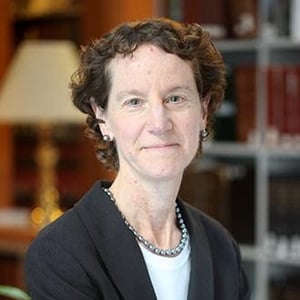



















Tara Leigh Grove is the Vinson & Elkins Chair in Law at the University of Texas School of Law. Grove graduated summa cum laude from Duke University and magna cum laude from Harvard Law School, where she served as the Supreme Court Chair of the Harvard Law Review. Grove clerked for Judge Emilio Garza on the U.S. Court of Appeals for the Fifth Circuit, and then spent four years as an attorney for the U.S. Department of Justice, Civil Division, Appellate Staff, where she argued fifteen cases in the courts of appeals.
Grove’s research focuses on the federal judiciary, interpretive theory, and the constitutional separation of powers. She has published with such prestigious law journals as the Harvard Law Review, the Yale Law Journal, the Columbia Law Review, the University of Pennsylvania Law Review, the New York University Law Review, the University of Chicago Law Review, the Virginia Law Review, the Texas Law Review, the Cornell Law Review, the Northwestern University Law Review, and the Vanderbilt Law Review. Grove has received awards for both her research and her teaching.
In 2021, Grove served on the Presidential Commission on the Supreme Court of the United States, a bipartisan commission created by President Biden and charged with examining proposals for Supreme Court reform. Since 2022, Grove has worked on the Princeton Initiative on Reclaiming the Constitutional Powers of Congress, which brings together former members of Congress, political scientists, and law professors. Grove serves as the Co-Chair of the section on the Appointments Process for the Princeton Initiative. Grove is a co-author of Low & Jeffries' Federal Courts and the Law of Federal-State Relations, a leading federal courts casebook, and she has served as the Chair of the Federal Courts Section of the Association of American Law Schools. Grove has been a visiting professor at both Harvard Law School and Northwestern Pritzker School of Law.


Panel II: The Democratic Election Process: What is Fair and Who Decides Fairness?
Lee E. Goodman, Derek T. Muller, Audrey Martin, Richard H. Pildes, Timothy M. Tymkovich
Democracy begins with elections. But the process for voting in our elections has been increasingly...
A Roundtable on Recent Developments at the FTC
Debbie Feinstein, William Kovacic, Richard J. Pierce, Bilal Sayyed, Joshua D. Wright
Recent months have seen a flurry of notable developments at the Federal Trade Commission, including...
Panel V: Is Judicial Review Democratic?
2023 National Student Symposium
Austin, TXMoore v. Harper - Post-Argument SCOTUScast
Andrew Grossman
On December 7, 2022, the U.S. Supreme Court heard oral argument in Moore v. Harper....
Does the Administrative Procedure Act Provide for Universal Vacatur?
John C. Harrison, Ronald M. Levin, Steven J. Menashi, Beth A. Williams
Section 706 of the Administrative Procedure Act instructs courts to "set aside" agency action that...
Examining the CFPB’s Targeting of Discrimination in Consumer Finance Through UDAAP
Bryan Schneider, Todd J. Zywicki, Brian C. Johnson
Under the Biden Administration, Consumer Financial Protection Bureau Director Rohit Chopra has dramatically increased the...
Chevron—Complicated, Start to Finish
Ronald A. Cass
A Review of Thomas W. Merrill, The Chevron Doctrine: Its Rise and Fall, and the...
Courthouse Steps Decision Webinar: West Virginia v. EPA
David Fotouhi, Garrett Kral, Justin Schwab
On June 30, 2022, the Supreme Court decided West Virginia v. EPA. In a 6-3...
Revisiting Jacobson
Josh Blackman, Sanford V. Levinson
In 1905, the U.S. Supreme Court decided Jacobson v. Massachusetts, upholding a state's ability to enforce compulsory...
Legal Review: Dobbs and the Holdings of Roe and Casey
Eric R. Claeys, Richard M. Re
Before the Supreme Court this term is the question of whether all pre-viability bans on...