
Howard Adler, Nome
Howard B. Adler is a retired partner at the international law firm Gibson, Dunn and Crutcher LLP. From 2019-21, he served as Deputy Assistant Secretary of the Treasury for the Financial Stability Oversight Council. He is the co-author of Surprised Again! The COVID Crisis and the New Market Bubble (2023).

Senior Fellow in Constitutional Jurisprudence, Independence Institute
Professor Robert G. Natelson is a constitutional scholar and author.
Rob’s constitutional scholarship has been cited repeatedly by justices and parties at the U.S. Supreme Court—as well as by federal appeals courts, and at least 18 state supreme courts.
Rob’s research into the Constitution’s original meaning has carried him to libraries throughout the United States and in Britain, including four months at Oxford University. His books and articles span many different parts of the Constitution, including groundbreaking studies of the Necessary and Proper Clause, the Indian Commerce Clause, federalism, Founding-Era interpretation, regulation of elections, and the amendment process of Article V. He created the first-ever online bibliography for 18th century materials used in constitutional research. He is a contributing author to the Encyclopedia of the Supreme Court of the United States (on Magna Carta). He contributed eight essays to the third edition of the Heritage Guide to the Constitution: five on the amendment procedure and one each on the Guarantee Clause, the Postal Clause, and the Recess Appointments Clause.
U.S. Supreme Court justices have relied explicitly on Rob’s research in 41 citations in 13 separate cases.
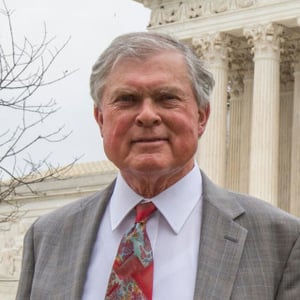
Senior Fellow, Independent Institute
Dr. Stephen P. Halbrook is a Senior Fellow at the Independent Institute. He has taught legal and political philosophy at George Mason University, Howard University, and Tuskegee Institute, and he received his J.D. from the Georgetown University Law Center and Ph.D. in social philosophy from Florida State University.
The winner of three cases before the U.S. Supreme Court (Printz v. United States, United States v. Thompson/Center Arms Company, and Castillo v. United States), he has testified before the Subcommittee on the Constitution of the Senate Judiciary Committee, Senate Subcommittee on the Constitution, Subcommittee on Crime of the House Judiciary Committee, Senate Governmental Affairs Committee, and House Committee on the District of Columbia.
A contributor to numerous scholarly volumes, he is the author of the books, Gun Control in Nazi-Occupied France: Tyranny and Resistance; Gun Control in the Third Reich: Disarming the Jews and “Enemies of the State”; The Founders’ Second Amendment: Origins of the Right to Bear Arms; That Every Man Be Armed: Evolution of a Constitutional Right; A Right to Bear Arms; Firearms Law Deskbook: Federal and State Criminal Practice; Securing Civil Rights: Freedmen, the Fourteenth Amendment, and the Right to Bear Arms; State and Federal Bills of Rights and Constitutional Guarantees; and Target Switzerland: Swiss Armed Neutrality in World War II. Dr. Halbrook’s scholarly articles have appeared in such journals as the Arizona Journal of International and Comparative Law, Drug Law Report, George Mason University Law Review, Journal of Air Law and Commerce, Journal of Law and Policy, Law & Contemporary Problems, National Law Journal, Northern Kentucky Law Review, St. John’s Journal of Legal Commentary; Seton Hall Constitutional Law Journal, Tennessee Law Review, University of Dayton Law Review, Valparaiso University Law Review, Vermont Law Review, and William & Mary Bill of Rights Journal.
Dr. Halbrook's popular articles have appeared in such publications as the Wall Street Journal, Newsday, San Francisco Chronicle, National Review, Investor’s Business Daily, Kansas City Star, Washington Examiner, Shreveport Times, Sacramento Bee, Providence Journal, Tampa Tribune, Pittsburgh Tribune-Review, History News Network, San Antonio Express-News, The Daily Caller, Detroit News, Honolulu Star Advertiser, Birmingham News, Environmental Forum, USA Today, and Washington Times. He has also appeared on numerous national TV/radio programs on CNN, Fox News Channel, Fox Business Network, Court TV, NewsMax TV, CBN, Voice of America, and C-SPAN.
Professor of Law, Trinity College Dublin
Catherine Donnelly undertook her LL.B. in Trinity College Dublin and is a former scholar of the College. She then completed a B.C.L. in Oxford, at Magdalen College, followed by an LL.M. and Fellowship in Harvard. She practised as a litigation attorney at Davis Polk & Wardwell in New York from 1999-2001 and was admitted to both the New York State and Federal Bars (Eastern and Southern Districts). During this time, she also taught an asylum law workshop at Columbia Law School and worked on pro bono projects for the Yale Law Clinic and Human Rights Watch.
From 2001-2004, she completed a D.Phil. in Oxford, again at Magdalen College, during part of which time she held a college lectureship shared between Corpus Christi College and St John's College, Oxford.
She joined the Law Faculty of the University of Oxford in 2005 as a University Lecturer and Fellow in Law at Wadham College, teaching Administrative, Constitutional and European Community Law. She joined the Law School in Trinity College in January 2007. She was elected to Fellowship of the College in 2011 and is an Associate Professor.
She has published and presented conference papers in the areas of human rights law, European Union law, administrative law, election law, constitutional law, comparative law, procurement law and public-private partnerships and is an author of De Smiths’ Judicial Review.
Catherine combines her academic work with practice as a barrister. She was called to the Bar of England and Wales in 2003 (Gray's Inn) and from 2004-2005, she undertook pupillage at Blackstone Chambers, and became a member of Blackstone Chambers in 2008.
She began practice at the Bar of Ireland in 2008, and was called to the Inner Bar and became a Senior Counsel in 2021. She has appeared in cases before the Court of Justice and General Court of the European Union, the European Court of Human Rights, and the national courts, including acting for the Data Protection Commissioner in the Schrems II litigation on EU-US data transfers and for Ireland in the Apple State Aid appeal. She practises in the areas of EU, Constitutional, Administrative and Commercial Law.

Laurence H. Silberman Chair in Constitutional Governance, American Enterprise Institute; Executive Director, Antonin Scalia Law School’s C. Boyden Gray Center for the Study of the Administrative State
Adam J. White is the Laurence H. Silberman Chair in Constitutional Governance and senior fellow at the American Enterprise Institute, where he focuses on the Supreme Court and the administrative state. He also directs the Antonin Scalia Law School’s C. Boyden Gray Center for the Study of the Administrative State.
He writes on regulation and constitutional government for a variety of publications. He practiced law in Washington, D.C., after clerking for the D.C. Circuit's Judge David Sentelle. He also has been chairman of the ABA's Administrative Law Section.
In 2021, he served on the Presidential Commission on the Supreme Court of the United States, where he criticized “Court packing” and other efforts to restructure the Supreme Court.

Partner, Arnold & Porter
John Elwood is the head of Arnold & Porter’s Appellate and Supreme Court practice. He has argued before the Supreme Court nine times, and appeared before most of the federal courts of appeals. He has successfully argued cases across a broad cross-section of subjects, with particular experience in environmental law, the False Claims Act, government contracting, and federal criminal law
Mr. Elwood’s work has earned him recognition as one of Washington’s top Supreme Court lawyers (Washingtonian, 2013), as one of “a small group of lawyers” with an “outsized influence at the U.S. Supreme Court” (Reuters, 2014), and as one of the country’s most innovative lawyers (Financial Times, 2014). Chambers USA reports that “[t]he much-admired John Elwood is praised for his advocacy skills” (2013), and describes Mr. Elwood as “phenomenal” (2014), “incredibly talented” (2012), and “a much-loved and widely respected lawyer who is quick on his feet” (2010).
Before joining the firm, Mr. Elwood served in senior-level positions in the U.S. Department of Justice. Beginning as an Assistant to the Solicitor General, and continuing with the firm, he has briefed more than 20 merits cases before the Supreme Court of the United States, and has briefed approximately 135 cases at the certiorari stage. As the senior Deputy in the Office of Legal Counsel, he advised the White House and federal agencies on a range of constitutional, statutory, and regulatory issues.

Topics
Cut International Law Down to Size: National Sovereignty Trumps Utopian Alternatives
The ongoing International Criminal Court (ICC) and International Court of Justice (ICJ) cases against Israel...
What Kind of Money is Best?: An Interesting New Investigation
Howard B. Adler
A review of Lawrence H. White, Better Money: Gold, Fiat, or Bitcoin? (Cambridge University Press...
Topics
2023 National Lawyers Convention: Insurrection & the 14th Amendment
Editor's Note: On December 19th, 2023 the Colorado Supreme Court ruled that Former President Donald Trump...
Topics
2023 National Lawyers Convention: Insurrection & the 14th Amendment
Editor's Note: On December 19th, 2023 the Colorado Supreme Court ruled that Former President Donald...
The Original Understanding of the Indian Commerce Clause: An Update
Robert G. Natelson
The Congress shall have Power . . . To regulate Commerce with foreign Nations, and...
Covid and the Regulatory State
TeleforumTopics
An Outsider Looks In: Election Rules in the UK
I watched the results of the November 3 election with increasing puzzlement. Counting ballots received...
To Bear Arms for Self-Defense: A “Right of the People” or a Privilege of the Few? Part 1
Stephen P. Halbrook
Note from the Editor: The Federalist Society takes no positions on particular legal and public...
Courthouse Steps: U.S. v. Microsoft
Corporations, Securities, and Antitrust Practice Group Teleforum
TeleforumTopics
Congress Should Write the Laws Before the Courts Do - United States v. Microsoft Corp.
In 2013, the United States issued a search warrant for emails in the possession of...