











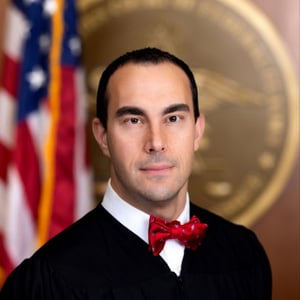










Brad Watts, senior vice president at the U.S. Chamber of Commerce’s Global Innovation Policy Center (GIPC), oversees the center’s day-to-day operations. He also leads the development and implementation of the Chamber’s U.S. and global intellectual property (IP) agenda to foster a political, legal, and economic environment where innovators and creators can invest in the next big thing for the benefit of Americans and the world.
Watts previously served as the Republican chief counsel on the Senate Judiciary Committee Subcommittee on Intellectual Property. There he was responsible for planning and implementing Senator Thom Tillis’ (R-NC) and the Republican party’s legislative portfolio on all aspects of IP law.
In the 116th Congress, when Senator Tillis was chairman of the subcommittee, Watts served as majority chief counsel and staff director for the Senate Judiciary Committee Subcommittee on Intellectual Property. He was responsible for implementing the senator’s legislative and oversight agenda on all aspects of America’s innovation economy.
During Watts’ tenure as majority chief counsel, the subcommittee held 17 legislative and oversight hearings and multiple staff briefings on IP issues, ranging from the state of patent eligibility law in America to reforming the Digital Millennium Copyright Act of 1998. Under his leadership, the subcommittee passed the CASE Act, the Trademark Modernization Act, and the Protecting Lawful Streaming Act, three landmark bills that collectively represent the largest changes to IP law since the Leahy-Smith America Invents Act.
Earlier, Watts was chief immigration counsel to then-Senate Judiciary Committee Chairman Chuck Grassley (R-IA). He began his career with former Senator Jeff Sessions (R-AL) as a legislative counsel on the Subcommittee on Immigration and the National Interest, handling civil rights and civil liberties law, general tort law, bankruptcy, telecommunications, and IP issues for the senator.








Everyone v. AI: Navigating the New Regulatory and Legal Battleground
Mariel Brookins, Benjamin Diggs, John Kim, Michael Richards, Mike Trinh
Presented by the In-House Counsel Network and the U.S. Chamber Litigation Center CLE credit for...
The Patent Eligibility Reform Act: Clarifying Patent Eligibility for the U.S. Patent System?
Earl Bright, David Jones, Joseph Matal, Kathleen M. O'Malley, Jamie Simpson
Join the Federalist Society for a discussion on the Patent Eligibility Restoration Act (PERA), legislation...
The Case for RESTORE? Injunctions, Patents, and the Future of Innovation
Ryan T. Holte, Andrei Iancu, Adam Mossoff, Kristen Osenga, Chris Storm
Join the Federalist Society for a timely and compelling discussion on the RESTORE Act, legislation...
AI Training vs. Copyright Law: Updates from the Copyright Office and the Courts
Meredith Filak Rose, Zvi Rosen, Regan Smith
Whether AI training and generation is a fair use under copyright law puts two important...
Medicare's New Drug Price Mandate: Healthcare & Innovation Implications
Lisa Larrimore Ouellette, Adam Mossoff, Dan Troy, Brad Watts
On January 17, the Biden-Harris Administration added 15 new drugs, including Ozempic, to the list of...
Prosecution Laches: No Good Deed Goes Unpunished!
Jeffrey E. Depp, Joseph Matal, Paul Redmond Michel, Gene Quinn
Prosecution laches is an infrequently used equitable doctrine that bars enforcement of a patent when...
[FedSoc Films] Creativity on Trial: The Music Copyright Dilemma
From Dua Lipa to Ed Sheeran, today’s top artists are regularly hit with claims of...
An Unconventional View of Intellectual Property and Antitrust Policy — A Fireside Chat with Prof. Jonathan Barnett
Jonathan Barnett, Brian Pandya
Join us on Thursday, February 27th at 12:00 PM ET for a special lunch panel sponsored by our Intellectual Property Practice...
The Federal Circuit's Reliance on One-Word Affirmances Under Rule 36: Is it Lawful?
Joseph Cianfrani, Robert J. Rando, Amit R. Vora
The Federal Circuit’s first Chief Judge, the Honorable Howard T. Markey, announced, “In our Court...
Topics
Why Weak Intellectual Property Rights Threaten Innovation and Competition
Over the past two decades, a largely overlooked revolution in intellectual property law has taken...