
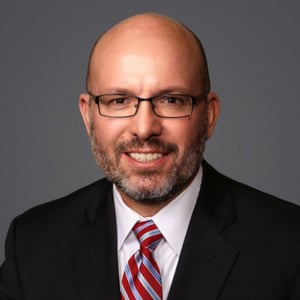
Shareholder, Ogletree, Deakins, Nash, Smoak & Stewart
Chris Murray is Co-Chair of the firm’s Arbitration and Alternative Dispute Resolution Practice Group. In this role, he assists attorneys throughout the firm and clients nationwide to create, roll out, and enforce effective employment arbitration agreements and other ADR programs. Mr. Murray has extensive experience with class/collective action waivers in employment arbitration. Mr. Murray was part of the Ogletree team that successfully defended the use of such waivers in the Fifth Circuit’s landmark decision in D.R. Horton, Inc. v. N.L.R.B. Since then, he has successfully defended the enforceability of class action waivers in numerous subsequent cases and submitted an amicus brief on the subject on behalf of several major employers’ associations in the Supreme Court’s Murphy Oil case. Mr. Murray assists clients and the Firm’s attorneys to draft or revise arbitration programs focused on a client’s specific needs and goals and in light of changing law and evolving best practices.

President and General Counsel, New Civil Liberties Alliance
NCLA’s President and General Counsel, Mark Chenoweth, has observed the administrative state up close and personal from perches in all four branches of the federal government. Mark served as the first chief of staff to Congressman Mike Pompeo, as legal counsel to Commissioner Anne Northup at the U.S. Consumer Product Safety Commission, as an attorney advisor in the Office of Legal Policy at the U.S. Department of Justice, and as a law clerk to the Hon. Danny J. Boggs on the U.S. Court of Appeals for the Sixth Circuit.
Mark has worked in several different roles in the private sector as well. He began his legal career in D.C. as a regulatory associate at Wilmer, Cutler & Pickering. He then returned to his home state of Kansas to serve as in-house counsel for Koch Industries. Most recently he spent over four years as general counsel of the Washington Legal Foundation.
Mark is a graduate of Yale College and the University of Chicago Law School, where he co-founded the Institute for Justice Clinic on Entrepreneurship and became a Tony Patiño Fellow. Mark has been widely quoted and/or published in newspapers and websites including the New York Times, San Francisco Chronicle, New Hampshire Union Leader, and Metropolitan Corporate Counsel. He has also had recurring op-eds in the Los Angeles Daily Journal, and at Forbes.com.
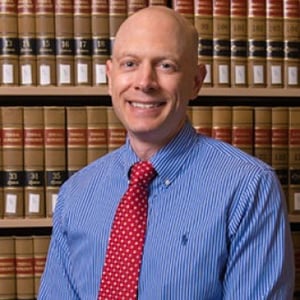
Chancellor Professor, University of Massachusetts Dartmouth School of Law
Peltz-Steele received his law degree from Duke University and a bachelor’s in journalism and Spanish from Washington & Lee University. Peltz-Steele has won awards in teaching, research, and public service. He practiced commercial law in Baltimore and Washington, D.C., and taught law for more than thirteen years before coming to UMass Law in 2011.
Peltz-Steele is author, co-author, or co-editor of qualitative and quantitative research in law and mass communication in journals and books, of treatises in law and development and access to information, and of textbooks in tort law and freedom of information. He is especially active in international media law and policy, having presented papers on five continents and having published in foreign journals and multinational collaborations. His current research focuses on comparative transparency in the context of development and in the private sector. Peltz-Steele serves in various roles in public service organizations, including the legal education committee of the American Bar Association, International Law Section.
Professor of Legal Rhetoric, American University Washington College of Law
Professor Paul Figley is a Professor of Legal Rhetoric at the Washington College of Law where he first joined the faculty in 2006. Professor Figley has taught Legal Rhetoric, first year Torts, and upper level Advanced Lawyering Skills: Tort Litigation. He serves on the Advisory Board of the Administrative Law Review and the American University Law Review. The Student Bar Association named Washington College of Law Professor of the Year for 2012-13 and Faculty Member of the Year for 2014-15.
Professor Figley has testified before Congress, presented at scholarly symposia and conferences of national organizations and government agencies. He has written for national legal writing publications and has published articles in scholarly journals. His book, A Guide to the Federal Tort Claims Act (ABA, 2018), is now in its second edition.
Professor Figley served three decades as a litigator for the U.S. Department of Justice where he was Deputy Director of the Torts Branch for fifteen years. At Justice, Professor Figley represented the United States and its agencies in appellate and district court litigation involving torts, national security, and information law.
Professor Figley is a graduate of Franklin & Marshall College and Southern Methodist University School of Law, where he was Leading Articles Editor for the Journal of Air Law & Commerce.
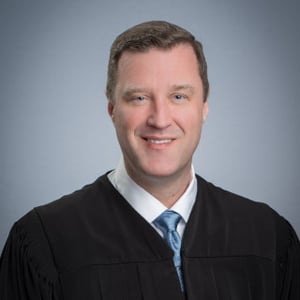
Justice, Texas Supreme Court
Evan Young is a Justice of the Supreme Court of Texas. Governor Greg Abbott, who appointed Young to fill an unexpired term, swore him into office on November 10, 2021. Justice Young was elected to a full term in November 2022.
Young graduated summa cum laude from Duke University in 1999, where he was inducted into Phi Beta Kappa. He was a British Marshall Scholar at Oxford University, where he completed his studies in 2001 and earned a First Class Honours degree in Modern History, focusing on British constitutional history. He earned his law degree from Yale Law School in 2004.
Young then worked as a lawyer in the judicial and executive branches of the federal government. He first served as a law clerk to Judge J. Harvie Wilkinson III of the U.S. Court of Appeals for the Fourth Circuit, and then to Justice Antonin Scalia at the U.S. Supreme Court. In 2006, after his clerkship with Justice Scalia ended, Justice Young became Counsel to the Attorney General at the U.S. Department of Justice, serving in the Office of the Attorney General under Attorneys General Alberto R. Gonzales and Michael B. Mukasey. While on the Attorney General’s staff, he accepted a detail to the U.S. Embassy in Baghdad, Iraq, where he was the Deputy Rule of Law Coordinator. In that position he worked to assist the Iraqi government in its efforts to strengthen its legal regime, including, for example, its courts and prison system.
Young returned to Texas and joined the Austin office of Baker Botts L.L.P. in 2009. His practice focused on trial and appellate litigation. He argued cases before both the Supreme Court of the United States and the Supreme Court of Texas, as well as many federal and state appellate courts. He represented clients across the country before every level of the state and federal judiciary.
Before joining the Texas Supreme Court, Young was appointed in 2017 by Governor Abbott and confirmed by the Texas Senate to serve as a member of the Texas Judicial Council, which is the policy-making body for the Texas Judiciary. In 2015, the Texas Supreme Court appointed him to the Supreme Court Advisory Committee, which assists the Court in drafting the rules that govern litigation in Texas courts. He served on both until his elevation to the bench.
Justice Young is an elected member of the American Law Institute and a member of the Texas Philosophical Society. He has been an adjunct law professor for many years at the University of Texas School of Law, where he has frequently taught the Federal Courts and Religious Liberty courses. He also has been an adjunct professor at the Unversity of Austin (UATX) and at the University of Mississippi School of Law. He served as Chair of the State Bar of Texas Business Law Section, Chair of the National Center for Missing and Exploited Children's Texas Regional Office, and Trustee of the Texas Supreme Court Historical Society.
Justice Young and his wife, Tobi, live in Austin with their daughter.

Partner, Morrison Foerster, LLP
Deanne E. Maynard, chair of the Appellate and Supreme Court Practice Group, is a partner in the Washington, D.C. office, and a former Assistant to the Solicitor General at the United States Department of Justice.
Ms. Maynard has argued 12 cases before the Supreme Court of the United States, and she has filed over 100 briefs in that Court. Notably, she has worked on some of the most important business cases over the last several Terms. Just last Term, she argued and prevailed in Ransom v. FIA Card Services, a case involving the interpretation of the federal bankruptcy statute. Ms. Maynard also has substantial knowledge and understanding of cutting-edge antitrust and intellectual property issues. Her arguments include the patent case MedImmune, Inc. v. Genentech, Inc. and the antitrust case Pacific Bell Telephone Company v. linkLine Communications, Inc. She was also a principal author of the briefs for the United States in Bell Atlantic Corp. v. Twombly and Quanta Computer, Inc. v. LG Electronics, Inc., and briefs at the certiorari stage in Bilski v. Doll and American Needle, Inc. v. National Football League.
In addition to her substantial Supreme Court experience, Ms. Maynard has argued and briefed significant cases in the federal courts of appeals. Her appellate experience mirrors the wide-ranging litigation breadth of the firm, running the gamut from patent appeals in the Federal Circuit to appeals in the other federal courts of appeals on antitrust, securities law, and other intellectual property issues.
Ms. Maynard served in the Solicitor General’s office from 2004-2009. Before joining the Solicitor General’s office, Ms. Maynard was a partner at Jenner & Block in Washington, D.C. Her practice at Jenner involved a wide variety of complex litigation matters at all levels of the federal judiciary, ranging from a multi-billion dollar government contracts case to media and First Amendment litigation.
After law school, Ms. Maynard clerked twice on the Supreme Court of the United States. During the October 1994 Term, she clerked for Justice Stephen Breyer in his first year on the Court. During the 1993 Term, she clerked for retired Supreme Court Justice Lewis Powell and affiliated with Justice John Paul Stevens. From 1991-1993, Ms. Maynard clerked for Judge Stanley Harris of the U.S. District Court for the District of Columbia.
Ms. Maynard graduated magna cum laude in 1991 from Harvard Law School, where she was an editor of the Harvard Law Review. She earned a B.A., with distinction, in English from the University of Virginia, where she was also Phi Beta Kappa and Omicron Delta Kappa.
Ms. Maynard is the President-elect of the Coke Appellate Inn of Court. She serves as Chair of the Jefferson Trust, an initiative of the University of Virginia Alumni Association.
Ms. Maynard is listed as a Leading Individual in Best Lawyers in America 2011 and 2012, Appellate Law in Chambers USA 2011, and Legal 500 US 2011.

Partner, Morrison Foerster, LLP
Jordan Eth is Co-Chair of the firm's Securities Litigation, Enforcement, and White-Collar Defense Group. He is a nationally recognized litigator, representing public companies and their officers and directors in securities class actions, SEC investigations, derivative suits, mergers and acquisitions litigation, and internal investigations. In 2008, Mr. Eth received a California Lawyer Attorney of the Year Award for co-leading the successful defense of JDS Uniphase Corp. and its former executives in a securities class action jury trial seeking $20 billion in damages.
Mr. Eth has 25 years of experience handling complex and high-stakes litigation. He has represented dozens of companies and individuals in a broad range of industries, including financial services, computer software and hardware, life sciences, and consumer products. Mr. Eth is a Lecturer at Stanford Law School, currently teaching “Modern Securities Fraud Litigation: Public and Private Enforcement.”
Mr. Eth is a frequent speaker across the country on securities litigation topics and actively participates in programs put on by The SEC Institute, the Practising Law Institute, and the Stanford Directors' College. He has also authored many articles on securities litigation. List of Mr. Eth's speaking engagements.
Mr. Eth is recommended by Chambers USA: America’s Leading Lawyers for Business, Legal 500 US, The Best Lawyers in America, Benchmark Litigation and PLC Which Lawyer? In 2010, he was selected by his peers as one of Law 360's 10 Most Admired Securities Attorneys.
He served as a law clerk to the Honorable Chief Judge Robert F. Peckham, United States District Court for the Northern District of California, from August 1985 through August 1986. From 1980 through 1982, Mr. Eth worked as an economist in Washington, D.C., first for the United States Department of Energy and then for the Budget Committee of the United States House of Representatives.
Mr. Eth received his J.D. from Stanford Law School, was elected to the Order of the Coif, and served as Co-President of the Moot Court Board. He received his B.A. in Economics from Swarthmore College, with highest honors and Phi Beta Kappa.
Deputy District Attorney, Philadelphia District Attorney's Office
Ronald Eisenberg heads the Law Division of the Philadelphia District Attorney's Office. The 60 lawyers in the division handle appeals, habeas corpus and civil litigation, and legislative matters. Mr. Eisenberg has appeared at all levels of the state and federal court system, and has argued several cases in the United States Supreme Court.
Mr. Eisenberg is a member of the Pennsylvania Supreme Court Investigating Grand Jury Task Force and the Advisory Committee for the Pennsylvania Suggested Standard Criminal Jury Instructions. He has represented his office on the Pennsylvania Advisory Committee on Wrongful Convictions, was an adjunct professor at Temple University School of Law, teaching legal writing and research, and has served on the Pennsylvania Criminal Rules and Appellate Rules Committees. He is a past president and current board member of the Association of Government Attorneys in Capital Litigation, a national organization of capital prosecutors.
Mr. Eisenberg received his bachelor's degree from Haverford College in 1978 and his law degree from the University of Pennsylvania Law School in 1981.
J.D., University of Pennsylvania
B.A., Haverford College

Courthouse Steps: China Agritech v. Resh
Christopher C. Murray
On March 26, the Supreme Court will hear arguments in China Agritech, Inc. v. Resh,...
California Public Employees’ Retirement System v. ANZ Securities Post-Decision SCOTUScast
Mark Chenoweth
On June 26, 2017, the Supreme Court decided California Public Employees’ Retirement System v. ANZ...
United States v. Wong and United States v. June - Post-Decision SCOTUScast
Richard J. Peltz-Steele
On April 22, 2015, the Supreme Court issued its decision in two related cases: United...
United States v. Wong and United States v. June - Post-Argument SCOTUScast
Paul Figley
On December 10, 2014, the Supreme Court heard oral argument in two related cases: United...
Sebelius v. Auburn Regional Medical Center - Post-Decision SCOTUScast
Evan A. Young
On January 22, 2013 the Supreme Court announced its decision in Sebelius v. Auburn Regional Medical...
Sebelius v. Auburn Regional Medical Center - Post-Argument SCOTUScast
Evan A. Young
On December 4, 2012 the Supreme Court heard oral argument in Sebelius v. Auburn Regional Medical...
Credit Suisse Securities v. Simmonds - Post-Decision SCOTUScast
Deanne Maynard, Jordan Eth
On March 26, 2012, the Supreme Court announced its decision in Credit Suisse Securities v. Simmonds....
Holland v. Florida - Post-Decision SCOTUScast
Ronald Eisenberg
On June 14, 2010, the Supreme Court announced its decision in Holland v. Florida. In...