
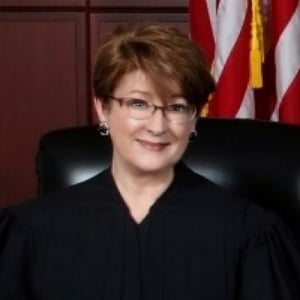
Texas Second Court of Appeals
Justice Kerr grew up in Memphis, Tennessee, graduating from White Station High School in 1974. She became a Texan when she matriculated at Rice University in Houston, obtaining a B.A. in English and Art History in 1978, followed by a J.D. from the University of Texas in 1982. Immediately following law school, Justice Kerr spent two years as a briefing attorney for the late Honorable Lucius D. Bunton, III, Judge of the United States District Court for the Western District of Texas, Midland Division.
From there, Justice Kerr began her private practice in Fort Worth in 1984, first with the firm of Law, Snakard & Gambill. During the 1990s, in addition to maintaining her legal practice Justice Kerr worked on numerous projects with lexicographer and author Bryan A. Garner, including as a contributing editor of the seventh edition of Black’s Law Dictionary. Starting in 1995, Justice Kerr taught legal writing and research off and on for a number of years at what began as the DFW School of Law and then became Texas Wesleyan (now Texas A&M) School of Law.
Most recently, she joined Friedman, Suder & Cooke in 2006, where she was of counsel until her election to the appellate bench in 2016. While at Friedman, Suder & Cooke, Justice Kerr was a member of the planning committee of the Tarrant County Bar Association’s appellate section, serving as its chair for the 2010-2011 bar year. She is a Fellow of the Tarrant County Bar Foundation and a Life Fellow of the Texas Bar Foundation.
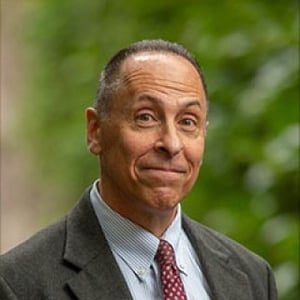
John Paul Stevens Professor of Law, Northwestern University School of Law
Andrew Koppelman is John Paul Stevens Professor of Law, Professor (by courtesy) of Political Science, and Philosophy Department Affiliated Faculty at Northwestern University. He received the Walder Award for Research Excellence from Northwestern, the Hart-Dworkin award in legal philosophy from the Association of American Law Schools, and the Edward S. Corwin Prize from the American Political Science Association. His scholarship focuses on issues at the intersection of law and political philosophy. He has written more than 100 scholarly articles and eight books, most recently Burning Down the House: How Libertarian Philosophy Was Corrupted by Delusion and Greed, (St. Martin’s Press). His column appears regularly at The Hill. You can find his recent work at andrewkoppelman.com.
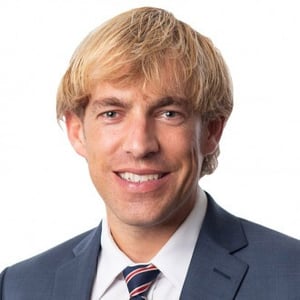
Principal, Spero Law LLC
Christopher Mills is the founder of Spero Law LLC. He was previously a partner at a national law firm and a Constitutional Law Fellow at the Becket Fund for Religious Liberty. He served as a law clerk to Justice Clarence Thomas on the U.S. Supreme Court during October Term 2018. He also clerked for the Honorable David B. Sentelle, then-Chief Judge of the U.S. Court of Appeals for the D.C. Circuit. He has authored briefs and motions in the Supreme Court, courts of appeals, and trial courts, and successfully argued before the D.C. Circuit. He has served as special counsel to South Carolina Governor Henry McMaster, and is an Adjunct Professor at the Charleston School of Law.
A 2012 magna cum laude graduate of Harvard Law School, Christopher was a senior editor of the Harvard Law Review, an editor of the Harvard Journal of Law and Public Policy, and served on the Executive Board of the Harvard Federalist Society. In 2009, he graduated Phi Beta Kappa and summa cum laude with a degree in economics from Furman University.
Christopher lives in Charleston, South Carolina with his wife, children, and golden retriever.
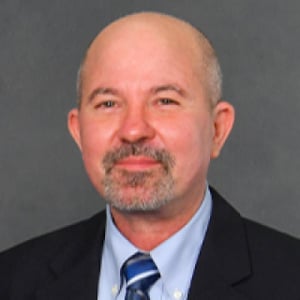
Legal Director, National Center for LGBTQ Rights
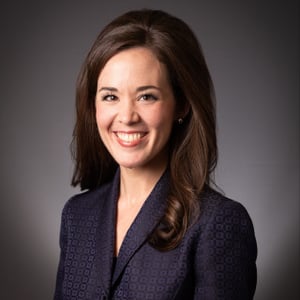
Senior Counsel, Alliance Defending Freedom
Christiana (Holcomb) Kiefer serves as senior counsel with Alliance Defending Freedom, where she is a key member of the Center for Conscience Initiatives.
When she joined ADF in 2012, Kiefer worked to defend the constitutionally protected freedom of churches, religious schools, and Christian ministries to exercise their faith without government interference. Since joining the Center for Conscience Initiatives in 2020, Kiefer has worked on groundbreaking cases to protect the right of women and girls to fair athletic competition, including Soule v. Connecticut Association of Schools and Hecox v. Little. She also works to protect the right of people of faith to foster and provide loving homes for children in need.
Kiefer has testified before Congress and successfully advocated at the grassroots level. As an ADF commentator, she regularly speaks at conferences and comments in television, radio, and print media.
Kiefer earned her Juris Doctor in 2010 from Oak Brook College of Law and Government Policy, where she graduated first in her class. Also in 2010, Kiefer completed the ADF leadership development program to become a Blackstone Fellow. She is admitted to the state bar of California, the District of Columbia, the U.S. Supreme Court, and numerous federal district and appellate courts.
Texas Second Court of Appeals
Justice Kerr grew up in Memphis, Tennessee, graduating from White Station High School in 1974. She became a Texan when she matriculated at Rice University in Houston, obtaining a B.A. in English and Art History in 1978, followed by a J.D. from the University of Texas in 1982. Immediately following law school, Justice Kerr spent two years as a briefing attorney for the late Honorable Lucius D. Bunton, III, Judge of the United States District Court for the Western District of Texas, Midland Division.
From there, Justice Kerr began her private practice in Fort Worth in 1984, first with the firm of Law, Snakard & Gambill. During the 1990s, in addition to maintaining her legal practice Justice Kerr worked on numerous projects with lexicographer and author Bryan A. Garner, including as a contributing editor of the seventh edition of Black’s Law Dictionary. Starting in 1995, Justice Kerr taught legal writing and research off and on for a number of years at what began as the DFW School of Law and then became Texas Wesleyan (now Texas A&M) School of Law.
Most recently, she joined Friedman, Suder & Cooke in 2006, where she was of counsel until her election to the appellate bench in 2016. While at Friedman, Suder & Cooke, Justice Kerr was a member of the planning committee of the Tarrant County Bar Association’s appellate section, serving as its chair for the 2010-2011 bar year. She is a Fellow of the Tarrant County Bar Foundation and a Life Fellow of the Texas Bar Foundation.
Senior Counsel, Alliance Defending Freedom
Christiana (Holcomb) Kiefer serves as senior counsel with Alliance Defending Freedom, where she is a key member of the Center for Conscience Initiatives.
When she joined ADF in 2012, Kiefer worked to defend the constitutionally protected freedom of churches, religious schools, and Christian ministries to exercise their faith without government interference. Since joining the Center for Conscience Initiatives in 2020, Kiefer has worked on groundbreaking cases to protect the right of women and girls to fair athletic competition, including Soule v. Connecticut Association of Schools and Hecox v. Little. She also works to protect the right of people of faith to foster and provide loving homes for children in need.
Kiefer has testified before Congress and successfully advocated at the grassroots level. As an ADF commentator, she regularly speaks at conferences and comments in television, radio, and print media.
Kiefer earned her Juris Doctor in 2010 from Oak Brook College of Law and Government Policy, where she graduated first in her class. Also in 2010, Kiefer completed the ADF leadership development program to become a Blackstone Fellow. She is admitted to the state bar of California, the District of Columbia, the U.S. Supreme Court, and numerous federal district and appellate courts.
John Paul Stevens Professor of Law, Northwestern University School of Law
Andrew Koppelman is John Paul Stevens Professor of Law, Professor (by courtesy) of Political Science, and Philosophy Department Affiliated Faculty at Northwestern University. He received the Walder Award for Research Excellence from Northwestern, the Hart-Dworkin award in legal philosophy from the Association of American Law Schools, and the Edward S. Corwin Prize from the American Political Science Association. His scholarship focuses on issues at the intersection of law and political philosophy. He has written more than 100 scholarly articles and eight books, most recently Burning Down the House: How Libertarian Philosophy Was Corrupted by Delusion and Greed, (St. Martin’s Press). His column appears regularly at The Hill. You can find his recent work at andrewkoppelman.com.
Principal, Spero Law LLC
Christopher Mills is the founder of Spero Law LLC. He was previously a partner at a national law firm and a Constitutional Law Fellow at the Becket Fund for Religious Liberty. He served as a law clerk to Justice Clarence Thomas on the U.S. Supreme Court during October Term 2018. He also clerked for the Honorable David B. Sentelle, then-Chief Judge of the U.S. Court of Appeals for the D.C. Circuit. He has authored briefs and motions in the Supreme Court, courts of appeals, and trial courts, and successfully argued before the D.C. Circuit. He has served as special counsel to South Carolina Governor Henry McMaster, and is an Adjunct Professor at the Charleston School of Law.
A 2012 magna cum laude graduate of Harvard Law School, Christopher was a senior editor of the Harvard Law Review, an editor of the Harvard Journal of Law and Public Policy, and served on the Executive Board of the Harvard Federalist Society. In 2009, he graduated Phi Beta Kappa and summa cum laude with a degree in economics from Furman University.
Christopher lives in Charleston, South Carolina with his wife, children, and golden retriever.
Legal Director, National Center for LGBTQ Rights

Senior Vice President, Strategic Initiatives & Special Counsel to the President, Alliance Defending Freedom
Ryan Bangert serves as senior vice president for strategic initiatives and special counsel to the president at Alliance Defending Freedom. He oversees ADF’s regulatory practice, government relations, and corporate engagement teams. He also advises executive leadership with strategic initiatives and appears as counsel for ADF clients.
Before joining ADF, Bangert served as deputy first assistant attorney general and deputy for legal counsel in the office of the Texas attorney general. In those roles, he oversaw the state’s Special Litigation Unit, which handled critical litigation against the federal government, and oversaw multiple divisions within the office. Prior to that, he served as deputy for civil litigation for Missouri Attorney General Josh Hawley, overseeing the state’s civil litigation divisions, including the consumer protection and antitrust divisions, with over 200 attorneys and staff. During his time in government service, Bangert handled a diverse array of matters involving Big Tech, election law, civil rights, multistate antitrust and consumer protection investigations, and many other issues.
Prior to his government service, Bangert was a litigation partner at Baker Botts L.L.P., where he was a member of the firm’s commercial litigation and appellate practice sections. A seasoned trial attorney, The Texas Lawyer ranked the verdict Bangert achieved in the Janvey v. Maldonado case as the #1 verdict in the securities category for 2015-2019, and The National Law Journal ranked it in its “Top 100 Verdicts of 2015.” He was named a “Texas Rising Star” for multiple years by Texas Lawyer and Law and Politics magazines. While at Baker Botts, he was a volunteer attorney for ADF and served as amicus counsel in numerous cases, including Trinity Lutheran v. Comer and Salazar v. Buono, receiving the firm’s Opus Justitae Award in recognition of his outstanding commitment to pro bono service.
Bangert earned his J.D. from Southern Methodist University, where he was a Hatton Sumner’s scholar and graduated first in his class. He also participated in ADF’s Blackstone program and is a Blackstone Fellow. Following law school, he clerked for the Honorable Patrick E. Higginbotham on the Fifth Circuit Court of Appeals.
Bangert is a member of the Philadelphia Society and Federalist Society. He is admitted to practice law in Texas, California (inactive), Missouri (inactive), the U.S. Supreme Court and numerous federal district and appellate courts. A frequent op-ed contributor, his work has appeared in National Review, Daily Wire, The Hill, Washington Examiner, The Federalist, Fox News, and RealClear Religion. He speaks nationally on constitutional, cultural, and religious liberty issues.
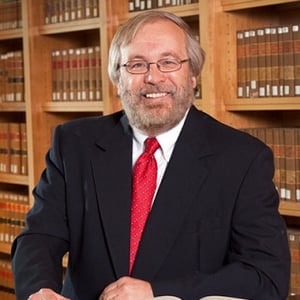
Welpton & Wise Professor of Law, University of Nebraska College of Law
Professor Rick Duncan is the Welpton & Wise Professor of Law at the University Of Nebraska College Of Law. He is a graduate of the Cornell Law School and served as an editor of the Cornell Law Review. He teaches Constitutional Law with a special emphasis on the law of religious freedom, free speech, and federalism. Duncan has written numerous books, articles, and commentaries on a wide variety of legal topics. His recent publications include an article on Justice Scalia’s legacy, another on Kermit Gosnell and Roe v. Wade, a piece on the Electoral College and Federalism, a 2019 piece on Masterpiece Cakeshop and the First Amendment, and three recent articles on the “no compelled speech” doctrine as a First Amendment defense against authoritarianism and tyranny. His most recent article, on School Choice and the First Amendment, will be published in 2023 in Case Western Law Review. He is also the co-author of a book on Secured Transactions under Article 9 of the UCC. He served as Chairman of the Nebraska Advisory Committee to the U.S. Commission on Civil Rights during the Reagan Administration. He also loves to speak at Federalist Society meetings around the country on life, liberty, and the pursuit of federalism.
Duncan has five children, five grandchildren, and a wonderful wife who help him pursue happiness. He loves lifting weights (particularly going heavy on the incline bench press), attending Broadway musicals and plays, including Hamilton: An American Musical which he has seen 12 times (possibly a Nebraska record). He regularly reads both the Bible and the New York Times because it is important to keep up with what both sides have to say. He loves following major league baseball, especially the San Diego Padres. And his favorite legal aphorism is “first come rights then comes government to secure those rights.”
Texas Second Court of Appeals
Justice Kerr grew up in Memphis, Tennessee, graduating from White Station High School in 1974. She became a Texan when she matriculated at Rice University in Houston, obtaining a B.A. in English and Art History in 1978, followed by a J.D. from the University of Texas in 1982. Immediately following law school, Justice Kerr spent two years as a briefing attorney for the late Honorable Lucius D. Bunton, III, Judge of the United States District Court for the Western District of Texas, Midland Division.
From there, Justice Kerr began her private practice in Fort Worth in 1984, first with the firm of Law, Snakard & Gambill. During the 1990s, in addition to maintaining her legal practice Justice Kerr worked on numerous projects with lexicographer and author Bryan A. Garner, including as a contributing editor of the seventh edition of Black’s Law Dictionary. Starting in 1995, Justice Kerr taught legal writing and research off and on for a number of years at what began as the DFW School of Law and then became Texas Wesleyan (now Texas A&M) School of Law.
Most recently, she joined Friedman, Suder & Cooke in 2006, where she was of counsel until her election to the appellate bench in 2016. While at Friedman, Suder & Cooke, Justice Kerr was a member of the planning committee of the Tarrant County Bar Association’s appellate section, serving as its chair for the 2010-2011 bar year. She is a Fellow of the Tarrant County Bar Foundation and a Life Fellow of the Texas Bar Foundation.
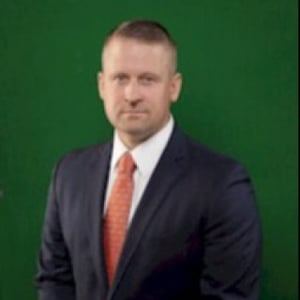
District Judge, United States District Court, Northern District of Texas
Matthew J. Kacsmaryk serves as United States District Judge for the Northern District of Texas.
He previously served in the (1) private, (2) government, and (3) nonprofit sectors:
Judge Kacsmaryk is an Honors graduate of the University of Texas Law School, where he joined the Federalist Society and served as an Executive Editor of the Texas Review of Law & Politics. Judge Kacsmaryk co-founded the Fort Worth Lawyers Chapter in 2012, coordinated the 2018 Texas Chapters Conference hosted by the Fort Worth Lawyers Chapter, and presently serves on its Advisory Board.
Texas Second Court of Appeals
Justice Kerr grew up in Memphis, Tennessee, graduating from White Station High School in 1974. She became a Texan when she matriculated at Rice University in Houston, obtaining a B.A. in English and Art History in 1978, followed by a J.D. from the University of Texas in 1982. Immediately following law school, Justice Kerr spent two years as a briefing attorney for the late Honorable Lucius D. Bunton, III, Judge of the United States District Court for the Western District of Texas, Midland Division.
From there, Justice Kerr began her private practice in Fort Worth in 1984, first with the firm of Law, Snakard & Gambill. During the 1990s, in addition to maintaining her legal practice Justice Kerr worked on numerous projects with lexicographer and author Bryan A. Garner, including as a contributing editor of the seventh edition of Black’s Law Dictionary. Starting in 1995, Justice Kerr taught legal writing and research off and on for a number of years at what began as the DFW School of Law and then became Texas Wesleyan (now Texas A&M) School of Law.
Most recently, she joined Friedman, Suder & Cooke in 2006, where she was of counsel until her election to the appellate bench in 2016. While at Friedman, Suder & Cooke, Justice Kerr was a member of the planning committee of the Tarrant County Bar Association’s appellate section, serving as its chair for the 2010-2011 bar year. She is a Fellow of the Tarrant County Bar Foundation and a Life Fellow of the Texas Bar Foundation.

Former Assistant United States Attorney at United States Attorney's Office
In February 2015, I entered private practice, concentrating on criminal law, forfeiture, and mediation services.
From 1985 until November 2013, I was an assistant United States attorney in the Northern District of Texas. I litigated civil and criminal forfeiture cases involving violations of federal laws on behalf of federal agencies (including the Drug Enforcement Administration, Federal Bureau of Investigation, Department of Homeland Security, Internal Revenue Service Bureau of Alcohol, Tobacco, Firearms, and Explosives, Secret Service, and Fish and Wildlife Service.
From July 2009 until January 2012, however, I served as the Asset Forfeiture/Money Laundering Coordinator on a detail to the Executive Office of United States Attorneys (EOUSA), United States Department of Justice, in Washington, D.C. In this capacity, I provided advice and assistance to EOUSA and 93 United States Attorney’s offices, on legal, logistical, and programmatic issues arising as part of the Department’s Asset Forfeiture/Money Laundering Program. I also served as a liaison between EOUSA and the Attorney General’s Advisory Committee, components of the Department of Justice (e.g., DEA, FBI, ATF) and Department of Treasury (e.g., IRS, SS, DHS) Asset Forfeiture Programs, and other agencies.
In both of these positions, I became familiar with federal forfeiture statutes, regulations, and cases, and agency forfeiture policies and procedures, as well as standard practices of agencies . Each year, I attended conferences on various substantive and procedural subjects related to forfeiture, including the annual Asset Forfeiture Chiefs and Experts Conference sponsored by the Department of Justice’s Asset Forfeiture/Money Laundering Section. Each month, I reviewed a summary of federal forfeiture case decisions prepared by renowned forfeiture expert Stefan Cassella. In addition, I regularly made presentations locally to various federal agencies on forfeiture topics.

Panel Discussion: Legal Challenges Involving Gender Identity Post-Bostock
Elizabeth Kerr, Andrew Koppelman, Christopher E. Mills, Shannon Minter, Christiana Michelle Kiefer
Litigation and legislation involving complex issues regarding gender identity are at the forefront of public...
Panel Discussion: Legal Challenges Involving Gender Identity Post-Bostock
2023 Texas Chapters Conference
Houston, TXIs School Choice Necessary for Religious Liberty and Freedom of Belief?
Fort Worth Lawyers Chapter
Fort Worth, TXCocktail Reception
Fort Worth Lawyers Chapter & Texas A&M University Law Students Chapter
Fort Worth , TXWelcome / Introduction / Invocation
2018 Texas Chapters Conference
Fort Worth, TX