
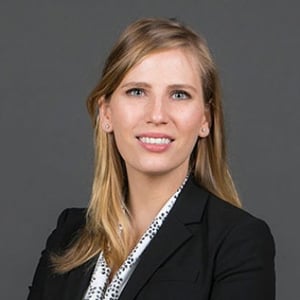
Assistant Professor of Law, George Mason University Antonin Scalia Law School
Caroline Cecot is an Assistant Professor of Law at Antonin Scalia Law School at George Mason University. She teaches environmental and administrative law and has published articles in peer-reviewed journals and law reviews on cost-benefit analysis, regulatory reform, and environmental regulation.
Professor Cecot holds a JD from Vanderbilt Law School, where she received the Robert F. Jackson and Archie B. Martin Memorial Prizes for her grades; was elected to Order of the Coif; and served as Senior Articles Editor for the Vanderbilt Law Review and Articles Editor for the Environmental Law and Policy Annual Review. Professor Cecot also holds a PhD in law and economics from Vanderbilt University. Following her graduate studies, Professor Cecot was the Postdoctoral Research Scholar in Law and Economics at Vanderbilt Law School and clerked for the Honorable Raymond J. Lohier, Jr., of the United States Court of Appeals for the Second Circuit. She was also Legal Fellow at the Institute for Policy Integrity at New York University School of Law, where she authored amicus curiae briefs and submitted comments on environmental and regulatory issues. Professor Cecot graduated from Harvard College magna cum laude with an AB degree in economics.
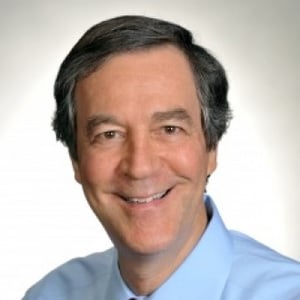
J. B. and Maurice C. Shapiro Professor of Environmental Law, George Washington University Law School
Robert L. Glicksman is a nationally and internationally recognized expert on environmental, natural resources, and administrative law issues. A graduate of the Cornell Law School, his areas of expertise include environmental, natural resources, administrative, and property law. Before joining the law school faculty in 2009, Professor Glicksman taught at the University of Kansas School of Law, where he joined the faculty in 1982 and was named the holder of the Robert W. Wagstaff Distinguished Professor of Law in 1995. Professor Glicksman has practiced with law firms in DC and New Jersey before joining and while on leave from academia, focusing on environmental, energy, and administrative law issues. He has consulted on various environmental and natural resources law issues, including work for the Secretariat of the Commission for Environmental Cooperation in Montreal, Canada.
Professor Glicksman has extensive publications in his areas of expertise. He is co-author of two law school casebooks, Environmental Protection: Law and Policy (6th ed. Aspen Publishers) and Administrative Law: Agency Action in Legal Context (Foundation Press); the four-volume treatise, Public Natural Resources Law (2d ed. Thomson/West); two monographs, Risk Regulation at Risk: A Pragmatic Approach, and Pollution Limits and Polluters’ Efforts to Comply: The Role of Government Monitoring and Enforcement, both published by Stanford University Press); and Modern Public Land Law in a Nutshell (3d ed. West). He has written numerous book chapters and articles on a variety of environmental and natural resources law topics, concentrating recently on topics such as climate change, federalism issues in environmental law, the challenges facing the federal land management agencies, and environmental enforcement. His articles have been published in law reviews and journals that include the Texas Law Review, Pennsylvania Law Review, the Northwestern University Law Review, the Duke Law Journal, the Vanderbilt Law Review, the Wake Forest Law Review, the Indiana Law Journal, the Stanford Environmental Law Journal, the Virginia Environmental Law Journal, and the Administrative Law Review.
Professor Glicksman has been a member scholar for the Center for Progressive Reform since 2002 and a member of the Center’s Board of Directors since 2008.

Founding Partner, Boyden Gray & Associates
Ambassador C. Boyden Gray is the founding partner of Boyden Gray & Associates, a law and strategy firm in Washington, D.C., focused on constitutional and regulatory issues.
Mr. Gray worked in the White House for twelve years, first as counsel to the Vice President during the Reagan administration and then as White House Counsel to President George H.W. Bush. In the Reagan administration, he was Counsel to the Presidential Task Force on Regulatory Relief, for which he wrote the original Executive Order 12291 requiring cost-benefit analysis and White House review of regulations (later renumbered as current EO 12866). In the George H.W. Bush Administration, Mr. Gray was in charge of judicial selection and was also instrumental in the enactment of the Clean Air Act Amendments of 1990, the Energy Policy Act of 1992, and a cap-and-trade system for acid rain emissions. In 1993, he received the Presidential Citizens Medal. Under President George W. Bush, Mr. Gray was U.S. Ambassador to the European Union and U.S. Special Envoy to Europe for Eurasian Energy.
Mr. Gray practiced law for 25 years at the law firm of Wilmer, Cutler & Pickering and was chairman of the Administrative Law and Regulatory Practice Section of the American Bar Association from 2000 to 2002. Early in his career, Mr. Gray helped to develop the Business Roundtable and served as its first counsel. He is an adjunct professor at Antonin Scalia Law School and a former adjunct professor at NYU Law School (teaching energy and environmental law). Mr. Gray is on the Board of Directors of the Atlantic Council, the Federalist Society, Reason Foundation, and the Trust for the National Mall.
Mr. Gray earned his A.B. magna cum laude from Harvard, where he was an editor of the Crimson, and his J.D. with high honors from the University of North Carolina at Chapel Hill, where he was editor-in-chief of the Law Review. Mr. Gray served in the United States Marine Corps, and after law school, he clerked for Earl Warren, Chief Justice of the United States Supreme Court.
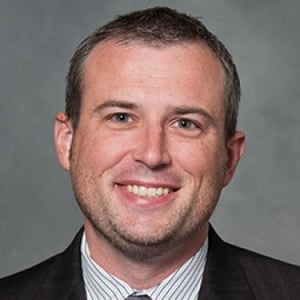
Professor of Law, Jacksonville University College of Law
Nathan Richardson is an Assistant Professor of Law at the University of South Carolina School of Law and a Visiting Fellow at Resources for the Future (RFF). Previously, he served as a Resident Scholar at RFF and managing editor of the blog Common Resources.
His areas of expertise and research encompass a wide range of environmental and energy issues, including U.S. climate policy (particularly regulation of greenhouse gases under the Clean Air Act), state and local regulation of oil and gas development (including hydraulic fracturing), the evolution of the electric utility sector, and the management of forests, particularly in the Southeast. Other interests include law and economics and European environmental and energy policy. His research has examined environmental liability, environmental federalism, and the relationship between law, regulatory institutions, and policy design.
Professor Richardson earned a B.S. from the Edmund A. Walsh School of Foreign Service at Georgetown University and earned his J.D. cum laude from the University of Chicago, where he served as Articles Editor of the Chicago Journal of International Law. Professor Richardson is licensed to practice law in California and the District of Columbia.

Laurence H. Silberman Chair in Constitutional Governance, American Enterprise Institute; Executive Director, Antonin Scalia Law School’s C. Boyden Gray Center for the Study of the Administrative State
Adam J. White is the Laurence H. Silberman Chair in Constitutional Governance and senior fellow at the American Enterprise Institute, where he focuses on the Supreme Court and the administrative state. He also directs the Antonin Scalia Law School’s C. Boyden Gray Center for the Study of the Administrative State.
He writes on regulation and constitutional government for a variety of publications. He practiced law in Washington, D.C., after clerking for the D.C. Circuit's Judge David Sentelle. He also has been chairman of the ABA's Administrative Law Section.
In 2021, he served on the Presidential Commission on the Supreme Court of the United States, where he criticized “Court packing” and other efforts to restructure the Supreme Court.

Senior Attorney, Institute for Justice
Erica Smith is a senior attorney with the Institute for Justice. She joined IJ in August 2011 and litigates cutting-edge constitutional cases protecting economic liberty, school choice, and free speech in federal and state courts.
Erica’s economic liberty work has a special focus on “food freedom.” Erica won Wisconsin home bakers the constitutional right to legally sell their goods in Kivirist v. Wisconsin Department of Agriculture. As a result, hundreds of home bakers across the state can now sell their cookies, cakes, and muffins without fear of fines or jail time. Erica also successfully defended the rights of home bakers and canners to fight against Minnesota’s arbitrary restrictions on selling their goods in Astramecki v. Minnesota Department of Agriculture. Erica is currently suing New Jersey—the last state to have a ban on selling homemade food. Erica’s legislative activities have also helped change the homemade food laws of several states.
Erica’s educational choice work gives parents the opportunity to guide the education of their children. She was the lead attorney representing families in Asociación de Maestros v. Departamento de Educación, where she persuaded the Puerto Rico Supreme Court to reject a teachers union’s challenge to the Commonwealth’s new voucher program. Erica was also part of the winning teams that protected both Georgia and New Hampshire’s tax-credit scholarship programs at the state supreme courts in Gaddy v. Georgia Department of Revenue and Duncan v. State of New Hampshire. She is currently fighting to protect Montana’s school choice program at the U.S. Supreme Court. In addition, Erica testifies as to the constitutionality of other educational choice programs across the country.
Erica’s free speech work includes her successful defense of a family’s right to use signs to advertise its gym in Fears v. City of Sacramento. She was part of the team that successfully defended Central Radio Company’s right to protest the illegal taking of its land in Central Radio Co. v. City of Norfolk. Most recently, Erica won the right of a family-owned video game store to advertise using a 9-foot inflatable Mario in Fisher v. Town of Orange Park.
Erica has appeared on CBS Sunday Morning, CBS This Morning, and Fox & Friends, and her writing has been published in the Washington Times, New York Post, Times-Free Press, The Virginian-Pilot, National Law Journal, and Federalist Society Review. She has also been quoted in media outlets across the nation, including the New York Times and Washington Post.
Before joining IJ, Erica served as a law clerk for the Honorable Terrence Boyle of the U.S. District Court for the Eastern District of North Carolina.
Erica received her law degree cum laude from the University of Pennsylvania Law School in 2010. Erica received her undergraduate degree summa cum laude from Stony Brook University’s Honors College in 2007, where she studied literature and journalism.
Senior Fellow, Center for Energy and Environment, Competitive Enterprise Institute
Marlo Lewis, Jr. is a Senior Fellow at the Competitive Enterprise Institute, where he writes on global warming, energy policy, and other public policy issues. Prior to joining CEI in April 2002, he served as Director of External Relations at the Reason Foundation in Los Angeles, California. During the 106th Congress, Marlo served as Staff Director of the House Government Reform Subcommittee on National Economic Growth, Natural Resources, and Regulatory Affairs.
His interests include the science, economics, and politics of global warming policy; the precautionary principle; environmentalism and religion; and the moral basis of free enterprise. Marlo has been published in The Washington Times, Investors Business Daily, TechCentralStation, National Review, and Interpretation: A Journal of Political Philosophy. He has appeared on various television and radio programs, and his ideas have been featured in radio commentary by Rush Limbaugh and G. Gordon Liddy.
Before joining CEI for his first tenure with the organization in 1993, Marlo served as Research Director for the grassroots organization, Citizens Against Government Waste. Earlier, he was a Staff Consultant to the House Foreign Affairs Subcommittee on International Economic Policy and Trade, a Special Assistant at the State Department Bureau of Inter-American Affairs and Bureau of International Organization Affairs, and a Visiting Assistant Professor of Political Science at Claremont McKenna College. He holds a Ph.D. in Government from Harvard University and a B.A. in Political Science from Claremont McKenna College.

Clayton J. and Henry R. Barber Professor of Law, Northwestern University Pritzker School of Law and Co-Chairman, Board of Directors, The Federalist Society
STEVEN GOW CALABRESI is the Clayton J. & Henry R. Barber Professor at Northwestern Pritzker School of Law. He has also co-taught in the Fall semester at Yale Law School from 2013 to the present. Calabresi clerked for Justice Antonin Scalia and Judges Robert H. Bork and Ralph K. Winter. He was a Special Assistant to Attorney General Meese from 1985 to 1987 and worked with Ken Cribb as his deputy in 1987 on the second floor of the West Wing of the Reagan White House. Calabresi has written books on presidential power and comparative constitutional law and the origins of judicial review. He and Gary Lawson are the co-editors of a casebook on U.S. Constitutional Law, and Calabresi is also the co-editor of a casebook on comparative constitutional law. He has written over seventy law review articles since 1990.
Member, Moore & Van Allen PLLC
A former North Carolina state representative and senator, as well as Supreme Court justice and law school dean, Bill Whichard applies his extensive judicial and legislative experience in advising and mentoring MVA litigation attorneys, focusing on appellate litigation for Moore & Van Allen clients.
He also assists with evaluating new matters, developing arguments, reviewing pleadings and documents, and supplying other trial support, giving MVA clients seasoned counsel that can materially affect dispute outcomes.
He has also served as a mediator and arbitrator in major, multimillion-dollar litigation.
Mr. Whichard has lectured and written extensively on North Carolina politics, law and history. Further, his commitment to public service and community betterment has earned him numerous honors and recognitions during his distinguished career.

Topics
The Concern for Human Flourishing at the Core of Antitrust Law
Antitrust law did not start in 1890. Though judges, scholars, and government officials often describe...
Creative Regulators and Environmental Protection
Caroline Cecot, Robert Glicksman, C. Boyden Gray, Nathan D. Richardson, Adam White
This symposium was co-sponsored by the Regulatory Transparency Project and took place at the Antonin...
Blaine Amendments and the Unconstitutionality of Excluding Religious Options From School Choice Programs
Erica Smith
Note from the Editor: This article discusses the school choice movement and how Blaine Amendments...
EPA Regulation of Fuel Economy: Congressional Intent or Climate Coup?
Marlo Lewis
Note from the Editor:1 This paper assesses EPA’s rule setting standards for motor vehicle greenhouse...
SCOTUScast 6-15-09 featuring Steven Calabresi
Steven G. Calabresi
On Wednesday, May 20, the Supreme Court granted certiorari in Free Enterprise Fund v. Public...
North Carolina Supreme Court Judicial Candidate Forum
Robert Edmunds, Suzanne Reynolds, Willis Whichard
On October 27, 2008, the Triangle Lawyers Chapter presented the "North Carolina Supreme Court Judicial...