


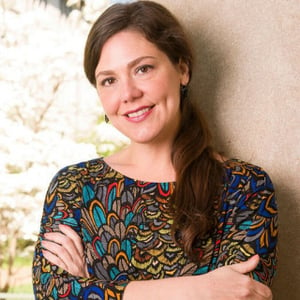
















Tara Leigh Grove is the Vinson & Elkins Chair in Law at the University of Texas School of Law. Grove graduated summa cum laude from Duke University and magna cum laude from Harvard Law School, where she served as the Supreme Court Chair of the Harvard Law Review. Grove clerked for Judge Emilio Garza on the U.S. Court of Appeals for the Fifth Circuit, and then spent four years as an attorney for the U.S. Department of Justice, Civil Division, Appellate Staff, where she argued fifteen cases in the courts of appeals.
Grove’s research focuses on the federal judiciary, interpretive theory, and the constitutional separation of powers. She has published with such prestigious law journals as the Harvard Law Review, the Yale Law Journal, the Columbia Law Review, the University of Pennsylvania Law Review, the New York University Law Review, the University of Chicago Law Review, the Virginia Law Review, the Texas Law Review, the Cornell Law Review, the Northwestern University Law Review, and the Vanderbilt Law Review. Grove has received awards for both her research and her teaching.
In 2021, Grove served on the Presidential Commission on the Supreme Court of the United States, a bipartisan commission created by President Biden and charged with examining proposals for Supreme Court reform. Since 2022, Grove has worked on the Princeton Initiative on Reclaiming the Constitutional Powers of Congress, which brings together former members of Congress, political scientists, and law professors. Grove serves as the Co-Chair of the section on the Appointments Process for the Princeton Initiative. Grove is a co-author of Low & Jeffries' Federal Courts and the Law of Federal-State Relations, a leading federal courts casebook, and she has served as the Chair of the Federal Courts Section of the Association of American Law Schools. Grove has been a visiting professor at both Harvard Law School and Northwestern Pritzker School of Law.



Luncheon Panel: Developments in Delaware: DExit, SB21, Musk, and More
Eric C. Chaffee, Itai Fiegenbaum, Mohsen Manesh, Robert T. Miller, Amanda Rose
Prof. Eric Chaffee, John C. Hutchins Professor of Law; Director, Compliance Risk Management and Financial Integrity...
Courthouse Steps Oral Argument: Learning Resources v. Trump
Jonathan H. Adler, Adam White
The Supreme Court recently heard oral argument in Learning Resources v. Trump, a case examining the...
Closing Banquet and Fireside Chat with Hon. James C. Ho and Allyson Newton Ho, and Presentation of the Annual Joseph Story Award and Feddie Awards
Allyson Newton Ho, James C. Ho, JJ Marshall, Katherine R. Slivensky
Overflow: Hutchins Hall Michigan Law School We are pleased to announce that the Honorable James...
Tech Roundup Episode 24 - DOGEing Barriers? Legal Challenges to AI in Government
Kevin Frazier, Dhruva Krishna, Megan Ma
Artificial Intelligence has been rapidly brought to the forefront of the public conversation in recent...
Climate Disclosure Litigation: Examining Legal Battles Against California and the SEC
Victor Flatt, Stephen Hall, Marc Marie, Trent McCotter
A panel of distinguished legal scholars and practitioners will provide an overview of the current...
Climate Disclosure Litigation: Examining Legal Battles Against California and the SEC
Victor Flatt, Stephen Hall, Marc Marie, Trent McCotter
A panel of distinguished legal scholars and practitioners will provide an overview of the current...
Climate Disclosure Litigation: Examining Legal Battles Against California and the SEC
A Regulatory Transparency Project Webinar
Supreme Court Preview: What Is in Store for October Term 2024?
Jonathan H. Adler, Paul S. Atkins, Lisa S. Blatt, Erin M. Hawley, Sarah Isgur, John S. Moran
On October 1, 2024, the Federalist Society's Faculty Division and Practice Groups will host a panel at...
Topics
The Future of Article III Standing
Is it “too easy” to show Article III standing, particularly in environmental cases? That is...
Showcase Panel II: Whither Precedent?
Tara Leigh Grove, Randy J. Kozel, Gary Lawson, John O. McGinnis, William H. Pryor
No one maintains that the Court has always and forever been originalist in its orientation....