
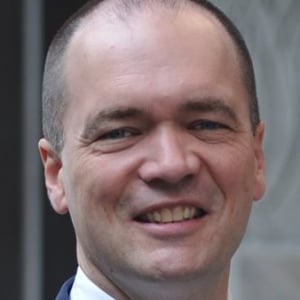
Professor of Law, High Point School of Law
Scott Gaylord directs High Point Law’s Appellate Litigation Clinic and serves as a Professor of Law, teaching Constitutional Law and related upper-level elective courses. The Appellate Clinic works with students to write and file briefs in significant court cases, including appeals before the United States Supreme Court.
Professor Gaylord is a prominent Constitutional Law scholar with an impressive background in both academia and legal practice. He has authored or co-authored 18 substantial law review articles, co-authored a Constitutional Law casebook, and has written more than 35 amicus briefs to the U.S. Supreme Court and federal circuit courts on prominent national cases involving religious liberty and free speech. He is a frequent speaker on constitutional law and First Amendment topics at law schools across the country and has regularly provided commentary on ongoing constitutional issues to national media outlets, including th eNew York Times, USA Today, the Diane Rehm Show, NPR, The National Constitution Center, and Bloomberg Law.
Professor Gaylord also started an appellate advocacy clinic at his former law school and currently serves on the North Carolina Chief Justice’s Commission on Professionalism, along with holding many other service and leadership roles. Prior to joining the academy in 2007, he practiced complex civil and commercial litigation with the Charlotte firm of Robinson Bradshaw & Hinson, and he clerked for Judge Edith H. Jones on the United States Court of Appeals for the Fifth Circuit.
Professor Gaylord earned his B.A. in philosophy and English, summa cum laude, from Colgate University, his Ph.D. in philosophy from the University of North Carolina at Chapel Hill, and his J.D. from Notre Dame Law School, where he also graduated summa cum laude.
Meir Katz is Legal Fellow at the Becket Fund for Religious Liberty. He focuses his practice on church-state issues in education and is an expert on the Blaine Amendments. Meir received his J.D. from Georgetown University Law Center, magna cum laude.

Professor of Law, University of Notre Dame Law School
Gerard V. Bradley is Professor of Law at the University of Notre Dame, where he teaches Legal Ethics and Constitutional Law. At Notre Dame he directs (with John Finnis) the Natural Law Institute and co-edits The American Journal of Jurisprudence, an international forum for legal philosophy. Bradley has been a Visiting Fellow at the Hoover Institution of Stanford University, and a Senior Fellow of the Witherspoon Institute, in Princeton, New Jersey. He served for many years as President of the Fellowship of Catholic Scholars.
Bradley received his B.A and J.D. degrees from Cornell University, graduating Summa cum laude from the law school in 1980. After serving in the Trial Division of the Manhattan District Attorney’s Office he joined the law faculty at the University of Illinois. He moved to Notre Dame in 1992. Bradley has published over one hundred scholarly articles and reviews. His most recent books are an edited collection of essays titled, Challenges to Religious Liberty in the Twenty-First Century (published by Cambridge University Press in 2012), Essays on Law, Religion, and Morality and Unquiet Americans: U.S. Catholics and the Common Good (both to be published in 2014.) He is currently working on a book about regulating obscenity in the Internet Age.
Publius comes from the pen name Alexander Hamilton, James Madison, and John Jay used when they wrote 85 publicly printed letters now known as the Federalist Papers. Hamilton chose “Publius” as a name that would represent friends of the newly proposed American republic - Publius Valeria Publicola was a Roman general who helped to found the Roman Republic. The Federalist Society continues the tradition of publishing things under the name Publius in celebration of our constitutional roots and recognition that author credit is not always necessary.

Of Tire Scraps, Blaine Amendments, and the Establishment Clause: Trinity Lutheran Church v. Pauley
Charlotte, North CarolinaTopics
The Dog That Hasn't Barked (Yet): Waiting on Trinity Lutheran Church of Columbia, Inc. v. Pauley
As the Supreme Court continues to fill its schedule for October Term 2016, one particularly...
Topics
Trinity Lutheran Church v. Pauley
The U.S. Supreme Court recently agreed to review the Eighth Circuit’s decision in Trinity Lutheran...
Topics
Constitutional Right to School Choice?
No one is a more fervent fan of school choice---or for that matter, of creative legal advocacy---than...
Topics
State Court Docket Watch News Clips: 9/2/2015
Arkansas Attorney General Leslie Rutledge issued an opnion interpreting state law to fobid counties and...
The State of Blaine: A Closer Look at the Blaine Amendments and Their Modern Application
Meir Katz
Governments aid religious organizations in a wide variety of ways. For example, governments provide vouchers...
Engage Volume 8, Issue 1, February 2007
ADMINISTRATIVE LAW & REGULATION State-Level Protection for Good-Faith Pharmaceutical Manufacturers by Daniel Troy Federalist Society...
The Blaine Amendment: Harbinger of Secularism?
Gerard V. Bradley
In August 1876, both houses of Congress voted on a series of proposals to amend...
Florida Supreme Court Strikes Down School Voucher Program
Publius
Since 1999, Florida’s Opportunity Scholarship Program (the “OSP”)1 provided students in failing public schools,2 which...