Patrick Hotung Professor of Constitutional Law, Georgetown University Law Center
Randy Barnett is the Patrick Hotung Professor of Constitutional Law at Georgetown University Law Center. He has argued before the United States Supreme Court, tried murder cases to juries as a prosecutor in Chicago, and appeared as a prosecutor in the feature film Inalienable. He is the author of numerous books, including Restoring the Lost Constitution, The Structure of Liberty, Our Republican Constitution, and The Original Meaning of the Fourteenth Amendment. He has published two memoirs, A Life for Liberty: The Making of an American Originalist, and Felony Review: Tales of True Crime and Corruption in Chicago. He is currently working on a new book, Freedom and Flourishing: Libertarianism for the Real World.
Former Judge, U.S. Court of Appeals, DC Circuit
Robert Heron Bork served as Solicitor General, acting Attorney General, and judge for the United States Court of Appeals for the District of Columbia Circuit. Judge Bork passed away in December 2012.
Tribute to Judge Robert Bork by John McGinnis - Event Audio/Video
Celebration of the Life of Robert Heron Bork 1927-2012
Judge Robert H. Bork: His Life and Legacy - Practice Group Podcast
A Conference Discussing the Contributions of Judge Robert H. Bork - June 26, 2007
Columbia Law School
E. Allan Farnsworth was a legal scholar whose writings on contract disputes have become a standard reference in courtrooms and law schools. A professor at Columbia University School of Law, Farnsworth was considered the country's foremost legal authority on contracts. He spent more than 50 years studying and explaining the legal underpinnings of contracts, whether written or oral, commercial or private, and wrote Farnsworth on Contracts, the most frequently cited reference work on contract law. He represented the US at diplomatic conferences on trade and on the UN Commission on International Trade Law.
Emeritus Professor of Law, UC Hastings College of Law
Professor Joseph Grodin, a native Californian, received his B.A. with honors from UC Berkeley in 1951 and his J.D. cum laude from Yale Law School in 1954. Upon graduation from law school he traveled to England on a Fulbright grant and earned a Ph.D. in labor law and labor relations from the London School of Economics.
Professor Grodin practiced law in San Francisco from 1955 to 1971, specializing in labor law and serving pro bono in a variety of civil rights and civil liberties matters. During portions of that period he taught as an adjunct professor at UC Hastings and a visiting professor at the University of Oregon Law School. Active in bar affairs, he served as chairman of the labor law section of the San Francisco Bar Association and as a member of the State Bar Committee on Legal Services.
From 1972 to 1979 Professor Grodin was a full-time professor at UC Hastings, teaching courses in labor law, employment discrimination, arbitration, and contracts. During portions of that period he served as a member of the first Agricultural Labor Relations Board, as foreman of the Alameda County Grand Jury, and as a visiting professor at Stanford Law School.
In 1979, Professor Grodin was appointed Associate Justice of the California Court of Appeal; in 1981, he was elevated to presiding justice of that court, and in 1982 was appointed Associate Justice of the California Supreme Court, a position he held until January 1987. Upon leaving the court, Professor Grodin returned to the UC Hastings faculty. He retired from full-time teaching in May 2005. He continues to teach part-time and to do arbitration and mediation work.
Professor Grodin is the author of numerous scholarly books and articles. He is particularly proud, however, of a book on hiking trails in the Silver Lake area of the Sierra, which he coauthored with his daughter, Sharon.
Senior Fellow, Cato Institute
Walter Olson is a senior fellow at the Cato Institute’s Robert A. Levy Center for Constitutional Studies and is known for his writing on the American legal system. His books include The Rule of Lawyers, on mass litigation, The Excuse Factory, on lawsuits in the workplace, and most recently Schools for Misrule, on the state of the law schools. His first book, The Litigation Explosion, was one of the most widely discussed general-audience books on law of its time. It led the Washington Post to dub him “intellectual guru of tort reform.” Active on social media, he is known as the founder and principal writer of what is generally considered the oldest blog on law as well as one of the most popular, Overlawyered.com. He has advised many public officials from the White House to town councils and in 2015 was named by Gov. Larry Hogan to be co-chair of the Maryland Redistricting Reform Commission, which issued its report recommendations later that year to acclaim across the state.
Before joining Cato, Olson was a senior fellow at the Manhattan Institute and an editor at the magazine Regulation, then edited by future Supreme Court Justice Antonin Scalia. Olson’s more than 400 broadcast appearances include all the major networks, NPR, the BBC, The Diane Rehm Show, and Oprah.
Writer, Historian, and Lecturer
Elizabeth Ann Fox-Genovese (May 28, 1941 – January 2, 2007) was an American historian best known for her works on women and society in the Antebellum South. A Marxist early on in her career, she later converted to Roman Catholicism and became a primary voice of the conservative women's movement. She was awarded the National Humanities Medal in 2003.
Editor, The Weekly Standard
William Kristol is the editor of The Weekly Standard. He is also a regular panelist on Fox News Sunday, a contributor for the Fox News Channel, and a monthly columnist for the Washington Post. Before starting the Weekly Standard in 1995, Mr. Kristol led the Project for the Republican Future, where he helped shape the strategy that produced the 1994 Republican congressional victory. Prior to that, Mr. Kristol served as chief of staff to Vice President Dan Quayle during the first Bush Administration, and to Education Secretary William Bennett under President Reagan. Before coming to Washington in 1985, Mr. Kristol was on the faculty of Harvard University’s Kennedy School of Government and the Department of Political Science at the University of Pennsylvania.
Voss-Bascom Professor of Law, University of Wisconsin Law School
Jane Larson (1958–2011) was the Voss-Bascom Professor of Law at the University of Wisconsin Law School.
Jane was born in Omaha, Neb., the oldest daughter of Donald G. and Wilma M. Larson. She graduated from Alameda West High School in Pleasanton, Calif. She received her undergraduate degree Phi Beta Kappa with a specialization in women's history from Macalester College in 1980. She received her law degree with high honors from the University of Minnesota Law School in 1985. She worked as a judicial clerk for Justice Rosalie Wahl of the Minnesota Supreme Court and for Judge Theodore McMillian of the U.S. Court of Appeals for the Eighth Circuit. From 1987 to 1990, she was an associate at the Washington, D.C., law firm of Powell, Goldstein, Frazer & Murphy.
In 1990, she joined the law faculty at Northwestern University School of Law, where she published a series of noted articles on legal history, property rights and social regulation, with particular emphasis on the rights of women and the poor (for example, "Free Markets Deep in the Heart of Texas," Georgetown Law Journal, 1995.) In 1996, she joined the faculty of University of Wisconsin Law School, where she continued her writing and lecturing on feminist legal theory and property law. Her academic writing has been called "a model of how to integrate the history of doctrine with the surrounding social values." She was an inspiring teacher, a self-taught decoder of Oriental rugs, and a jazz aficionado who requested Coltrane in lieu of epidural during the birth of her son, Simon. When she retired in October 2011, she was the Voss-Bascom Professor of Law.
Founder, Eagle Forum
Phyllis Schlafly was a national leader of the conservative movement since the publication of her best-selling 1964 book, A Choice Not An Echo. She created the pro-family movement in 1972, when she started her national volunteer organization called Eagle Forum. In a ten-year battle, Mrs. Schlafly led the pro-family movement to victory over the principal legislative goal of the radical feminists, called the Equal Rights Amendment. An articulate and successful opponent of the radical feminist movement, she debated on college campuses more frequently than any other conservative. She was named one of the 100 most important women of the 20th century by the Ladies’ Home Journal.
Mrs. Schlafly’s monthly newsletter called The Phyllis Schlafly Report was published for fifty years. At her request, the monthly newsletter was renamed after her death to the Eagle Forum Report: the Successor to The Phyllis Schlafly Report. Eagle Forum is the publisher of the Eagle Forum Report.
Her syndicated column appeared in 100 newspapers, and on many conservative websites.
Mrs. Schlafly was the author or editor of 27 books on subjects as varied as family and feminism (The Power of the Positive Woman and Feminist Fantasies); the judiciary (The Supremacists: The Tyranny of Judges and How to Stop It); religion (No Higher Power: Obama’s War on Religious Freedom); nuclear strategy (Strike From Space and Kissinger on the Couch); education (Child Abuse in the Classroom); child care (Who Will Rock the Cradle?); and phonics (First Reader and Turbo Reader).
Mrs. Schlafly was a lawyer and served as a member of the Commission on the Bicentennial of the U.S. Constitution, 1985-1991, appointed by President Ronald Reagan. She testified before more than 50 Congressional and State Legislative committees on constitutional, national defense, and family issues.
Mrs. Schlafly was a Phi Beta Kappa graduate of Washington University, received her Master’s in Political Science from Harvard University, and received her J.D. from Washington University Law School. In 2008, Washington University/St. Louis awarded Phyllis Schlafly an honorary Doctor of Humane Letters.
Phyllis Schlafly was America’s best-known advocate of the dignity and honor that we as a society owe to the role of fulltime homemaker. The mother of six children, she was the 1992 Illinois Mother of the Year.
Author, Journalist, Researcher, and Consultant
Karl Zinsmeister is an experienced executive, original researcher, and productive author with deep analytical, communications, public-policy, creative, and marketing skills—including high-level experience managing a range of publications, businesses, nonprofits, and government agencies. He is currently a consultant to major business figures and wealth creators as a designer of large-scale philanthropy projects, historian of American civil society, and expert on social reform and culture change.
He has written a dozen books—embedded war reporting, histories, political analysis, reference works, a novel, literary collections, academic volumes, a storytelling cookbook, even a book-length Marvel comic book. Two of his works have recently been optioned for development into a television series and a documentary film. He has edited or co-produced many other books.
Zinsmeister's magazine and newspaper journalism totals several hundred articles. These have been published in a wide range of national publications, from cover stories for The Atlantic to essays in the Wall Street Journal, where he is a frequent contributor. Karl also has more than two decades of experience as an Editor in Chief, managing writing, artistic, and business teams producing nationally circulated magazines of thought and culture.
He created The Almanac of American Philanthropy—the authoritative 1,342-page reference on private giving that is often referred to as “the bible” documenting America's distinctive tradition of solving major problems through civil society and voluntary action. Between cash contributions and volunteer labor, philanthropy is approaching the trillion-dollar level as an annual undertaking in the U.S., and it is one of our country's most potent sources of social innovation and improvement.
Zinsmeister established the nation's first independent advisory on philanthropy for veterans and servicemembers. He raised $15 million and designed an unprecedented randomized-control experiment to prove out better ways of assisting men and women injured during military service.
He created the “Sweet Charity” podcast, presenting 5-10 minute stories on important achievements in philanthropic creativity. He wrote and edited a series of “Wise Giver's Guides” offering donors practical help in specific fields. The volumes he authored himself include one analyzing charter schools, and another on the relationship between philanthropy and public policy.
In response to national concern over polarization and government stalemate, Zinsmeister researched and released a political/historical work What Comes Next?, describing how America can be dramatically improved by private actors even amidst political gridlock, documented by encouraging examples from our past.
From 2006 to 2009 Zinsmeister served in the West Wing as President George W. Bush’s chief domestic policy adviser. His responsibilities stretched across many issues: the formulation of new immigration policies, the mortgage and student-loan credit crises, stem-cell and biotechnology innovation, improving care for military veterans, school reform, issues in health, transportation, environmental quality, and national competitiveness.
Earlier in his career Karl was a U.S. Senate aide to Senator Daniel Patrick Moynihan. He has been an adviser to many public policy groups, and has testified before Congressional committees and Presidential commissions on topics including family issues, economic policy, and the Iraq war.
For more than a decade, Zinsmeister occupied the J. B. Fuqua Chair at the American Enterprise Institute, a premier Washington, D.C. think tank, where he researched economic, demographic, and cultural topics. While there he created an acclaimed national monthly magazine of politics, business, and culture, The American Enterprise. Author and former Cabinet Secretary William Bennett called it “one of America’s finest magazines.... intellectually interesting, well-written, lively, wide-ranging, and above all useful.” Zinsmeister wrote nearly 300 articles for the magazine, and conducted interviews with public figures extending from Rudy Giuliani to Pat Moynihan, Andres Duany to Rupert Murdoch.
In concert with his wife, Zinsmeister conceived and produced a feature documentary film entitled Warriors that aired nationally on PBS in 2007. The film won $450,000 of funding from the Corporation for Public Broadcasting in a major international competition. It presented personal profiles of America’s fighting forces via on-the-scene footage that Zinsmeister and two combat cameramen shot in Iraq. The New York Times described Warriors as “entirely compelling.” Footage from the film was used as a plot item in the final week of the HBO television series The Sopranos.
In the private sector, Zinsmeister was an executive in his native region of upstate New York at the Stickley company—an historic firm that designs, manufactures, and markets iconic American Arts & Crafts furniture designs worldwide. His responsibilities included marketing and sales, advertising, catalogs, photography, websites, communications, the Stickley Museum, some product design, and the modernization of many business and data systems. Zinsmeister has also operated his own businesses over a period of years, including designing, financing, renovating, and building eight properties with historic appeal, in Washington and New York.
A graduate of Yale University, Zinsmeister did further studies at Trinity College Dublin in Ireland. During college he won national rowing championships in both the U.S. and Ireland. He has given hundreds of public lectures, originated a weekly radio commentary syndicated to 100 stations, and appeared often on a wide variety of national television and radio programs. He has lived, worked, or traveled in 40 countries, and nearly every U.S. state. He holds the highest U.S. security clearance.
Zinsmeister is married and has three grown children. He is an active outdoorsman, enjoys extended wilderness backpacking trips, and swims, bicycles, sculls, skis, and hikes often. He has been an avid photographer, woodworker, gardener and keeper of hens, taught Sunday school, and sung in church choirs. He currently lives in Washington, D.C. on a houseboat he designed and built himself.
Sterling Professor Emeritus of Law, Yale Law School
Mirjan Damaška is Sterling Professor Emeritus of Law at Yale Law School. He teaches and writes in the fields of comparative and foreign law, procedural law, evidence, international criminal law, and continental legal history.
He is the author of six books, among which The Faces of Justice and Evidence Law Adrift were translated into several languages. He has published more than 100 articles in professional journals of numerous countries.
He received his basic law degree at the University of Zagreb in his native Croatia. He then studied at the Academy of International Law at The Hague, and the Comparative Law Faculty in Luxembourg. He earned his Ph.D. at the University of Ljubljana (Slovenia). Following time spent practicing in the courts of former Yugoslavia, he began his teaching career at the University of Zagreb Law School, rising quickly to the rank of full professor, and briefly serving as Acting Dean. In 1971, he left his native land, and accepted a tenured position at the University of Pennsylvania Law School. Since 1976, he has been on the faculty of Yale Law School.
Damaška is a fellow of the American Academy of Arts and Sciences, a member of the International Academy of Comparative Law, the Croatian Academy of Arts and Sciences, and the American Society of Comparative Law. In 1978-79, he was fellow of the National Endowment for the Humanities. He is also holder of several honorary degrees.
He was keynote speaker and general reporter at many international congresses. Five symposia were organized about his work: Bielefeld (Germany) in 1987; Siena (Italy) in 1988; San Francisco in 1998; Zagreb (Croatia) in 2006; and New Haven in 2008. From 1990 to 1995, he served on the Advisory Board of the Central and East European Legal Initiative of ABA. Since 1995, he has periodically advised the Croatian government in its relations with the International War Crimes Tribunal for the Former Yugoslavia, and the International Court of Justice in The Hague.
In 2005, he was appointed Amicus Curiae of the International War Crimes Tribunal for the Former Yugoslavia in the matter of transferring cases to domestic courts. In 2009, he was presented the lifetime achievement award by the American Society of Comparative Law. In 2014, he was awarded the Life Achievement award by Jadranko Crnic Foundation, Croatia. He does counseling work on foreign law problems for law firms in New York, Los Angeles, and Washington.
In 2010 he was appointed special adviser to the Prime Minister of Croatia, and agent of the Republic of Croatia before the International Court of Justice, heading a team of Croatian and English lawyers in the case of Croatia v. Serbia.
Two books of essays have been published in his honor: Jackson, Langer, & Tillers (eds.), "Crime, Procedure, and Evidence: Essays in honor of Mirjan Damaška (Oxford 2008), and Ackerman, Ambos, Sikiric (eds.), "Visions of Justice, Liber Amicorum Mirjan Damaška" (Berlin 2016).
Professor of Comparative Constitutional Law, European University Institute
Since September 2016 Gábor Halmai, professor of law, is the chair of Comparative Constitutional Law at the European University Institute in Florence. Since January 2018 he is the Director of Graduate Studies at the Law Department. His primary research interests are comparative constitutional law, and international human rights. He has published several books and articles, as well as edited volumes on these topics in English, German and Hungarian. He is joining the EUI after a teaching and research career (at the Eötvös Loránd University in Hungary, the Princeton University in the USA, the the European Masters Program in Human Rights and Democratization in Italy) as well as years of professional career as chief advisor to the President of the Hungarian Constitutional Court, member of the EU Fundamental Rights Agency’s Management Board and numerous other civic activities.
Prior to joining to EUI Professor Halmai has worked on various research projects at the IWM in Vienna and the Woodrow Wilson School of Princeton University: Backsliding of liberal democracies within the European Union, with special focus on the development of constitutionalism and human rights in Hungary since its democratic transition in 1989-1990 till now; Models of state-church relations and religious freedom; Constitutionalism and transitional justice in Central and Eastern Europe. His most recent book, „Perspectives on Global Constitutionalism” deals with the use of foreign and international law by domestic courts (published by Eleven International Publishing in 2014). In addition to research, Professor Halmai has also been teaching and supervising students in Budapest, Princeton and Florence on the subjects of comparative constitutional law and human rights, as well as on rule of law.
Besides his academic work he was member of the EU Fundamental Rights Agency’s Management Board based in Vienna, Austria (2007-2010), the national director of the European Masters Program in Human Rights and Democratization in Venice, Italy (2003-2013), vice-chair of the Hungarian National Election Commission (2006-2010; chief counsellor to the President of the Hungarian Constitutional Court (1990-1996).
Gábor Halmai is founder and editor-in-chief of Fundamentum, the Hungarian human right quarterly, and Member of the Scientific Advisory Board of the European Yearbook on Human Rights, the Review of Constitutionalism and Constitutional Change (RC3), and the This Century’s Review.
Assistant Professor, University of Ústí nad Labem
Daniel Kroupa is a Czech politician and philosopher, dissident, signatory of Charter 77, President of the Civic Democratic Alliance (ODA) from 1998 to 2001, former MP, Euro MP and senator. After the Velvet Revolution, he taught political philosophy at several faculties of Charles University in Prague. From 2005 to 2015, he was the Head of the Department of Political Science and Philosophy of the Faculty of Arts, University of Ústí nad Labem. Since 2015 he has been an assistant professor at this department.
Philosopher, Journalist, Novelist, and Diplomat
Michael John Novak Jr. (1933–2017) was an American Roman Catholic philosopher, journalist, novelist, and diplomat. The author of more than forty books on the philosophy and theology of culture, Novak is most widely known for his book The Spirit of Democratic Capitalism (1982). In 1993 Novak was honored with an honorary doctorate at Universidad Francisco Marroquín due to his commitment to the idea of liberty. In 1994 he was awarded the Templeton Prize for Progress in Religion, which included a million-dollar purse awarded at Buckingham Palace. He wrote books and articles focused on capitalism, religion, and the politics of democratization.
Former Judge, United States Court of Appeals, Fifth Circuit
Alvin Benjamin Rubin's long and storied tenure as a federal judge began with a nomination by President Lyndon B. Johnson in 1966 and ended in 1991 at his death.
Judge Rubin was born in Alexandria, Louisiana, in 1920, and received a B.S. from Louisiana State University in 1941. He started at Louisiana State University Law School in 1940. When World War II broke out, he enlisted in the U.S. Army, was assigned to General Patton's "Big Red 1," and served in the European Theatre of Operations in England, France, Belgium, and Germany, rising to the rank of Captain and serving as an Assistant Judge Advocate. After the war ended, he married Janice Ginsberg, also from Alexandria, and returned to Baton Rouge for law school in an accelerated post-war program for returning war veterans. He graduated first in his law school class in 1942 and was Editor-in-Chief of the Louisiana Law Review.
After his graduation, he began practicing law in Baton Rouge with J.Y. Sanders and Ben Miller, Sr., and after several years the firm of Sanders, Miller, Downing, Rubin and Kean was formed. Judge Rubin specialized in tax law, corporate transactions, and trust and estates law. He also was an arbitrator and mediator.
Soon after he started practice in 1942, the illness of a faculty member at the LSU Law School propelled Judge Rubin back into the classroom as a professor. Judge Rubin taught a variety of subjects continuously at the Law School until 1989, including Admiralty, Civil Code, Ethics, Negotiations, Constitutional Law, Federal Procedure, State and Local Tax Law, Federal Tax Law, Law Office Practice, and many others. Judge Rubin's love of teaching and of student interaction was particularly meaningful to him, and throughout his life Judge Rubin was invited to teach and lecture at schools around the world, including Harvard, Yale, Notre Dame, University of Pennsylvania, Cornell, University of Miami, University of Georgia, University of Texas, Tulane, and Duke. He also traveled to give presentations throughout Europe. Because of his expertise in civil law, during the Vietnam War, Judge Rubin was asked by the State Department to travel to South Vietnam and assist in drafting the constitution for South Vietnam. He also served as a moderator for the Aspen Institute and for many programs for the American Bar Association.
In 1963, Judge Rubin and Dean Henry George McMahon co-authored Louisiana Pleadings and Judicial Forms Annotated. For over 20 years, Judge Rubin continued the annual updates for this vital resource used by Louisiana attorneys. Before 1960, Louisiana civil law prohibited the establishment of Trusts. Judge Rubin was instrumental in the creation of a Trust Code for Louisiana, which was adopted by the Louisiana Legislature in 1960. In 1966 he and his wife, Janice, co-authored the Louisiana Trust Handbook, and later, he wrote Louisiana Wills and Trust: A Drafting System (with Professor Gerald LeVan). Judge Rubin's list of law review and journal articles spans many pages. Two of his most prominent works are "A Causerie on Lawyer's Ethics" and "Hazards of a Civilian Venturer in Federal Court: Travel and Travail on the Erie Railroad" (both in the Louisiana Law Review).
He then practiced law until 1966 when President Johnson nominated him to a new seat on the United States District Court for the Eastern District of Louisiana created by 80 Stat. 75. Judge Rubin served at an important time in the Court's history, hearing many of the desegregation and civil rights cases in the 1960s. He served as Chief Judge of the District and wrote and implemented the first comprehensive written pre-trial procedure rules for the District. He served on and chaired many committees for the Judicial Conference and co-wrote the first law clerk handbook for the federal system. Judge Rubin kept long hours and was often in his Chambers early. He always took home briefs to read and drafts of opinions to edit, keeping two secretaries busy at all times.
After eleven years as a judge on the federal district court, Judge Rubin was nominated in 1977 by President Jimmy Carter to fill a seat on the United States Court of Appeals for the Fifth Circuit vacated by John Minor Wisdom. Judge Rubin assumed senior status on July 1, 1989, and served in that capacity until his death in 1991 in Baton Rouge, Louisiana. In his memory, the Louisiana Law Review published a special edition (Vol. 52, 1992) dedicated solely to his life and work, including articles and remembrances by his wife, Justice Byron White, Judge John Minor Wisdom, Judge Charles Clark, Judge Fred Cassibry, Judge Henry Politz, and many others.
Judge Rubin wrote more than 700 important (and sometimes humorous) opinions during his time as a federal judge. His rulings included ones that ended Louisiana's exemption of women from juries, applied the Voting Rights Act to local elections, and upheld the rights of government employees to criticize their superiors and to organize unions. Judge Rubin's interests spanned poetry, drama, history, art, the classics, and music of all types. He enjoyed writing Gilbert-and-Sullivan-ish parodies concerning legal matters and performing them for students, clerks, lawyers, at judicial seminars, and even for United States Supreme Court Justices.
The judicial activity that Judge Rubin reportedly most enjoyed was conducting naturalization ceremonies in open court. Judge Rubin spoke not as a jurist but as the son of immigrants from Eastern Europe whose parents had lost many relatives to war and hatred. He spoke movingly of his parents, their courage, and their determination to give their children the education and opportunities they had never had. Judge Rubin always emphasized that those citizens, new though they were, had equal rights. They could vote. They could develop their own talents and those of their children. They were entitled to occupy as well as to stand before the bench of justice.
Judge Rubin also enjoyed the close friendship of his many law clerks (serving as officiant of at least one wedding) and was an avid tennis player and jogger, often enlisting law clerks and young lawyers as his tennis or running partner.
Judge Rubin was the first member of the LSU Law Center Hall of Alumni Distinction, and was the First Alumni Member of the LSU Phi Beta Kappa Chapter. He was awarded the Louisiana ACLU Award for his civil rights work and was active in the National Conference of Christians and Jews and his synagogue in Baton Rouge.
Judge John Minor Wisdom wrote that "Alvin Rubin was born to be a judge, a great judge. His intellect, scholarship, and judicial leadership place him in a select group. In recent years, some of this small group graced the Supreme Court: Holmes, Brandeis, and Cardozo. These judges would have welcomed him on equal intellectual terms and as a kindred spirit."
The New Orleans Chapter of the Federal Bar Association hosts an annual symposium in Judge Rubin's honor. The symposium is an annual discussion on aspects of federal law or practice as a living memorial to Judge Rubin's contribution to federal jurisprudence and legal scholarship. The symposium is well attended by his family, friends, former clerks, and lawyers.
Judge Rubin's wife, Janice, best summed him up. "[His] friends spanned continents and age barriers . . . . [He] was the jurist he was because he was the man the boy became, a man who remembered Biblical injunctions about relationships and courage, about discipline and standards, about justice and mercy and integrity, a man whose goal on the bench was the oath taken by judges on the Isle of Man: 'You shall do justice between cause and cause as equally as the backbone of the herring doth lie midmost of the fish.' "
Senior Counsel, Cahill Gordon & Reindel LLP
Floyd Abrams is Senior Counsel in Cahill Gordon & Reindel LLP's litigation practice group.
Floyd has a national trial and appellate practice and extensive experience in high-visibility matters, often involving First Amendment, securities litigation, intellectual property, public policy and regulatory issues. He has argued frequently in the Supreme Court in cases raising issues as diverse as the scope of the First Amendment, the interpretation of ERISA, the nature of broadcast regulation, the impact of copyright law and the continuing viability of the Miranda rule. Most recently, Floyd prevailed in his argument before the Supreme Court on behalf of Senator Mitch McConnell as amicus curiae, defending the rights of corporations and unions to speak publicly about politics and elections in Citizens United v. Federal Election Commission. Floyd's clients have included The McGraw-Hill Companies in a large number of litigations around the country involving claims against its subsidiary, Standard & Poor’s Financial Services LLC, The New York Times in the Pentagon Papers case and others, ABC, NBC, CBS, CNN, Time Magazine, Business Week, The Nation, Reader's Digest, Hearst, AIG, and others in trials, appeals and investigations.
Floyd has represented Standard & Poor’s in litigations about its ratings; he defended the Brooklyn Museum of Art in its legal battles with Mayor Rudolph Giuliani; he represented two of the nation’s largest insurers in litigation under Section 17200 in California and he has frequently testified before congressional committees and prepared clients to do so. In 1998, he represented CNN in investigating and issuing a report on its broadcast accusing the United States of using nerve gas on a military mission in Laos in 1970, and again in 1999 in seeking to persuade the United States Senate to permit the public to view its deliberations as it determined whether or not to convict President Clinton of alleged high crimes and misdemeanors. He represented Nina Totenberg and National Public Radio in the 1992 "leak" investigation conducted by the United States Senate arising out of the confirmation hearing of Justice Clarence Thomas and, in 2004 and 2005, Judith Miller and Matthew Cooper in their efforts to avoid revealing their confidential sources.
In 2006, Floyd was elected to the American Academy of Arts & Sciences, an independent research center that conducts multidisciplinary studies of complex and emerging problems advanced by its 4,600 elected members, who are leaders in the academic disciplines, the arts, business and public affairs from around the world. In 2015, Floyd was honored by Yale Law School with its prestigious Award of Merit. Also in 2015, Floyd received the Walter Cronkite Freedom of Information Award presented by the Connecticut Foundation for Open Government. In 2011, Floyd was awarded the CUNY Graduate School of Journalism's Lifetime Achievement Award. In 1998, Floyd was the recipient of the William J. Brennan, Jr. Award for outstanding contribution to public discourse; the Learned Hand Award of the American Jewish Committee; and the Thurgood Marshall Award of the Association of the Bar of the City of New York. In November, 1999, he received the William J. Brennan, Jr. award of the Libel Defense Resource Center. Floyd was awarded, in 1997, the Milton S. Gould Award for outstanding appellate advocacy by the Office of the Appellate Defender in New York. Previously he had been awarded the Ross Essay Prize of the American Bar Association for his study of the Ninth Amendment of the United States Constitution. He has also received awards from, among others, the American Jewish Congress, Catholic University, the New York and Philadelphia Chapters of the Society of Professional Journalists, Sigma Delta Chi, the New York Civil Liberties Union, the Association for Education in Journalism and Mass Communication, and the National Broadcast Editorial Association.
In November, 2011, Yale Law School announced the formation of The Floyd Abrams Institute for Freedom of Expression, whose mission is to promote free speech, scholarship and law reform on emerging questions concerning traditional and new media. Developed in cooperation with Floyd, the Institute includes a clinic for Yale Law students to engage in litigation, draft model legislation, and advise lawmakers and policy makers on issues of media freedom and informational access.
The American Bar Association awarded Floyd its Certificate of Merit for his article published in The New York Times Magazine entitled "The New Effort to Control Information," which was described by the ABA as a "noteworthy contribution to public understanding of the American system of law and justice."
Described by Senator Daniel Patrick Moynihan as "the most significant First Amendment lawyer of our age," Floyd is top-ranked by Chambers USA. He is listed in Who’s Who Legal, Who’s Who in American Law, and has been awarded with Lifetime Achievement Awards by The New York Law Journal and The American Lawyer (2013).
Floyd, who served as chairman of Mayor Edward Koch's Committee on Appointments, New York City, served as the Chairman of the New York State Zenger Commemoration Planning Committee. Previously, he served as the Chairman of the Communications Committee of the Association of the Bar of the City of New York, as well as Chairman of the Committee on Freedom of Speech and of the Press of the Individual Rights Section of the American Bar Association and of the Committee on Freedom of Expression of the Litigation Section of the American Bar Association.
He has appeared frequently on television on Nightline, the News Hour with Jim Lehrer, Charlie Rose and other programs and has published articles and reviews in The New York Times, The Washington Post, The Yale Law Journal, The Harvard Law Review, and elsewhere.
Floyd served on the Technology and Privacy Advisory Committee of the U.S. Department of Defense in 2003-4 and as the Chair of the New York State Commission on Public Access to Court Records in 2004.
For fifteen years, Floyd was the William J. Brennan, Jr. Visiting Professor of First Amendment Law at the Columbia Graduate School of Journalism. He has, as well, been a Visiting Lecturer at Yale Law School and Columbia Law School and he is author of Friend of the Court: On the Front Lines with the First Amendment, published by Yale University Press (2013) and Speaking Freely: Trials of the First Amendment, published by Viking Press (2005).
General Counsel, Tikvah Fund
Suzanne Garment is an American scholar, writer, editor and attorney.
Garment is best known for her book, Scandal: The Culture of Mistrust in American Politics, and for her work as a aide to Ambassador Daniel Patrick Moynihan working to block the 1975 United Nations General Assembly Resolution 3379 of the United Nations that "Zionism is a form of racism and racial discrimination."
Garment holds the A.B. from Radcliffe College, the M.A. from the University of Sussex in the United Kingdom, the PhD in political science from Harvard University, the J.D. and a master of laws degree in taxation from Georgetown University
She has served as a visiting scholar at the Indiana University Center on Philanthropy at Indiana University; special counsel to Richard Ravitch, New York Lieutenant Governor and as counsel to the Task Force on the State Budget Crisis, co-chaired by Ravitch and former Federal Reserve chairman Paul Volcker. Before earning the J.D., she was a scholar at the American Enterprise Institute; associate editorial page editor of the Wall Street Journal; author of the "Capital Chronicle" column at the Wall Street Journal; and special assistant to Daniel Patrick Moynihan, U.S. ambassador to the United Nations. Garment has taught politics and public policy at Yale and Harvard Universities. She was the executive editor of Jewish Ideas Daily.
Professor of Law Emeritus, Brooklyn Law
Henry Mark Holzer received his B.A. degree from New York University where he studied Russian and political science. After graduation in 1954 he served in South Korea with United States Army intelligence, holding top secret clearance as chief order of battle analyst (Chinese Communist Forces) at Eighth Army Headquarters in Seoul. Following Professor Holzer’s military service he earned his Juris Doctor degree at New York University School of Law. After his admission to the New York bar in December 1959 he practiced constitutional and appellate law.
From 1972 to 1993 he taught full time at Brooklyn Law School, and for two years was an associate dean. His courses included Constitutional Law, Administrative Law, Civil Liberties, First Amendment and Appellate Advocacy. In the fall of 1993, he taught as a visiting professor at the University of New Mexico School of Law in Albuquerque.
He is author of approximately 300 articles, essays, and reviews. He has published legal and political commentary on current issues in print and electronic media, and has often been interviewed on radio and television.
Several of his out-of-print books are The Gold Clause: Government’s Money Monopoly; Sweet Land of Liberty? The Supreme Court and Individual Rights; Speaking Freely: The Case Against Speech Codes; Why Not Call it Treason? Korea, Vietnam, Afghanistan and Today. With his wife, Erika Holzer, he is co-author of “Aid and Comfort”: Jane Fonda in North Vietnam; and Fake Warriors: Identifying, Exposing, and Punishing Those Who Falsify Their Military Service.
His book The Supreme Court Opinions of Clarence Thomas, 1919-2006, was published in 2007. The second edition, covering the years 1991-2011 was published in 2012. Also published in 2012, in a print edition and eBook, was Professor Holzer’s book The American Constitution and Ayn Rand’s “Inner Contradiction.”
Journalist, Professor, and Author
Donald "Don" Oberdorfer Jr. (May 28, 1931 – July 23, 2015) was an American professor at the Paul H. Nitze School of Advanced International Studies (SAIS) at Johns Hopkins University with a specialty in Korea, and was a journalist for 38 years, 25 of them with The Washington Post. He is the author of five books and several academic papers. His book, Senator Mansfield: The Extraordinary Life of a Great American Statesman and Diplomat, won the D.B. Hardeman Prize in 2003.
Oberdorfer graduated from Princeton University and went to South Korea as a U.S. Army lieutenant after the signing of the armistice that ended the Korean War. In 1955 he joined The Charlotte Observer, and eventually found a job with The Washington Post. During the next 25 years, he worked for The Post, serving as White House correspondent, Northeast Asia correspondent, and diplomatic correspondent. He retired from the paper in 1993.
At the Nitze school, beyond his teaching position, Oberdorfer served as chairman of the U.S.-Korea Institute from its inauguration in 2006 and was named chairman emeritus in 2013.
Former Assistant Attorney General, U.S. Department of Justice, Civil Division
During the Reagan Administration, Richard Willard served as Assistant Attorney General in charge of the Civil Division, the largest litigation division of the US Department of Justice. There, he chaired the Reagan Administration's Tort Policy Working Group and developed its proposals for reforming civil litigation, workplace drug testing, and preventing unauthorized disclosure of classified information.
More recently, he served as senior vice president and general counsel for Bristol-Myers Squibb Co. and Gillette Company, where he led large worldwide legal departments, advised on strategic transactions, and enabled launch of new products with strong intellectual property protection.
Mr. Willard's private practice involved corporate counseling and litigation of cases raising public policy concerns. He served as lead counsel in complex litigation involving multiple claims, parties, and jurisdictions. He frequently appeared in trial and appellate courts around the country, including six arguments in the Supreme Court.
Ronald Reagan Distinguished Fellow Emeritus, The Heritage Foundation
Edwin Meese III, the prominent conservative leader, thinker and elder statesman, continues a quarter-century formal association with The Heritage Foundation as the leading think tank’s Ronald Reagan Distinguished Fellow Emeritus.
In that capacity, Meese oversees special projects and acts as an ambassador for Heritage within the conservative movement.
Meese was chairman of Heritage’s Center for Legal and Judicial Studies from its founding in 2001 until what he calls his “semi-retirement” on Feb. 1, 2013.
He joined Heritage in 1988 as the think tank's first Ronald Reagan Distinguished Fellow -- the only policy chair in the country to be officially named for the 40th president. His work focused on keeping President Reagan’s legacy of conservative principles alive in public debate and discourse.
The legal center now bears his name, in recognition of Meese’s contributions to the rule of law and the nation’s understanding of constitutional law. Its mission is to educate government officials, the media and the public about the Constitution and legal principles -- and how they affect public policy.
Perhaps best known as U.S. attorney general during Reagan’s second term, Meese’s service to the conservative icon stretched from the California governor’s mansion in 1966 to the White House in 1981 before he went to the Department of Justice four years later.
His Heritage “hats” kept Meese among the major conservative voices in national policy debates at an age when most men and women enjoyed quiet retirements.
In 2006, for example, Meese was named to the Iraq Study Group, a special presidential commission dedicated to examining the best resolutions for America's involvement in Iraq. In the past few years he wrote and spoke about constitutional topics ranging from religious liberty to the responsibility of Supreme Court justices.
Immediately after Reagan's death in 2004, and in the years since, Meese often agreed to major media appearances to discuss the lasting impact of his old friend, mentor and boss. He has summarized the Reagan legacy in three accomplishments: Reagan cut taxes and kept them low. He worked to defeat and end the Soviet Union and its worldwide push for communism. And he restored America's faith in itself after years of failure and "malaise."
"I admired him as a leader and cherish his friendship," Meese wrote in a 2004 essay for Heritage members and supporters. "Ronald Reagan had strong convictions. He was committed to the principles that had led to the founding of our nation. And he had the courage to follow his convictions against all odds." <[>Edwin Meese III was born Dec. 2, 1931, to Edwin Jr. and Leone Meese in Oakland, Calif. He graduated from Yale University in 1953 and holds a law degree from the University of California-Berkeley.
Meese spent much of his adult life working for Reagan, first after the former actor, sports announcer and athlete was elected as California’s governor in 1966 and then when he sought and won the presidency in 1980.
Reagan never forgot Meese's loyalty and hard work. During a press conference at which reporters questioned Meese's actions at the Justice Department, Reagan replied: "If Ed Meese is not a good man, there are no good men."
During the Reagan governorship, Meese served as executive assistant and chief of staff from 1969 through 1974 and as legal affairs secretary from 1967 through 1968. He previously was deputy district attorney in Alameda County, Calif.
From January 1981 to February 1985, Meese held the position of counsellor to the president -- the senior job on the White House staff -- and functioned as Reagan's chief policy adviser. In 1985, he received Government Executive magazine's annual award for excellence in management.
Meese served as the 75th attorney general of the United States from February 1985 to August 1988. As the nation's chief law enforcement officer, he directed the Justice Department and led international efforts to combat terrorism, drug trafficking and organized crime.
Meese’s relationship with Heritage began when he met with senior management to discuss the think tank's landmark policy guide, Mandate for Leadership, prepared for the incoming administration. Meese later recalled that Reagan personally handed out copies of the 1,093-page book to members of his Cabinet and asked them to read it. Nearly two-thirds of Mandate's 2,000 recommendations would be adopted or attempted by the Reagan administration.
More than a decade after joining Heritage, Meese assumed the chairmanship of its Center for Legal and Judicial Studies. Under his guidance, the center counseled White House staffers, Justice Department officials and Senate Judiciary Committee members on the importance of filling judicial vacancies with qualified men and women who are committed to interpreting the Constitution according to the founding document's original meaning.
The center became known for hosting "moot court" practice sessions to sharpen the arguments of attorneys slated to bring important cases before the Supreme Court. Those cases addressed constitutional issues ranging from property rights to racial preferences in primary and secondary schools to restrictions on free speech in campaign finance law.
Meese headed the legal center's Advisory Board for the writing and editing of the best-selling book, The Heritage Guide to the Constitution (Regnery, 2005). In it, 109 experts walked readers through a clause-by-clause analysis of the Constitution. Sen. Tom Coburn (R-Okla.) was among those keeping the reference work handy during Judiciary Committee hearings on Supreme Court nominees.
Meese's other books include “Leadership, Ethics and Policing” (Prentice Hall, 2004); “Making America Safer” (Heritage, 1997); and “With Reagan: The Inside Story” (Regnery Gateway, 1992).He wrote the Introduction to a well-received 2010 book on the “overcriminalization” trend, “One Nation Under Arrest,” by Heritage veterans Paul Rosenzweig and Brian W. Walsh.
He also is a distinguished visiting fellow at the Hoover Institution at Stanford University in California and lectures, writes and consults throughout the United States on a variety of subjects.
As both attorney general and counsellor to Reagan, Meese was a member of the Cabinet and the National Security Council. He served as chairman of the Domestic Policy Council and the National Drug Policy Board. After Reagan won the White House in the 1980 election, Meese headed the transition team. During the campaign, he was the Reagan-Bush Committee's senior official.
Meese had a career outside government and politics. From 1977 to 1981, he was a law professor at the University of San Diego, where he also directed the Center for Criminal Justice Policy and Management.
He was an executive in the aerospace and transportation industry as vice president for administration of Rohr Industries Inc. in Chula Vista, Calif. He left Rohr to return to the practice of law, doing corporate and general work in San Diego County.
A retired colonel in the Army Reserve, Meese remains active in numerous civic and educational organizations.
He and his wife, Ursula, have two grown children and reside in McLean, Va.
Assistant Professor of Law, The Ohio State University - Moritz College of Law
Bridget Dooling is a nationally recognized expert on administrative law and regulatory policy. Her scholarship on regulatory matters has been or will be published in leading legal journals including the Duke Law Journal, the Administrative Law Review, the Minnesota Law Review Headnotes, the American University Law Review and The Annals of Health Law.
Professor Dooling teaches courses on legislation and regulation, administrative law and other regulatory topics. She is a Senior Fellow at the Administrative Conference of the United States (ACUS) and recently served on the Council of the American Bar Association’s Section of Administrative Law and Regulatory Practice.
Prior to joining the faculty at Ohio State, Dooling was a research professor with the George Washington University Regulatory Studies Center and a professor of law (by courtesy) at GW Law. Before that, Professor Dooling spent over 10 years in the federal government as a deputy chief, senior policy analyst and attorney for the Office of Information and Regulatory Affairs at the U.S. Office of Management and Budget.
Professor of Law, University of Michigan Law School
Christopher J. Walker is a Professor of Law at the University of Michigan. Prior to joining Michigan law faculty in 2022, he spent a decade teaching at The Ohio State University Moritz College of Law. He previously clerked for Justice Anthony Kennedy of the U.S. Supreme Court, worked on the Civil Appellate Staff at the U.S. Department of Justice, and served on the Senate Judiciary Committee staff for the Gorsuch Supreme Court confirmation. Professor Walker’s research focuses on administrative law, regulation, and law and policy at the agency level. Outside the law school, he chaired the American Bar Association’s Section of Administrative Law and Regulatory Practice in 2020-21 and served as one of forty Public Members of the Administrative Conference of the United States from 2016-2022, and he continues to serve in both organizations in various capacities. He also works of counsel at the U.S. Chamber Litigation Center. In 2022, he received the Federalist Society’s Joseph Story Award.
Senior Fellow, American Enterprise Institute
Philip Wallach is a senior fellow at the American Enterprise Institute (AEI), where he studies America’s separation of powers, with a focus on regulatory policy issues and the relationship between Congress and the administrative state.
In his latest book Why Congress (Oxford University Press, 2023), Dr. Wallach defends the centrality of Congress in America’s constitutional system, traces the roots of current dysfunction, and suggests how the institution might be restored.
Before joining AEI, Dr. Wallach was a senior fellow in governance studies at the Brookings Institution, where he authored To the Edge: Legality, Legitimacy, and the Responses to the 2008 Financial Crisis (Brookings Institution Press, 2015). He was later affiliated with the R Street Institute and served as a fellow with the House Select Committee on the Modernization of Congress in 2019.
Dr. Wallach’s scholarly and popular work has been published widely, including in the publications of the Brookings Center on Regulation and Markets, Studies in American Political Development, Fortune, National Affairs, National Review, Law & Liberty, Los Angeles Times, RealClearPolicy, the Bulwark, the Hill, the Wall Street Journal, and the Washington Post. A frequent conference participant, he has lectured at William & Mary, the University of Oregon, Northwestern University’s Medill School of Journalism, and the University of Michigan, among others.
Dr. Wallach received a master’s and doctorate in politics from Princeton University and a bachelor’s degree from Wesleyan University’s College of Social Studies.
Associate, Wiley Rein LLP
Joel S. Nolette is an associate at Wiley Rein LLP, where he advocates on behalf of corporate and individual clients in a broad spectrum of complex litigation matters. In 2017, Joel graduated cum laude from the Georgetown University Law Center, where he served as the Editor in Chief of Volume 15 of the Georgetown Journal of Law and Public Policy. From 2019 to 2021, Joel clerked for the Honorable Raymond W. Gruender of the U.S. Court of Appeals for the Eighth Circuit; and from 2021 to 2022, he clerked for the Honorable Timothy J. Kelly of the U.S. District Court for the District of Columbia. Before attending law school, Joel graduated summa cum laude from Gordon College in Wenham, MA, with his Bachelor of Arts in Biblical Studies and worked as a letter carrier with the U.S. Postal Service.
Assistant Professor of Law, The Ohio State University - Moritz College of Law
Bridget Dooling is a nationally recognized expert on administrative law and regulatory policy. Her scholarship on regulatory matters has been or will be published in leading legal journals including the Duke Law Journal, the Administrative Law Review, the Minnesota Law Review Headnotes, the American University Law Review and The Annals of Health Law.
Professor Dooling teaches courses on legislation and regulation, administrative law and other regulatory topics. She is a Senior Fellow at the Administrative Conference of the United States (ACUS) and recently served on the Council of the American Bar Association’s Section of Administrative Law and Regulatory Practice.
Prior to joining the faculty at Ohio State, Dooling was a research professor with the George Washington University Regulatory Studies Center and a professor of law (by courtesy) at GW Law. Before that, Professor Dooling spent over 10 years in the federal government as a deputy chief, senior policy analyst and attorney for the Office of Information and Regulatory Affairs at the U.S. Office of Management and Budget.
Director, GW Regulatory Studies Center & Distinguished Professor of Practice, Trachtenberg School of Public Policy & Public Administration, The George Washington University
Susan Dudley is the Founder and Director of the George Washington University Regulatory Studies Center, established in 2009 to raise awareness of regulations’ effects and improve regulatory policy through research, education, and outreach. She is also a distinguished professor of practice in the Trachtenberg School of Public Policy and Public Administration. She is past-president of the Society for Benefit Cost Analysis, a senior fellow of the Administrative Conference of the United States, and on the Regulatory Transparency Project Regulatory Practice Working Group. Her book, Regulation: A Primer, with Jerry Brito, is available on Amazon.com.
From April 2007 through January 2009, Professor Dudley served as the Presidentially-appointed Administrator of the Office of Information and Regulatory Affairs in the U.S. Office of Management and Budget and was responsible for the review of draft executive branch regulations under Executive Order 12866, the collection of federal-government-wide information under the Paperwork Reduction Act, the development and implementation of government-wide policies in the areas of information policy, privacy, and statistical policy, and international regulatory cooperation efforts.
Prior to OIRA, she directed the Regulatory Studies Program at the Mercatus Center at George Mason University, and taught courses on regulation at the George Mason University School of Law. Earlier in her career, Professor Dudley served as an economist at OIRA, as well as the Environmental Protection Agency and the Commodity Futures Trading Commission. She was also a consultant to government and private clients at Economists Incorporated. She holds a Master of Science degree from the Sloan School of Management at MIT and a Bachelor of Science degree (summa cum laude) in Resource Economics from the University of Massachusetts, Amherst.
Senior Counsel and Director of Global Regulatory Matters, ConsenSys Software
Bill Hughes is senior counsel and director of global regulatory matters for ConsenSys Software, the leading Ethereum blockchain software company. Bill focuses on the diverse and ever evolving crypto global regulatory landscape, and the legal and public policy issues with which ConsenSys and the broader crypto ecosystem is grappling.
Bill joined ConsenSys after serving as an Associate Deputy Attorney General at the Department of Justice, where he managed, among other things, the Department’s work on prospective regulations, legislative proposals, and policies across a broad spectrum of legal and operational issues. He worked closely with the White House and other federal agencies on regulatory and policy initiatives and coordinated DOJ’s law enforcement response to COVID-19-related consumer fraud and money laundering. Bill also has served at the White House, where he oversaw various operational components. Bill began his career by clerking for a federal judge in New York and litigating with the firm of Sullivan & Cromwell LLP. Bill received his JD from the University of Virginia School of Law and his BA from Vanderbilt University.
Lyle T. Alverson Professor of Law, George Washington University Law School
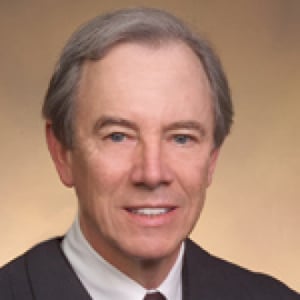
Professor Pierce is author of over twenty books and 130 articles on administrative law, government regulation, and the effects of various forms of government intervention on the performance of markets. His books and articles have been cited in hundreds of judicial opinions, including over a dozen opinions of the U.S. Supreme Court.
Laurence H. Silberman Chair in Constitutional Governance and Senior Fellow, American Enterprise Institute; Co-Director, Antonin Scalia Law School’s C. Boyden Gray Center for the Study of the Administrative State
Adam J. White is the Laurence H. Silberman Chair in Constitutional Governance and senior fellow at the American Enterprise Institute, where he focuses on the Supreme Court and the administrative state. Concurrently, he codirects the Antonin Scalia Law School’s C. Boyden Gray Center for the Study of the Administrative State.
Mr. White practiced constitutional and administrative law, particularly in the regulation of energy and financial markets. He started his legal career as a law clerk for Judge David B. Sentelle at the US Court of Appeals for the DC Circuit.
Mr. White has written for the Wall Street Journal, the New York Times, the Washington Post, National Affairs, Commentary, Harvard Journal of Law & Public Policy, and Notre Dame Law Review, among other publications. He is a regular contributor to the Yale Journal on Regulation’s Notice and Comment blog, and for many years, he was one of the Weekly Standard’s lead writers on constitutional law and the Supreme Court.
Mr. White has testified often before Congress, including before the Senate’s Committees on the Judiciary; Commerce, Science, and Transportation; and Homeland Security and Governmental Affairs and before the House’s Judiciary and Financial Services Committees. In 2018, the Senate Committee on the Judiciary called him to testify in Brett Kavanaugh’s Supreme Court confirmation hearings to advise senators on Kavanaugh’s approach to administrative law.
In 2021, he served on the Presidential Commission on the Supreme Court of the United States, where he criticized “Court packing” and other efforts to restructure the Supreme Court. In 2017, he was appointed to serve on the Administrative Conference of the United States. He also serves on the leadership council for the American Bar Association’s Administrative Law and Regulatory Practice Section, which he will chair in 2023–24. Before joining AEI, he was a research fellow at Stanford University’s Hoover Institution and an adjunct fellow at the Manhattan Institute.
Mr. White has a JD from Harvard Law School and a bachelor of business administration from the College of Business at the University of Iowa.
The Death of Contract and the Rise of Tort [Archive Collection]
1991 Annual Lawyers Convention
Washington, DCFamily Law and Individual Responsibility [Archive Collection]
1991 Annual Lawyers Convention
Washington, DCThe Judiciary and the Role of the Rule of Law [Archive Collection]
1990 National Lawyers Convention
New Orleans, LAPanel II: The First Amendment and National Security [Archive Collection]
Foreign Affairs and the Constitution
Washington, DCThe Great Debate: Attorney General Ed Meese III - November 15, 1985
Edwin Meese
Attorney General Edwin Meese III Before the DC Chapter of the Federalist Society Lawyers Division...
Necessary & Proper Episode 86: Why Congress
Bridget Dooling, Christopher J. Walker, Philip A. Wallach, Joel S. Nolette
In his recent book Why Congress, Dr. Phillip Wallach covers the past, present, and future of...
Necessary & Proper Episode 96: The Art of Deregulation: Executive Orders and Limited Government
Bridget Dooling, Susan E. Dudley, William C. Hughes, Richard J. Pierce, Adam White
Since taking office on January 20, 2025, President Trump has emphasized deregulation. Deregulatory efforts have...