
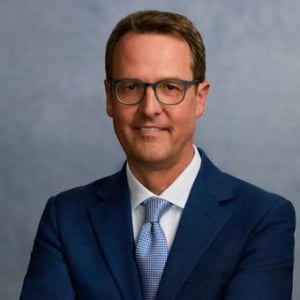
Partner, Orrick, Herrington & Sutcliffe LLP
Andy excels at solving complex problems for his clients using a variety of effective strategies. As former Chief Deputy Attorney General for the State of Wisconsin, Andy Cook has extensive experience representing businesses before state Attorneys General involving investigations and lawsuits. His strong relationships with Attorneys General and their senior staff frequently facilitate the successful resolution of client issues through diplomacy and negotiations. When litigation becomes necessary, Andy effectively advocates for clients throughout the litigation process.
Andy combines his legal expertise in numerous areas of law covered by state Attorneys General, an understanding of how state AG offices operate, and vast knowledge of legal and regulatory issues facing his clients. This substantive and comprehensive legal approach is crucial to effectively representing clients before state Attorneys General. Andy also has substantial experience drafting and enacting complex civil liability reforms before state legislatures to successfully address client goals.
Andy’s main practice focuses on advising Fortune 500 companies before state Attorneys General in the areas of antitrust, consumer protection, False Claims Act, environmental law, and cybersecurity and data privacy. Andy, in collaboration with a team of attorneys, successfully navigated a client through antitrust regulatory review by state Attorneys General in one of the nation’s largest mergers of two major telecommunication companies. Andy also worked with a team of lawyers representing a large corporation involving the multistate opioids litigation brought by state Attorneys General.
Andy gained valuable experience serving as Deputy Attorney General for the State of Wisconsin where he was the second in command of the 700-plus state agency. In his role as Chief Deputy Attorney General, Andy oversaw the day-to-day operations at the Wisconsin Department of Justice (DOJ); directed the State’s litigation strategy; negotiated, reviewed, and approved all settlements; drafted and reviewed attorney general opinions; managed the agency’s budget; oversaw civil and criminal investigations handled by DOJ; and managed DOJ’s legislative agenda.
Andy played college hockey and remains active by running, cross country skiing, and playing golf. On the weekends, Andy and his wife enjoy watching their kids’ sporting events, including soccer, baseball, gymnastics, and track. In his rare spare time, Andy reads history books.

Executive Vice President, The Federalist Society
Dean Reuter is Executive Vice President at the Federalist Society for Law and Public Policy Studies. He has served in two federal government agency Offices of the Inspector General, as Counsel to the Inspector General and Deputy Inspector General, responsible for policing the use of federal funds granted and contracted through those agencies. As such, he helped conduct and oversee criminal investigations across the country. He is the principal author of the non-fiction book, The Hidden Nazi: The Untold Story of America's Deal with the Devil, and editor of Liberty’s Nemesis: The Unchecked Expansion of the State and Confronting Terror: 9/11 and the Future of American National Security. He was appointed by the President and served as Vice-Chairman of the Board of Directors of the Corporation for National and Community Service, and recently served as an appointee on the U.S. Commission on Presidential Scholars. He is a graduate of Hood College (BA with Honors) and the University of Maryland School of Law.
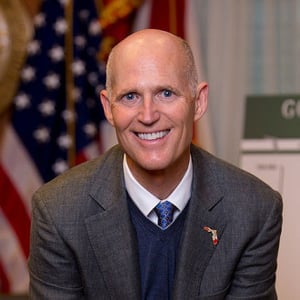
United States Senator, Florida
Rick Scott was elected to the U.S. Senate in 2018 and is currently serving his first term representing the state of Florida. Prior to his election to the U.S. Senate, Rick Scott served two terms as the 45th Governor of Florida, working every day to turn around Florida’s economy and secure the state’s future as the best place for families and businesses to succeed. Rick Scott grew up in public housing in the Midwest as his adoptive father, a World War II veteran and truck driver, and his mother, a store clerk, struggled to financially support their family. After marrying his high school sweetheart, Ann, Rick Scott joined the Navy, where he served active duty as a radar man aboard the USS Glover. He used the G.I. Bill to attend the University of Missouri, Kansas City, and eventually opened his first business – a donut shop. Rick Scott went on to run the world’s largest healthcare company and continues to fight every day so families across the state can have the same opportunities he had to live the American dream.
Rick Scott knows firsthand that a good paying job is one of the most important things for a family, and following Florida’s economic collapse ten years ago, he made the decision to run for governor as a businessman with no political experience. During his term as Governor, he successfully championed more than $10 billion in tax cuts and cut thousands of burdensome regulations that led Florida businesses to create nearly 1.7 million new jobs. Under his leadership, the unemployment rate dropped from 11 percent to 3.3 percent, Florida paid down $10 billion in state debt, and record investments were made in what matters most to Floridians – education, the environment, and public safety.
Rick Scott and his wife, Ann, have been married for 49 years and have two daughters, Allison and Jordan, six grandsons, Auguste, Quinton, Sebastian, Eli, Louie and Jude, and one granddaughter, Zelda Ann.
Executive Vice President, The Federalist Society
Dean Reuter is Executive Vice President at the Federalist Society for Law and Public Policy Studies. He has served in two federal government agency Offices of the Inspector General, as Counsel to the Inspector General and Deputy Inspector General, responsible for policing the use of federal funds granted and contracted through those agencies. As such, he helped conduct and oversee criminal investigations across the country. He is the principal author of the non-fiction book, The Hidden Nazi: The Untold Story of America's Deal with the Devil, and editor of Liberty’s Nemesis: The Unchecked Expansion of the State and Confronting Terror: 9/11 and the Future of American National Security. He was appointed by the President and served as Vice-Chairman of the Board of Directors of the Corporation for National and Community Service, and recently served as an appointee on the U.S. Commission on Presidential Scholars. He is a graduate of Hood College (BA with Honors) and the University of Maryland School of Law.
United States Senator, Florida
Rick Scott was elected to the U.S. Senate in 2018 and is currently serving his first term representing the state of Florida. Prior to his election to the U.S. Senate, Rick Scott served two terms as the 45th Governor of Florida, working every day to turn around Florida’s economy and secure the state’s future as the best place for families and businesses to succeed. Rick Scott grew up in public housing in the Midwest as his adoptive father, a World War II veteran and truck driver, and his mother, a store clerk, struggled to financially support their family. After marrying his high school sweetheart, Ann, Rick Scott joined the Navy, where he served active duty as a radar man aboard the USS Glover. He used the G.I. Bill to attend the University of Missouri, Kansas City, and eventually opened his first business – a donut shop. Rick Scott went on to run the world’s largest healthcare company and continues to fight every day so families across the state can have the same opportunities he had to live the American dream.
Rick Scott knows firsthand that a good paying job is one of the most important things for a family, and following Florida’s economic collapse ten years ago, he made the decision to run for governor as a businessman with no political experience. During his term as Governor, he successfully championed more than $10 billion in tax cuts and cut thousands of burdensome regulations that led Florida businesses to create nearly 1.7 million new jobs. Under his leadership, the unemployment rate dropped from 11 percent to 3.3 percent, Florida paid down $10 billion in state debt, and record investments were made in what matters most to Floridians – education, the environment, and public safety.
Rick Scott and his wife, Ann, have been married for 49 years and have two daughters, Allison and Jordan, six grandsons, Auguste, Quinton, Sebastian, Eli, Louie and Jude, and one granddaughter, Zelda Ann.
Partner, Bracewell & Giuliani LLP
Jason Hutt advises energy companies, manufacturers, project developers, investor groups and financial institutions about environmental risks and liabilities associated with regulatory compliance, project development, congressional investigations, internal investigations and corporate transactions. He also assists in the defense of administrative, civil and criminal proceedings involving environmental enforcement agencies at the federal and state levels.
Mr. Hutt counsels clients on current and upcoming regulatory developments at the nexus of environmental and energy policy, with focused attention on natural gas development (including hydraulic fracturing), responses to the Deepwater Horizon incident, and climate change. He is nationally recognized for his work on shale gas issues on behalf of producers, oil field services companies, hedge funds and technology developers.
Mr. Hutt routinely is involved in identifying, evaluating and managing environmental risks and opportunities associated with corporate acquisitions, divestitures and financings, including environmental due diligence, purchase and sale agreement negotiation, and post-closing integration efforts. Within the energy sector, his representative experience includes transactions involving petroleum refineries, liquefied natural gas (LNG) import terminals, renewable energy projects (e.g., wind, biofuels and geothermal), natural gas processing plants, cogeneration facilities, oil and gas wells, pipelines, propane retailers and synfuel facilities.
Representative work in other sectors involves operations and industries such as chemical manufacturers, oil field services, independent tank terminal operators, glass manufacturing, textiles manufacturing, uranium mining, industrial cleaning operations, hazardous waste management facilities, paper and plastic manufacturing facilities, and medical equipment manufacturing facilities.
Mr. Hutt performs environmental risk evaluations and advises on permit strategy and contract negotiation in relation to project development. His most recent work has involved onshore and offshore LNG import terminals, highway expansions, coal-fired power plant siting on tribal lands, utility privatizations at military bases, international undersea pipelines, interstate undersea electric transmission cables and a pump-storage project.
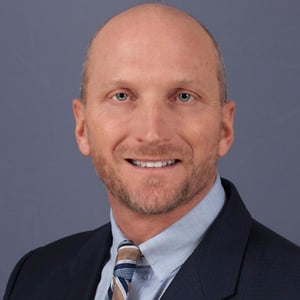
Distinguished Professor of Law, Widener University Delaware Law School
James R. May is Distinguished Professor of Law, and Chief Sustainability Officer, Widener University (USA). He also serves as co-Director of the Environmental Rights Institute and co-Director of the Dignity Rights Project at Widener University Delaware Law School. May is also an Adjunct Professor of Graduate Engineering, and founded and co-chairs a program on marine policy. May is the editor of Principles of Constitutional Environmental Law (American Bar Association), and co-editor of Shale Gas and the Future of Energy (Edward Elgar), Global Environmental Constitutionalism (Cambridge), Environmental Constitutionalism in Context (Edward Elgar), New Frontiers in Environmental Constitutionalism (United National Environment Programme, forthcoming), Implementing Environmental Constitutionalism(Cambridge, forthcoming), Standards of Environmental Constitutionalism (Cambridge, forthcoming), and Human Rights and the Environment: Indivisibility, Dignity and Legality (Edward Elgar, forthcoming). May is also author or co-author of more than 100 articles and book chapters, and numerous amicus briefs to the U.S. Supreme Court and U.S. federal courts of appeal on issues including environmental law, constitutional law, comparative constitutional, international environmental law, environmental rights, and human dignity.
May founded two non-profit environmental organizations (the Mid-Atlantic and the Eastern Environmental Law Centers), and has litigated more than 200 public interest environmental claims, including cases throughout the Mid-Atlantic to restore water and air quality, conserve rare species and habitats, and protect biodiversity.
May is a Member of Faculty to the National Judicial College, and a Fellow of the American College of Environmental Lawyers, for whom he has served as a delegate to Haiti and China. May has also served as a consultant to the U.S. Embassy on legal education in the Philippines, and to the Hungarian Embassy and the Moroccan Human Rights Council on constitutional reform. May is a member of Phi Kappa Phi, serves on numerous boards, and has won numerous awards, including from Pace University, Sierra Club, and the American Canoe Association. He earned his B.S. in Mechanical Engineering from the University of Kansas (Bowman Scholar), J.D. from the University of Kansas (Appellate Advocacy Scholar and national moot court champion), and LL.M. in Environmental Law from Pace University, where he was the Feldshuh Fellow and graduated first in class.
May is a member of the bar in the State of Pennsylvania, several federal courts of appeal, and the U.S. Supreme Court.
Associate Attorney, Sierra Club Environmental Law Program
Craig Segall started at the Sierra Club in 2008 as an environmental law fellow. Before coming to the Club, Craig was a law clerk to the Honorable Marsha S. Berzon of the U.S. Court of Appeals for the Ninth Circuit. He is a graduate of the University of Chicago and of Stanford Law School, where he spent most of his time in the basement working with Stanford's environmental law clinic. When not practicing law, Craig keeps busy outdoors. In recent years, he has barely beaten a 12-year-old to the top of Mount Whitney, accidentally driven transmission-deep into a salt lake, and, on an ill-advised hike in South Africa, provoked a surprisingly aggressive ostrich.
Judge, United States Court of Appeals, Tenth Circuit
Judge Tymkovich, of Denver, Colorado, was nominated to the Tenth Circuit Court of Appeals by President George W. Bush, and confirmed in April 2003. On October 1, 2015 he became Chief Circuit Judge and held this position until October 2022. He was Chair of the US Judicial Conference’s Committee on Judicial Resources from 2011 to 2015. Since 2008 he has been an adjunct professor of law at the University of Colorado School of Law, teaching Election Law. He is a member of the Doyle Inn of Court, the American Law Institute, and the International Society of Barristers. Since he joined the Circuit, Judge Tymkovich has hosted judicial delegations from Russia, Kazakhstan, and Afghanistan, and has also represented the United States in programs at Kiev and Yalta in Ukraine.
Partner, Bracewell & Giuliani LLP
Jason Hutt advises energy companies, manufacturers, project developers, investor groups and financial institutions about environmental risks and liabilities associated with regulatory compliance, project development, congressional investigations, internal investigations and corporate transactions. He also assists in the defense of administrative, civil and criminal proceedings involving environmental enforcement agencies at the federal and state levels.
Mr. Hutt counsels clients on current and upcoming regulatory developments at the nexus of environmental and energy policy, with focused attention on natural gas development (including hydraulic fracturing), responses to the Deepwater Horizon incident, and climate change. He is nationally recognized for his work on shale gas issues on behalf of producers, oil field services companies, hedge funds and technology developers.
Mr. Hutt routinely is involved in identifying, evaluating and managing environmental risks and opportunities associated with corporate acquisitions, divestitures and financings, including environmental due diligence, purchase and sale agreement negotiation, and post-closing integration efforts. Within the energy sector, his representative experience includes transactions involving petroleum refineries, liquefied natural gas (LNG) import terminals, renewable energy projects (e.g., wind, biofuels and geothermal), natural gas processing plants, cogeneration facilities, oil and gas wells, pipelines, propane retailers and synfuel facilities.
Representative work in other sectors involves operations and industries such as chemical manufacturers, oil field services, independent tank terminal operators, glass manufacturing, textiles manufacturing, uranium mining, industrial cleaning operations, hazardous waste management facilities, paper and plastic manufacturing facilities, and medical equipment manufacturing facilities.
Mr. Hutt performs environmental risk evaluations and advises on permit strategy and contract negotiation in relation to project development. His most recent work has involved onshore and offshore LNG import terminals, highway expansions, coal-fired power plant siting on tribal lands, utility privatizations at military bases, international undersea pipelines, interstate undersea electric transmission cables and a pump-storage project.
Distinguished Professor of Law, Widener University Delaware Law School
James R. May is Distinguished Professor of Law, and Chief Sustainability Officer, Widener University (USA). He also serves as co-Director of the Environmental Rights Institute and co-Director of the Dignity Rights Project at Widener University Delaware Law School. May is also an Adjunct Professor of Graduate Engineering, and founded and co-chairs a program on marine policy. May is the editor of Principles of Constitutional Environmental Law (American Bar Association), and co-editor of Shale Gas and the Future of Energy (Edward Elgar), Global Environmental Constitutionalism (Cambridge), Environmental Constitutionalism in Context (Edward Elgar), New Frontiers in Environmental Constitutionalism (United National Environment Programme, forthcoming), Implementing Environmental Constitutionalism(Cambridge, forthcoming), Standards of Environmental Constitutionalism (Cambridge, forthcoming), and Human Rights and the Environment: Indivisibility, Dignity and Legality (Edward Elgar, forthcoming). May is also author or co-author of more than 100 articles and book chapters, and numerous amicus briefs to the U.S. Supreme Court and U.S. federal courts of appeal on issues including environmental law, constitutional law, comparative constitutional, international environmental law, environmental rights, and human dignity.
May founded two non-profit environmental organizations (the Mid-Atlantic and the Eastern Environmental Law Centers), and has litigated more than 200 public interest environmental claims, including cases throughout the Mid-Atlantic to restore water and air quality, conserve rare species and habitats, and protect biodiversity.
May is a Member of Faculty to the National Judicial College, and a Fellow of the American College of Environmental Lawyers, for whom he has served as a delegate to Haiti and China. May has also served as a consultant to the U.S. Embassy on legal education in the Philippines, and to the Hungarian Embassy and the Moroccan Human Rights Council on constitutional reform. May is a member of Phi Kappa Phi, serves on numerous boards, and has won numerous awards, including from Pace University, Sierra Club, and the American Canoe Association. He earned his B.S. in Mechanical Engineering from the University of Kansas (Bowman Scholar), J.D. from the University of Kansas (Appellate Advocacy Scholar and national moot court champion), and LL.M. in Environmental Law from Pace University, where he was the Feldshuh Fellow and graduated first in class.
May is a member of the bar in the State of Pennsylvania, several federal courts of appeal, and the U.S. Supreme Court.
Associate Attorney, Sierra Club Environmental Law Program
Craig Segall started at the Sierra Club in 2008 as an environmental law fellow. Before coming to the Club, Craig was a law clerk to the Honorable Marsha S. Berzon of the U.S. Court of Appeals for the Ninth Circuit. He is a graduate of the University of Chicago and of Stanford Law School, where he spent most of his time in the basement working with Stanford's environmental law clinic. When not practicing law, Craig keeps busy outdoors. In recent years, he has barely beaten a 12-year-old to the top of Mount Whitney, accidentally driven transmission-deep into a salt lake, and, on an ill-advised hike in South Africa, provoked a surprisingly aggressive ostrich.
Judge, United States Court of Appeals, Tenth Circuit
Judge Tymkovich, of Denver, Colorado, was nominated to the Tenth Circuit Court of Appeals by President George W. Bush, and confirmed in April 2003. On October 1, 2015 he became Chief Circuit Judge and held this position until October 2022. He was Chair of the US Judicial Conference’s Committee on Judicial Resources from 2011 to 2015. Since 2008 he has been an adjunct professor of law at the University of Colorado School of Law, teaching Election Law. He is a member of the Doyle Inn of Court, the American Law Institute, and the International Society of Barristers. Since he joined the Circuit, Judge Tymkovich has hosted judicial delegations from Russia, Kazakhstan, and Afghanistan, and has also represented the United States in programs at Kiev and Yalta in Ukraine.
Professor of Law, Antonin Scalia Law School, George Mason University
Professor of Law Michael S. Greve joined the faculty of the Antonin Scalia Law School, George Mason University in fall 2012 after having served as John G. Searle Scholar at the American Enterprise Institute (AEI), where he specialized in constitutional law, courts, and business regulation and served as chairman of the Competitive Enterprise Institute. Prior to joining AEI, Greve was founder and co-director of the Center for Individual Rights, a public interest law firm specializing in constitutional litigation.
Greve has served previously as an adjunct professor at a number of universities, including Cornell and Johns Hopkins Universities, and has been a visiting professor at Boston College since 2004. He was awarded a PhD and an MA in government by Cornell University. Greve also earned a Diploma from the University of Hamburg in Germany.
A prolific writer, Greve is the author of nine books and a multitude of articles appearing in scholarly publications, as well as numerous editorials, short articles, and book reviews. He is a frequent speaker for professional and scholarly organizations and has made many appearances on radio and television.
In addition Greve has provided congressional and state legislative testimony, has lobbied and consulted in federal agency proceedings, and has provided litigation services and management in over 30 cases, including matters before the U.S. Supreme Court.
Executive Vice President and Senior Counselor to the President, The Federalist Society for Law and Public Policy Studies
B.A., Yale; J.D., University of Chicago. Lee Liberman Otis is the Executive Vice President and Senior Counselor to the President at the Federalist Society. She also serves as a member of the American Law Institute (ALI), a senior fellow of the Administrative Conference (ACUS), and as the co-chair of the National Constitution Center's Coalition of Freedom Advisory Board. She previously was a special assistant and an Associate Deputy Attorney General at the U.S. Department of Justice, General Counsel of the Department of Energy, an associate in the appellate section of Jones, Day, Reavis & Pogue, an associate counsel to President George H.W. Bush, and a law clerk to Associate Justice Antonin Scalia. She also served as an assistant professor of law at George Mason, where she taught legislation, federal jurisdiction, constitutional law, civil procedure, and appellate advocacy. Ms. Otis has been an important member of the Federalist Society team since the organization’s beginnings. Together with David McIntosh, she led the effort to start what became the Chicago chapter of the Society. She also helped organize the Society’s first conference at Yale, its second conference at Chicago, and its first Lawyers Division chapter in Washington DC, as well as the effort to incorporate the Society, recruit its permanent staff, and obtain its early funding. She was a Founding Director of the Federalist Society.
Director of Policy and Special Counsel, AFL-CIO
Damon A. Silvers is the Director of Policy and Special Counsel for the AFL-CIO. He joined the AFL-CIO as Associate General Counsel in 1997.
Mr. Silvers serves on a pro bono basis as a Special Assistant Attorney General for the state of New York. Mr. Silvers is also a member of the Investor Advisory Committee of the Securities and Exchange Commission, the Treasury Department’s Financial Research Advisory Committee, the Public Company Accounting Oversight Board’s Standing Advisory Group and its Investor Advisory Group.
Mr. Silvers served as the Deputy Chair of the Congressional Oversight Panel for TARP from 2008 to 2011. Between 2006 and 2008, Mr. Silvers served as the Chair of the Competition Subcommittee of the United States Treasury Department Advisory Committee on the Auditing Profession and as a member of the United States Treasury Department Investor’s Practice Committee of the President’s Working Group on Financial Markets.
Prior to working for the AFL-CIO, Mr. Silvers worked for the Harvard Union of Clerical and Technical Workers, the Amalgamated Clothing and Textile Workers, and as a law clerk at the Delaware Court of Chancery for Chancellor William T. Allen and Vice-Chancellor Bernard Balick.
S. Samuel Arsht Professor of Corporate Law, University of Pennsylvania Law School
David Skeel is the Caryl Louise Boies Visiting Professor of Law at New York University, and the S. Samuel Arsht Professor of Corporate Law at the University of Pennsylvania. He is the author of The New Financial Deal: Understanding the Dodd-Frank Act and its (Unintended) Consequences (Wiley, 2011); Icarus in the Boardroom: The Fundamental Flaws in Corporate America and Where They Came From (Oxford University Press, 2005); Debt’s Dominion: A History of Bankruptcy Law in America (Princeton University Press, 2001); and numerous articles on bankruptcy, corporate law, financial regulation, Christianity and law, and other topics. Professor Skeel has also written commentaries for the New York Times, Wall Street Journal, Books & Culture, The Weekly Standard, and other publications.
Professor of Law, High Point School of Law
Scott Gaylord directs High Point Law’s Appellate Litigation Clinic and serves as a Professor of Law, teaching Constitutional Law and related upper-level elective courses. The Appellate Clinic works with students to write and file briefs in significant court cases, including appeals before the United States Supreme Court.
Professor Gaylord is a prominent Constitutional Law scholar with an impressive background in both academia and legal practice. He has authored or co-authored 18 substantial law review articles, co-authored a Constitutional Law casebook, and has written more than 35 amicus briefs to the U.S. Supreme Court and federal circuit courts on prominent national cases involving religious liberty and free speech. He is a frequent speaker on constitutional law and First Amendment topics at law schools across the country and has regularly provided commentary on ongoing constitutional issues to national media outlets, including th eNew York Times, USA Today, the Diane Rehm Show, NPR, The National Constitution Center, and Bloomberg Law.
Professor Gaylord also started an appellate advocacy clinic at his former law school and currently serves on the North Carolina Chief Justice’s Commission on Professionalism, along with holding many other service and leadership roles. Prior to joining the academy in 2007, he practiced complex civil and commercial litigation with the Charlotte firm of Robinson Bradshaw & Hinson, and he clerked for Judge Edith H. Jones on the United States Court of Appeals for the Fifth Circuit.
Professor Gaylord earned his B.A. in philosophy and English, summa cum laude, from Colgate University, his Ph.D. in philosophy from the University of North Carolina at Chapel Hill, and his J.D. from Notre Dame Law School, where he also graduated summa cum laude.
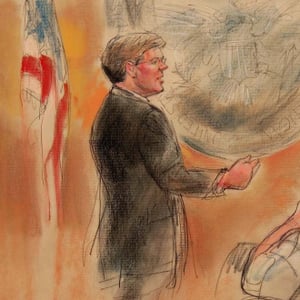
Partner, Neilson Law Group P.C.
C. Thomas Ludden is the head of the Appellate Practice group at Lipson Neilson P.C. He has appeared before the United States Supreme Court, the Michigan Supreme Court, the Sixth and Ninth Circuit Courts of Appeal and the Michigan Court of Appeals. Mr. Ludden is a 1990 graduate of the University of Michigan (J.D./M.B.A) and a 1986 graduate of Dickinson College (B.A.) where he majored in Latin, Ancient Greek and Economics.
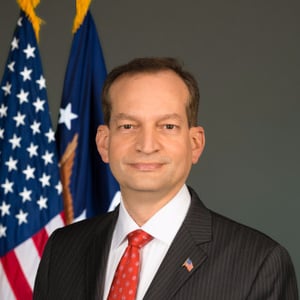
Former Secretary; U.S. Department of Labor
Rene Alexander Acosta is an American attorney and politician, who served as the 27th United States Secretary of Labor from 2017 to 2019.
Secretary Acosta is the son of Cuban refugees, a native of Miami, and first-generation college graduate. He earned his undergraduate and law degrees from Harvard University.
Following law school, he worked as a law clerk for Justice Samuel A. Alito, Jr., at the U.S. Court of Appeals for the Third Circuit. He then worked at the law firm of Kirkland & Ellis and went on to teach at George Mason University’s Antonin Scalia School of Law.
Secretary Acosta has served in three presidentially appointed, Senate-confirmed positions. In 2002, he was appointed to serve as a member of the National Labor Relations Board, where he participated in or authored more than 125 opinions. In 2003, he was appointed Assistant Attorney General for the Civil Rights Division of the U.S. Department of Justice, and from 2005 to 2009 he served as the U.S. Attorney for the Southern District of Florida.
Prior to his tenure at the Department of Labor, Secretary Acosta served as the dean of the FIU College of Law.
Secretary Acosta has twice been named one of the nation’s 50 most influential Hispanics by Hispanic Business magazine. He was also named to the list of 100 most influential individuals in business ethics in 2008. In 2013, the South Florida Hispanic Chamber of Commerce presented him with the Chairman’s Higher Education Award in recognition of his “outstanding achievements, leadership and determination throughout a lifetime of caring and giving back to the community.”
Secretary Acosta and his wife enjoy spending time together as a family, raising their two daughters.

Milton R. Underwood Chair in Free Enterprise, Vanderbilt University Law School
Brian Fitzpatrick is the Milton R. Underwood Chair in Free Enterprise and Professor of Law at Vanderbilt Law School, where his research focuses on class action litigation, federal courts, judicial selection, and constitutional law. He is best known for his empirical studies of class action settlements as well as his book The Conservative Case for Class Actions (University of Chicago Press, 2019). Professor Fitzpatrick joined Vanderbilt's law faculty in 2007 after serving as the John M. Olin Fellow at New York University School of Law. He graduated first in his class from Harvard Law School and went on to clerk for Judge Diarmuid O'Scannlain on the U.S. Court of Appeals for the Ninth Circuit and Justice Antonin Scalia on the U.S. Supreme Court. After his clerkships, Professor Fitzpatrick practiced commercial and appellate litigation for several years at Sidley Austin in Washington, D.C., and served as Special Counsel for Supreme Court Nominations to U.S. Senator John Cornyn. Before earning his law degree, Fitzpatrick graduated summa cum laude with a bachelor's of science in chemical engineering from the University of Notre Dame. He has received the Hall-Hartman Outstanding Professor Award, which recognizes excellence in classroom teaching, for his Civil Procedure and Federal Courts courses.
Shareholder, Jones Foster Johnson & Stubbs PA
Scott Hawkins, the firm's Vice-Chair (and Shareholder since 1990) and the President of The Florida Bar (2011 - 2012), is Florida Bar Board Certified in Business Litigation and practices commercial litigation with an emphasis on intellectual property, trade secret disputes, covenants not to compete and real estate litigation. He also has significant civil and administrative litigation experience in areas involving environmental and land use disputes and disputes involving claims arising under ERISA Plans. His clients include technology companies (internet technology, software development, pharmaceutical product development), major property land owners and insurance companies. Mr. Hawkins graduated the University of Florida in 1980 with a degree in Economics, with honors, earned his J.D. from the University of Florida in 1983, and graduated with his Masters of Business Administration from the University of Edinburgh, Scotland as a Rotary International Foundation Scholar.
A member of the ABA House of Delegates, Mr. Hawkins is a former President of the Palm Beach County Bar Association. He was awarded Palm Beach Atlantic University’s American Free Enterprise Day Companion Medal in 2003. Mr. Hawkins was named "Most Productive Young Lawyer" by The Florida Bar's Young Lawyers Section in 1995. He is listed as aCorporate Counsel Super Lawyer and a Florida Super Lawyerby Law & Politics Super Lawyers Magazine;and is listed inThe Best Lawyers in America (designated a Bet the Company Litigator). Mr. Hawkins also has been recognized as one of the Top Lawyers in South Floridaby the South Florida Legal Guide and listed as one of Florida Trend Magazine's Legal Elite.
Owner, The Knight Law Firm
A lawyer since 1981, Mr. Knight is rated AV by Martindale-Hubbell. Mr. Knight has vast experience in complex litigation, corporate law, and international transactions. He practices in the fields of Aviation, Bankruptcy, Corporate, Commercial, and International Law. He also handles luxury car and RV Lemon Law claims.
Prior to founding his own firm in 1992, he was with the venerable Miami firms Walton Lantaff and Blackwell Walker. He has represented financial institutions, manufacturers, air carriers, repair stations, and wealthy investors from the US, Europe, Latin America, the Middle East, and the Far East.
He is admitted to practice before the United States Supreme Court, the Eleventh Circuit Court of Appeals, and in all three Federal District and Bankruptcy Courts in Florida.
Mr. Knight graduated in 1981 from the University of Miami School of Law, where he served as the Executive Editor of the International Law Journal. During law school he clerked with the Equal Employment Opportunity Commission.
He earned a B.A. degree from Vanderbilt University in 1978, with majors in Philosophy, Political Science, and Spanish, as well as minors in French and History. Also during his undergraduate years, he attended the Universidad Complutense of Madrid, Spain, Georgetown University, and Vanderbilt's institute at Aix-en-Provence, France.
Mr. Knight is licensed to pilot both helicopters and airplanes. In addition to flying, his interests include karate, skiing, hunting, fishing and military history. He is a member of the Miami Rotary Club.
Mr. Knight has lectured on "Aircraft and Engine Liens in and out of Bankruptcy Court" (Miami Aircraft Maintenance Council, May 2001) "Election Law Ethics" (RNLA, Orlando, June 2004), "Fundamentals of Election Law" (RNLA, Orlando, January 2006), "The Help America Vote Act" (RNLA, Miami, September 2008), Moderator RNLA Florida Election Law School, Orlando, September 2010.
Mr. Knight served as Chair of the RNLA's Florida Chapter from the April 2004 through April 2006, and as Co-Chair from April 2006 until April 2009. In June 2004 he was the Director of and organized RNLA's first Florida Election Law School. During the 2002 election cycle he was a member of the Miami-Dade County Legal Team's Executive Committee. In 2000 he served as a member of the Bush-Cheney "Recount" Team.

Tort Reform Update: Recently Enacted Legislative Reforms and State Court Challenges
Andrew Cook
State Courts White Paper
Introduction Since the 2010 elections altered the makeup of many state legislative and executive branches,...
Address by Governor Rick Scott
Dean Reuter, Rick Scott
2012 National Lawyers Convention
Governor Rick Scott of Florida addressed attendees of the Federalist Society's 2012 National Lawyers Convention...
Address by Governor Rick Scott
Dean Reuter, Rick Scott
2012 National Lawyers Convention
Governor Rick Scott of Florida addressed attendees of the Federalist Society's 2012 National Lawyers Convention...
Environmental Law: Federalism and the Energy Revolution: Can State and Federal Regulators Adapt to Innovations?
Jason B. Hutt, James R. May, Craig Segall, Timothy M. Tymkovich
2012 National Lawyers Convention
The Environmental Law & Property Rights Practice Group hosted this panel on "Federalism and the...
Environmental Law: Federalism and the Energy Revolution: Can State and Federal Regulators Adapt to Innovations?
Jason B. Hutt, James R. May, Craig Segall, Timothy M. Tymkovich
2012 National Lawyers Convention
The Environmental Law & Property Rights Practice Group hosted this panel on "Federalism and the...
When States Go Broke
Michael S. Greve, E McMahon, Lee Liberman Otis, Damon A. Silvers, David Skeel
Faculty Division
Extraordinary and sometimes crippling levels of debt have plagued American states in recent years. State...
A Review of the Florida Supreme Court: 2000-2012
Elizabeth Price Foley
State Courts Project White Paper
On November 6, 2012, Floridians will vote on the retention of three justices of the...
The Effect of Super PACs on North Carolina Judicial Elections
Scott W. Gaylord
This November, North Carolinians will have the opportunity to select one person to serve an...
Textualism and the Michigan Supreme Court
C. Thomas Ludden
In this white paper, the author analyzes selected Michigan Supreme Court cases interpreting the Michigan...
35 Years of Retention Elections of Appellate Court Judges in Florida: Has the System Measured Up?
R. Alexander Acosta, Brian T. Fitzpatrick, Scott Hawkins, Jefferson P. Knight
Miami Lawyers Chapter
On September 11, 2012, the Miami Lawyers Chapter hosted a debate on "35 Years of...