
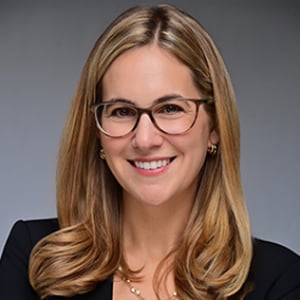
Partner, Clement & Murphy
A seasoned trial and appellate advocate, Danielle Sassoon represents individuals and corporations in high-stakes white-collar, appellate, and commercial matters. Danielle joined the firm after serving as interim United States Attorney for the Southern District of New York, following over eight years as an Assistant United States Attorney. During her time at the SDNY, Danielle handled some of the Office’s most sensitive and consequential cases. As Chief of Appeals for the Criminal Division, Danielle supervised and argued dozens of appeals before the U.S. Court of Appeals for the Second Circuit. As a leader in the SDNY, Danielle oversaw hundreds of cases, advised on complex legal and strategic issues, and managed over 200 lawyers across the SDNY’s civil and criminal divisions.
As a prosecutor, Danielle handled high-profile investigations and criminal trials, including against Samuel Bankman-Fried, for perpetrating a multi-billion-dollar cryptocurrency fraud, and against Lawrence Ray, for racketeering conspiracy, sex trafficking, and other offenses related to his abuse and exploitation of his daughter’s college roommates. As a prosecutor, Danielle was awarded the FBI Director’s Award for Outstanding Criminal Investigation and the Women in Federal Law Enforcement Top Prosecutor Award.
Following law school, Danielle clerked for Judge J. Harvie Wilkinson III of the U.S. Court of Appeals for the Fourth Circuit and for Associate Justice Antonin Scalia of the U.S. Supreme Court.
Danielle serves as a Senior Fellow at the Manhattan Institute.
U.S. Court of Appeals, Ninth Circuit
Jay Scott Bybee is a federal judge on the United States Court of Appeals for the Ninth Circuit. He has published numerous articles in law journals and has taught in law school. His primary research interests are in constitutional and administrative law.
Interim Dean; SUNY Distinguished Professor; Bridget and Thomas B, University at Buffalo School of Law
On December, 2014, SUNY Distinguished Professor James A. Gardner was named interim dean by Provost Charles F. Zukoski.
A member of the law faculty since 2001, Gardner is a highly regarded specialist in constitutional and election law. He is a prolific scholar who has published six books, as well as numerous book chapters, articles and review essays. Gardner recently was recognized as one of the 10 most frequently cited scholars in the field of election law by Election Law blog.
He has served as the director of the law school’s Jaeckle Center for Law, Democracy, and Governance and formerly served as the school’s vice dean for academic affairs, 2005-2012.
Gardner has served as the elected chair of the School of Law’s ad hoc Strategic Planning Committee, which was charged with evaluating the current state of the school and identifying strategies to preserve and enhance its strengths moving forward.
His most recent publications include Election Law in the American Political System (Aspen), What Are Campaigns For? The Role of Persuasion in Electoral Law and Politics (Oxford University Press) and a new revision of his Legal Argument: The Structure and Language of Effective Advocacy (LexisNexis).
He has taught at Western New England University, William and Mary, the University of Connecticut and Florida State University, and in 2012 held the Fulbright Visiting Research Chair in the Theory and Practice of Constitutionalism and Federalism at McGill University in Montreal.
Gardner received his BA from Yale University in 1980 and his J.D. from the University of Chicago in 1984. From 1984 to 1988, he practiced law in the Civil Division of the U.S. Department of Justice in Washington, D.C.

Former President & CEO, The Federalist Society for Law and Public Policy Studies
Eugene B. Meyer, former President and CEO of the Federalist Society, has served as Executive Director, CEO, and/or President of the organization for more than 40 years. He is responsible for shepherding the organization from a small group of law students to a community of 90,000 lawyers, law students, academics, judges, and others interested in the rule of law. The Society now includes a Student Chapter at nearly every ABA-accredited law school in the country and Lawyers Chapters in 220 major cities across the nation. Gene earned his B.A. in history at Yale in 1975 and his M.A. in political science from the London School of Economics in 1976. Gene currently serves on the boards of the U.S. Chess Center, the Holman Foundation, the Sarah Scaife Foundation, and the advisory board of the Adam Smith Society. He holds the title of International Chess Master.
Associate Professor and Associate Director, Rose Institute of St, Claremont McKenna College
Dr. Ken Miller became Associate Director of the Rose Institute in 2009. He has served as a member of CMC’s Government faculty since 2003. Dr. Miller’s research focuses on state government institutions, with emphasis on direct democracy (initiative, referendum, and recall) and the interaction between law and politics. His publications include Direct Democracy and the Courts (Cambridge University Press 2009) and a co-edited volume The New Political Geography of California(Berkeley Public Policy Press 2008). Dr. Miller has worked with Rose Institute students on several research projects, including the 24-state Miller-Rose Institute Initiative Database. Dr. Miller returns this year after a year-long sabbatical at Princeton University in Princeton, New Jersey.
Professor of Law, Notre Dame Law School
Professor Derek Muller is a nationally-recognized scholar in the field of election law. His research focuses on the role of states in the administration of federal elections, the constitutional contours of voting rights and election administration, the limits of judicial power in the domain of elections, and the Electoral College.
He has published more than two dozen academic works, and his op-eds have appeared in the New York Times, the Los Angeles Times, and the Wall Street Journal. He has testified before Congress, and he is a contributor at the Election Law Blog. He is a co-author on a Federal Courts casebook published by Carolina Academic Press. He is also the co-reporter on a new Restatement of the Law, Election Litigation, an effort led by the American Law Institute.
Professor Muller teaches Election Law, Civil Procedure, and Evidence.
U.S. Court of Appeals, Ninth Circuit
Jay Scott Bybee is a federal judge on the United States Court of Appeals for the Ninth Circuit. He has published numerous articles in law journals and has taught in law school. His primary research interests are in constitutional and administrative law.
Interim Dean; SUNY Distinguished Professor; Bridget and Thomas B, University at Buffalo School of Law
On December, 2014, SUNY Distinguished Professor James A. Gardner was named interim dean by Provost Charles F. Zukoski.
A member of the law faculty since 2001, Gardner is a highly regarded specialist in constitutional and election law. He is a prolific scholar who has published six books, as well as numerous book chapters, articles and review essays. Gardner recently was recognized as one of the 10 most frequently cited scholars in the field of election law by Election Law blog.
He has served as the director of the law school’s Jaeckle Center for Law, Democracy, and Governance and formerly served as the school’s vice dean for academic affairs, 2005-2012.
Gardner has served as the elected chair of the School of Law’s ad hoc Strategic Planning Committee, which was charged with evaluating the current state of the school and identifying strategies to preserve and enhance its strengths moving forward.
His most recent publications include Election Law in the American Political System (Aspen), What Are Campaigns For? The Role of Persuasion in Electoral Law and Politics (Oxford University Press) and a new revision of his Legal Argument: The Structure and Language of Effective Advocacy (LexisNexis).
He has taught at Western New England University, William and Mary, the University of Connecticut and Florida State University, and in 2012 held the Fulbright Visiting Research Chair in the Theory and Practice of Constitutionalism and Federalism at McGill University in Montreal.
Gardner received his BA from Yale University in 1980 and his J.D. from the University of Chicago in 1984. From 1984 to 1988, he practiced law in the Civil Division of the U.S. Department of Justice in Washington, D.C.
Former President & CEO, The Federalist Society for Law and Public Policy Studies
Eugene B. Meyer, former President and CEO of the Federalist Society, has served as Executive Director, CEO, and/or President of the organization for more than 40 years. He is responsible for shepherding the organization from a small group of law students to a community of 90,000 lawyers, law students, academics, judges, and others interested in the rule of law. The Society now includes a Student Chapter at nearly every ABA-accredited law school in the country and Lawyers Chapters in 220 major cities across the nation. Gene earned his B.A. in history at Yale in 1975 and his M.A. in political science from the London School of Economics in 1976. Gene currently serves on the boards of the U.S. Chess Center, the Holman Foundation, the Sarah Scaife Foundation, and the advisory board of the Adam Smith Society. He holds the title of International Chess Master.
Associate Professor and Associate Director, Rose Institute of St, Claremont McKenna College
Dr. Ken Miller became Associate Director of the Rose Institute in 2009. He has served as a member of CMC’s Government faculty since 2003. Dr. Miller’s research focuses on state government institutions, with emphasis on direct democracy (initiative, referendum, and recall) and the interaction between law and politics. His publications include Direct Democracy and the Courts (Cambridge University Press 2009) and a co-edited volume The New Political Geography of California(Berkeley Public Policy Press 2008). Dr. Miller has worked with Rose Institute students on several research projects, including the 24-state Miller-Rose Institute Initiative Database. Dr. Miller returns this year after a year-long sabbatical at Princeton University in Princeton, New Jersey.
Professor of Law, Notre Dame Law School
Professor Derek Muller is a nationally-recognized scholar in the field of election law. His research focuses on the role of states in the administration of federal elections, the constitutional contours of voting rights and election administration, the limits of judicial power in the domain of elections, and the Electoral College.
He has published more than two dozen academic works, and his op-eds have appeared in the New York Times, the Los Angeles Times, and the Wall Street Journal. He has testified before Congress, and he is a contributor at the Election Law Blog. He is a co-author on a Federal Courts casebook published by Carolina Academic Press. He is also the co-reporter on a new Restatement of the Law, Election Litigation, an effort led by the American Law Institute.
Professor Muller teaches Election Law, Civil Procedure, and Evidence.

Patrick Hotung Professor of Constitutional Law, Georgetown University Law Center; Faculty Director, Georgetown Center for the Constitution
Randy E. Barnett is the Patrick Hotung Professor of Constitutional Law at the Georgetown University Law Center and is the Faculty Director of the Georgetown Center for the Constitution. After graduating from Northwestern University and Harvard Law School, he tried many felony cases as a prosecutor in the Cook County States’ Attorney’s Office in Chicago. A recipient of a Guggenheim Fellowship in Constitutional Studies and the Bradley Prize, Professor Barnett has been a visiting professor at Penn, Northwestern and Harvard Law School.
Professor Barnett’s publications includes thirteen books, more than one hundred articles and reviews, as well as numerous op-eds. His most recent book is Felony Review: Tales of True Crime and Corruption in Chicago (2026). His other books on the Constitution include: A Life for Liberty: The Making of an American Originalist (2024); The Original Meaning of the Fourteenth Amendment: Its Letter and Spirit (2021) (with Evan Bernick); An Introduction to Constitutional Law: 100 Supreme Court Cases Everyone Should Know (2019) (with Josh Blackman); Restoring the Lost Constitution: The Presumption of Liberty (2nd ed. 2013); Our Republican Constitution: Securing the Liberty and Sovereignty of We the People (2016); and Constitutional Law: Cases in Context (5th ed. forthcoming 2027) (with Josh Blackman). His books on contracts are The Oxford Introductions to U.S. Law: Contracts (2010) and Contracts: Cases and Doctrine (7th ed. 2021) (with Nate Oman). And he is the author of The Structure of Liberty: Justice and the Rule of Law (2nd ed. 2014).
In 2004, he argued the medical marijuana case of Gonzalez v. Raich before the U.S. Supreme Court. In 2012, he was one of the lawyers representing the National Federation of Independent Business in its constitutional challenge to the Affordable Care Act in NFIB v. Sebelius. He’s appeared in numerous documentaries and portrayed a prosecutor in the 2010 science-fiction feature film, InAlienable: The Movie. On X he is @RandyEBarnett
Associate Professor of Law, Notre Dame Law School
Professor and D’Alemberte Chair in Constitutional Law, Florida State University College of Law
Alexander Tsesis is the D’Alemberte chair in constitutional law at the Florida State University College of Law. He is also the general editor of the Cambridge Studies on Civil Rights and Civil Liberties and the Oxford Theoretical Foundations in Law. Tsesis’ scholarship and teaching focus on a breadth of subjects, including constitutional law, civil rights, constitutional reconstruction, interpretive methodology, free speech theory, and legal history.
Tsesis’ most recent book is Free Speech in the Balance (Cambridge University Press 2020). His previous books include Constitutional Ethos: Liberal Equality for the Common Good (Oxford University Press 2017) and For Liberty and Equality: The Life and Times of the Declaration of Independence (Oxford University Press 2012), We Shall Overcome: A History of Civil Rights and the Law (Yale University Press 2008), The Thirteenth Amendment and American Freedom (New York University Press 2004), and Destructive Messages: How Hate Speech Paved the Way for Harmful Social Movements (New York University Press 2002). He also edited a collection of essays in Promises of Liberty (Columbia University Press 2010). The subjects of his articles range from cyber speech, constitutional interpretation, civil rights law, and human rights. They have appeared or will appear in a variety of law reviews across the country, including the Boston University Law Review, Columbia Law Review, Cornell Law Review, Minnesota Law Review, Northwestern University Law Review, Southern California Law Review, Stanford Law Review, and Vanderbilt Law Review.
Associate Professor of Law,, St. Thomas University College of Law

Topics
Bauer v. Becerra
In Bauer v. Becerra, the Ninth Circuit Court of Appeals upheld a $5.00 fee on...
The Decades of Our Discontent: Judge J. Harvie Wilkinson III Reflects on the Sixties and Today
Danielle Sassoon
Federalist Society Review, Volume 18
A Review of: All Falling Faiths: Reflections on the Promise & Failure of the 1960s,...
Topics
"Uncommonly Silly"—and Correctly Decided: The Right and Wrong of Griswold v. Connecticut and Why It Matters Today
It is one of the Supreme Court’s most consequential and controversial decisions, and no one should...
Topics
Montana Legislature Passes Joint Resolution Declaring New ABA Rule 8.4(G) Unconstitutional
In October 2016, the Supreme Court of Montana proposed the adoption of ABA Rule of...
Topics
Racial Impact Statement Laws in New Jersey and Elsewhere
On February 27, 2017, the New Jersey Assembly Law and Public Safety Committee reported favorably on Senate Bill...
Topics
Does Title II of the Civil Rights Act prohibit racially disparate impacts?
Our civil rights laws are designed to prohibit discrimination on the basis of certain traits....
Topics
Fourth Circuit misinterprets Supreme Court 2nd Amendment precedent
In Kolbe v. Hogan, the Fourth Circuit, sitting en banc, became the first Federal Circuit...
Forty Years Later: The Brennan Article and State Constitutions
Jay S. Bybee, James A. Gardner, Eugene B. Meyer, Kenneth P. Miller, Derek T. Muller
2017 Annual Western Chapters Conference
In 1977, the publication of Justice William Brennan’s article, “State Constitutions and the Protection of...
Forty Years Later: The Brennan Article and State Constitutions
Jay S. Bybee, James A. Gardner, Eugene B. Meyer, Kenneth P. Miller, Derek T. Muller
2017 Annual Western Chapters Conference
In 1977, the publication of Justice William Brennan’s article, “State Constitutions and the Protection of...
The Thirteenth Amendment 150 Years Later
Randy E. Barnett, Jennifer Mason McAward, Alexander Tsesis, David Upham
19th Annual Faculty Conference
December 2015 marked 150 years since the ratification of the Thirteenth Amendment—an occasion of singular...