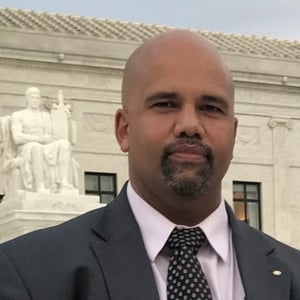
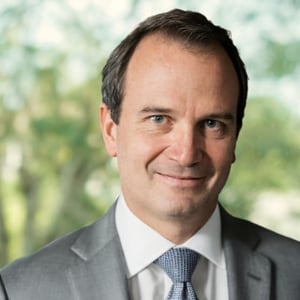
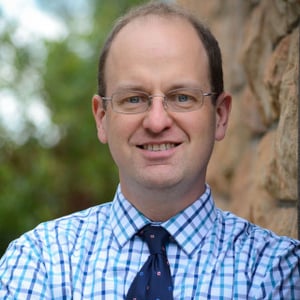
Dr. Brooks is currently professor of history at East Stroudsburg University, where he teaches several courses, including African Americans and the Courts and US Constitutional History and Law and other courses in legal history. Further to his work at ESU, he is also a founding member and vice president of the Harrisburg lawyers' chapter of the Federalist Society.
Professor Brooks received his BA and MA in US History from East Stroudsburg University of Pennsylvania. He then received a Rotary Ambassadorial Scholarship to Edinburgh University (Scotland), where he studied British influences on the US judiciary. He completed his doctoral work at Kassel University (Germany). There he worked on the international “Modern Constitutionalism” project, editing and translating constitutions from German to English and English to German. His doctoral work there focused in particular on eleventh amendment sovereignty issues and law during the US founding era. While in Germany, Prof. Brooks was an active member of the Center for North American Research, where he focused on constitutional and legal history, especially as it pertained to jurisprudential matters. He ran a solo business where he trained attorneys in several mid- to large-sized German and international law firms in legal English and communication. Prof. Brooks also did legal translation for many firms and for Germany’s Federal Constitutional Court, that nation’s highest court. Two books resulting from his work there include German Employment Law: 618 Questions Frequently Asked by Foreigners (2014) and Expats in Germany - Inbound and Outbound: Questions Frequently Asked by Foreigners (2017).
Current areas of research include state appellate judicial selection reform, early black attorneys, and comparative employment law.
Dr. Brooks has also written extensively Real Clear Politics, Real Clear Pennsylvania, and Allentown’s The Morning Call. His work has also appeared in New York Daily News, Los Angeles Times, Chicago Tribune, and The Hill.
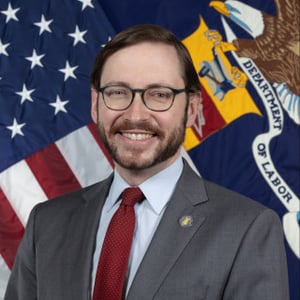
Jonathan Berry is Solicitor at the U.S. Department of Labor, in service to President Trump’s agenda to put American workers first. He leads the Department’s lawyers in advising the Secretary and agency leadership on all aspects of law and in representing the Department in court. He was previously managing partner at Boyden Gray PLLC, where he provided strategic counsel and litigated on issues at the intersection of law, politics, and public policy. Earlier, he headed the regulatory office at Labor, and also served at the Department of Justice, in the first Trump Administration. Mr. Berry served as a law clerk to Judge Jerry E. Smith of the United States Court of Appeals for the Fifth Circuit, and to Associate Justice Samuel A. Alito, Jr., of the Supreme Court of the United States.
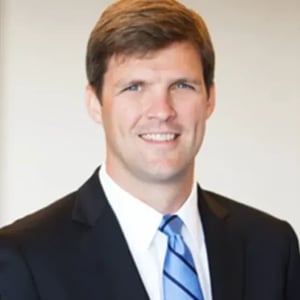
Jay Edelson is the founder of Edelson PC. He is considered one of the nation’s leading plaintiff’s lawyers, with his firm having helped secure over $45 billion in settlements and verdicts on behalf of classes, individuals, and governmental entities. Law360 described Jay as a “Titan of the Plaintiff’s Bar.” Jay has been recognized as one of “America’s top trial lawyers” in the mass action arena. LawDragon named him one of the top Plaintiff Financial Lawyers in the country. He has been called “probably the best known, and most innovative, consumer privacy lawyer on the planet,” with he and his firm holding records for the largest trial verdict in a consumer privacy case ($925m), the largest consumer privacy settlement ($650m) and the largest TCPA settlement ($76m).
Jay has been appointed to represent state and local regulators on some of the largest issues of the day, ranging from opioids suits against pharmaceutical companies, to environmental actions against polluters, to breaches of trust against energy companies and for-profit hospitals, to privacy suits against Google, Facebook, and others.
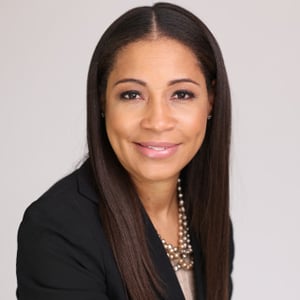
Stacy Hawkins is a frequent writer and sought-after speaker on the issue of employment law and diversity. She’s served on the Philadelphia Diversity Law Group and the Pennsylvania Bar Association Commission on Women in the Profession Diversity Task Force. She worked as a senior labor and employment attorney and as the director of diversity for major law firms.
Speaker Information
Gregory G. Katsas
Judge, United States Court of Appeals, District of Columbia Circuit
Biography
Judge Katsas was appointed to the D.C. Circuit in December 2017. He graduated from Princeton University and Harvard Law School, where he was an executive editor on the Harvard Law Review. Between 1989 and 1992, he served as a law clerk to Judge Edward Becker on the Third Circuit, to then-Judge Clarence Thomas on the D.C. Circuit, and to Justice Thomas on the Supreme Court. Between 1992 and 2001, he was an associate and then partner in the Washington office of Jones Day, where he specialized in appellate and complex civil litigation. Between 2001 and 2009, he served in many senior positions in the Department of Justice, including as Assistant Attorney General for the Civil Division and as Acting Associate Attorney General. In 2009, he returned to Jones Day. From January to December 2017, he served as Deputy Assistant to the President and Deputy Counsel to the President.
Before joining the bench, Judge Katsas argued more than 75 appeals, including three cases in the Supreme Court, 13 cases in the D.C. Circuit, and cases in every other federal court of appeals. By appointment of the Chief Justice, he served on the Advisory Committee on Appellate Rules from 2013 to 2017. In 2016, he was elected to membership in the American Academy of Appellate Lawyers.
Jason C. Schwartz is a litigation partner in the Washington, D.C. office of Gibson Dunn, co-chair of the Labor & Employment Practice Group, General Counsel of the law firm and a member of the firm’s Executive Committee. Jason was recognized as an MVP in employment law five times, awarded by Law360 to “attorneys whose achievements in major litigation or transactions have set a new standard for accomplishment in corporate law.” Law360 referred to Jason as “an expert dismantler of worker class actions.”
Jason is ranked in Band 1 in Labor & Employment by Chambers USA, which stated, “He is a whip-smart, results-oriented and zealous advocate who is really committed to the client. His judgment is impeccable.” According to Chambers USA, “[c]lients note: He’s an excellent litigator with a good sense of the client’s needs in a business environment. He’s just a pleasure to work with. He’s disciplined, a great writer and gets great results.” Jason has been recognized as a Top 20 Labor & Employment Litigator in the U.S. by Benchmark Litigation; on the Top 100 list of the Nation’s Most Powerful Employment Attorneys by Human Resource Executive magazine; as a Top Lawyer in Employment Defense by Washingtonian Magazine; as a Leading Lawyer in Labor & Employment Disputes by The Legal 500 US; by Lawdragon 500 Leading Corporate Employment Lawyers for Labor & Employment (Litigation); in The Best Lawyers in America in the Employment Law-Management category; as a Super Lawyer by Washington, D.C. Super Lawyers; and as an Am Law Litigation Daily “Litigator of the Week” for his win in an independent contractor misclassification/wage-and-hour class action. He is a Fellow of the College of Labor & Employment Lawyers.
The practice group Jason co-leads was named by The American Lawyer as the Labor & Employment Litigation Department of the Year in its most recent competition. The American Lawyer noted, “with novel labor and employment issues swirling, Gibson Dunn’s litigators set standards and settle the law,” and that a case “typical for Gibson Dunn’s labor and employment team” is “high-profile,” “cutting-edge,” and “a victory.” The group was also recognized ten times as a Law360 Employment Practice Group of the Year and won The National Law Journal’s D.C. Labor & Employment Litigation Department of the Year competition for the last seven years in a row.
Jason’s practice includes sensitive workplace investigations, high-profile trade secret and non-compete matters, wage-hour and discrimination class actions, Sarbanes-Oxley and other whistleblower protection claims, executive and other significant employment disputes, labor union controversies, and workplace safety litigation.
Recent representative matters include:
Won precedent-setting arbitration appeal relating to Amazon Flex drivers (Harper v. Amazon (3rd Cir. 2021));
Won decertification of nationwide FLSA collective action (Bah v. Enterprise Rent-A-Car (D. Mass. 2023));
Won motion to dismiss and prevailed on appeal in nationwide wage-and-hour class action regarding tax reform bonuses and paid volunteer time (McPhee v. Lowe’s (4th Cir. 2021));
Won appeal of closely-watched COVID-safety and whistleblower retaliation action brought by New York Attorney General (People v. Amazon (First Appellate Department 2022));
Won dismissal of Fair Credit Reporting Act class action (Downing v. Lowe’s (D. Az. 2023));
Won dismissal and prevailed on appeal in highly-publicized COVID-safety and race discrimination class action (Smalls v. Amazon (2nd Cir. 2022));
Led high-profile workplace investigations for a Special Committee of the Board of Directors of Wynn Resorts and for Vox Media; and
Prevailed at trial in manager exemption PAGA action (Ortiz v. Amazon (N.D. Cal. 2022)).
Jason has also successfully tried several sensitive whistleblower matters for major national employers, and he prevailed in a precedent-setting Labor Department appeal of one of the first Sarbanes-Oxley whistleblower cases to proceed to trial. He prevailed for Enterprise Rent-A-Car in a case of first impression in which the U.S. Court of Appeals for the Third Circuit created a new joint employer test (the Enterprise test) and affirmed summary judgment for a parent corporation in a series of wage-hour class actions, defeating the plaintiffs’ effort to form a nationwide class (In re Enterprise Rent-A-Car Wage & Hour Employment Practices Litig. (3rd Cir. 2012)). In another case of first impression, he successfully argued in the Utah Supreme Court against the recognition of a tort for spoliation of evidence. In addition, he served as lead trial counsel for a retailer in a highly-publicized OSHA enforcement action relating to crowd control at a day-after-Thanksgiving sale.
Jason also has significant experience in administrative law and rulemakings. He served as counsel to the Fair Labor Standards Reform Coalition, and he played a leading role in preparing comments on behalf of the business community relating to the U.S. Department of Labor’s overtime exemption regulations.
Jason served for many years as the Secretary of the Retail Litigation Center, and he testified before Congress regarding OSHA enforcement programs on behalf of the U.S. Chamber. He frequently speaks and writes on employment law and trade secret related topics. He is the co-author of the treatise Whistleblower Law: A Practitioner’s Guide, published by American Lawyer Media/Law Journal Press, and he previously authored the annual “Trade Secrets Litigation Round-Up” published by Bloomberg BNA.
Jason earned his law degree magna cum laude from Georgetown University Law Center, where he was elected to the Order of the Coif and received the George Brent Mickum III Prize and the Charles A. Keigwin Award for the best academic record in first year courses. From 1995 to 1996, he worked as a Legislative Assistant to Congressman Jon D. Fox. Jason received a B.A. degree in international affairs cum laude in 1994 from The George Washington University.
Jason is admitted to practice in the District of Columbia, Virginia and Maryland, as well as in numerous federal courts. He served for many years as an officer and board member of the Charles E. Smith Jewish Day School, currently serves as a member of the Washington Lawyers Committee of the U.S. Holocaust Memorial Museum, and provides pro bono employment counsel to numerous community organizations.
Judge, United States District Court for the Western District of Kentucky
Biography
Prior to joining the bench, Judge Beaton was a Partner at Squire Patton Boggs LLP, where he co-chaired the firm’s Appellate & Supreme Court practice group. Judge Beaton’s represented clients engaged in complex commercial litigation in Federal and State courts, and before administrative agencies. Judge Beaton also served as an adjunct professor at the University of Louisville Brandeis School of Law, where he taught constitutional interpretation. Before joining Squire Patton Boggs, Judge Beaton practiced in the Washington, D.C. office of Sidley Austin, LLP, and also served as a legal fellow with the International Justice Mission in Kampala, Uganda. Upon graduation from law school, Judge Beaton served as a law clerk to Justice Ruth Bader Ginsburg of the United States Supreme Court, and to Judge A. Raymond Randolph of the United States Court of Appeals for the D.C. Circuit. Judge Beaton earned his B.A., summa cum laude, from Centre College, and his J.D. from Columbia Law School, where he served as an Articles Editor on the Columbia Law Review.
Judge, United States Court of Appeals, Fourth Circuit
Biography
Judge Julius “Jay” Richardson serves on the United States Court of Appeals for the Fourth Circuit. Jay grew up in Barnwell, South Carolina. After graduating from Vanderbilt University, Jay moved to Hawaii and worked at a pool-side bar-and-grill. Jay later earned his law degree from the University of Chicago Law School, where he served as Articles Editor for the Law Review and right fielder for the law school’s championship softball team. Following law school, Jay clerked for Judge Richard A. Posner and for Chief Justice William H. Rehnquist. He then practiced with Kellogg Hansen in Washington, DC before returning to South Carolina as an Assistant United States Attorney. Along with prosecuting violent crime, gangs, terrorism, public corruption, civil rights, and narcotics trafficking, he led the prosecution of Dylann Roof, who was convicted and sentenced to death for his racist massacre of nine Black worshippers during a Bible study at Mother Emanuel AME Church in Charleston. He and his wife Macon are blessed with four daughters.
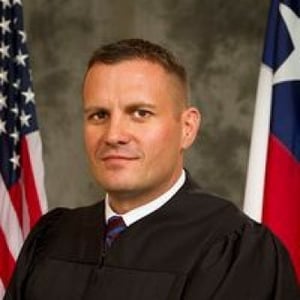
Judge, United States District Court for the Northern District of Texas
Biography
Immediately preceding his appointment to the federal bench, Judge Pittman was an Associate Justice on the Court of Appeals for the Second District of Texas since 2017. Prior to his appointment to the Court of Appeals, he served for two years on the trial bench of the 352nd Judicial District Court in Tarrant County.
Judge Pittman is also an experienced litigator, having served as an Enforcement Attorney at the U.S. Securities and Exchange Commission, where he also spent a year on special assignment prosecuting economic crimes as a Special Assistant U.S. Attorney. Prior to that, he was a Senior Attorney for the Federal Deposit Insurance Corporation, an Assistant U.S. Attorney for the Northern District of Texas, and a Trial Attorney in the Civil Division of the U.S. Department of Justice in Washington, D.C. He has also worked in private practice as a civil litigation attorney with Kelly, Hart and Hallman, LLP and served as a law clerk to United States District Judge Eldon B. Mahon in the Northern District of Texas, Fort Worth Division.
Judge Pittman received a Bachelor of Arts degree magna cum laude from Texas A&M University in 1996, and a Doctor of Jurisprudence degree from the University of Texas School of Law in 1999. While studying law, he clerked in the General Counsel’s Office of the Governor of Texas under Governor George W. Bush and was a founding member of the Texas Review of Law & Politics.
Judge Pittman is a former vice-president and founding member of the Fort Worth Chapter of the Federalist Society and a master of the Eldon B. Mahon Inn of Court. He serves on the Board of Ballet Concerto of Fort Worth and the Tarrant County Volunteer Attorney Services Committee and coaches youth sports at the YMCA. Judge Pittman, a history buff, is a member of the Fort Worth Civil War Roundtable and the A.M. Pate Book Award in Civil War History selection committee. A sixth generation Texan, he was born in Big Spring and raised in Cooper. He and his wife, Katrina, have been married fifteen years and are the parents of four children.
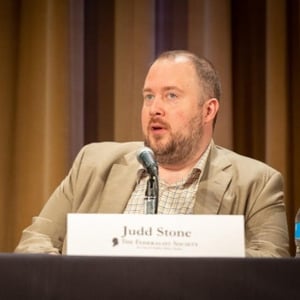
A founding partner of Stone Hilton, Judd Stone is well respected both in Texas and across the nation as an insightful and tenacious appellate litigator. A lifelong Texan, Judd has argued dozens of appeals in both federal and state court, including arguing eight cases before the United States Supreme Court.
Judd began his legal career clerking for United States Supreme Court Justice Antonin Scalia and Fifth Circuit Chief Judge Edith H. Jones. With a J.D. from Northwestern University School of Law where he graduated first in his class, Judd's academic and professional credentials place him among the most distinguished lawyers in the profession. At the helm of countless major legal battles and emergency appeals for the State of Texas, Judd's deep understanding of the law and persuasive advocacy have been instrumental in shaping legal precedents. His tenure as the Solicitor General of Texas is a testament to his expertise and the trust placed in him by high-ranking state officials. Judd's strategic prowess extends beyond the courtroom; his advisory roles have made him a respected figure among policymakers.
His contributions to Stone Hilton and the legal community are characterized by his meticulous approach to cases, his acumen as a counselor, and his unwavering commitment to justice. As a partner at Stone Hilton, Judd continues to apply his formidable talents to advocate for his clients with the utmost dedication and to uphold the pillars of integrity and excellence that the firm stands for.
Associate Dean & Principle Lecturer, Regent University School of Law
Biography
Professor Jacob has been a law professor at Regent University since January 2001. Prior to coming to Regent, his career began in a big-firm law practice and included years as a religious liberty lawyer, in Christian ministry leadership, and in Christian higher education.
Most of his teaching and scholarship is in the area of constitutional law. His published articles include"Griswold and the Defense of Traditional Marriage” in the North Dakota Law Review; “Will the Real Constitutional Originalist Please Stand Up?” in the Creighton Law Review; “Back to Basics: Constitutional Meaning and ‘Tradition,’” in the Texas Tech Law Review; and “Free Exercise in the ‘Lobbying Nineties,’” in the Nebraska Law Review.
J.D. 1983, University of Chicago Law School
B.A. 1980, summa cum laude, University of Delaware.
Somin’s work has appeared in numerous scholarly journals, including the Yale Law Journal, Stanford Law Review, Northwestern University Law Review, Georgetown Law Journal, Critical Review, and others. Somin has also published articles in a variety of popular press outlets, including the New York Times, Washington Post, Wall Street Journal, Los Angeles Times, CNN, NBC, The Atlantic, USA Today, Boston Globe, US News and World Report, South China Morning Post, National Law Journal and Reason. He has been quoted or interviewed by the New York Times, Washington Post, Wall Street Journal, Time, Newsweek, The Economist, the Christian Science Monitor, the Financial Times, The Guardian, the Associated Press, CBS, MSNBC, NPR, BBC, Reuters, the Canadian Broadcasting Corporation, the Australian Broadcasting Corporation, Radio Free Europe/Radio Liberty, Al Jazeera, and the Voice of America, among other media.
Somin’s writings have been cited in decisions by the United States Supreme Court, multiple state supreme courts and lower federal courts, and the Supreme Court of Israel. He is co-counsel for the plaintiffs in VOS Selections, Inc. v. Trump, a case challenging the constitutionality of President Trump’s “Liberation Day” tariffs. Somin has testified on the use of drones for targeted killing in the War on Terror before the US Senate Judiciary Subcommittee on the Constitution, Civil Rights, and Human Rights. In 2009, he testified on property rights issues at the United States Senate Judiciary Committee confirmation hearings for Supreme Court Justice Sonia Sotomayor. Somin writes regularly for the popularVolokh Conspiracylaw and politics blog, now affiliated with Reason magazine (previously affiliated with the Washington Post from 2014 to 2017). From 2006 to 2013, he served as Co-Editor of the Supreme Court Economic Review, one of the country’s top-rated law and economics journals.
Somin has served as a visiting professor at the University of Pennsylvania Law School. He has also been a visiting professor or scholar at the Georgetown University Law Center, the University of Hamburg, Germany, the University of Torcuato Di Tella in Buenos Aires, Argentina, Uriel Reichman University in Israel, and Zhengzhou University in China. He is a University Affiliate of the Schar School of Policy and Government at George Mason University, and an affiliated faculty member of the George Mason University Institute for Immigration Research. Before joining the faculty at George Mason, Somin was the John M. Olin Fellow in Law at Northwestern University Law School in 2002-2003. In 2001-2002, he clerked for the Hon. Judge Jerry E. Smith of the U.S. Court of Appeals for the Fifth Circuit. Professor Somin earned his B.A., Summa Cum Laude, at Amherst College, M.A. in Political Science from Harvard University, and J.D. from Yale Law School.
Professor of Law, University of Wyoming College of Law
Biography
George Mocsary is an expert in corporate and small-business law, and the law of firearms.
Currently, he is Professor of Law, Founder & Director of Firearms Research Center, and Director of the Business Planning Practicum and at the University of Wyoming College of Law.
Professor Mocsary teaches and writes about Agency & Partnership, Contracts, Corporations, Securities Regulation, the Second Amendment, and Firearms Law, including the intersection of Firearms Law and private law. He is a co-author of Firearms Law and the Second Amendment: Regulation, Rights, and Policy (3rd ed. 2021), the first casebook on this topic.
Prior to his appointment at Wyoming, he served as an Associate Professor of Law at the Southern Illinois University School of Law and spent two years as a Visiting Assistant Professor at the University of Connecticut School of Law. He practiced corporate and bankruptcy law at Cravath, Swaine and Moore in New York, and clerked for the Honorable Harris L. Hartz of the U.S. Court of Appeals for the Tenth Circuit.
Professor Mocsary holds a J.D. from Fordham Law School and an M.B.A. from the University of Rochester Simon School of Business. At Fordham, he graduated first in his class, and served as Notes and Articles Editor of the Fordham Law Review. He has published in the George Washington Law Review, George Mason Law Review, Fordham Law Review, Duke Law Journal Online, and other journals. His work has been cited by the Supreme Court of the United States, several U.S. Courts of Appeals, the Supreme Court of Illinois, the Delaware Court of Chancery, and other courts.