SCOTUS Reforms
Notre Dame Student Chapter
1100 Eck Hall of Law
Notre Dame, IN 46556
*******
As always, the Federalist Society takes no position on particular legal or public policy issues; all expressions of opinion are those of the speaker.
*******
As always, the Federalist Society takes no position on particular legal or public policy issues; all expressions of opinion are those of the speaker.
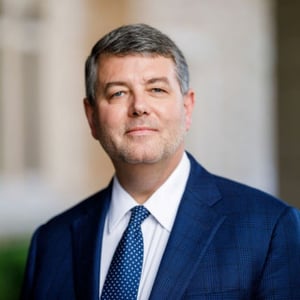
John P. Murphy Foundation Professor of Law, Notre Dame Law School
Barry Cushman came to Notre Dame in 2012 following fifteen years on the faculty at the University of Virginia, where he was the James Monroe Distinguished Professor of Law and Professor of History. Cushman's scholarship examines the relations among constitutional law, political economy, and social reform movements in the late 19th and early 20th centuries. His book, Rethinking the New Deal Court: The Structure of a Constitutional Revolution (Oxford University Press), was awarded the American Historical Association's Littleton-Griswold Prize in American Law and Society. His article, “Court-Packing in Context,” was recognized with the Hughes-Gossett Award from the Supreme Court Historical Society. He has held research fellowships at New York University School of Law and in the Politics Department at Princeton University. In 2003, he was honored with the University of Virginia's All-University Teaching Award.
Before entering teaching, Cushman practiced as an estate planning and probate attorney with the Los Angeles firm of Riordan & McKinzie. He has served on the Board of Directors and the Executive Committee of the American Society for Legal History, on the Board of Directors of the University of Virginia Press, on the Scholar Advisory Board for the National Constitution Center, and on the Indiana State Probate Commission. He currently serves on the editorial board of the Journal of Supreme Court History, on the boards of the Albemarle County Rotary Club and the Albemarle County Rotary Club Foundation, and as Deputy Grand Knight of the Father Justin Cunningham Council of the Knights of Columbus.
Senior Fellow and Director of Constitutional Studies, Manhattan Institute
Ilya Shapiro is a senior fellow and director of constitutional studies at the Manhattan Institute and a contributing editor of City Journal. Previously he was executive director and senior lecturer at the Georgetown Center for the Constitution, and before that a vice president of the Cato Institute.
Shapiro is the author of Lawless: The Miseducation of America’s Elites (2025) and Supreme Disorder: Judicial Nominations and the Politics of America’s Highest Court (2020), coauthor of Religious Liberties for Corporations? (2014), and editor of 11 volumes of the Cato Supreme Court Review (2008-18). He has contributed to a variety of academic, popular, and professional publications, including the Wall Street Journal, Harvard Journal of Law & Public Policy, Washington Post, Los Angeles Times, USA Today, National Review, and Newsweek. He also regularly provides commentary for various media outlets, writes the Shapiro’s Gavel newsletter on Substack, and once appeared on the Colbert Report.
Shapiro has testified many times before Congress and state legislatures and has filed more than 500 amicus curiae “friend of the court” briefs in the Supreme Court. He lectures regularly on behalf of the Federalist Society, is a member of the board of fellows of the Jewish Policy Center, was an inaugural Washington Fellow at the National Review Institute, and has been an adjunct law professor at the George Washington University and University of Mississippi. He is also the chairman of the board of advisers of the Mississippi Justice Institute, a barrister in the Edward Coke Appellate Inn of Court, and a former member of the Virginia Advisory Committee to the U.S. Commission on Civil Rights.
Earlier in his career, Shapiro was a special assistant/adviser to the Multi-National Force in Iraq on rule-of-law issues and practiced at Patton Boggs and Cleary Gottlieb. Before entering private practice, he clerked for Judge E. Grady Jolly of the U.S. Court of Appeals for the Fifth Circuit. He holds an AB from Princeton University, an MSc from the London School of Economics, and a JD from the University of Chicago Law School.