
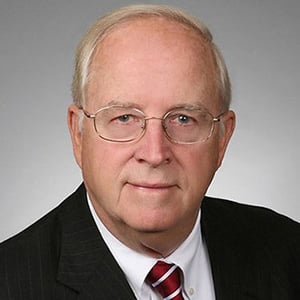
Of Counsel, Kirkland & Ellis LLP
John focuses his practice on labor and employment litigation and counseling employers on mergers, acquisitions and consolidations, downsizing, plant relocations, union representation elections, labor negotiations, strikes and lockouts, NLRB unfair labor practices, arbitration, wage and hour, wrongful discharge and equal employment. John, a former NLRB General Counsel and Labor Department official, was selected as a global leader in the field of employment & labor law in The International Who's Who of Labor and Employment Lawyers by Law Business Research, The Best Lawyers in America, and Super Lawyers.
John earned his B.A. from Brown University and both his J.D. and LL.M. from Georgetown.
Warren Belmar has served as the Deputy General Counsel for Energy Policy since June, 2006. He is responsible for coordinating the activities and functions assigned to the Assistant General Counsel for Legislation and Regulatory Law, the Assistant General Counsel for Fossil Energy and Energy Efficiency, the Assistant General Counsel for Regulatory Interventions and Power Marketing, and the Assistant General Counsel for General Law. In this role, he acts as principal legal advisor, on behalf of the General Counsel, to the Secretary and senior DOE officials within assigned functional areas, and performs other tasks within and outside of functional responsibility as determined by the General Counsel.
Prior to becoming Deputy General Counsel for Energy Policy, Mr. Belmar’s legal career has been spent in private practice in Washington, D.C., primarily with the law firm of Fulbright & Jaworski LLP, from which he retired in 1999 after 22 years as a partner. In the years immediately prior to joining DOE, Mr. Belmar served as Managing Partner of Capitol Counsel Group, LLC, and as a partner with the law firm of Balch & Bingham LLP. His practice primarily involved providing counsel to clients in the financial services and energy sectors, representing clients in litigation in the Federal courts and before various federal and state departments and agencies, and before the U. S. Congress.
Mr. Belmar received his bachelor’s degree with honors from Brooklyn College in 1963, and his law degree with honors from Columbia Law School in 1966. He served as Court law clerk for the United States Court of Appeals for the District of Columbia Circuit, and as an attorney with the Office of Legal Counsel of the U. S. Department of Justice. He is a former Chair of the Administrative Law and Regulatory Practice Section of the American Bar Association, a former Chair of the Judicial Review Committee of the Administrative Conference of the United States, a former Senior Counsel of the Federalist Society for Law and Public Policy Studies, and a Life Member of American Law Institute.
B.A. Brooklyn College, 1963
J.D. Columbia Law School, 1966
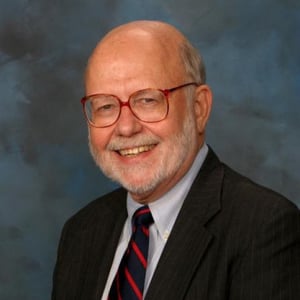
Principal, Ely & Company, Inc.
Bert Ely has specialized in deposit insurance and banking structure issues since 1981. In 1986, he became an early predictor of the S&L crisis and a taxpayer bailout of the FSLIC. In 1991, he was the first person to correctly predict the non-crisis in commercial banking; in 1992, he predicted an eventual taxpayer bailout of the Japanese banking system.
Bert continuously monitors conditions in the banking and S&L industries, monetary policy, and the growing federalization of credit risk. He has helped to draft legislation to enact the cross-guarantee concept for privatizing banking regulation and its related deposit insurance and systemic risks. He has testified on numerous occasions before congressional committees on banking issues and he often speaks on these matters to bankers and others.
Bert first established his consulting practice in 1972. Before that, he was the chief financial officer of a public company, a consultant with Touche, Ross & Company, and an auditor with Ernst & Ernst. He received his MBA from the Harvard Business School in 1968 and his Bachelor's degree in economics in 1964 from Case Western Reserve University.

Counsel to the Firm, Cascadia Cross-Border Law
Margaret Stock focuses her practice on immigration and citizenship law. She is a nationally known expert on immigration and national security laws, and has testified regularly before Congressional committees on immigration, homeland security, and military matters. As a retired Lieutenant Colonel in the Military Police, U.S. Army Reserve, Margaret has extensive experience with U.S. military issues. She has also worked as a professor at the United States Military Academy at West Point, and she has served as an adjunct instructor at the University of Alaska. Margaret served as a member of the American Bar Association Commission on Immigration from 2008-2012. She regularly authors articles on military-related immigration issues, and is well-versed on “parole in place” for military family members and the Military Accessions Vital to the National Interest (“MAVNI”) Program. Margaret authored the book Immigration Law & the Military, which was published by the American Immigration Lawyers Association in 2012.

George C. Dix Professor in Constitutional Law, Northwestern University Pritzker School of Law
John O. McGinnis is a graduate of Harvard College and Harvard Law School where he was an editor of the Harvard Law Review. He also has an MA degree from Balliol College, Oxford, in philosophy and theology. Professor McGinnis clerked on the U.S. Court of Appeals for the District of Columbia. From 1987 to 1991, he was deputy assistant attorney general in the Office of Legal Counsel at the Department of Justice. He is the author of Accelerating Democracy: Transforming Government Through Technology (Princeton 2013) and Originalism and the Good Constitution (Harvard 2013) (with M. Rappaport). He is a past winner of the Paul Bator award given by the Federalist Society to an outstanding academic under 40. He has been listed by the United States on the roster of panelists who may be called upon to decide World Trade Organization Disputes.

Should the Federal Government Backstop Insurance Industry Terrorism Coverage?
Judyth W. Pendell, Warren B. Azano
Judyth W. Pendell, Director, Center for Legal Policy, Manhattan InstituteWarren B. Azano, Vice President, Hartford...
Summary of Federal Employment and Reemployment Rights of Members of the Uniformed Services
John S. Irving
by John Irving, Kirkland & EllisAs you may know the federal government recently has ordered...
The Workplace as a Front Line in the War Against Terrorism
Joseph McHugh, Jennifer B. Healey
The Federalist Society takes no position on particular legal or public policy initiatives. All expressions...
Ambulance Chasing for Justice: How Private Lawsuits for Civil Damages Can Help Combat International Terror
Gordon Dwyer Todd
On January 21, 2002, the North Idaho College announced the donation of a tract of...
Money Laundering and Terrorism: A Failed Past and a Bleak Future
John Pickering
By: John PickeringNow more than ever, national security requires that the people of the United...
A Dissenting View: Some Guarded Optimism on Combating Terrorists Money Laundering
Warren Belmar
We will not win the terrorism war only by pursuing the money-laundering techniques of the...
A Different Perspective of the USA PATRIOT Act Title III
James M. Rockett, Bert Ely
While the White Paper provides an excellent overview of the history of the Bank Secrecy...
Combating Bioterrorism: The Product Liability Threat
Bert W. Rein, Kristina Reynolds Osterhaus
By: Bert W. Rein and Kristina R. Osterhaus [1]The September 11 attack and recent anthrax...
United States Immigration Law in a World of Terror
Margaret D. Stock
By Margaret D. Stock*I. Introduction The terrorist attacks of September 11, 2001 have spurred a...
Expanding Trade: A Powerful Weapon Against Terrorism
John O. McGinnis
By John O. McGinnis [1]SummaryDefending the Homeland will involve more than beefing up security for...