The Tea Party: Three Principles - Faculty Book Podcast
Faculty Division Podcast 03-19-12 featuring Elizabeth Price Foley and Jared Goldstein


This Federalist Society Faculty Book Podcast features Professor Elizabeth Price Foley’s new book, The Tea Party: Three Principles.
As Publisher Cambridge University Press states: “In The Tea Party: Three Principles, constitutional law professor Elizabeth Price Foley takes on the mainstream media's characterization of the American Tea Party movement, asserting that it has been distorted in a way that prevents meaningful political dialogue and may even be dangerous for America's future. Foley sees the Tea Party as a movement of principles over politics. She identifies three "core principles" of American constitutional law that bind the decentralized, wide-ranging movement: limited government, unapologetic U.S. sovereignty, and constitutional originalism. These three principles, Foley explains, both define the Tea Party movement and predict its effect on the American political landscape. Foley explains the three principles' significance to the American founding and constitutional structure. She then connects the principles to current issues as health care reform, illegal immigration, the war on terror, and internationalism.”
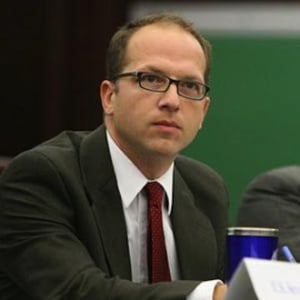
Professor Foley, a Professor of Law at Florida International University School of Law, is joined by critical commenter Jared Goldstein, a Professor at Roger Williams University School of Law, to discuss the book.

Roger Williams University School of Law
While serving as an associate at Shearman & Sterling in Washington, D.C., Professor Goldstein became one of the first civilian lawyers allowed into the Guantanamo Bay prison, in conjunction with his representation of several families of Kuwaiti detainees.
After resistance from the U.S. Government, the Supreme Court agreed to hear the case Rasul v. Bush. Professor Goldstein’s involvement with the Guantanamo cases included drafting district, appellate and Supreme Court briefs on behalf of the detainees. He continues his work with the detainees through his scholarship at RWU, and is a national expert on the applicability of habeas corpus to the Guantanamo Bay detainees. He has published numerous articles on the topic and penned an Op-ed reprinted in newspapers around the country.
Additionally, Professor Goldstein was a Bristow Fellow in the Office of the United States Solicitor General and served as an attorney for the Department of Justice, working in the appellate section of the Environment and Natural Resources division, where he drafted briefs on behalf of the United States in several Supreme Court cases. He received numerous awards while working at the Department of Justice including the Special Commendation for Outstanding Service and the National Oceanic and Atmospheric Administration General Counsel’s award.
Professor Goldstein teaches Constitutional Law and an array of Environmental Law courses. He regularly publishes in top law journals and because of his nationally recognized expertise, he has authored numerous briefs in the Supreme Court of the United States. Professor Goldstein is a graduate of Vassar and Michigan (J.D., magna cum laude).