Deep Dive Episode 191 – Talks with Authors: A Dubious Expediency
Regulatory Transparency Project's Fourth Branch Podcast
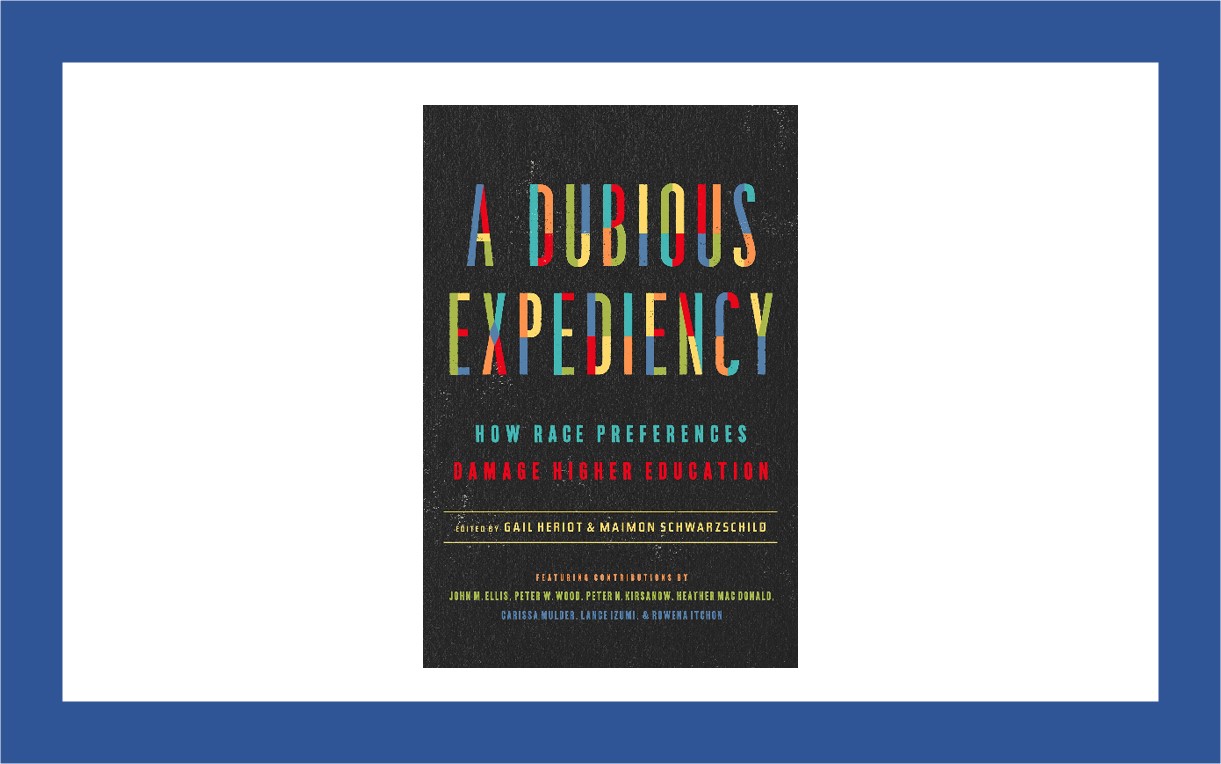

“A Dubious Expediency: How Race Preferences Damage Higher Education” is a collection of eight essays written by experts in the field examining and analyzing the impact of racial diversity preferences and identity politics in American colleges and universities. The book’s title comes from a 1976 California Supreme Court opinion in Bakke v. UC Regents authored by Justice Stanley Mosk, who wrote: “To uphold the [argument for race-preferential admissions] would call for the sacrifice of principle for the sake of dubious expediency and would represent a retreat in the struggle to assure that each man and woman shall be judged on the basis of individual merit alone, a struggle which has only lately achieved success in removing legal barriers to racial equality.” In the book, the authors take up the question of race-based preferences in higher education, arguing that mounting empirical evidence shows race-based solutions cause long term harm both to intended beneficiaries and to society as a whole.
Featuring:
Visit our website – www.RegProject.org – to learn more, view all of our content, and connect with us on social media.

Professor of Law, University of San Diego School of Law (Retired)
Gail Heriot is a recently retired law professor from the University of San Diego. She also served as a member of the U.S. Commission on Civil Rights from 2007 to 2025. She is also the chairman of the board of the American Civil Rights Project and the chair emerita of the Civil Rights practice group at the Federalist Society for Law & Public Policy.
Professor Heriot is a prolific writer in the area of civil rights. She is the author of many law review articles. She is also the editor (along with Maimon Schwarzschild) of the 2021 anthology, A Dubious Expediency: How Race Preferences Damage Higher Education. Her upcoming book is entitled, Why We Walk on Eggshell: How Our Civil Rights Laws Helped Bring About the Woke Era—And the Trump Era, Too.
Her writings for a general audience have appeared in the Wall Street Journal, the San Diego Union-Tribune, the National Review and many other newspapers and magazines.
In 1996, she co-chaired the successful “Yes on Proposition 209” campaign, which amended the California Constitution to prohibit state-sponsored discrimination or preferential treatment based on race, sex, color, ethnicity or national origin. In 2020, she co-chaired the “No on Proposition 16” campaign, which successfully prevented Proposition 209’s repeal.
Professor of Law, University of San Diego School of Law
Maimon Schwarzschild is Professor of Law at the University of San Diego, where he has taught
since 1982. He has published extensively on constitutional law, jurisprudence, law and religion,
and civil rights. He is an English barrister and an American lawyer: he was an attorney in the
Civil Rights Division of the US Department of Justice from 1976 to 1981 and practised as a
barrister in London in the 1980s. He was a visiting professor at the Sorbonne for several years,
and has been a visiting professor at the Hebrew University in Jerusalem. He is a Director of the
Institute of Law and Religion at the University of San Diego and a member of the editorial board
of Law and Philosophy. With Gail Heriot he recently co-edited a volume entitled “A Dubious
Expediency: How Race Preferences Damage Higher Education”, published by Encounter Books.