How Does the Federal Reserve Fit into Our Constitutional Order?
Note from the Editor: The Federalist Society takes no positions on particular legal and public policy matters. Any expressions of opinion are those of the author. We welcome responses to the views presented here. To join the debate, please email us at [email protected].
An earlier and extended version of this essay was published in the New York Sun.
The Federal Reserve is a fundamental problem for the constitutional order of the American Republic. How can the central bank unilaterally impose permanent inflation on the country without legislative debate or approval?
The nature of money and the stability of its value is an essential political and social question. William Jennings Bryan famously proclaimed, “You shall not crucify mankind upon a cross of gold!” On the other hand, we may proclaim, “You shall not drown mankind in a flood of paper money!” Who gets to choose between inflationist money and sound money?
Not the Fed by itself. Regulating the value of the money and deciding whether it should be sound and stable, or perpetually depreciating, and if so, at what rate, are profoundly important questions of a legislative nature requiring the action of Congress.
Congress can legislatively cancel the 2% inflation target announced by the Fed until the Congress has approved that or some other guidance. I would recommend stable prices as the guiding principle.
Our elected representatives need to control the powerful and dangerous Fed by using the checks and balances of our constitutional republic.

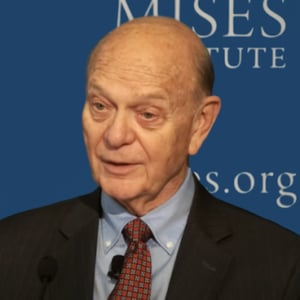
Senior Fellow, Mises Institute
Alex J. Pollock is a Senior Fellow with the Mises Institute, providing thought and policy leadership on financial issues and the study of financial systems. His work includes cycles of booms and busts, financial crises with their political responses, housing finance, government-sponsored enterprises, risk and uncertainty, central banking, banking and financial regulation, corporate governance, retirement finance, student loans, and the politics of finance.
He previously served as the Principal Deputy Director of the Office of Financial Research in the U.S. Treasury Department 2019-2021. He was a Distinguished Senior Fellow with the R Street Institute 2015-2019 and 2021, and a resident fellow at the American Enterprise Institute, 2004-2015. Among the many aspects of his AEI work, he developed the One Page Mortgage Form to give borrowers in clear form the key information they need in order to know what they are committing themselves to. He was President and CEO of the Federal Home Loan Bank of Chicago from 1991 to 2004. There he invented the Mortgage Partnership Finance program, which successfully created front-end mortgage credit risk sharing beginning in 1997. His decades of banking experience include being a Visiting Scholar at the Federal Reserve Bank of St. Louis, 1991.
Pollock was a director of the CME Group 2004-2019 and of Ascendium Education Group 1989-2019. He is a director and past-chairman of the Great Books Foundation and a past president of the International Union for Housing Finance.
He is the co-author of Surprised Again! - The COVID Crisis and the New Market Bubble (2022), and the author of Finance and Philosophy—Why We’re Always Surprised (2018) and Boom and Bust: Financial Cycles and Human Prosperity (2011), as well as numerous articles and Congressional testimony.
Pollock is a graduate of Williams College, the University of Chicago, and Princeton University.
His work is available on alexjpollock.com.