Facts of the Case
Shortly after taking office on January 20, 2025, President Donald J. Trump issued an Executive Order titled “Protecting the Meaning and Value of American Citizenship.” This Order declared that certain individuals born in the United States would not be granted U.S. citizenship at birth if their mothers were either in the country illegally or temporarily and if their fathers were not U.S. citizens or lawful permanent residents. Specifically, the Order directed federal agencies not to issue or recognize documents affirming U.S. citizenship for individuals born under these circumstances after February 19, 2025. The Order further mandated that agencies revise their policies and issue guidance to implement these new rules. The interpretation marked a dramatic shift from long-standing constitutional and statutory understandings of the Fourteenth Amendment's Citizenship Clause, which has historically been viewed as providing birthright citizenship to nearly all individuals born in the U.S., regardless of their parents’ immigration status.
In response to the Executive Order, lawsuits were quickly filed in multiple federal district courts—specifically in Maryland, Massachusetts, and Washington—by states, organizations, and individuals who would be affected. These plaintiffs argued that the Order violated the Constitution and the Immigration and Nationality Act. All three district courts issued preliminary injunctions blocking the enforcement and implementation of the Executive Order nationwide. The federal government appealed the injunctions, arguing that the lawsuits should only apply to the specific plaintiffs and not the entire country, and also requested permission for government agencies to continue internal planning for implementation. Appeals courts declined to limit the injunctions, prompting the federal government to ask the U.S. Supreme Court to partially stay the orders—specifically to allow agency planning and to restrict injunctive relief to the named plaintiffs only.
Questions
Can a district court issue a nationwide (universal) injunction that blocks enforcement of a federal executive order beyond the specific parties involved in the lawsuit?
Conclusions
-
Federal courts likely lack equitable authority under the Judiciary Act of 1789 to issue universal injunctions that prohibit enforcement of executive actions beyond the parties before the court. Justice Amy Coney Barrett authored the 6-3 majority opinion of the Court.
Under the Judiciary Act of 1789, federal courts possess only those equitable remedies “traditionally accorded by courts of equity” at the time of the founding. The Court finds no historical precedent for universal injunctions in English equity courts or early American practice. English equity courts operated through party-specific proceedings, where relief was limited to those actually before the court. While bills of peace allowed courts to adjudicate rights of dispersed groups, these involved small, cohesive groups and bound all members—unlike universal injunctions that protect non-parties without binding them. The historical absence of universal injunctions until the mid-20th century confirms they fall outside traditional equitable authority.
The complete relief principle permits courts to fashion remedies that fully redress plaintiffs’ injuries, but complete relief does not equal universal relief. Courts may award relief that incidentally benefits non-parties when necessary to provide complete relief to plaintiffs, such as in nuisance cases where divisible relief is impossible. However, prohibiting enforcement of the Executive Order against individual plaintiffs’ children provides them complete relief without requiring nationwide application. For state plaintiffs claiming administrative and financial harms, the Court remands for lower courts to determine whether narrower injunctions could provide complete relief, such as prohibiting enforcement within plaintiff states or treating affected children as eligible for federally funded benefits.
Justice Clarence Thomas authored a concurring opinion, joined by Justice Neil Gorsuch, emphasizing that courts must not expand the complete relief principle to recreate universal injunctions under a different name and that relief should be tailored to redress only plaintiffs’ particular injuries.
Justice Samuel Alito authored a concurring opinion, joined by Justice Thomas, warning that lax enforcement of third-party standing requirements and class certification procedures could create loopholes that undermine the Court’s holding against universal injunctions.
Justice Brett Kavanaugh authored a concurring opinion explaining that while universal injunctions are improper, plaintiffs may still seek classwide preliminary relief under Rule 23(b)(2) or ask courts to set aside agency rules under the Administrative Procedure Act, and emphasizing that the Court will continue to serve as the ultimate arbiter of the interim legal status of major federal actions.
Justice Sonia Sotomayor authored a dissenting opinion, joined by Justices Elena Kagan Ketanji Brown Jackson, arguing that universal injunctions have deep roots in equity’s history through bills of peace and taxpayer suits, that the Executive Order is patently unconstitutional under the Citizenship Clause, and that limiting injunctive relief will leave constitutional rights meaningful in name only for those unable to sue.
Justice Jackson authored a separate dissenting opinion arguing that the majority’s decision creates an existential threat to the rule of law by allowing the Executive to violate the Constitution with respect to anyone who has not sued, effectively creating zones where executive compliance with law becomes optional rather than mandatory.
Structure Over Spectacle: The Supreme Court's 2024 Term
Federalist Society Review, Volume 26
After several years of headline-grabbing decisions that reshaped national political debate—from abortion and affirmative action...
The Forces Shaping Administrative Law: Executive, Courts, and Beyond
Administrative Law Practice Group
CLE credit for this event is available at On-Demand CLE. Recent Supreme Court decisions—often via the...
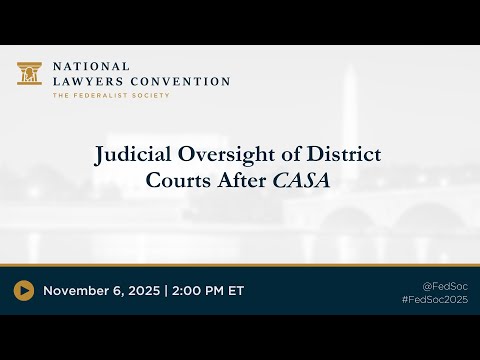
Judicial Oversight of District Courts After CASA
Federalism & Separation of Powers Practice Group
CLE credit for this event is available at On-Demand CLE. In recent years, leaders of both...
Inside the Oral Argument of Trump v. CASA: Will the Court Rein in Universal Injunctions?
On May 15, 2025, the U.S. Supreme Court heard oral arguments in Trump v. CASA, Inc.,...

The Future of Class Actions after Oral Argument in Trump v. CASA
Many people have asked me in the days after the Supreme Court argument in the...

CANCELED: Nationwide Injunctions after Trump v. CASA: Prof. Brian Fitzpatrick on the Future of Class Actions
Orange County Lawyer Chapter
1st Floor Conference Room2040 Main Street, 1st Floor
Irvine, CA 92614
The Forces Shaping Administrative Law: Executive, Courts, and Beyond
Administrative Law Practice Group
Washington, DC