Facts of the Case
Swift took a bill of exchange as payment of a promissory note that was due to him by Norton & Keith. The bill was issued in Maine, but Tyson had accepted the bill in New York and was responsible in that capacity for paying the amount of $1,540.30 to Swift. When the bill was dishonored after it came due, Swift sought to compel payment from Tyson. Recognizing that Swift was a bone fide holder of the bill who was unaware of any problems with it, Tyson responded that he had originally accepted the bill from Norton & Keith as partial consideration for buying property in Maine to which Norton & Keith had fraudulently and falsely claimed title.
Tyson claimed that there was no consideration for the obligation to Swift, that New York state law governed the case because the bill had been accepted in New York, and that these laws, as interpreted by state courts, provide that a pre-existing debt generally does not constitute consideration of value that is applicable to negotiable instruments. The lower federal courts were uncertain about how to rule on these issues, so they certified the question to the Supreme Court.
An Extended Essay on Church Autonomy
Federalist Society Review, Volume 22
The doctrine of church autonomy[1] is distinct from the two more familiar lines of cases...
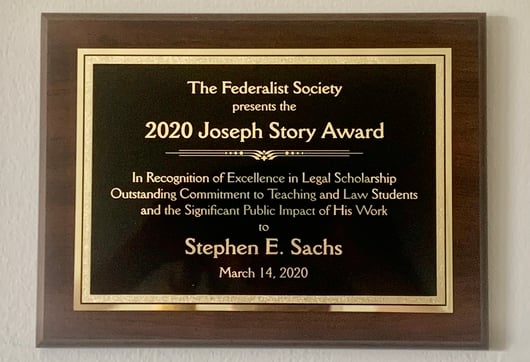
Remarks from the 2020 Joseph Story Award
Chair of the 2020 Joseph Story Award, Brendan Anderson “The constitution is the will, the...
Conservative & Libertarian Legal Scholarship: Civil Procedure
VIII. Civil Procedure
[Return to Table of Contents] VIII. Civil Procedure The Role of the Federal Judge Charles...
Administrative Common Law and the Original Meaning of Judicial Review Under the APA
Administrative Law Practice Group Newsletter - Volume 3, Issue 2, Summer 1999
In 1946 Congress enacted a "comprehensive statement of the right, mechanics, and scope of judicial...