Facts of the Case
Ann Hopkins worked at Price Waterhouse for five years before being proposed for partnership. Although Hopkins secured a $25 million government contract that year, the board decided to put her proposal on hold for the following year. The next year, when Price Waterhouse refused to re-propose her for partnership, she sued under Title VII for sex discrimination. Of 622 partners at Price Waterhouse, 7 were women. The partnership selection process relied on recommendations by other partners, some of whom openly opposed women in advanced positions, but Hopkins also had problems with being overly aggressive and not getting along with office staff.
The district court held that Price Waterhouse had discriminated, but Hopkins was not entitled to full damages because her poor interpersonal skills also contributed to the board’s decision. The U.S. Court of Appeals for the District of Columbia Circuit affirmed, but held that the employer is not liable if it can show by clear and convincing evidence that it would have made the same employment decision in the absence of discrimination.
Questions
Did the Court of Appeals err in requiring the employer to prove it would have made the same employment decision in the absence of discrimination by clear and convincing evidence?
Conclusions
-
Yes in part. In a 6-3 decision, Justice William J. Brennan wrote the plurality opinion reversing the lower court and remanding. The Supreme Court held that the court of appeals applied the right test, but should have placed the burden at “preponderance of the evidence” not “clear and convincing evidence”. On remand, Price Waterhouse would escape liability if it shows it would have denied Hopkins partnership even if she were not a woman.
Justice Byron R. White wrote a concurrence, stating that there was no requirement for the employer to submit objective evidence. The employer’s credible testimony alone was enough. Justice Sandra Day O’Connor wrote a concurrence, expressing that the Court’s opinion was only a supplement to McDonnell Douglas.
Justice Anthony Kennedy wrote a dissent, stating that he would stick with the evidentiary standards from McDonnell Douglas. Chief Justice William H. Rehnquist and Justice Antonin Scalia joined in the dissent.
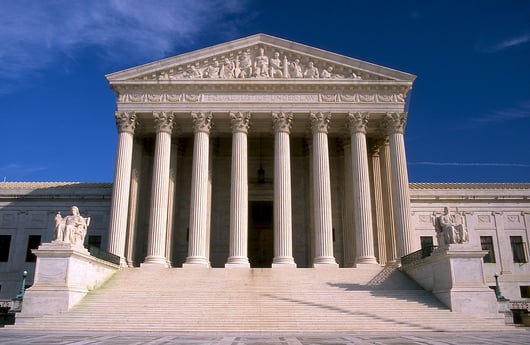
Supreme Court Sticks to the Statute In Latest Wage and Hour Case
In a recent decision, the Supreme Court once again stuck to the text and declined...

Unleashed and Unbound: Living Textualism in Bostock v. Clayton County
Federalist Society Review, Volume 21
Note from the Editor: The Federalist Society takes no positions on particular legal and public...
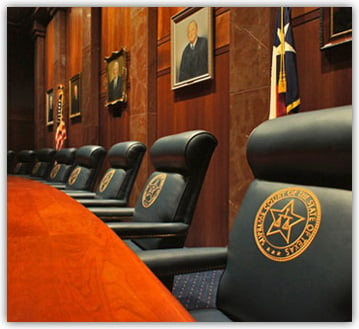
Docket Watch: Alamo Heights Independent School District v. Clark
The Texas Supreme Court Tackles the Issue of “Same-Sex” Sexual Harassment
Texas’s employment discrimination statute (the Texas Commission on Human Rights Act, codified in the Texas...

Alamo Heights Independent School District v. Clark
The Texas Supreme Court Tackles the Issue of “Same-Sex” Sexual Harassment
Texas’s employment discrimination statute (the Texas Commission on Human Rights Act, codified in the Texas...
Circumventing Congress: The Use of Sex-Stereotyping Theory to Expand Protected Classes Under Title VII
Federalist Society Review, Volume 17, Issue 1
Note from the Editor: This article is about the EEOC’s use of the Supreme Court’s...
Two Guiding Trends in Contemporary Labor and Employment Law: Technology and Fairness
Engage Volume 12, Issue 3, November 2011
There are two primary trends guiding contemporary labor and employment law. The first is the...