Facts of the Case
Harry Keyishian and other faculty of the University of Buffalo became state employees in 1962, when the University of Buffalo was merged into the State University of New York system. As state employees, Keyishian and the other faculty members were subject to statutes and administrative regulations meant to prevent the appointment and continued employment of “subversive persons.” Because the appellants refused to sign a statement declaring that they were not Communists and had never been Communists, they were subject to dismissal and/or non-renewal of contract. The appellants sued for declaratory and injunctive relief and argued that the program of statutes and regulations violate the Constitution. A three-judge federal court upheld the constitutionality of the program.
Questions
Are the provisions requiring public servants to formally renounce Communism so overly broad and vague that they are unconstitutional?
Conclusions
-
Yes. Justice William J. Brennan, Jr. delivered the opinion of the 5-4 majority. The Court held that the provisions of the New York plan were defined in such uncertain terms that they infringed upon the constitutional rights of public servants. Because the country had an interest in protecting the First Amendment rights of teachers in order for the educational system to be as free and open as possible, such overly broad and vague requirements both violated the teachers’ rights and were detrimental to the profession. The Court held that the government could only regulate First Amendment rights with “narrow specificity.” The Court also held that specific provisions of the Civil Service Law and Educational Service Law were too overly broad because they prohibit membership in the Communist Party without determining whether or not there was any specific intent to overthrow the United States government.
Justice Tom C. Clark dissented and argued that the duties of a public servant allow the government to inquire into the employee’s fitness to serve in a particular position. He also argued that the provisions in question are specific to actions that “advocate, advise, or teach” the overthrow of the United States government and are not unconstitutionally vague. Justice John M. Harlan, Justice Potter Stewart, and Justice Byron R. White joined in the dissent.
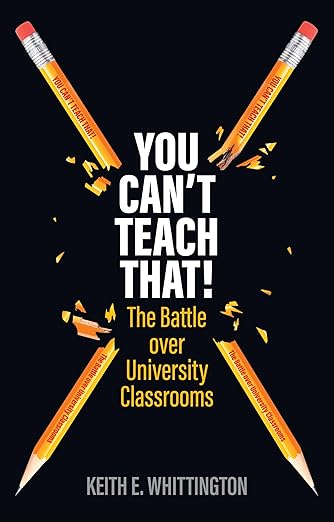
Who Controls What College Professors Teach?
A review of You Can’t Teach That! The Battle Over University Classrooms, by Keith E....

An Academic Freedom Exception to Government Control of Employee Speech
Federalist Society Review, Volume 22
Public employee speech cases often arise as Section 1983 actions in which a public employee...

New Heterodox Academy initiative
Here's the latest from the Heterodox Academy: Over at Heterodox Academy, we have been hearing from...