Facts of the Case
New York voters sought declaratory judgment in a New York federal district court to prevent compliance with Section 4(e) of the Voting Rights Act of 1965. That section provided that no person who successfully completed the sixth grade in a school accredited by the Commonwealth of Puerto Rico in which the language of instruction was other than English shall be denied the right to vote in any election because of his inability to read or write English. The plaintiffs argued that Section 4(e) prevented the enforcement of New York election laws which required an ability to read and write English as a condition of voting. A three-judge panel of the district court granted declaratory judgment and prevented enforcement of Section 4(e). It held that Congress exceeded its constitutionally designated powers in enacting Section 4(e) and usurped the powers reserved to the states under the Tenth Amendment.
Questions
Does Section 4(e) of the Voting Rights Act of 1965 exceed the scope of Congress' powers to enact legislation because it infringes on powers reserved to the states under the Tenth Amendment?
Conclusions
-
No. The Supreme Court held that Section 4(e) is a proper exercise of the powers granted to Congress. With Justice William J. Brennan writing for the majority, the Court reasoned that Congress exercised its powers consistent with those afforded it by Section 5 of the Fourteenth Amendment. The Court then concluded that the Supremacy Clause prevented the enforcement of the New York English literacy requirement.
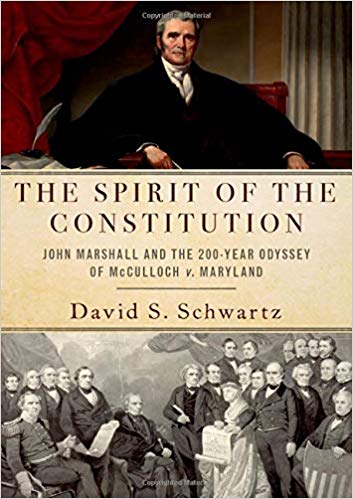
The Mythical McCulloch
Federalist Society Review, Volume 21
A Review of The Spirit of the Constitution: John Marshall and the 200-Year Odyssey of...
Sleeping Giant?: Section Two of the Thirteenth Amendment, Hate Crimes Legislation, and Academia’s Favorite New Vehicle for the Expansion of Federal Power
Engage Volume 13, Issue 3 October 2012
A brief look at the Thirteenth Amendment might suggest that it has rather limited application...
Federalism Revived? The Printz and City of Boerne Decisions
Federalism & Separation of Powers Practice Group Newsletter - Volume 2, Issue 1, Spring 1998
The following program was sponsored by the Federalism and Separation of Powers Practice Group at...