Facts of the Case
President Hoover appointed, and the Senate confirmed, Humphrey as a commissioner of the Federal Trade Commission (FTC). In 1933, President Roosevelt asked for Humphrey's resignation since the latter was a conservative and had jurisdiction over many of Roosevelt's New Deal policies. When Humphrey refused to resign, Roosevelt fired him because of his policy positions. However, the FTC Act only allowed a president to remove a commissioner for "inefficiency, neglect of duty, or malfeasance in office." Since Humphrey died shortly after being dismissed, his executor sued to recover Humphrey's lost salary.
Questions
Did section 1 of the Federal Trade Commission Act unconstitutionally interfere with the executive power of the President?
Conclusions
-
The unanimous Court found that the FTC Act was constitutional and that Humphrey's dismissal on policy grounds was unjustified. The Court reasoned that the Constitution had never given "illimitable power of removal" to the president. Justice Sutherland dismissed the government's main line of defense in this case which relied heavily on the Court's decision in Myers v. United States (1926). In that case the Court upheld the president's right to remove officers who were "units of the executive department." The FTC was different, argued Sutherland, because it was a body created by Congress to perform quasi-legislative and judicial functions. The Myers precedent, therefore, did not apply in this situation.
What Was the Founders' Design for National Security Beyond the Battlefield?
The Founders Gave Us the Tools Series
In this Federalist Society America 250 series, experts analyze modern legal and policy debates through...
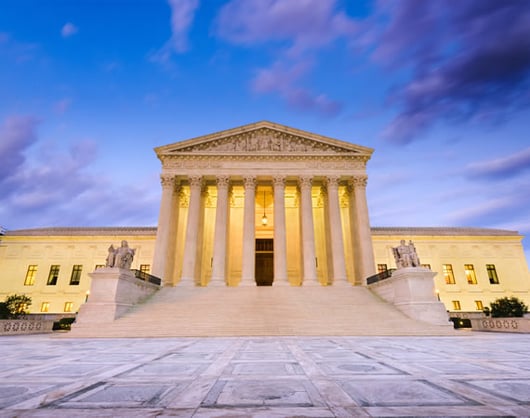
From the Courthouse Steps: Trump v. Slaughter and Trump v. Cook
In Trump v. Slaughter, the Supreme Court held 6-3 that the Federal Trade Commission's (FTC)...
From the Courthouse Steps: Trump v. Slaughter and Trump v. Cook
In Trump v. Slaughter, the Supreme Court held 6-3 that the Federal Trade Commission's (FTC)...
Plenary Session 2: Unitary Executive & Administrative Agencies– Who’s in Charge?
Inaugural Executive Branch Summit
Featuring: Mr. Samuel Adkisson, Associate Counsel to the President, White House Counsel's Office Hon. Daniel Burrows,...

The Presidential Toolbox: Instruments of Executive Power
What are the legal tools available to a President to shape policy and execute the...

The FTC's 2026 Consumer Protection Priorities
What are the FTC’s 2026 priorities in the areas of consumer protection, privacy, and artificial...
Structure Over Spectacle: The Supreme Court's 2024 Term
Federalist Society Review, Volume 26
After several years of headline-grabbing decisions that reshaped national political debate—from abortion and affirmative action...
Courthouse Steps Oral Argument: Trump v. Slaughter
Humphrey's Executor v. United States, decided in 1935, upheld the Federal Trade Commission Act, declaring...
Courthouse Steps Oral Argument: Trump v. Slaughter
Humphrey's Executor v. United States, decided in 1935, upheld the Federal Trade Commission Act, declaring...
Courthouse Steps Oral Argument: Trump v. Slaughter
Humphrey's Executor v. United States, decided in 1935, upheld the Federal Trade Commission Act, declaring...
Showcase Panel 1: Landmark SCOTUS Decisions of the 2020s
2025 National Lawyers Convention
CLE credit for this event is available at On-Demand CLE. This year marks the 20th anniversary...

A Seat at the Sitting - December 2025
The December Docket in 90 Minutes or Less
Each month, a panel of constitutional experts convenes to discuss the Court’s upcoming docket sitting...
Should a Labor Court Replace the Adjudication Function of the NLRB?
The National Labor Relations Board (NLRB) has come under increasing criticism, with some accusing it...

Does "Board Law" Matter after Loper Bright?
Administrative law is in flux, nowhere more so than at the National Labor Relations Board....
Agency Independence and Accountability to the Executive
President Trump’s February 18 “Ensuring Accountability for All Agencies” Executive Order directs independent regulatory agencies...
Litigation Update: Wilcox v. Trump
In late January, President Donald Trump fired Gwynne Wilcox, a member of the National Labor...

You’re Fired! Trump, Tenure Protection, and the Future of Humphrey’s Executor
The recent flurry of firings in the federal government has sparked new questions surrounding the...

Litigation Update: Amazon, the NLRB, and “Captive Audience” Meetings
Section 8(c) of the National Labor Relations Act states an employer’s communication is not an...

Remedies in Presidential Removal Cases: A Shifting Landscape
The Supreme Court's decision in Collins v. Yellen represented a paradigm shift. Now, in cases...
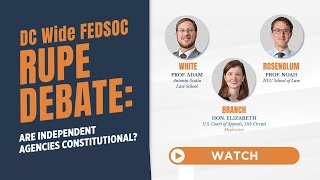
DC-Wide FedSoc Rupe Debate: Are Independent Agencies Constitutional?
Registration is now closed. Join The Federalist Society’s local DC Young Lawyers Chapter and the Georgetown...
Is FTC Administrative Litigation Constitutional?
Axon and Jarkesy have renewed scrutiny of the constitutionality and fairness of FTC’s administrative litigation. For example, the...

Courthouse Steps Oral Argument: Illumina v. FTC
A Regulatory Transparency Project Webinar
In September, a panel of judges on the Fifth Circuit Court of Appeals heard oral...
The Administrative State on Trial?
EBRXI
The Supreme Court continues to accept for review cases that challenge agency authority on separation...

The Implications of the FTC's Proposed Ban on Noncompete Agreements
A Regulatory Transparency Project Webinar
In January 2023, the FTC announced a proposed rule that would ban noncompete agreements across...

Humphrey’s Executor and Presidential Removal Power
In one of its most significant separation of powers opinions, the U.S. Supreme Court decided...
Who Runs the FDIC in a New Administration?
The FDIC board of directors has been convulsed by the widely publicized dispute over who controls...
Panel Two: Where We Might Be Headed: Examining Proposed Antitrust Bills and Their Marketplace Implications
The Antitrust Paradox: Where We've Been and Where We're Going
On September 15, 2021, The Federalist Society's Practice Groups hosted a conference titled The Antitrust...
Debate: The Outer Reaches of the Unitary Executive Theory and the Termination of EEOC General Counsel Sharon Gustafson
This teleforum will include a discussion about the Unitary Executive Theory, its judicial and legislative...

Courthouse Steps Oral Argument Teleforum: Mnuchin v. Collins
The case of Mnuchin v. Collins will have oral arguments before the Supreme Court on December 9,...
Collins v. Mnuchin- Post-Argument SCOTUScast
featuring Elizabeth Slattery
On December 9, 2020 the Supreme Court heard oral argument in Collins v. Mnuchin (consolidated...

Race and Policing
In this teleforum, James R. Copland will discuss competing legislative proposals in Congress, in the...
2020 Annual Supreme Court Round Up
Webinar & Live Stream
On August 10, 2020, the Federalist Society's Washington, D.C. Lawyers Chapter will present its annual...
Deep Dive Episode 120 – FTC Rulemaking: Underutilized Tool or National Nanny Renewed?
A Regulatory Transparency Project Webinar
This expert panel examined recent calls for the Federal Trade Commission (FTC) to engage in...

Executive Power and More
John Malcolm and John Yoo continue their Teleforum series, joining us to discuss recent events...
Courthouse Steps Decision Teleforum: Seila Law LLC v. Consumer Financial Protection Bureau (CFPB)
Financial Services & E-Commerce and Federalism & Separation of Powers Practice Groups Teleforum
In Seila Law LLC v. Consumer Financial Protection Bureau (CFPB), the Supreme Court decided the constitutionality of...
Unitary Executive and Independent Agencies
Executive Branch Review Week Teleforum
Article II of the United States Constitution provides that “The executive Power shall be vested...
Restoring the Executive Power: Revisiting Humphrey's Executor, Reviving the Unitary Executive
Executive Branch Review Week Webinar
The Eighth Annual Executive Branch Review Conference was held on April 28, 2020 via an...
Courthouse Steps Oral Argument: Seila Law LLC v. Consumer Financial Protection Bureau (CFPB)
In Seila Law LLC v. Consumer Financial Protection Bureau (CFPB), the Supreme Court will decide the...
Courthouse Steps Preview: Seila Law LLC v. Consumer Financial Protection Bureau (CFPB)
In Seila Law LLC v. Consumer Financial Protection Bureau (CFPB), the Supreme Court will decide...
Litigation Update: FTC v. Qualcomm
On May 21, 2019, the U.S. District Court for the Northern District of California ruled...
Supreme Court Denies Review of Constitutional Challenge to CFPB
On Jan. 14 the Supreme Court denied the cert petition in State National Bank of...
Revisiting the Community Reinvestment Act
2018 National Lawyers Convention
It is difficult to find anyone today who is satisfied with how CRA currently works....
Showcase Panel II: Balancing Insulation and Accountability of Agency Decisions
2018 National Lawyers Convention
Many federal government decisions that affect Americans’ day-to-day lives are made by agencies. Agency decisions,...
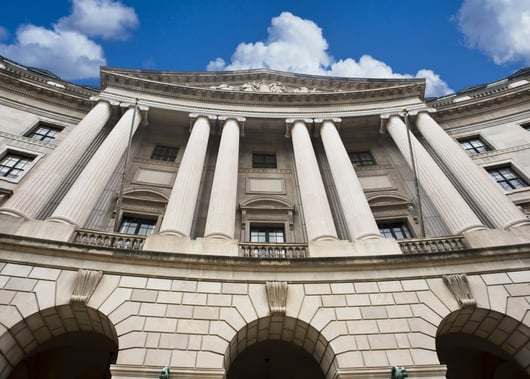
Independent Agencies: How Independent is Too Independent?
2018 National Lawyers Convention
Justice Scalia put it bluntly in Morrison v. Olson: “There are now no lines.” Morrison,...

Humphrey's Executor & Executive Appointments [No. 86]
Short video featuring Gregory Jacob
In 1935, the Supreme Court decided a landmark case which established that the dismissal of...
New Challenge to the Constitutionality of the CFPB
Financial Services & E-Commerce Practice Group and Regulatory Transparency Project Teleforum
Recently the State National Bank of Big Spring filed a petition for certiorari seeking Supreme...
Civil Service Reform
Sixth Annual Executive Branch Review Conference
The Sixth Annual Executive Branch Review Conference is scheduled for Tuesday, April 17 at the...
The Executive Power: Prerogative Versus Delegated Powers – A King Minus Powers Given to Congress or Subservient to the Legislature?
2018 National Student Symposium
What role for the executive was envisioned by the Framers and Founding generation? How did...

En Banc D.C. Circuit Upholds CFPB Constitutionality
Regulatory Transparency Project Teleforum
On Wednesday, January 31, the full United States Court of Appeals for the District of...

Showcase Panel III: The Executive Branch and the Regulatory State
2017 National Lawyers Convention
In recent decades, the President has sought to control the regulatory state through the Office...

17th Annual Barbara K. Olson Memorial Lecture
2017 National Lawyers Convention
On September 11, 2001, at the age of 45 and at the height of her...
Influence of Individual Members of Congress on Agencies
Fifth Annual Executive Branch Review Conference
The Fifth Annual Executive Branch Review Conference will examine the changing and often convoluted relationship...
Courthouse Steps: D.C. Circuit En Banc Argument - Podcast
Federalism & Separation of Powers Practice Group Podcast
The D.C. Circuit heard a rare doubleheader of en banc arguments on major structural separation...
The Legacy of Justice Scalia
2017 Annual Florida Chapters Conference
This panel, The Legacy of Justice Scalia, was held on February 3, 2017, at the...
The Constitutionality of Independent Agencies: The CFPB - Podcast
Litigation Practice Group Podcast
In April, the mortgage lender PHH Corporation challenged the constitutionality of the Consumer Financial Protection...
Luncheon Panel - Regulation and the Rule of Law?
First Annual Executive Branch Review Conference
On June 11, 2013, the Federalist Society's Executive Branch Review Project held its First Annual...
Dodd-Frank Litigation Update: Amended Complaint - Podcast
Financial Service & E-Commerce Practice Group Podcast
Last year, several parties filed a constitutional challenge to parts of the Dodd-Frank financial reform...
Panel 2: Dodd Frank
15th Annual Faculty Conference
The Federalist Society's Facutly Division hosted this panel discussion on "Dodd-Frank" on Saturday, January 5,...
Showcase Panel II: Separation of Powers
2012 National Lawyers Convention
The present Supreme Court was also closely divided in the recent separation of powers case,...
Panel 1: The Rule of Law and the Administrative State
2012 National Student Symposium
The rule of law, whatever that term describes, is one of the central concepts in...
Showcase Panel IV: Ideas for Structural Change: Term Limits, Reviving the Right to Civil Jury Trial, Moving Administrative Law Judges to Article III, and Others
2010 National Lawyers Convention
Are there structural ways that are practically plausible to limit or reduce the power of...
Free Enterprise Fund v. Public Company Accounting Oversight Board - Post-Decision SCOTUScast
SCOTUScast 07-13-10 featuring Steven G. Calabresi
On June 28, 2010, the Supreme Court announced its decision in Free Enterprise Fund v....
PCAOB Debate
Online Debate
This debate will focus on the following questions: Is the Sarbanes-Oxley Act consistent with the...
SCOTUScast 6-15-09 featuring Steven Calabresi
Free Enterprise Fund v. Public Company Accounting Oversight Board
On Wednesday, May 20, the Supreme Court granted certiorari in Free Enterprise Fund v. Public...

Second Annual Alaska Federalist Society Summer Social and SCOTUS Roundup
Alaska Lawyer Chapter
Treadwell-McClure Residence528 N Street
Anchorage, AK 99501