Facts of the Case
Tompkins was walking along the railroad tracks in Pennsylvania when he was hit by an open railcar door. However, in a likely instance of forum shopping, he filed a lawsuit against the railroad company in a federal court in New York, where the corporation was a resident. A federal court jury awarded Tompkins damages. The 1842 Supreme Court decision in Swift v. Tyson ruled that federal courts sitting in diversity jurisdiction should apply federal common law to non-statutory causes of action. Whereas federal common law applied an ordinary negligence standard for the duty of care owed by railroads to people in his situation, Pennsylvania state law would have required Tompkins to show wanton negligence. The payment of Tompkins’s award was stayed during the proceedings.
Questions
Should federal courts sitting in diversity jurisdiction apply state or federal law?
Conclusions
-
Writing for the majority, Justice Louis Dembitz Brandeis decided that it was time to depart from the rule in Swift and seek greater uniformity in how the law is applied. Arguing that the Swift decision went beyond the boundaries of the appropriate constitutional role for the judicial branch, Brandeis wrote that federal courts are not entitled to create their own common law for issues that properly fall within state law. He also suggested that the impact of that decision created vertical separation of powers concerns involving the federal government and the states. Instead, he felt that applying state substantive law would lead to more predictable outcomes for litigants and greater efficiency for courts. Thus, the Court concluded that in diversity jurisdiction cases, courts should apply substantive state law and federal procedural law unless there is a conflict between substantive state and federal law.
Justice Stanley Forman Reed concurred, arguing that the Swift ruling was erroneous rather than unconstitutional.
Justices Pierce Butler and Clark McReynolds dissented. Butler pointed out that neither party had raised a constitutional question in the case, and therefore the Court had decided it on inappropriate grounds. He felt that the Court went beyond its appropriate role in Erie, not Swift.

From Ratio to Auctoritas: The Decline of Reason and the Rise of Authority in American and Roman Law
Federalist Society Review, Volume 26
Are we Rome? In the United States, the question is usually directed at our politics...
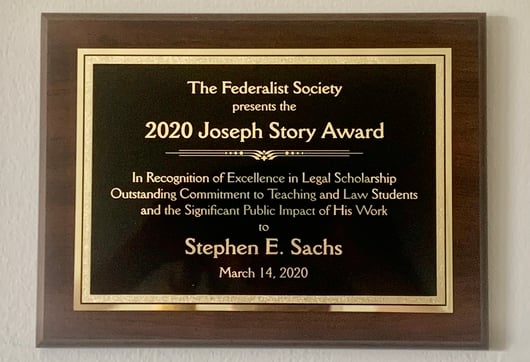
Remarks from the 2020 Joseph Story Award
Chair of the 2020 Joseph Story Award, Brendan Anderson “The constitution is the will, the...
The Upside-Down Constitution by Michael S. Greve
Engage Volume 13, Issue 1, March 2012
“I must study politics and war, that my sons may have liberty to study mathematics...
Shady Grove Orthopedic Associates, P. A. v. Allstate Ins. Co. - Post-Decision SCOTUScast
SCOTUScast 08-10-10 featuring Jonathan F. Mitchell
On March 23, 2010, the Supreme Court announced its decision in Shady Grove Orthopedic Associates,...