Facts of the Case
Brandenburg, a leader in the Ku Klux Klan, made a speech at a Klan rally and was later convicted under an Ohio criminal syndicalism law. The law made illegal advocating "crime, sabotage, violence, or unlawful methods of terrorism as a means of accomplishing industrial or political reform," as well as assembling "with any society, group, or assemblage of persons formed to teach or advocate the doctrines of criminal syndicalism."
Questions
Did Ohio's criminal syndicalism law, prohibiting public speech that advocates various illegal activities, violate Brandenburg's right to free speech as protected by the First and Fourteenth Amendments?
Conclusions
-
The Court's Per Curiam opinion held that the Ohio law violated Brandenburg's right to free speech. The Court used a two-pronged test to evaluate speech acts: (1) speech can be prohibited if it is "directed at inciting or producing imminent lawless action" and (2) it is "likely to incite or produce such action." The criminal syndicalism act made illegal the advocacy and teaching of doctrines while ignoring whether or not that advocacy and teaching would actually incite imminent lawless action. The failure to make this distinction rendered the law overly broad and in violation of the Constitution.
Lessons From John Adams: Defending Unpopular Clients from the Founding Era to the Present
The Founders Gave Us the Tools Series
CLE credit for this event is available at On-Demand CLE. In this Federalist Society America...
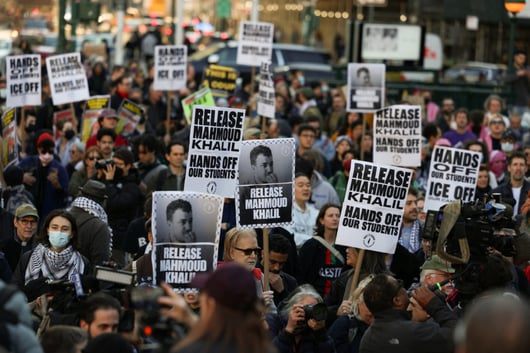
The Case of Mahmoud Khalil: Free Speech or National Security?
Mahmoud Khalil, a Palestinian green card holder, was detained by ICE on March 8 and...
Showcase Panel I: The Age of Group Identity: What is it? How Did We Get Here? How Do We Move Beyond It?
2024 National Lawyers Convention
The generation of political leaders that produced the landmark legislation of the Civil Rights Era...
Talks with Authors: The Indispensable Right
In his new book The Indispensable Right: Free Speech in an Age of Rage, Professor...
Conservatives Talk Presidential Power: End of Year Update on Trials, Impeachment, and Immunities
As 2023 comes to a close, John Malcolm and John Yoo continue their discussion of...
Showcase Panel IV: How Originalist is the Supreme Court?
2023 National Lawyers Convention
Featuring: Prof. J. Joel Alicea, Co-Director, Project on Constitutional Originalism and the Catholic Intellectual Tradition,...
Conservatives Talk Presidential Power: A Look into the Latest Trials, Testimonies, and Plea Deals
John Malcolm and John Yoo continue their discussion of presidential power as they examine the...

Courthouse Steps Oral Argument: United States v. Hansen
On Monday, March 27, 2023 the Supreme Court is set to hear oral argument in...

Litigation Update: Volokh et al v. James
In early December, Prof. Eugene Volokh, Rumble Canada, and Locals Technology filed a complaint in...
Fireside Chat with Nadine Strossen
Free speech champion and icon Nadine Strossen joins Erik Jaffe for a virtual “fireside” chat...

Free Speech and Criminal Intent
Terroristic threats straddle the line between criminal acts and constitutionally protected speech. This is especially...

Social Media Content Control
Telecommunications & Electronic Media and Free Speech Practice Groups Teleforum
In two recently filed lawsuits conservative organizations have complained that Google has restricted their access...
Free Speech & Election Law: Originalism and the First Amendment
2016 National Lawyers Convention
Has Originalism played a significant role in the Supreme Court's free speech jurisprudence? One scholar...
Danish Publisher: Charlie Hebdo and Free Speech in Europe and US - Podcast
Free Speech & Election Law Practice Group Podcast
Lars Hedegaard was prosecuted under the European “incitement to hate” law all the way up...
The Facebook Threat Case -- Elonis v. United States - Podcast
Criminal Law & Procedure Practice Group Podcast
Anthony Douglas Elonis was convicted and sentenced to forty-four months in prison for a series...