Facts of the Case
During hearings of the House Committee on Un-American Activities, Lloyd Barenblatt, a university professor, refused to answer questions concerning his political and religious beliefs along with his associational activities. He was found in contempt of Congress for failing to cooperate with the committee investigation.
Questions
Did the House Committee's investigation into Barenblatt's affiliations with the Communist Party transgress his First Amendment protections which limit congressional inquiries?
Conclusions
-
The divided Court found that the Committee's actions did not violate the First Amendment and, thus, upheld Barenblatt's conviction for contempt of Congress. Justice Harlan noted that the First Amendment does not protect a witness from all lines of questioning. As long as the Congressional inquiry is pursued to "aid the legislative process" and to protect important government interests, then it is legitimate.
Party Like It’s 1935?: Gundy v. United States and the Future of the Non-Delegation Doctrine
Federalist Society Review, Volume 19
Note from the Editor: This article discusses Gundy v. United States, a case involving the...
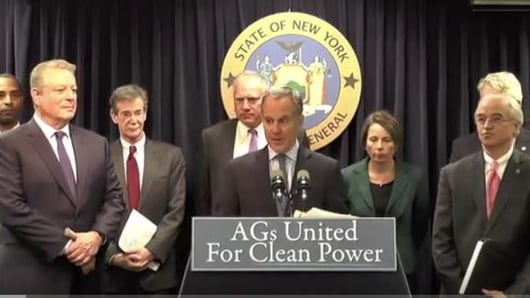
Constitutional Subpoena Power Transcends Views on Climate Debate
The House Science, Space and Technology Committee, chaired by Lamar Smith, R-TX, recently issued subpoenas...
First Principles: Are Judicial and Legislative Oversight of NSA Constitutional?
First Principles: Are Judicial and Legislative Oversight of NSA Constitutional? Robert F. Turner* This issue...
Executive Privilege (Continued)
Online Debate
This past June, the House and Senate Judiciary Committees issued five congressional subpoenas directing the...