
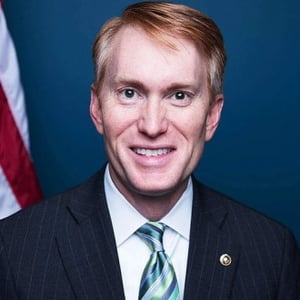
United States Senator from Oklahoma
Senator Lankford of Oklahoma served four years in the U.S. House of Representatives and was elected to the U.S. Senate to complete an unexpired term on November 4, 2014 and re-elected to a full six-year senate term on November 8, 2016.
As chairman of the Senate Subcommittee on Regulatory Affairs and Federal Management, Lankford fights unnecessary and burdensome regulation and advocates for a more restrained federal government.
Personal faith, local decision-making, and opportunity for every person, regardless of their background, are core values for Senator Lankford. Before his time in Congress, from 1995 to 2009, the Senator served as Director of Student Ministry at the Baptist Convention of Oklahoma and Director of the Falls Creek Youth Camp, the largest youth camp in the United States, with more than 51,000 individuals attending each summer.
Committee Assignments:

Senior Vice President, Bipartisan Policy Center
G. William Hoagland is a BPC senior vice president. In this capacity, he helps direct and manage fiscal, health, and economic policy analyses.
Before joining BPC in September 2012, Hoagland served as vice president of public policy for CIGNA Corporation, working with business leaders, trade associations, business coalitions, and interest groups to develop CIGNA policy on health care reform issues at both the federal and state levels.
Prior to joining CIGNA, Hoagland completed 33 years of federal government service, including 25 years on the U.S. Senate staff. From 2003 to 2007, he served as the director of budget and appropriations in the office of Senate Majority Leader Bill Frist. He assisted in evaluating the fiscal impact of major legislation and helped to coordinate budget policy for the Senate leadership.
From 1982 to 2003, Hoagland served as a staff member and director of the Senate Budget Committee, reporting to U.S. Sen. Pete V. Domenici, chairman and ranking member of the committee during this period. He participated in major federal budget negotiations, including the 1985 Gramm-Rudman-Hollings Budget Deficit Reduction Act, the 1990 Omnibus Budget Reconciliation Act, and the historic 1997 Balanced Budget Agreement.
In 1981, he served as the administrator of the Department of Agriculture’s Food and Nutrition Service and as a special assistant to the Secretary of Agriculture. He was one of the first employees of the Congressional Budget Office in 1975, working with its first director, Alice Rivlin.
In both 1997 and 2005, National Journal listed him as one of the “Washington 100 Decision Makers” and referred to him as a “bottom-liner who is not a hard-liner.” Roll Call consistently named Hoagland as one of the top 50 Hill staffers. In 2002, he received the James L. Blum Award for Distinguished Service in Budgeting. The National Association of State Budget Officers honored him in 2004 with its Leadership in Budgeting Award, and in 2006 he was inducted as a fellow in the National Academy of Public Administration.
Hoagland is an affiliate professor of public policy at the George Mason University and a board member of the Committee for a Responsible Federal Budget, the National Academy of Social Insurance, and the National Advisory Committee to the Workplace Flexibility 2010 Commission. In 2009, he was appointed to the Peterson-Pew Commission on Budget Reform examining the overall structure of the budget, authorization, and appropriations process, and was a member of BPC’s Debt Reduction Task Force that published Restoring America’s Future in November 2010. He coordinated BPC’s 2013 report, A Bipartisan Rx for Patient-Centered Care and System-Wide Cost Containment. In April 2015, he co-chaired the National Academy of Social Insurance report, “Addressing Pricing Power in Health Care Markets.”
Hoagland attended the U.S. Merchant Marine Academy and holds degrees from Purdue University and The Pennsylvania State University. His family’s Indiana family farm was recognized as a “Hoosier Homestead” for having remained in the family for over a century.

Associate Professor of Law, Emory University School of Law
Matthew B. Lawrence is associate professor of law. Lawrence researches and publishes on health care finance, administrative law, and addictions. He has written widely on these subjects with articles published or forthcoming in Columbia Law Review; Florida Law Review; Duke Law Journal; Harvard Law and Policy Review; the Journal of Law, Medicine, and Ethics; New York University Law Review; William & Mary Law Review; and Yale Law Journal, among other journals.
In addition to his teaching and scholarship, Lawrence possesses a wealth of experience in the federal government. He most recently served as a special legal advisor to the US House of Representatives Budget Committee (Majority). Previously, he worked on health care regulatory issues during the Obama and Trump Administrations as a trial attorney in the Department of Justice’s Federal Programs Branch and attorney advisor in the Office of Management and Budget’s Office of General Counsel in the Executive Office of the President. In 2016, he received an individual special commendation award for his defense of Affordable Care Act programs while serving as trial attorney in the US Department of Justice.
Before coming to Emory Law Lawrence was assistant professor of law at Pennsylvania State University (Dickinson Law), where he also held a courtesy appointment as assistant professor at Penn State College of Medicine in the Department of Surgery. He was recognized by the American Society for Law, Medicine, and Ethics as a 2017 Health Law Scholar, and is affiliate faculty at Harvard Law School’s Petrie-Flom Center for Health Law Policy, Bioethics, and Biotechnology, where he was previously a fellow.
Lawrence is a graduate of New York University School of Law and Brown University; and he served as a law clerk to the Honorable Douglas H. Ginsburg on the US Court of Appeals for the DC Circuit.
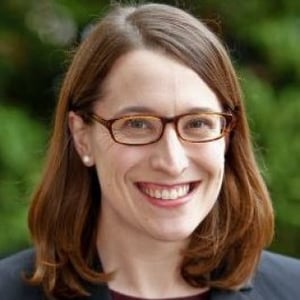
Senior Fellow - Governance Studies, Brookings Institution
Molly Reynolds is a senior fellow in Governance Studies at Brookings. She studies Congress, with an emphasis on how congressional rules and procedure affect domestic policy outcomes.
She is the author of the book, "Exceptions to the Rule: The Politics of Filibuster Limitations in the U.S. Senate," which explores creation, use, and consequences of the budget reconciliation process and other procedures that prevent filibusters in the U.S. Senate. Current research projects include work on oversight in the House of Representatives, congressional reform, and the congressional budget process. She also supervises the maintenance of "Vital Statistics on Congress," Brookings’s long-running resource on the first branch of government.
Reynolds received her Ph.D. in political science and public policy from the University of Michigan and her A.B. in government from Smith College, and previously served as a senior research coordinator in the Governance Studies program at Brookings. In addition, she has served as an instructor at George Mason University.

Senior Fellow and Director of Constitutional Studies, Manhattan Institute
Ilya Shapiro is a senior fellow and director of constitutional studies at the Manhattan Institute and a contributing editor of City Journal. Previously he was executive director and senior lecturer at the Georgetown Center for the Constitution, and before that a vice president of the Cato Institute.
Shapiro is the author of Lawless: The Miseducation of America’s Elites (2025) and Supreme Disorder: Judicial Nominations and the Politics of America’s Highest Court (2020), coauthor of Religious Liberties for Corporations? (2014), and editor of 11 volumes of the Cato Supreme Court Review (2008-18). He has contributed to a variety of academic, popular, and professional publications, including the Wall Street Journal, Harvard Journal of Law & Public Policy, Washington Post, Los Angeles Times, USA Today, National Review, and Newsweek. He also regularly provides commentary for various media outlets, writes the Shapiro’s Gavel newsletter on Substack, and once appeared on the Colbert Report.
Shapiro has testified many times before Congress and state legislatures and has filed more than 500 amicus curiae “friend of the court” briefs in the Supreme Court. He lectures regularly on behalf of the Federalist Society, is a member of the board of fellows of the Jewish Policy Center, was an inaugural Washington Fellow at the National Review Institute, and has been an adjunct law professor at the George Washington University and University of Mississippi. He is also the chairman of the board of advisers of the Mississippi Justice Institute, a barrister in the Edward Coke Appellate Inn of Court, and a former member of the Virginia Advisory Committee to the U.S. Commission on Civil Rights.
Earlier in his career, Shapiro was a special assistant/adviser to the Multi-National Force in Iraq on rule-of-law issues and practiced at Patton Boggs and Cleary Gottlieb. Before entering private practice, he clerked for Judge E. Grady Jolly of the U.S. Court of Appeals for the Fifth Circuit. He holds an AB from Princeton University, an MSc from the London School of Economics, and a JD from the University of Chicago Law School.
Senior Vice President, Bipartisan Policy Center
G. William Hoagland is a BPC senior vice president. In this capacity, he helps direct and manage fiscal, health, and economic policy analyses.
Before joining BPC in September 2012, Hoagland served as vice president of public policy for CIGNA Corporation, working with business leaders, trade associations, business coalitions, and interest groups to develop CIGNA policy on health care reform issues at both the federal and state levels.
Prior to joining CIGNA, Hoagland completed 33 years of federal government service, including 25 years on the U.S. Senate staff. From 2003 to 2007, he served as the director of budget and appropriations in the office of Senate Majority Leader Bill Frist. He assisted in evaluating the fiscal impact of major legislation and helped to coordinate budget policy for the Senate leadership.
From 1982 to 2003, Hoagland served as a staff member and director of the Senate Budget Committee, reporting to U.S. Sen. Pete V. Domenici, chairman and ranking member of the committee during this period. He participated in major federal budget negotiations, including the 1985 Gramm-Rudman-Hollings Budget Deficit Reduction Act, the 1990 Omnibus Budget Reconciliation Act, and the historic 1997 Balanced Budget Agreement.
In 1981, he served as the administrator of the Department of Agriculture’s Food and Nutrition Service and as a special assistant to the Secretary of Agriculture. He was one of the first employees of the Congressional Budget Office in 1975, working with its first director, Alice Rivlin.
In both 1997 and 2005, National Journal listed him as one of the “Washington 100 Decision Makers” and referred to him as a “bottom-liner who is not a hard-liner.” Roll Call consistently named Hoagland as one of the top 50 Hill staffers. In 2002, he received the James L. Blum Award for Distinguished Service in Budgeting. The National Association of State Budget Officers honored him in 2004 with its Leadership in Budgeting Award, and in 2006 he was inducted as a fellow in the National Academy of Public Administration.
Hoagland is an affiliate professor of public policy at the George Mason University and a board member of the Committee for a Responsible Federal Budget, the National Academy of Social Insurance, and the National Advisory Committee to the Workplace Flexibility 2010 Commission. In 2009, he was appointed to the Peterson-Pew Commission on Budget Reform examining the overall structure of the budget, authorization, and appropriations process, and was a member of BPC’s Debt Reduction Task Force that published Restoring America’s Future in November 2010. He coordinated BPC’s 2013 report, A Bipartisan Rx for Patient-Centered Care and System-Wide Cost Containment. In April 2015, he co-chaired the National Academy of Social Insurance report, “Addressing Pricing Power in Health Care Markets.”
Hoagland attended the U.S. Merchant Marine Academy and holds degrees from Purdue University and The Pennsylvania State University. His family’s Indiana family farm was recognized as a “Hoosier Homestead” for having remained in the family for over a century.
United States Senator from Oklahoma
Senator Lankford of Oklahoma served four years in the U.S. House of Representatives and was elected to the U.S. Senate to complete an unexpired term on November 4, 2014 and re-elected to a full six-year senate term on November 8, 2016.
As chairman of the Senate Subcommittee on Regulatory Affairs and Federal Management, Lankford fights unnecessary and burdensome regulation and advocates for a more restrained federal government.
Personal faith, local decision-making, and opportunity for every person, regardless of their background, are core values for Senator Lankford. Before his time in Congress, from 1995 to 2009, the Senator served as Director of Student Ministry at the Baptist Convention of Oklahoma and Director of the Falls Creek Youth Camp, the largest youth camp in the United States, with more than 51,000 individuals attending each summer.
Committee Assignments:
Associate Professor of Law, Emory University School of Law
Matthew B. Lawrence is associate professor of law. Lawrence researches and publishes on health care finance, administrative law, and addictions. He has written widely on these subjects with articles published or forthcoming in Columbia Law Review; Florida Law Review; Duke Law Journal; Harvard Law and Policy Review; the Journal of Law, Medicine, and Ethics; New York University Law Review; William & Mary Law Review; and Yale Law Journal, among other journals.
In addition to his teaching and scholarship, Lawrence possesses a wealth of experience in the federal government. He most recently served as a special legal advisor to the US House of Representatives Budget Committee (Majority). Previously, he worked on health care regulatory issues during the Obama and Trump Administrations as a trial attorney in the Department of Justice’s Federal Programs Branch and attorney advisor in the Office of Management and Budget’s Office of General Counsel in the Executive Office of the President. In 2016, he received an individual special commendation award for his defense of Affordable Care Act programs while serving as trial attorney in the US Department of Justice.
Before coming to Emory Law Lawrence was assistant professor of law at Pennsylvania State University (Dickinson Law), where he also held a courtesy appointment as assistant professor at Penn State College of Medicine in the Department of Surgery. He was recognized by the American Society for Law, Medicine, and Ethics as a 2017 Health Law Scholar, and is affiliate faculty at Harvard Law School’s Petrie-Flom Center for Health Law Policy, Bioethics, and Biotechnology, where he was previously a fellow.
Lawrence is a graduate of New York University School of Law and Brown University; and he served as a law clerk to the Honorable Douglas H. Ginsburg on the US Court of Appeals for the DC Circuit.
Senior Fellow - Governance Studies, Brookings Institution
Molly Reynolds is a senior fellow in Governance Studies at Brookings. She studies Congress, with an emphasis on how congressional rules and procedure affect domestic policy outcomes.
She is the author of the book, "Exceptions to the Rule: The Politics of Filibuster Limitations in the U.S. Senate," which explores creation, use, and consequences of the budget reconciliation process and other procedures that prevent filibusters in the U.S. Senate. Current research projects include work on oversight in the House of Representatives, congressional reform, and the congressional budget process. She also supervises the maintenance of "Vital Statistics on Congress," Brookings’s long-running resource on the first branch of government.
Reynolds received her Ph.D. in political science and public policy from the University of Michigan and her A.B. in government from Smith College, and previously served as a senior research coordinator in the Governance Studies program at Brookings. In addition, she has served as an instructor at George Mason University.
Senior Fellow and Director of Constitutional Studies, Manhattan Institute
Ilya Shapiro is a senior fellow and director of constitutional studies at the Manhattan Institute and a contributing editor of City Journal. Previously he was executive director and senior lecturer at the Georgetown Center for the Constitution, and before that a vice president of the Cato Institute.
Shapiro is the author of Lawless: The Miseducation of America’s Elites (2025) and Supreme Disorder: Judicial Nominations and the Politics of America’s Highest Court (2020), coauthor of Religious Liberties for Corporations? (2014), and editor of 11 volumes of the Cato Supreme Court Review (2008-18). He has contributed to a variety of academic, popular, and professional publications, including the Wall Street Journal, Harvard Journal of Law & Public Policy, Washington Post, Los Angeles Times, USA Today, National Review, and Newsweek. He also regularly provides commentary for various media outlets, writes the Shapiro’s Gavel newsletter on Substack, and once appeared on the Colbert Report.
Shapiro has testified many times before Congress and state legislatures and has filed more than 500 amicus curiae “friend of the court” briefs in the Supreme Court. He lectures regularly on behalf of the Federalist Society, is a member of the board of fellows of the Jewish Policy Center, was an inaugural Washington Fellow at the National Review Institute, and has been an adjunct law professor at the George Washington University and University of Mississippi. He is also the chairman of the board of advisers of the Mississippi Justice Institute, a barrister in the Edward Coke Appellate Inn of Court, and a former member of the Virginia Advisory Committee to the U.S. Commission on Civil Rights.
Earlier in his career, Shapiro was a special assistant/adviser to the Multi-National Force in Iraq on rule-of-law issues and practiced at Patton Boggs and Cleary Gottlieb. Before entering private practice, he clerked for Judge E. Grady Jolly of the U.S. Court of Appeals for the Fifth Circuit. He holds an AB from Princeton University, an MSc from the London School of Economics, and a JD from the University of Chicago Law School.

Necessary & Proper Episode 74: Can Congress Improve Budget Transparency and Process?
James Lankford, G. William Hoagland, Matthew B. Lawrence, Molly Reynolds, Ilya Shapiro
Some experts argue that the first and most important place for congressional reform is its...
Can Congress Improve Budget Transparency and Process?
G. William Hoagland, James Lankford, Matthew B. Lawrence, Molly Reynolds, Ilya Shapiro
Article I Initiative Virtual Event
Some experts argue that the first and most important place for congressional reform is its...