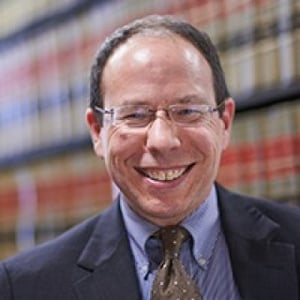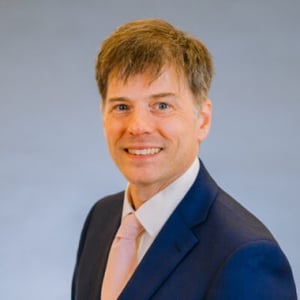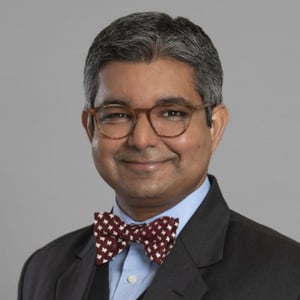
Professor Candeub joined the MSU Law faculty in fall 2004. He is also a Fellow with MSU's Institute of Public Utilities. Prior to joining MSU, he served as an advisor at the Federal Communications Commission (FCC). From 1998 to 2000, Professor Candeub was a litigation associate for the Washington D.C. firm of Jones, Day, Reavis & Pogue and also has served as a corporate associate with Cleary, Gottlieb, Steen & Hamilton, also in Washington, D.C. Immediately following law school, he clerked for Chief Judge J. Clifford Wallace, U.S. Court of Appeals for the Ninth Circuit. While in law school, Professor Candeub was an articles editor for the University of Pennsylvania Law Review.
Professor Candeub's scholarly interests focus on the law and regulation of communications, internet, technology. His numerous law review articles and scholarly papers have placed him at the center of legal and policy controversies, and he often writes for popular outlets such as the Wall Street Journal and US News. Federal courts, including the U.S. Supreme Court, have cited and relied upon his work.
He joined the Trump administration in 2019 as Deputy Assistant Secretary of Commerce for Telecommunications and Information and assumed the role of Acting Assistant Secretary. He later joined the Department of Justice as Deputy Associate Attorney General.
Professor Candeub is a senior fellow at the D.C.-based Center of Renewing America.
*****
A person listed on this page has spoken or otherwise participated in Federalist Society events, publications, or multimedia presentations. A person's appearance on this list does not imply any other endorsement or relationship between the person and the Federalist Society. In most cases, the biographical information on a person's bio page is provided directly by the person, and the Federalist Society does not edit or otherwise endorse that information. The Federalist Society takes no position on particular legal or public policy issues. All expressions of opinion by a speaker or author are those of the individual.
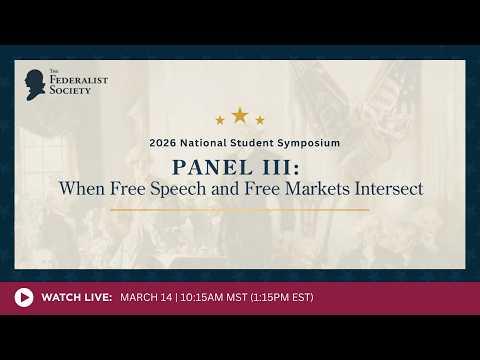
Panel III: When Free Speech and Free Markets Intersect
2026 National Student Symposium
Beus Center for Law and Society111 E. Taylor Street
Phoenix, AZ 85004



Supreme Court Roundup
Michigan State Student Chapter
Michigan State College of Law648 N Shaw Ln
East Lansing, MI 48824
Panel III: When Free Speech and Free Markets Intersect
2026 National Student Symposium
Featuring: Prof. Adam Candeub, Professor of Law, Michigan State University (currently serving as FCC General Counsel)...
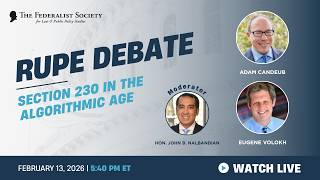
Arthur N. Rupe Debate: Section 230 in the Algorithmic Age
The Michigan Law Federalist Society is pleased to host students and attorneys from across...
Panel: Regulation of Algorithms
Opaque algorithms shape what news stories you see on social media, dictate how artificial intelligence...
Panel: Regulation of Algorithms
Opaque algorithms shape what news stories you see on social media, dictate how artificial intelligence...
Free Speech Coalition v. Paxton: Age Verification for Porn Sites Is Commonsense Policy and Constitutionally Sound
Age verification mandates are among society’s most widespread and prosaic legal obligations. States require age...