
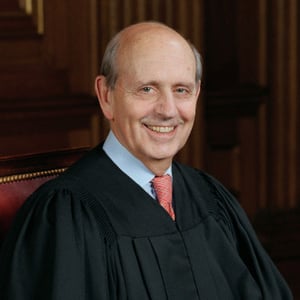
Former Associate Justice, United States Supreme Court
Stephen G. Breyer was born in San Francisco, California, August 15, 1938. He married Joanna Hare in 1967, and has three children - Chloe, Nell, and Michael. He received an A.B. from Stanford University, a B.A. from Magdalen College, Oxford, and an LL.B. from Harvard Law School. He served as a law clerk to Justice Arthur Goldberg of the Supreme Court of the United States during the 1964 Term, as a Special Assistant to the Assistant U.S. Attorney General for Antitrust, 1965–1967, as an Assistant Special Prosecutor of the Watergate Special Prosecution Force, 1973, as Special Counsel of the U.S. Senate Judiciary Committee, 1974–1975, and as Chief Counsel of the committee, 1979–1980. He was an Assistant Professor, Professor of Law, and Lecturer at Harvard Law School, 1967–1994, a Professor at the Harvard University Kennedy School of Government, 1977–1980, and a Visiting Professor at the College of Law, Sydney, Australia and at the University of Rome. From 1980–1990, he served as a Judge of the United States Court of Appeals for the First Circuit, and as its Chief Judge, 1990–1994. He also served as a member of the Judicial Conference of the United States, 1990–1994, and of the United States Sentencing Commission, 1985–1989. President Clinton nominated him as an Associate Justice of the Supreme Court, and he took his seat August 3, 1994. Justice Breyer retired from the Supreme Court on June 30, 2022.

U.S. Court of Appeals, Seventh Circuit
Frank H. Easterbrook is a judge of the United States Court of Appeals for the Seventh Circuit and a Senior Lecturer at the Law School of the University of Chicago. He was Chief Judge from 2006–2013. Before joining the court in 1985, he was the Lee andBrena Freeman Professor of Law at the University of Chicago, where he taught and wrote in antitrust, securities, corporate law, jurisprudence, and criminal procedure. He has published The Economic Structure of Corporate Law (with Daniel R. Fischel) and about 100 scholarly articles. He served as Co-Editor of the Journal of Law and Economics from 1982 to 1991 and as a member of the Judicial Conference’s Standing Committee on Rules of Practice and Procedure from 1991 to 1997. Before joining the faculty of the Law School in 1979, Judge Easterbrook was Deputy Solicitor General of the United States. He holds degrees from Swarthmore College (B.A. with high honors, 1970) and the University of Chicago (J.D. cum laude, 1973), and is a member of the American Academy of Arts and Sciences, the American Law Institute, the Mont Pelerin Society, Phi Beta Kappa, and the Order of the Coif.
Former Executive Director, Federal Defender Program
Mr. MacCarthy graduated at the top of his class from St. Joseph's College in 1955, with a B.A. in Philosophy. After serving as a Lieutenant in the Marines, he attended law school at DePaul, graduating again in the top ten percent of his class in 1960. Following graduation, he served as an Assistant Professor of contracts and real property before beginning a clerkship to former Chief Judge William J. Campbell of the US District Court for the Northern District of Illinois and serving as Illinois Special Assistant Attorney General, specializing in civil trials and appeals. In 1966, he began serving as Executive Director of the Federal Defender Program in the US District Court for the Northern District of Illinois. He was selected for the position by the judges of the District Court and the deans of the six Chicago law schools. As Executive Director, Mr. MacCarthy was primarily responsible for the administration of the unique and highly successful program that provides counsel for some 1500 defendants each year who are charged with federal crimes but are unable to afford private counsel. Since its beginning, the office is frequently reported as being one of the best defender offices in the nation. Always a strong believer in mentoring, Mr. MacCarthy has authored and published over twenty legal articles. Terrence MacCarthy is a member of the American, Illinois, Chicago, Federal and Seventh Circuit Bar Associations, the Illinois Attorneys for Criminal Justice, the National College of Criminal Defense, the National Legal Aid & Defender Association and the National Association of Criminal Defense Lawyers serving on the Board of each. He has been awarded the DePaul University College of Law 1994 Alumni Service Award, the 1993 National Association of Criminal Lawyers Distinguished Service Award, the Illinois Attorneys for Criminal Justice 1993 Annual Award for Extraordinary Contribution to the Goals and Ideals of the Association, the California Attorneys for Criminal Justice 1990 Annual Award for Significant Contribution to Criminal Justice and the 1989 University of Virginia School of Law William J. Brennan, Jr. Award, presented to him by Justice Brennan.
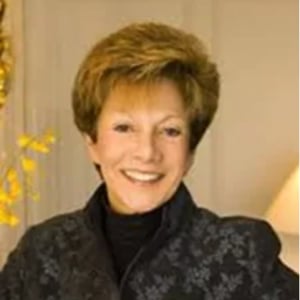
President, Education Executives, LLC
Ilene H. Nagel is President of Education Executives, LLC, a consulting firm that specializes in the search for AAU and research university presidents, provosts, and deans, as well as the search for senior leaders of distinguished scientific organizations. In addition, Ilene has led the search for the VP for Health Sciences and/or Dean of Medicine for Hopkins, Stanford, UCLA, the University of Michigan, Harvard, Emory, UVA, Brown, UT Southwestern, UAB, Stony Brook, SUNY Buffalo, Indiana University, among others, as well as a variety of chair searches for academic medical centers, and the search for the CEO of the hospital systems for Stanford and for UCLA.
From 2005-2016, Ilene led the Higher Education practice for Russell Reynolds Associates, an internationally renowned executive search firm; her clients included Harvard, MIT, Stanford, Lehigh, USC, Northwestern, the University of Pennsylvania, NYU, Johns Hopkins, Duke, Georgetown, Washington University, Brown, Emory, UCLA, UVA, UCSD, the University of Michigan, the University of North Carolina, Chapel Hill, UT Austin, the University of Minnesota, and a host of others, including, but not limited to the Fred Hutchinson Cancer Center, the Salk Institute for Biological Studies, the Smithsonian, the Moore Foundation, and Brookhaven National Laboratory.
Before becoming a search consultant, Ilene had more than 30 years’ experience as an academic, with professorial appointments in several AAU research universities. Most recently, Ilene served as the Executive Vice Chancellor (chief academic officer) at the University of California, Santa Barbara. Before joining the University of California, Ilene was Dean of the Graduate School and Associate Provost for Research at the University of Maryland, College Park. Previously, she was on the law faculty at Indiana University, Bloomington, where she was a tenured Full Professor, with a joint appointment in the College of Arts and Sciences. During her 20+ year tenure at Indiana University, Ilene took several leaves of absence to accept a variety of visiting faculty appointments at Yale Law School, Cambridge University, Columbia University School of Law, and George Washington University’s National Law Center.
Ilene received her B.A., magna cum laude, from Hunter College, and her M.A. and Ph.D. from New York University. She did a post-doctoral fellowship at the University of Minnesota, and received her Master’s of Legal Studies from Stanford Law School. She was a Guggenheim Fellow at Yale Law School, a Visiting Scholar at the Bellagio Conference Center in Italy, and a Visiting Scholar at Cambridge University.
In addition to her academic appointments, Ilene was nominated by the President, and confirmed by the United States Senate to serve a 6-year term in the federal judiciary, as a Member of the United States Sentencing Commission. She ultimately served for 9 years, full time, from 1985-1994, under three United States presidents, while retaining her faculty appointments on a part time basis.
Ilene serves as a corporate board member of Strada Education Network, an Indiana based Higher Education company, as well as a member of the Board of CGS (the Celerian Group), a subsidiary of Blue Cross Blue Shield of South Carolina. In addition, Ilene served for several terms on the Board of the Santa Barbara Museum of Art, and on the Board of Santa Barbara Visiting Nurse and Hospice Association. She is a past and now honorary member of the Board of the Santa Barbara International Film Festival, and a prior member of the Alfred University Board of Trustees. She is also presently serving as a Board member of the Cape Ann Museum, and the Birnam Wood Golf Club.
Ilene and her husband, contemporary sculptor Aristides Burton Demetrios, reside in Montecito, California. Aris is a graduate of Harvard University; he is the son of Virginia Lee Burton, renowned children’s book author and illustrator, and George Demetrios, a classical sculptor.
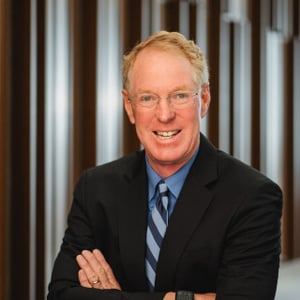
Ronald N. Boyce Presidential Professor of Criminal Law and University Distinguished Professor of Law, The University of Utah College of Law
Paul G. Cassell is an internationally recognized legal scholar on criminal and civil justice, crime victims' rights, constitutional law, evidence, judicial process, and other legal issues. Cassell received a B.A. (1981) and a J.D. (1984) from Stanford University, where he graduated Order of the Coif and was President of the Stanford Law Review. He clerked for then-Judge Antonin Scalia when Scalia was on the U.S. Court of Appeals for the D.C. Circuit (1984-85) and for Chief Justice Warren Burger of the United States Supreme Court (1985-86). Cassell then served as an Associate Deputy Attorney General with the U.S. Justice Department (1986-88) and as an Assistant U.S. Attorney for the Eastern District of Virginia (1988 to 1991). Cassell joined the faculty at the College of Law in 1992, where he taught full-time until he was sworn in as a U.S. District Court Judge for the District of Utah in July 2002. In November 2007, he resigned his judgeship to return full-time to the College of Law to teach, write, and litigate concerning issues relating to crime victims' rights and criminal and civil justice reform. Professor Cassell has also published numerous law review articles in journals such as the Stanford Law Review, the Michigan Law Review, the Harvard Journal of Law and Public Policy, and the Journal of Criminal Law and Criminology. He is a co-author of the nation's only law school textbook on crime victims' rights, Victims in Criminal Procedure (various editions, most recently in its fifth edition published in 2025). Professor Cassell has argued pro bono cases relating to criminal procedure and crime victims' rights before the United States Supreme Court, the 2nd, 4th, 5th, 6th, 7th, 8th, 9th, 10th, 11th, and D.C. Circuits (including the 5th and 11th Circuits en banc), several U.S. District Courts, the Utah Supreme Court, and the Arizona Supreme Court. In 2020, Cassell received the Ronald Wilson Reagan Public Policy Award - National Crime Victims' Service Award from the U.S. Department of Justice. Cassell is a member of the American Law Institute, a fellow of the American Bar Foundation, and an inaugural member of the Council on Criminal Justice. He is also an occasional blogger at The Volokh Conspiracy.
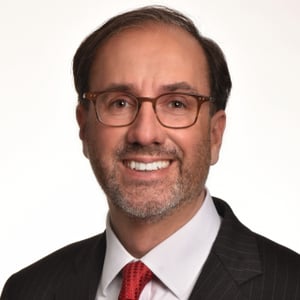
President and CEO, The Buckeye Institute
Robert Alt is the President and Chief Executive Officer of The Buckeye Institute where he has catalyzed exponential growth since he took the organization’s helm in 2012. He has since founded Buckeye’s renowned Economic Research Center and established its impactful Legal Center.
Alt is a distinguished scholar and attorney with particular expertise in legal policy, criminal justice, national security, and constitutional law. He previously worked for former U.S. Attorney General Edwin Meese III, regularly provides commentary on television and radio programs, and his writings have appeared in countless outlets.
In 2004, Alt spent five months in Iraq as an embedded war correspondent.
Alt has testified before Congress multiple times—including at the confirmation hearings for U.S. Supreme Court Justice Elena Kagan—the Federal Election Commission regarding matters of constitutional and administrative law, and numerous state legislatures.
Alt serves as an officer on the boards of The Philadelphia Society and the Federalist Society’s Columbus Lawyers Chapter. He taught national security law, criminal law, and legislation at Case Western Reserve University School of Law, as well as constitutional law and political parties and interest groups at Ashland University.
Alt earned his Doctor of Law degree from The University of Chicago Law School, where he was Symposium Editor and the winner of the Mulroy Prize for Excellence in Appellate Advocacy as well as research assistant to Professor Richard Epstein. Following law school, he clerked for Judge Alice Batchelder on the U.S. Court of Appeals for the Sixth Circuit. Alt graduated with his Bachelor of Arts in philosophy and political science magna cum laude from Azusa Pacific University where he also won the Outstanding Senior Award in Political Science.
Alt is an accomplished high-altitude alpinist and endurance athlete who has successfully climbed 6.75 of the famed Seven Summits of the World including Mount Everest. He is the creator of PROFOUND CLIMBING™ and a frequent speaker across the country and around the world on legal and public policy topics as well as effective leadership, management, decision-making, and teamwork in contexts ranging from extraordinary life/death situations to ordinary professional/business settings.

Vice President, Edwin Meese III Institute for the Rule of Law, Advancing American Freedom
John G. Malcolm oversees Advancing American Freedom’s work to increase understanding of the Constitution and the rule of law as Vice President of the organization’s Edwin Meese III Institute for the Rule of Law. Malcolm brings to the challenge a wealth of legal expertise and experience in both the public and private sectors.
Prior to joining Advancing American Freedom in 2025, Malcolm was the Vice President of the Institute for Constitutional Government and the Director of the Meese Center for Legal and Judicial Studies at the Heritage Foundation. Prior to joining Heritage in 2012, Malcolm was general counsel at the U.S. Commission on International Religious Freedom, as well as a distinguished practitioner in residence at Pepperdine Law School. From 2004 to 2009, Malcolm was executive vice president and director of worldwide anti-piracy operations for the Motion Picture Association.
Malcolm served as a deputy assistant attorney general in the Department of Justice’s Criminal Division from 2001 to 2004, where he oversaw sections on computer crime and intellectual property, domestic security, child exploitation and obscenity, and special investigations. Immediately prior to that, he was a founding partner in the Atlanta law firm of Malcolm & Schroeder, LLP.
From 1990 to 1997, Malcolm was an assistant U.S. attorney in Atlanta, assigned to the fraud and public corruption section, and also an associate independent counsel, investigating fraud and abuse in the Department of Housing and Urban Development. He was honored with the Director’s Award for Superior Performance for his work in connection with the successful prosecution of Walter Leroy Moody Jr., who assassinated an 11th Circuit judge and the head of the Savannah chapter of the NAACP.
A graduate of Harvard Law School and Columbia College, Malcolm began his career as a law clerk to a federal district court judge and a federal appellate court judge, and as an associate at the Atlanta-based law firm of Sutherland, Asbill & Brennan (new Eversheds Sutherland).
Malcolm, who resides in Washington, D.C., serves on the Board of Trustees of the Washington National Opera and is a Senate-confirmed member of the Board of Directors of the Legal Services Corporation, the largest funder of civil legal aid in the United States.
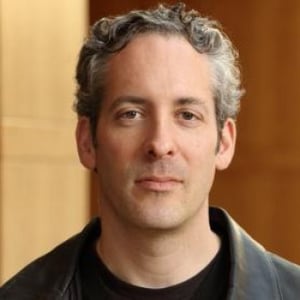
Justice Thurgood Marshall Distinguished Professor of Law, University of Virginia School of Law
Brandon L. Garrett joined the law faculty in 2005. His research and teaching interests include criminal procedure, wrongful convictions, habeas corpus, corporate crime, scientific evidence, civil rights, civil procedure and constitutional law. Garrett’s recent research includes studies of DNA exonerations and organizational prosecutions. The research web pages below provide data related to those studies.
Garrett’s recent book examining corporate prosecutions, titled “Too Big to Jail: How Prosecutors Compromise with Corporations,” was published by Harvard University Press in Fall 2014. Translations are forthcoming in Spain and Taiwan. A new book titled “End of its Rope: How Killing the Death Penalty Can Revive Criminal Justice,” examining the implications of the decline of the death penalty, is forthcoming in Fall 2017 from Harvard University Press. In 2011, Harvard University Press published Garrett’s book, "Convicting the Innocent: Where Criminal Prosecutions Go Wrong," examining the cases of the first 250 people to be exonerated by DNA testing. That book was the subject of a symposium issue in New England Law Review, and received an A.B.A. Silver Gavel Award, Honorable Mention, and a Constitutional Commentary Award. It was translated for editions in China, Japan and Taiwan. In 2013, Foundation Press published Garrett’s casebook, “Federal Habeas Corpus: Executive Detention and Post-Conviction Litigation,” co-authored with Lee Kovarsky. Garrett’s work has been widely cited by courts, including the U.S. Supreme Court, lower federal courts, state supreme courts, and courts in other countries, such as the Supreme Courts of Canada and Israel. Garrett also frequently speaks about criminal justice matters before legislative and policymaking bodies, groups of practicing lawyers, law enforcement, and to local and national media.
Garrett attended Columbia Law School, where he was an articles editor of the Columbia Law Review and a Kent Scholar. After graduating, he clerked for the Hon. Pierre N. Leval of the U.S. Court of Appeals for the Second Circuit. He then worked as an associate at Neufeld, Scheck & Brustin LLP in New York City.
Ronald N. Boyce Presidential Professor of Criminal Law and University Distinguished Professor of Law, The University of Utah College of Law
Paul G. Cassell is an internationally recognized legal scholar on criminal and civil justice, crime victims' rights, constitutional law, evidence, judicial process, and other legal issues. Cassell received a B.A. (1981) and a J.D. (1984) from Stanford University, where he graduated Order of the Coif and was President of the Stanford Law Review. He clerked for then-Judge Antonin Scalia when Scalia was on the U.S. Court of Appeals for the D.C. Circuit (1984-85) and for Chief Justice Warren Burger of the United States Supreme Court (1985-86). Cassell then served as an Associate Deputy Attorney General with the U.S. Justice Department (1986-88) and as an Assistant U.S. Attorney for the Eastern District of Virginia (1988 to 1991). Cassell joined the faculty at the College of Law in 1992, where he taught full-time until he was sworn in as a U.S. District Court Judge for the District of Utah in July 2002. In November 2007, he resigned his judgeship to return full-time to the College of Law to teach, write, and litigate concerning issues relating to crime victims' rights and criminal and civil justice reform. Professor Cassell has also published numerous law review articles in journals such as the Stanford Law Review, the Michigan Law Review, the Harvard Journal of Law and Public Policy, and the Journal of Criminal Law and Criminology. He is a co-author of the nation's only law school textbook on crime victims' rights, Victims in Criminal Procedure (various editions, most recently in its fifth edition published in 2025). Professor Cassell has argued pro bono cases relating to criminal procedure and crime victims' rights before the United States Supreme Court, the 2nd, 4th, 5th, 6th, 7th, 8th, 9th, 10th, 11th, and D.C. Circuits (including the 5th and 11th Circuits en banc), several U.S. District Courts, the Utah Supreme Court, and the Arizona Supreme Court. In 2020, Cassell received the Ronald Wilson Reagan Public Policy Award - National Crime Victims' Service Award from the U.S. Department of Justice. Cassell is a member of the American Law Institute, a fellow of the American Bar Foundation, and an inaugural member of the Council on Criminal Justice. He is also an occasional blogger at The Volokh Conspiracy.
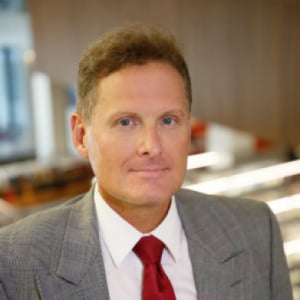
Amelia D. Lewis Professor of Constitutional and Criminal Law, Sandra Day O'Connor College of Law at Arizona State University
Erik Luna is the Amelia D. Lewis Professor of Constitutional and Criminal Law in the Sandra Day O'Connor College of Law at Arizona State University.
Professor Luna teaches and writes primarily in the areas of criminal law and criminal procedure. Luna has received two Fulbright awards. In 2000, he served as the senior Fulbright Scholar to New Zealand at Victoria University Law School (Wellington, NZ). In 2016-17, he was the Fulbright Distinguished Chair at the University of Birmingham (Birmingham, UK). Luna has also been a visiting scholar with the Max Planck Institute for Foreign and International Criminal Law (Freiburg, DE), a visiting professor with the Cuban Society of Penal Sciences (Havana, CU), a visiting professional in the Office of the Prosecutor of the International Criminal Court (The Hague, NL), and a research fellow with the Alexander von Humboldt Foundation (Bonn, DE). Prior to coming to ASU, Luna was the Sydney & Frances Lewis Professor of Law at Washington and Lee University, and before that, he was the Hugh B. Brown Chair in Law at the University of Utah. Luna is a member of the American Law Institute and an adjunct scholar with the Cato Institute. He graduated summa cum laude from the University of Southern California and received his J.D. with honors from Stanford Law School. Upon graduation, Luna was a prosecutor in the San Diego District Attorney’s Office and a fellow and lecturer at the University of Chicago Law School.
Ronald N. Boyce Presidential Professor of Criminal Law and University Distinguished Professor of Law, The University of Utah College of Law
Paul G. Cassell is an internationally recognized legal scholar on criminal and civil justice, crime victims' rights, constitutional law, evidence, judicial process, and other legal issues. Cassell received a B.A. (1981) and a J.D. (1984) from Stanford University, where he graduated Order of the Coif and was President of the Stanford Law Review. He clerked for then-Judge Antonin Scalia when Scalia was on the U.S. Court of Appeals for the D.C. Circuit (1984-85) and for Chief Justice Warren Burger of the United States Supreme Court (1985-86). Cassell then served as an Associate Deputy Attorney General with the U.S. Justice Department (1986-88) and as an Assistant U.S. Attorney for the Eastern District of Virginia (1988 to 1991). Cassell joined the faculty at the College of Law in 1992, where he taught full-time until he was sworn in as a U.S. District Court Judge for the District of Utah in July 2002. In November 2007, he resigned his judgeship to return full-time to the College of Law to teach, write, and litigate concerning issues relating to crime victims' rights and criminal and civil justice reform. Professor Cassell has also published numerous law review articles in journals such as the Stanford Law Review, the Michigan Law Review, the Harvard Journal of Law and Public Policy, and the Journal of Criminal Law and Criminology. He is a co-author of the nation's only law school textbook on crime victims' rights, Victims in Criminal Procedure (various editions, most recently in its fifth edition published in 2025). Professor Cassell has argued pro bono cases relating to criminal procedure and crime victims' rights before the United States Supreme Court, the 2nd, 4th, 5th, 6th, 7th, 8th, 9th, 10th, 11th, and D.C. Circuits (including the 5th and 11th Circuits en banc), several U.S. District Courts, the Utah Supreme Court, and the Arizona Supreme Court. In 2020, Cassell received the Ronald Wilson Reagan Public Policy Award - National Crime Victims' Service Award from the U.S. Department of Justice. Cassell is a member of the American Law Institute, a fellow of the American Bar Foundation, and an inaugural member of the Council on Criminal Justice. He is also an occasional blogger at The Volokh Conspiracy.
Vice President, Edwin Meese III Institute for the Rule of Law, Advancing American Freedom
John G. Malcolm oversees Advancing American Freedom’s work to increase understanding of the Constitution and the rule of law as Vice President of the organization’s Edwin Meese III Institute for the Rule of Law. Malcolm brings to the challenge a wealth of legal expertise and experience in both the public and private sectors.
Prior to joining Advancing American Freedom in 2025, Malcolm was the Vice President of the Institute for Constitutional Government and the Director of the Meese Center for Legal and Judicial Studies at the Heritage Foundation. Prior to joining Heritage in 2012, Malcolm was general counsel at the U.S. Commission on International Religious Freedom, as well as a distinguished practitioner in residence at Pepperdine Law School. From 2004 to 2009, Malcolm was executive vice president and director of worldwide anti-piracy operations for the Motion Picture Association.
Malcolm served as a deputy assistant attorney general in the Department of Justice’s Criminal Division from 2001 to 2004, where he oversaw sections on computer crime and intellectual property, domestic security, child exploitation and obscenity, and special investigations. Immediately prior to that, he was a founding partner in the Atlanta law firm of Malcolm & Schroeder, LLP.
From 1990 to 1997, Malcolm was an assistant U.S. attorney in Atlanta, assigned to the fraud and public corruption section, and also an associate independent counsel, investigating fraud and abuse in the Department of Housing and Urban Development. He was honored with the Director’s Award for Superior Performance for his work in connection with the successful prosecution of Walter Leroy Moody Jr., who assassinated an 11th Circuit judge and the head of the Savannah chapter of the NAACP.
A graduate of Harvard Law School and Columbia College, Malcolm began his career as a law clerk to a federal district court judge and a federal appellate court judge, and as an associate at the Atlanta-based law firm of Sutherland, Asbill & Brennan (new Eversheds Sutherland).
Malcolm, who resides in Washington, D.C., serves on the Board of Trustees of the Washington National Opera and is a Senate-confirmed member of the Board of Directors of the Legal Services Corporation, the largest funder of civil legal aid in the United States.
Ronald N. Boyce Presidential Professor of Criminal Law and University Distinguished Professor of Law, The University of Utah College of Law
Paul G. Cassell is an internationally recognized legal scholar on criminal and civil justice, crime victims' rights, constitutional law, evidence, judicial process, and other legal issues. Cassell received a B.A. (1981) and a J.D. (1984) from Stanford University, where he graduated Order of the Coif and was President of the Stanford Law Review. He clerked for then-Judge Antonin Scalia when Scalia was on the U.S. Court of Appeals for the D.C. Circuit (1984-85) and for Chief Justice Warren Burger of the United States Supreme Court (1985-86). Cassell then served as an Associate Deputy Attorney General with the U.S. Justice Department (1986-88) and as an Assistant U.S. Attorney for the Eastern District of Virginia (1988 to 1991). Cassell joined the faculty at the College of Law in 1992, where he taught full-time until he was sworn in as a U.S. District Court Judge for the District of Utah in July 2002. In November 2007, he resigned his judgeship to return full-time to the College of Law to teach, write, and litigate concerning issues relating to crime victims' rights and criminal and civil justice reform. Professor Cassell has also published numerous law review articles in journals such as the Stanford Law Review, the Michigan Law Review, the Harvard Journal of Law and Public Policy, and the Journal of Criminal Law and Criminology. He is a co-author of the nation's only law school textbook on crime victims' rights, Victims in Criminal Procedure (various editions, most recently in its fifth edition published in 2025). Professor Cassell has argued pro bono cases relating to criminal procedure and crime victims' rights before the United States Supreme Court, the 2nd, 4th, 5th, 6th, 7th, 8th, 9th, 10th, 11th, and D.C. Circuits (including the 5th and 11th Circuits en banc), several U.S. District Courts, the Utah Supreme Court, and the Arizona Supreme Court. In 2020, Cassell received the Ronald Wilson Reagan Public Policy Award - National Crime Victims' Service Award from the U.S. Department of Justice. Cassell is a member of the American Law Institute, a fellow of the American Bar Foundation, and an inaugural member of the Council on Criminal Justice. He is also an occasional blogger at The Volokh Conspiracy.

Equality vs. Discretion in Sentencing [Archive Collection]
Stephen G. Breyer, Frank H. Easterbrook, Terence F. MacCarthy, Ilene H. Nagel
On September 9-10, 1988, The Federalist Society hosted its second annual National Lawyers Convention at...
Do Victim Impact Statements Impact Criminal Sentencing? [POLICYbrief]
Paul G. Cassell
Every courtroom in America allows crime victims to give statements to the judge before sentencing....
Criminal Justice Reform
Robert Alt, John G. Malcolm
Federal criminal law reform earned a great deal of attention in the past year, meanwhile...
Criminal Justice Reform Discussion
Brandon Garrett, Paul G. Cassell, Erik Luna
Criminal justice reform has been a hot political topic for several years now, bringing together...
Government Wrongs and Victims’ Rights - Podcast
Paul G. Cassell
Paul G. Cassell, a University of Utah School of Law professor and a former federal...
Who Pays the Damages for Child Pornography? Paroline v. United States - Podcast
John G. Malcolm, Paul G. Cassell
On April 23, 2014, the Supreme Court decided Paroline v. United States, a case involving...
The Victims' Rights Amendment
Paul G. Cassell
What will be the next amendment to the United States Constitution? If you picked the...