
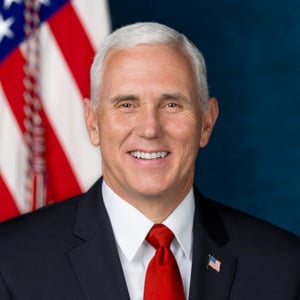
48th Vice President of the United States
Michael R. Pence was born in Columbus, Indiana, on June 7, 1959, one of six children born to Edward and Nancy Pence. As a young boy he had a front row seat to the American Dream. After his grandfather immigrated to the United States when he was 17, his family settled in the Midwest. The future Vice President watched his Mom and Dad build everything that matters—a family, a business, and a good name. Sitting at the feet of his mother and his father, who started a successful convenience store business in their small Indiana town, he was raised to believe in the importance of hard work, faith, and family.
Vice President Pence set off for Hanover College, earning his bachelor’s degree in history in 1981. While there, he renewed his Christian faith which remains the driving force in his life. He later attended Indiana University School of Law and met the love of his life, Second Lady Karen Pence.
After graduating, Vice President Pence practiced law, led the Indiana Policy Review Foundation, and began hosting The Mike Pence Show, a syndicated talk radio show and a weekly television public affairs program in Indiana. Along the way he became the proud father to three children, Michael, Charlotte, and Audrey.
Growing up in Indiana, surrounded by good, hardworking Hoosiers, Vice President Pence always knew that he needed to give back to the state and the country that had given him so much. In 2000, he launched a successful bid for his local congressional seat, entering the United States House of Representatives at the age of 40.
The people of East-Central Indiana elected Vice President Pence six times to represent them in Congress. On Capitol Hill he established himself as a champion of limited government, fiscal responsibility, economic development, educational opportunity, and the U.S. Constitution. His colleagues quickly recognized his leadership ability and unanimously elected him to serve as Chairman of the House Republican Study Committee and House Republican Conference Chairman. In this role, the Vice President helped make government smaller and more effective, reduce spending, and return power to state and local governments.
In 2013, Vice President Pence left the nation’s capital when Hoosiers elected him the 50th Governor of Indiana. He brought the same limited government and low tax philosophy to the Indiana Statehouse. As Governor, he enacted the largest income tax cut in Indiana history, lowering individual income tax rates, the business personal property tax, and the corporate income tax in order to strengthen the State’s competitive edge and attract new investment and good-paying jobs. Due to his relentless focus on jobs, the state’s unemployment rate fell by half during his four years in office, and at the end of his term, more Hoosiers were working than at any point in the state’s 200-year history.
As Governor of Indiana, Vice President Pence increased school funding, expanded school choice, and created the first state-funded Pre-K plan in Indiana history. He made career and technical education a priority in every high school. Under Vice President Pence’s leadership, Indiana, known as “The Crossroads of America,” invested more than $800 million in new money for roads and bridges across the state. Despite the record tax cuts and new investments in roads and schools, the state remained fiscally responsible, as the Vice President worked with members of the Indiana General Assembly to pass two honestly balanced budgets that left the state with strong reserves and AAA credit ratings that were the envy of the nation.
It was Indiana’s success story, Vice President Pence’s record of legislative and executive experience, and his strong family values that prompted President Donald Trump to select Mike Pence as his running mate in July 2016. The American people elected President Donald Trump and Vice President Pence on November 8, 2016. President Donald Trump and Vice President Pence entered office on January 20, 2017.
In February 2021, Vice President Mike Pence joined the Heritage Foundation as a distinguished visiting fellow. The Heritage Foundation helped shape Vice President Mike Pence’s conservative philosophy for decades and played a pivotal role advancing conservative policies throughout the Trump Administration. Vice President Pence also joined Young America’s Foundation as the Ronald Reagan Presidential Scholar. Long before Mike Pence became Vice President to President Donald Trump, the vision and leadership of Ronald Reagan inspired his youth.
Vice President Mike Pence remains grateful for the grace of God, the love and support of his family, and the blessings of liberty that are every American’s birthright.
48th Vice President of the United States
Michael R. Pence was born in Columbus, Indiana, on June 7, 1959, one of six children born to Edward and Nancy Pence. As a young boy he had a front row seat to the American Dream. After his grandfather immigrated to the United States when he was 17, his family settled in the Midwest. The future Vice President watched his Mom and Dad build everything that matters—a family, a business, and a good name. Sitting at the feet of his mother and his father, who started a successful convenience store business in their small Indiana town, he was raised to believe in the importance of hard work, faith, and family.
Vice President Pence set off for Hanover College, earning his bachelor’s degree in history in 1981. While there, he renewed his Christian faith which remains the driving force in his life. He later attended Indiana University School of Law and met the love of his life, Second Lady Karen Pence.
After graduating, Vice President Pence practiced law, led the Indiana Policy Review Foundation, and began hosting The Mike Pence Show, a syndicated talk radio show and a weekly television public affairs program in Indiana. Along the way he became the proud father to three children, Michael, Charlotte, and Audrey.
Growing up in Indiana, surrounded by good, hardworking Hoosiers, Vice President Pence always knew that he needed to give back to the state and the country that had given him so much. In 2000, he launched a successful bid for his local congressional seat, entering the United States House of Representatives at the age of 40.
The people of East-Central Indiana elected Vice President Pence six times to represent them in Congress. On Capitol Hill he established himself as a champion of limited government, fiscal responsibility, economic development, educational opportunity, and the U.S. Constitution. His colleagues quickly recognized his leadership ability and unanimously elected him to serve as Chairman of the House Republican Study Committee and House Republican Conference Chairman. In this role, the Vice President helped make government smaller and more effective, reduce spending, and return power to state and local governments.
In 2013, Vice President Pence left the nation’s capital when Hoosiers elected him the 50th Governor of Indiana. He brought the same limited government and low tax philosophy to the Indiana Statehouse. As Governor, he enacted the largest income tax cut in Indiana history, lowering individual income tax rates, the business personal property tax, and the corporate income tax in order to strengthen the State’s competitive edge and attract new investment and good-paying jobs. Due to his relentless focus on jobs, the state’s unemployment rate fell by half during his four years in office, and at the end of his term, more Hoosiers were working than at any point in the state’s 200-year history.
As Governor of Indiana, Vice President Pence increased school funding, expanded school choice, and created the first state-funded Pre-K plan in Indiana history. He made career and technical education a priority in every high school. Under Vice President Pence’s leadership, Indiana, known as “The Crossroads of America,” invested more than $800 million in new money for roads and bridges across the state. Despite the record tax cuts and new investments in roads and schools, the state remained fiscally responsible, as the Vice President worked with members of the Indiana General Assembly to pass two honestly balanced budgets that left the state with strong reserves and AAA credit ratings that were the envy of the nation.
It was Indiana’s success story, Vice President Pence’s record of legislative and executive experience, and his strong family values that prompted President Donald Trump to select Mike Pence as his running mate in July 2016. The American people elected President Donald Trump and Vice President Pence on November 8, 2016. President Donald Trump and Vice President Pence entered office on January 20, 2017.
In February 2021, Vice President Mike Pence joined the Heritage Foundation as a distinguished visiting fellow. The Heritage Foundation helped shape Vice President Mike Pence’s conservative philosophy for decades and played a pivotal role advancing conservative policies throughout the Trump Administration. Vice President Pence also joined Young America’s Foundation as the Ronald Reagan Presidential Scholar. Long before Mike Pence became Vice President to President Donald Trump, the vision and leadership of Ronald Reagan inspired his youth.
Vice President Mike Pence remains grateful for the grace of God, the love and support of his family, and the blessings of liberty that are every American’s birthright.

Professor of Law, Northwestern University Pritzker School of Law
Joshua Kleinfeld teaches and writes about political, legal, and moral philosophy, criminal law, and criminal procedure. He also practices law in Northwestern's Juvenile Criminal Defense Clinic. He is a full professor with tenure at the Northwestern Pritzker School of the Law and (by courtesy) in Northwestern’s philosophy department. In 2017-18, he was a visiting professor at Harvard and Stanford Law Schools. He is the recipient of the Bator Award, given annually to one American law professor under the age of 40 who has demonstrated "excellence in legal scholarship, a commitment to teaching, a concern for students, and who has made a significant public impact."
In philosophy, Kleinfeld's research focuses on the idea of "embodied ethical life," as developed in the socio-theoretic tradition of Hegel, Weber, and Durkheim. This tradition aims to understand and critique social life by bringing to light the normative ideas implicit in social practices and institutions. In law, this means that the most interesting philosophical concepts are often those reflected or actualized in legal practice – in the law as judges and lawyers think of it and wield it.
In criminal law and procedure, Kleinfeld has developed a theory known as "reconstructivism," which holds that the chief office of criminal law is not to dole out retributive justice, nor to optimize crime and cost control, but to reconstruct a violated normative order in the wake of a crime. This work, which draws on the thought of Hegel, Durkheim, Jean Hampton, and Antony Duff, develops an alternative to retributive and utilitarian theories of criminal law by focusing on the distinctive social function and sense of justice at work in the criminal system.
Kleinfeld is also involved in practical criminal justice reform. In this vein, he defends children accused of homicide in the Northwestern Juvenile Criminal Defense clinic and assists in litigation efforts meant to reform American criminal law through the courts. He has also developed a view of criminal justice reform known as "democratization," which holds that the root of the American criminal justice crisis is a set of bureaucratic attitudes, structures, and incentives divorced from the American public’s concerns and sense of justice, and that the primary solution is to make criminal justice more community-focused and responsive to lay influences. Working with others, he has developed a number of policy proposals meant to reform American criminal justice in a democratic direction.
Kleinfeld holds a JD from Yale Law School, a PhD in philosophy from the Goethe University of Frankfurt (supervised by Axel Honneth, Klaus Günther, and Rainer Forst), and a BA in philosophy from Yale College. He clerked for Judge J. Harvie Wilkinson on the United States Court of Appeals for the Fourth Circuit; Judge Janice Rogers Brown on the United States Court of Appeals for the D.C. Circuit; and President (chief justice) Aharon Barak of the Supreme Court of Israel. He worked as an Associate at Debevoise & Plimpton LLP in Frankfurt, Germany, in the area of corporate criminal law. Before law school, he worked as a Senior Research Analyst at the White House’s Council on Bioethics.
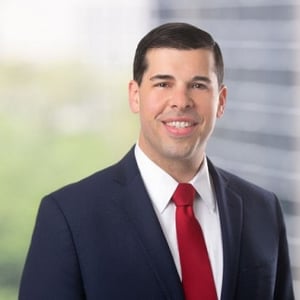
Partner, Boies Schiller Flexner LLP
Jesse, the former third-ranking official at the U.S. Department of Justice, helps clients with their most difficult litigation and regulatory issues─whether that means defending against an enforcement action, pursuing high-stakes litigation and appeals, navigating regulatory thickets at federal and state agencies, or crafting a comprehensive strategy to manage a crisis. He approaches these problems with the knowledge gained both from his broad private-practice experience and from having served at the highest levels of federal and state government.
Jesse has experience across a range of substantive and regulatory areas. He has sued the federal government and has also been one of its top law-enforcement officials; he has represented states and has also navigated their regulatory agencies on behalf of clients; and he has represented companies in business disputes, both as defendants and plaintiffs.
Before joining the firm, Jesse was the Acting Associate Attorney General at the United States Department of Justice. In that role, he oversaw the civil and criminal work of the Antitrust, Civil, Civil Rights, Environment and Natural Resources, and Tax Divisions. During Jesse’s tenure, the Associate’s office closely managed the Department’s most significant litigation, including matters involving large financial institutions, healthcare companies, automakers, energy companies, and state and local governments. In addition, Jesse served as Chair of DOJ’s Regulatory Reform Task Force and Vice Chair of DOJ’s Task Force on Market Integrity and Consumer Fraud. Jesse regularly provided legal and strategic advice to the highest-level decision makers in the federal government, including the Attorney General and Deputy Attorney General, general counsels across the spectrum of federal agencies, and White House officials.
Jesse served for three years as the secretary of Florida’s labor, economic-development, and land-use agency, the Florida Department of Economic Opportunity. Before that, he served as Governor (now Senator) Rick Scott’s general counsel.
Jesse maintains offices in both Washington D.C. and Florida. From Washington, he focuses on federal litigation and crisis management. In Florida, in addition to federal litigation, Jesse employs his knowledge of state government and regulation to help clients in courts across the state, from trial through the Florida Supreme Court.
Jesse currently serves on the Florida Supreme Court Judicial Nominating Commission, the body that provides the governor with nominees for appointment to the Florida Supreme Court. Jesse is also a fellow at the Center for the Study of the Administrative State at the Scalia Law School at George Mason University, where he writes and speaks about administrative law.

Member, Sherrard Roe Voigt Harbison
Chris Sabis heads the firm’s Government Compliance & Investigations group. Chris concentrates his practice in the areas of Government Investigations and Litigation. He has extensive experience in False Claims Act (FCA) matters involving allegations of healthcare and procurement fraud, white-collar fraud investigations, commercial litigation, and government investigations under the Americans with Disabilities Act (ADA) and Mutual Legal Assistance Treaties (MLATs). Chris has significant experience in the mediation of FCA cases and is a Rule 31 Listed General Civil Mediator by the Tennessee Supreme Court. He also has advised clients on provisions of the Families First Coronavirus Response Act (FFCRA) and the CARES Act, including emergency leave provisions and the Paycheck Protection Program enacted in response to the COVID-19 pandemic.
Before joining the firm, Chris served nearly a decade as an Assistant United States Attorney in the Middle District of Tennessee. In addition to his regular duties, he was the District’s Elder Justice Coordinator and International Affairs Coordinator. Before becoming an AUSA, Chris represented clients in complex commercial litigation at Drinker Biddle & Reath in Washington, D.C. Chris was a law clerk to the Honorable Noël Anketell Kramer of the D.C. Court of Appeals and the Honorable Joan Zeldon of the D.C. Superior Court.
Chris earned his J.D. at Georgetown University Law Center, where he was Senior Notes Editor of the Georgetown Journal of Legal Ethics. He graduated magna cum laude with a B.A. in History and Political Science from the University of Rochester.
Chris serves as a Hearing Examiner for the Tennessee Board of Professional Responsibility. He is a member of the Harry Phillips American Inn of Court and of the Tennessee Bar Association, where he has served as Chair and Vice Chair of the Federal Practice Section. He is a member of the Nashville Bar Association and Chair and former Secretary of its Historical Committee. Chris is also a member of the American Health Law Association, the Health Care Compliance Association, and the American Bar Association.
Active in the community, Chris is the Past Chair of the Board for Stars Nashville, a non-profit that provides prevention, intervention, treatment, and training programs addressing bullying, substance abuse, violence, and social and emotional barriers to success in Tennessee schools. He is a board member and the Board Secretary of Autism Tennessee and is a member of the Rotary Club of Nashville. Chris has been an Adjunct Professor of Law at Belmont University. He enjoys hockey, theater, and spending time with his wife and two young boys.
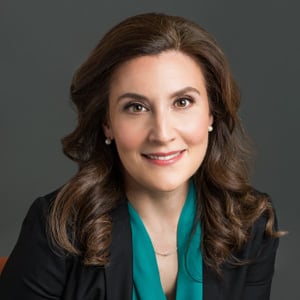
Board Member, U.S. Privacy and Civil Liberties Oversight Board
Beth A. Williams is a Board Member of the United States Privacy and Civil Liberties Oversight Board, an agency whose mission is to ensure that the federal government's efforts to prevent terrorism are balanced with the need to protect privacy and civil liberties.
Prior to her Board service, Ms. Williams was the Assistant Attorney General for the Office of Legal Policy at the United States Department of Justice from August 2017 to December 2020. In that role, she served as the primary policy advisor to the Attorney General and the Deputy Attorney General, and as the Chief Regulatory Officer for the Department. Ms. Williams also led the judicial nomination process for the Department, assisting in the selection and confirmation of more than 230 Article III judges to the bench.
Prior to becoming Assistant Attorney General, Ms. Williams was a litigation and appellate partner at a national law firm, where her practice focused on complex commercial, securities, appellate, and First Amendment litigation. From 2005-2006, Ms. Williams served as Special Counsel to the United States Senate Committee on the Judiciary, where she assisted with the confirmation of Chief Justice John G. Roberts, Jr. and Associate Justice Samuel A. Alito, Jr. to the United States Supreme Court.
Ms. Williams clerked for the Hon. Richard C. Wesley on the United State Court of Appeals for the Second Circuit. She graduated from Harvard College magna cum laude, with a degree in History and Literature, and she earned her law degree from Harvard Law School, where she served as Executive Editor of the Harvard Journal of Law and Public Policy.
Partner, Boies Schiller Flexner LLP
Jesse, the former third-ranking official at the U.S. Department of Justice, helps clients with their most difficult litigation and regulatory issues─whether that means defending against an enforcement action, pursuing high-stakes litigation and appeals, navigating regulatory thickets at federal and state agencies, or crafting a comprehensive strategy to manage a crisis. He approaches these problems with the knowledge gained both from his broad private-practice experience and from having served at the highest levels of federal and state government.
Jesse has experience across a range of substantive and regulatory areas. He has sued the federal government and has also been one of its top law-enforcement officials; he has represented states and has also navigated their regulatory agencies on behalf of clients; and he has represented companies in business disputes, both as defendants and plaintiffs.
Before joining the firm, Jesse was the Acting Associate Attorney General at the United States Department of Justice. In that role, he oversaw the civil and criminal work of the Antitrust, Civil, Civil Rights, Environment and Natural Resources, and Tax Divisions. During Jesse’s tenure, the Associate’s office closely managed the Department’s most significant litigation, including matters involving large financial institutions, healthcare companies, automakers, energy companies, and state and local governments. In addition, Jesse served as Chair of DOJ’s Regulatory Reform Task Force and Vice Chair of DOJ’s Task Force on Market Integrity and Consumer Fraud. Jesse regularly provided legal and strategic advice to the highest-level decision makers in the federal government, including the Attorney General and Deputy Attorney General, general counsels across the spectrum of federal agencies, and White House officials.
Jesse served for three years as the secretary of Florida’s labor, economic-development, and land-use agency, the Florida Department of Economic Opportunity. Before that, he served as Governor (now Senator) Rick Scott’s general counsel.
Jesse maintains offices in both Washington D.C. and Florida. From Washington, he focuses on federal litigation and crisis management. In Florida, in addition to federal litigation, Jesse employs his knowledge of state government and regulation to help clients in courts across the state, from trial through the Florida Supreme Court.
Jesse currently serves on the Florida Supreme Court Judicial Nominating Commission, the body that provides the governor with nominees for appointment to the Florida Supreme Court. Jesse is also a fellow at the Center for the Study of the Administrative State at the Scalia Law School at George Mason University, where he writes and speaks about administrative law.
Member, Sherrard Roe Voigt Harbison
Chris Sabis heads the firm’s Government Compliance & Investigations group. Chris concentrates his practice in the areas of Government Investigations and Litigation. He has extensive experience in False Claims Act (FCA) matters involving allegations of healthcare and procurement fraud, white-collar fraud investigations, commercial litigation, and government investigations under the Americans with Disabilities Act (ADA) and Mutual Legal Assistance Treaties (MLATs). Chris has significant experience in the mediation of FCA cases and is a Rule 31 Listed General Civil Mediator by the Tennessee Supreme Court. He also has advised clients on provisions of the Families First Coronavirus Response Act (FFCRA) and the CARES Act, including emergency leave provisions and the Paycheck Protection Program enacted in response to the COVID-19 pandemic.
Before joining the firm, Chris served nearly a decade as an Assistant United States Attorney in the Middle District of Tennessee. In addition to his regular duties, he was the District’s Elder Justice Coordinator and International Affairs Coordinator. Before becoming an AUSA, Chris represented clients in complex commercial litigation at Drinker Biddle & Reath in Washington, D.C. Chris was a law clerk to the Honorable Noël Anketell Kramer of the D.C. Court of Appeals and the Honorable Joan Zeldon of the D.C. Superior Court.
Chris earned his J.D. at Georgetown University Law Center, where he was Senior Notes Editor of the Georgetown Journal of Legal Ethics. He graduated magna cum laude with a B.A. in History and Political Science from the University of Rochester.
Chris serves as a Hearing Examiner for the Tennessee Board of Professional Responsibility. He is a member of the Harry Phillips American Inn of Court and of the Tennessee Bar Association, where he has served as Chair and Vice Chair of the Federal Practice Section. He is a member of the Nashville Bar Association and Chair and former Secretary of its Historical Committee. Chris is also a member of the American Health Law Association, the Health Care Compliance Association, and the American Bar Association.
Active in the community, Chris is the Past Chair of the Board for Stars Nashville, a non-profit that provides prevention, intervention, treatment, and training programs addressing bullying, substance abuse, violence, and social and emotional barriers to success in Tennessee schools. He is a board member and the Board Secretary of Autism Tennessee and is a member of the Rotary Club of Nashville. Chris has been an Adjunct Professor of Law at Belmont University. He enjoys hockey, theater, and spending time with his wife and two young boys.
Board Member, U.S. Privacy and Civil Liberties Oversight Board
Beth A. Williams is a Board Member of the United States Privacy and Civil Liberties Oversight Board, an agency whose mission is to ensure that the federal government's efforts to prevent terrorism are balanced with the need to protect privacy and civil liberties.
Prior to her Board service, Ms. Williams was the Assistant Attorney General for the Office of Legal Policy at the United States Department of Justice from August 2017 to December 2020. In that role, she served as the primary policy advisor to the Attorney General and the Deputy Attorney General, and as the Chief Regulatory Officer for the Department. Ms. Williams also led the judicial nomination process for the Department, assisting in the selection and confirmation of more than 230 Article III judges to the bench.
Prior to becoming Assistant Attorney General, Ms. Williams was a litigation and appellate partner at a national law firm, where her practice focused on complex commercial, securities, appellate, and First Amendment litigation. From 2005-2006, Ms. Williams served as Special Counsel to the United States Senate Committee on the Judiciary, where she assisted with the confirmation of Chief Justice John G. Roberts, Jr. and Associate Justice Samuel A. Alito, Jr. to the United States Supreme Court.
Ms. Williams clerked for the Hon. Richard C. Wesley on the United State Court of Appeals for the Second Circuit. She graduated from Harvard College magna cum laude, with a degree in History and Literature, and she earned her law degree from Harvard Law School, where she served as Executive Editor of the Harvard Journal of Law and Public Policy.

Partner, Sullivan & Cromwell LLP
Andrei Iancu is a partner at Sullivan & Cromwell and one of the leading voices in intellectual property law and innovation policy. He is a former Undersecretary of Commerce for Intellectual Property and Director of the U.S. Patent and Trademark Office (USPTO), a position to which he was confirmed unanimously by the Senate. Andrei has decades of experience representing plaintiffs and defendants in IP matters across the technical and scientific spectra, including medical devices, genetic testing, therapeutics, the Internet, telephony, TV broadcasting, video game systems and computer peripherals. He represents clients in litigation and trials before the district courts, the U.S. International Trade Commission and the USPTO, the Federal Circuit and U.S. Supreme Court, and also counsels clients on obtaining, licensing, enforcing and defending against IP rights globally.
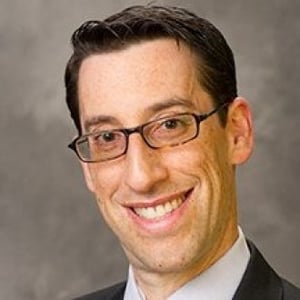
Distinguished Professor of Law, Rutgers Law School
Michael A. Carrier is a leading authority in antitrust and intellectual property law with expertise in the pharmaceutical, high-technology, and music industries. He has been quoted more than 1000 times in media outlets including ABC News, Bloomberg, CBS News, Chicago Tribune, CNBC.com, CNNMoney, Consumer Reports, ESPN, Financial Times, Forbes, Fortune, Fox News, Huffington Post, Los Angeles Times, Nature, NBC News, New York Times, NPR, Philadelphia Inquirer, San Francisco Chronicle, Seattle Times, USA Today, Wall Street Journal, and Washington Post.
Professor Carrier is a co-author of the leading IP/antitrust treatise, IP and Antitrust Law: An Analysis of Antitrust Principles Applied to Intellectual Property Law (3d ed. 2017, with Hovenkamp, Janis, Lemley, and Leslie). He also is the author of Innovation for the 21st Century: Harnessing the Power of Intellectual Property and Antitrust Law (Oxford University Press 2009, paperback 2011) and the editor of Critical Concepts in Intellectual Property Law: Competition (Edward Elgar Publishing 2011).
He has written more than 95 book chapters and law review articles in leading journals including the Stanford Law Review, Michigan Law Review, University of Pennsylvania Law Review, Duke Law Journal, Vanderbilt Law Review, Minnesota Law Review, Iowa Law Review, Notre Dame Law Review, Emory Law Journal, and Wisconsin Law Review, as well as online journals at Harvard, Yale, Stanford, NYU, Penn, Northwestern, Minnesota, and Wisconsin.
Professor Carrier’s scholarship has been cited in opinions of the U.S. Supreme Court, California Supreme Court, D.C. Circuit, Second Circuit, Third Circuit, Fourth Circuit, district courts, International Trade Commission, and Federal Trade Commission, as well as in congressional hearings, government officials’ speeches, and congressional and government agency reports.
Carrier has testified before the U.S. Senate Judiciary Committee (Subcommittee on Antitrust, Competition Policy and Consumer Rights), National Academies (Board on Science, Technology, and Economic Policy), and U.S. Food and Drug Administration, and given talks to the Canadian Competition Bureau, U.S. Department of Justice, Federal Trade Commission, and state attorneys general.
He is a Contributing Editor of the Antitrust Law Journal; member of the Board of Advisors of the American Antitrust Institute; former participant on the ABA Antitrust 2016 Presidential Task Force; past chair of the Executive Committee of the Antitrust and Economic Regulation section of the Association of American Law Schools (AALS); and has written and submitted amicus briefs on behalf of antitrust/consumer organizations and hundreds of professors in the U.S. and California Supreme Courts and Federal, First, Second, and Third Circuits.
Professor Carrier is a summa cum laude graduate of Yale University and a cum laude graduate of Michigan Law School, where he was Book Review Editor of the law review. Before entering academia, he clerked for the Honorable John D. Butzner, Jr. on the U.S. Court of Appeals for the Fourth Circuit and litigated antitrust, civil, intellectual property, and sports cases at Covington & Burling, in Washington, D.C.

Professor of Law and Director of the Center for Intellectual Property Law, Maurice A. Deane School of Law at Hofstra University
Professor Manta teaches intellectual property law subjects. Her research examines the intersection between intellectual property law and social science, with a focus on psychology. She has most recently written about the hedonic value of trademarks and its legal implications, the problem of cognitive bias in copyright infringement litigation, price discrimination through software licensing in the age of the Internet of Things, and the role of criminal sanctions in intellectual property. Professor Manta has published or has forthcoming work in the Emory Law Journal, William & Mary Law Review, Iowa Law Review, Alabama Law Review, Boston College Law Review, Ohio State Law Journal, Washington and Lee Law Review, Harvard Journal of Law & Technology, Stanford Technology Law Review, Florida Law Review, Arizona Law Review, and Cornell Law Review Online, among others. She is also a co-author for a forthcoming textbook on criminal law issues in intellectual property. Professor Manta has further been a guest blogger for PrawfsBlawg and for Concurring Opinions. In 2014, she received the Lawrence A. Stessin Prize for Outstanding Scholarly Publications, which is awarded to two junior faculty members across all disciplines at Hofstra University.
Before joining the law school faculty in 2012, Professor Manta was an Assistant Professor of Law at the Case Western Reserve University School of Law. She was a Bigelow Teaching Fellow and Lecturer in Law at the University of Chicago Law School from 2007 to 2009. Professor Manta has also served on the faculties of Brooklyn Law School, The George Washington University School of Law, and the University of Arkansas at Little Rock William H. Bowen School of Law. She clerked for Judge Morris S. Arnold on the U.S. Court of Appeals for the Eighth Circuit for the 2006-2007 term.
While earning her J.D. at Yale Law School, Professor Manta was the grand prize winner of the Foley & Lardner LLP Intellectual Property Writing Competition. She also served as tributes editor of the Yale Law Journal, articles editor of the Yale Law & Policy Review, and editor of the Yale Journal on Regulation. She graduated magna cum laude from Yale University with a B.A. in psychology.

Keynote Address by Vice President Michael R. Pence
Mike Pence
Former Vice President Michael R. Pence delivered the Keynote Address at the Eighth Annual Florida...
Keynote Address by Vice President Michael R. Pence
Mike Pence
Former Vice President Michael R. Pence delivered the Keynote Address at the Eighth Annual Florida...
Draft SEP Policy Statement
TeleforumTopics
Religious Liberty Update on Congress and the Biden Administration
Congress 1. The Fairness For All Act (FFAA) is likely dead after House Republican Chair...
Topics
Do Androids Dream of Patent Protections? American Patent Law and AI-Generated Inventions
The incredible ability of artificial intelligence (AI) has captured the minds of inventors, writers, scientists,...
Morissette v. United States [SCOTUSbrief]
Joshua Kleinfeld
Morissette v. United States is a landmark case in American law. How did a case...
Intellectual Property and the U.S. - China Race for the Future
Rutgers-Camden Student Chapter
Camden, NJU.S.-China Strategic Competition
Quinnipiac Student Chapter
North Haven, CTSwitchbacks at the DOJ: the Sessions, Brand, and Garland Memos
Jesse Panuccio, Christopher C. Sabis, Beth A. Williams
During President Biden’s first year in office, Attorney General Merrick Garland rescinded two key memos...
Switchbacks at the DOJ: the Sessions, Brand, and Garland Memos
Jesse Panuccio, Christopher C. Sabis, Beth A. Williams
During President Biden’s first year in office, Attorney General Merrick Garland rescinded two key memos...