
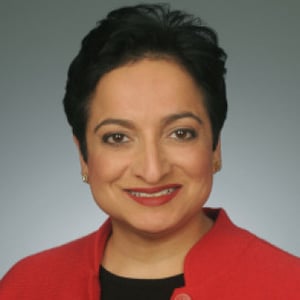
President, Mastercard Center for Inclusive Growth
Shamina Singh has spent her career building connections across the public, private and non-profit sectors to deliver strategies that contribute positively to the global economy. As president of the Mastercard Center for Inclusive Growth, she is responsible for ensuring the Center achieves its mission to advance sustainable and equitable economic growth and financial inclusion around the world. Previously, she served as the Global Director of Mastercard’s Government Services and Solutions, where she worked to digitize social subsidy programs in over 40 countries.
In 2015, Ms. Singh was appointed by President Obama to a six-year term on the board of the Corporation for National and Community Service, a federal agency responsible for engaging more than five million citizens in community service. She currently serves as Board Chair. She is also a member of the U.S. Secretary of State’s Advisory Committee on Public-Private Partnerships, a newly-formed advisory body to the U.S. Government on policies, proposals and strategies for developing public-private partnerships that promote shared value with the private sector worldwide.
Prior to joining Mastercard, Ms. Singh led Government and Public Affairs for Nike and spent five years with Citigroup’s Global Community Development Group. Over a 15-year career in the public sector, she held senior positions in the White House and the U.S. House of Representatives.
Ms. Singh is an alumna of the World Economic Forum’s Young Global Leaders program and currently serves on the Council on Economic Growth and Social Inclusion. She is on the board of Global Health Corps and the advisory boards of Data & Society and the Beeck Center for Social Impact + Innovation at Georgetown University. She is a Henry Crown Fellow with the Aspen Institute. Shamina holds an M.P.A from the Lyndon B. Johnson School of Public Affairs at the University of Texas, Austin and a B.S. from Old Dominion University.
Professor of Law, Louis D. Brandeis School of Law
Jim Chen joined the University of Louisville in January 2007, where he served as dean of Louis D. Brandeis School of Law from 2007-2012. Professor Chen is a prolific and influential scholar whose works span subjects such as administrative law, agricultural law, constitutional law, economic regulation, environmental law, industrial policy, legislation, and natural resources law. He is the coauthor of Disasters and the Law: Katrina and Beyond (Aspen Publishers, 2006), the first book to provide comprehensive coverage of the legal issues surrounding natural disasters. This pathbreaking book is now in its second edition under the title Disaster Law and Policy. He provides expert advice on the law of regulated industries, particularly telecommunications. Professor Chen has also taught courses in criminal law and food and drug law.
Professor Chen's lectures have spanned fifteen countries, four continents, and three languages. In 1995, he held a chaire départementale in the Faculté de Droit et des Sciences Politiques of the Université de Nantes. In 1999, he became the first American to teach law as a visiting professor at Heinrich-Heine Universität in Düsseldorf. He taught in 2000 at Slovenská Pol'nohospodárska Univerzita v Nitre (the Slovak Agricultural University in Nitra).
From July 1993 to January 2007, Professor Chen taught at the University of Minnesota Law School. In his final years at Minnesota, Professor Chen served as that school's associate dean. He was an editor of Constitutional Commentary and the faculty editor-in-chief of the Minnesota Journal of Law, Science & Technology. He also served as faculty advisor to the Minnesota Law Review and Law & Inequality. Within the University of Minnesota's Conservation Biology Program, Professor Chen served as a member of the graduate faculty.
Professor Chen received his B.A. degree, summa cum laude, and his M.A. degree from Emory University. After studying as a Fulbright Scholar at Háskóli Íslands (the University of Iceland), he earned his J.D. degree, magna cum laude, from the Harvard Law School, where he served as an executive editor of the Harvard Law Review. He clerked for Judge J. Michael Luttig of the United States Court of Appeals for the Fourth Circuit and for Justice Clarence Thomas of the Supreme Court of the United States.

Alton C. and Cecile Cunningham Craig Professor of Law, The University of Alabama School of Law
Julie Andersen Hill is the Alton C. and Cecile Cunningham Craig Professor of Law at the University of Alabama School of Law where she teaches banking and commercial law. Her scholarly work focuses on the unwritten rules of banking regulation. She often examines how regulators respond to financial innovation. Before entering the legal academy, Professor Hill practiced law in the Washington, D.C. office of Skadden, Arps, Slate, Meagher & Flom LLP. As part of the litigation group, she represented large financial institutions in government investigations. She also clerked for Judge Wade Brorby on the United States Court of Appeals for the Tenth Circuit. Professor Hill earned her undergraduate degree in economics summa cum laude from Southern Utah University and her J.D. summa cum laude from the J. Reuben Clark Law School at Brigham Young University.
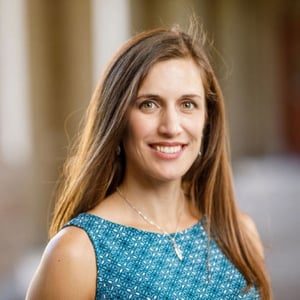
Associate Professor of Law, Notre Dame Law School
Marah Stith McLeod joined Notre Dame Law School in 2016. She teaches criminal law and criminal procedure and studies legal and ethical problems in these areas. Her scholarship explores the distribution of decisional power in the criminal justice system and the theory and practice of criminal punishment, including the death penalty.
McLeod attended Yale Law School, where she was notes editor of the Yale Law Journal. She served as a law clerk to Judge Diarmuid O’Scannlain of the Ninth Circuit Court of Appeals and to Justice Clarence Thomas of the U.S. Supreme Court. She also served an Attorney-Adviser in the Office of Legal Counsel in the U.S. Department of Justice.
After her government work, McLeod joined Sidley Austin LLP in Chicago and became a civil litigator and pro bono counsel in death penalty cases. She taught legal writing at Columbia Law School prior to coming to Notre Dame.
McLeod studied political theory at Harvard University, after which she spent a year working with Mother Teresa’s sisters in a home for handicapped orphans in Kolkata, India. McLeod now has three beloved children of her own.
Associate Professor of Law, DePaul University College of Law
Mark Moller is an Associate Professor of Law at DePaul University College of Law. An expert in complex litigation, Moller joined the college of law in 2007, and teaches in the area of civil procedure. He received a J.D. with honors from the University of Chicago Law School (1999), an LL.M. with first class honors from the University of Cambridge (2000), and a bachelor's degree magna cum laude from Duke University (1994). Prior to joining DePaul, Moller was an associate in the appellate and class action groups at Gibson Dunn & Crutcher in Washington, D.C., where he served on the team that successfully litigated Bush v. Gore. Following private practice, he was a senior fellow at the Cato Institute's Center for Constitutional Studies in Washington, D.C., where he oversaw Cato's Supreme Court amicus program and appeared frequently as a legal commentator in print and on television and radio
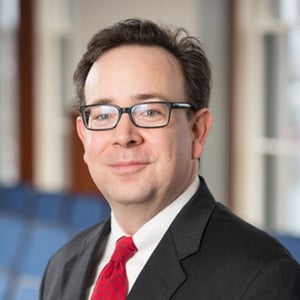
Professor of Law, Oklahoma City University School of Law
Professor O’Shea is a nationally recognized expert on firearms law and the Second Amendment. He is a co-author of the first law school casebook on the subject, Firearms Law and the Second Amendment: Regulation, Rights, and Policy, published in 2012. He serves as the Associate Director of OCU Law’s Center for State Constitutional Law and Government.
Professor O’Shea is an honors graduate of Harvard College and Harvard Law School. He also holds a master’s degree in philosophy from the University of Pittsburgh. Before coming to Oklahoma City University School of Law in 2006, he practiced commercial litigation in Chicago and in his hometown of Kansas City, Missouri. He also served as a law clerk to Chief Judge Danny J. Boggs of the U.S. Court of Appeals for the Sixth Circuit and to Judge John R. Gibson of the U.S. Court of Appeals for the Eighth Circuit.

Accelerating Financial Inclusion and Inclusive Growth - Podcast
Shamina Singh
Today, approximately two billion people lack access to financial services. Because of their exclusive reliance...
7 Minute Presentations of Works in Progress 2-B
17th Annual Faculty Conference
Washington, DC