
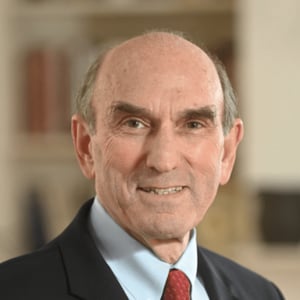
Senior Fellow for Middle Eastern Studies, Council on Foreign Relations
Elliott Abrams is senior fellow for Middle Eastern studies at the Council on Foreign Relations (CFR) in Washington, DC. He served as deputy assistant to the president and deputy national security advisor in the administration of President George W. Bush, where he supervised U.S. policy in the Middle East for the White House, and as Special Representative for Iran and Venezuela in the administration of Donald Trump.
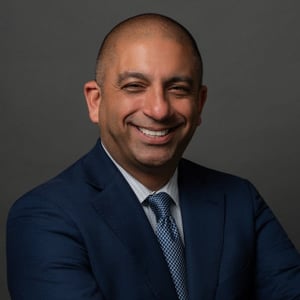
Founder and Executive Director, National Security Institute; Assistant Professor of Law, Antonin Scalia Law School, George Mason University
Jamil N. Jaffer is the Founder and Executive Director of the National Security Institute at the Antonin Scalia Law School at George Mason University where he also serves as an Assistant Professor of Law, Director of the National Security Law and Policy Program, and Director of the Cyber, Intelligence, and National Security LLM Program. Jamil also teaches classes on counterterrorism, intelligence, surveillance, cybersecurity, and other national security matters, as well as a summer course held abroad with U.S. Supreme Court Justice Neil M. Gorsuch. Jamil is also affiliated with Stanford University’s Center for International Security and Cooperation and previously served as a Visiting Fellow at the Hoover Institution from 2016 to 2019.
Jamil is also a Venture Partner with Paladin Capital Group, where he assists the firm with investments across the full range of its themes and theses, including a focus on dual-use national security technologies. Jamil also serves on the board of directors of RangeForce, a cybersecurity training and readiness platform startup and Tozny, a digital identity startup, and on the advisory boards of U.S. Strategic Metals, North America’s largest primary producer of cobalt, a critical mineral used in EV batteries, aerospace, and other national security applications; and Constella Intelligence, a deep and dark web intelligence startup. Jamil also serves as an advisor to Beacon Global Strategies, a strategic advisory firm and Duco, a technology platform startup that connects corporations with geopolitical and international business experts. Jamil is also the managing director of Trigraph Caveat Capital, a private investment vehicle.
Among other things, Jamil currently serves on the Board of Directors for the Greater Washington Board of Trade, the Board of Advisors for the Global Cyber Alliance, and the Advisory Board of the Foundation for the Defense of Democracies’ Center on Cyber and Tech Innovation, the Executive Committee of the Reagan Institute Strategy Group. Jamil is also a Fellow at the Academy for Judaic, Christian, and Islamic Studies, an advisor to the Concordia Summit, and is a member of the Board of Directors for the Center for Intelligence Policy, the Board of Directors of Speech First, and the Executive Committee of the International Law and National Security Practice Group of the Federalist Society.
Immediately prior to his current positions, from 2015-2021, Jamil served as a senior business leader at IronNet Cybersecurity, helping take the company from a bootstrapped first-year technology products startup through two rounds of venture capital fundraising, growing from 40 employees to over 300, and through its listing on New York Stock Exchange. In his role as IronNet's Senior Vice President for Strategy, Partnerships & Corporate Development, Jamil worked directly for the co-CEOs of the company, Gen (ret.) Keith B. Alexander, the former Director of the National Security Agency and Founding Commander of U.S. Cyber Command, and Bill Welch, the former COO of Zscaler and Duo; in that role, Jamil led all of the company’s strategic and technology partnership efforts, including developing go-to-market and technology integration plans with some of the largest cloud platforms and cybersecurity companies in the market, evaluating potential acquisition targets, and developing overall corporate strategy and thought leadership around collective security and collaborative defense in the cyber arena.
Prior to his time at IronNet, Jamil served on the leadership team of the Senate Foreign Relations Committee as Chief Counsel and Senior Advisor under Chairman Bob Corker (R-TN), where he worked on key national security and foreign policy issues, including leading the drafting of the proposed Authorization for the Use of Military Force against ISIS in 2014 and 2015, the AUMF against Syria in 2013, and revisions to the 9/11 AUMF against al Qaeda. Jamil was also the lead architect of the Iran Nuclear Agreement Review Act and two sanctions laws against Russia for its first intervention in Ukraine.
Prior to joining SFRC, Jamil served as Senior Counsel to the House Permanent Select Committee on Intelligence under Chairman Mike Rogers (R-MI) where he led the committee’s oversight of NSA surveillance, NRO intelligence issues, and NGA analytic and collection matters, as well as intelligence community-wide counterterrorism issues. Jamil was also the lead architect of the Cyber Intelligence Sharing and Protection Act, the nation’s first cyber threat intelligence sharing legislation that was signed into law in 2015.
In the Bush Administration, Jamil served in the White House as an Associate Counsel to the President, handling Defense Department, State Department, and intelligence community matters, and serving as one of the White House Counsel’s primary representatives to the National Security Council Deputies Committee.
Prior to the White House, Jamil served on the leadership team of the Justice Department’s National Security Division as Counsel to the Assistant Attorney General for National Security, where he focused on counterterrorism and intelligence matters. At NSD, Jamil helped lead the division’s work on In re: Directives, the first ever two-party litigated matter in the FISA Court and the second case before the FISA Court of Review in its 30-year history. Jamil also led NSD’s efforts on the President’s Comprehensive National Cybersecurity Initiative (CNCI), including the drafting of NSPD-54/HSPD-23, and related classified matters, and advised the National Security Agency (NSA) and U.S. Cyber Command’s predecessor organization, the Joint Function Component Command for Network Warfare (JFCC-NW), on matters related to cyber intelligence collection and offensive cyber activities. For his work on these matters, Jamil was awarded the Assistant Attorney General’s Award for Special Initiative and was among the group of lawyers awarded the Director of National Intelligence’s 2008 Legal Award (Team of the Year – Cyber Legal).
Jamil also served in other positions in the Justice Department, including in the Office of Legal Policy, where he worked on the confirmations of Chief Justice John G. Roberts, Jr. and Justice Samuel A. Alito, Jr. to the United States Supreme Court.
Jamil also served as a lawyer in private practice at Kellogg Huber, a Washington, DC-based litigation boutique, as a policy advisor to Congressman Bob Goodlatte (R-VA), and as a staff member or senior advisor on a number of political campaigns, including two presidential campaigns and a presidential transition team. While in law school, Jamil was a member of the University of Chicago Law Review, managing editor of the Chicago Journal of International Law, and National Symposium Editor of the Harvard Journal of Law & Public Policy. Following law school, Jamil served as a law clerk to Judge Edith H. Jones of the United States Court of Appeals for the Fifth Circuit and, later in his career, as a law clerk to then-Judge Neil M. Gorsuch when he first joined the United States Court of Appeals for the Tenth Circuit as well as a law clerk to Justice Neil Gorsuch when he joined the U.S. Supreme Court.
Jamil has published multiple op-eds and academic articles on national security, foreign policy, cybersecurity, counterterrorism, encryption, and intelligence matters, and is the co-author of a book chapter with former NSA Director Gen. (Ret.) Keith B. Alexander on national security and the press in National Security, Leaks, and the Freedom of the Press: The Pentagon Papers Fifty Years On (2021) and a book chapter with former CIA Director Gen. (ret.) Mike Hayden on ISIS, al Qaeda, and other international terrorist groups in Choosing to Lead: American Foreign Policy for a Disordered World (2015). Jamil has also written book chapters on cybersecurity and surveillance, as well as op-eds and policy papers with former Attorney General Michael B. Mukasey, former National Counterterrorism Center Director Matt Olsen, and Congressman Mike Waltz (R-FL), among others.
Jamil has previously taught graduate-level courses in intelligence law and policy at George Washington University’s Elliott School of International Affairs and the National Intelligence University, served an outside advisor to the Cyberspace Solarium Commission, and has recently testified before committees of the U.S. Senate and House of Representatives on China, cybersecurity, counterterrorism, and other national security matters. Jamil has also recently appeared on a range of national television and radio outlets including CNN, Fox News, Fox Business, MSNBC, Bloomberg, PBS, Voice of America, and National Public Radio, and in various print and online publications, including the Wall Street Journal, New York Times, and the Washington Post on a range of national security matters including cybersecurity, counterterrorism, surveillance, encryption, privacy, and foreign policy issues.
Jamil holds degrees from UCLA (BA, cum laude), the University of Chicago Law School (JD, with honors), and the United States Naval War College (MA, with distinction).

Senior Fellow for U.S. Foreign Policy, Middle East Institute
Brian Katulis is Senior Fellow for US Foreign Policy at the Middle East Institute. He was formerly a senior fellow at the Center for American Progress (CAP), where he built the Center’s Middle East program and also worked on broader issues related to U.S. national security.
He has produced influential studies that have shaped important discussions around regional policy, often providing expert testimony to key congressional committees on his findings. Katulis has also conducted extensive research in countries such as Egypt, Israel, Jordan, and the Palestinian territories. His past experience includes work at the National Security Council and the U.S. Departments of State and Defense.
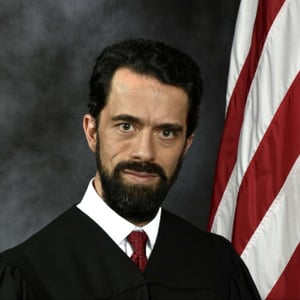
Judge, United States Court of Appeals, Third Circuit
Stephanos Bibas is a judge on the U.S. Court of Appeals for the Third Circuit. Judge Bibas was previously a professor of law and criminology at the University of Pennsylvania Law School. As director of the Penn Law Supreme Court Clinic, he argued six cases before the Supreme Court of the United States and filed briefs in dozens of others. He graduated summa cum laude and Phi Beta Kappa from Columbia University in 1989 with a B.A. in political theory and from Oxford University in 1991 with a B.A. in jurisprudence. He then earned his J.D. from Yale Law School in 1994.
After graduating from Yale Law, Judge Bibas clerked for Judge Patrick Higginbotham of the U.S. Court of Appeals for the Fifth Circuit and Justice Anthony Kennedy on the Supreme Court and was a litigation associate at Covington & Burling LLP in Washington, D.C. Thereafter, Judge Bibas served as an Assistant U.S. Attorney in the Southern District of New York, where he successfully prosecuted the world’s leading expert in Tiffany stained glass for hiring a grave robber to steal priceless Tiffany windows from cemeteries. Before his tenure at Penn Law, Judge Bibas taught at the University of Chicago Law School and the University of Iowa College of Law and was a research fellow at Yale Law School. He has published two books and seventy scholarly articles.
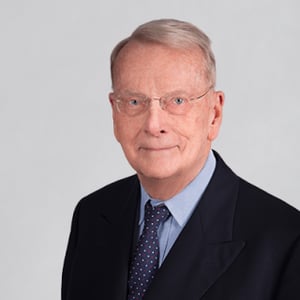
Judge, Iran-United States Claims Tribunal and Arbitrator Member, Twenty Essex Chambers
Charles’s 55-year career in the law has combined extensive practice at the bar with distinguished public service, both national and international. For nearly 40 years he has focused on public international law and international dispute resolution.
As counsel or arbitrator he has handled cases on all six continents, principally under the rules of the ICC, UNCITRAL, LCIA, AAA, United Nations Compensation Commission, ICSID, Stockholm Chamber of Commerce, Insurance and Reinsurance Arbitration Society and LMAA. These cases have involved a wide variety of commercial disputes as well as issues of public international law, particularly involving the oil and gas sector, major infrastructural projects, expropriations, and other investment disputes, including ones arising under both bilateral and multilateral investment treaties.
Charles started his career with White & Case LLP in New York, before serving for four years in the United States Department of State in Washington, DC, concluding as its Acting Legal Adviser. He then rejoined White & Case LLP, co-founding its Washington, DC office, where his practice came to be comprised almost exclusively of substantial international arbitrations.
He has served continuously since 1983 as a judge of the Iran-United States Claims Tribunal in The Hague, The Netherlands. That service was interrupted for some months in 1987 by White House service as Deputy Special Counsellor to President Reagan. Charles resumed partnership in White & Case LLP from 1988 until joining 20 Essex Street in 2001. Since 2014 he has also served as a Judge ad hoc at the International Court of Justice.
In 2015 Charles was only the fourth ever recipient of the Global Arbitration Review Lifetime Achievement Award.
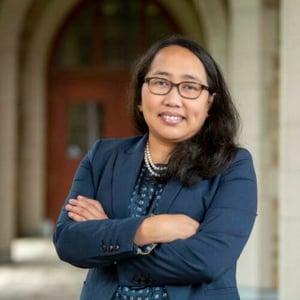
Professor of Law and Global Affairs Faculty Director, LL.M. in International Human Rights Law; Global Director, Notre Dame Law School Global Human Rights Clinic, Notre Dame Law School
Diane A. Desierto joined the Law School in January 2021 as Professor of Law and LL.M. Faculty Director, with a joint appointment at the Keough School of Global Affairs. Desierto teaches, publishes, and practices in the areas of international law and human rights, international economic law and development, international arbitration, maritime security, Association of Southeast Asian Nations (ASEAN) Law, and comparative public law. At Notre Dame, Desierto is a Faculty Fellow at the Klau Institute for Civil Human Rights, Kellogg Institute of International Studies, Liu Institute for Asia and Asian Studies, Pulte Institute for Global Development, and Nanovic Institute of European Studies. She is also Co-Principal Investigator of the Notre Dame Reparations Design and Compliance Lab.
Desierto is a Member and former Chair-Rapporteur of the Expert Group of the United Nations Working Group on the Right to Development, Resource Expert for the Association of Southeast Asian Nations (ASEAN), former Director of Studies and Faculty of the Hague Academy of International Law, President of the Friends of the Hague Academy Foundation, and the Philippines Focal Point for the International Criminal Court Bar Association. She is active as international counsel at matters successfully litigated at the Permanent Court of Arbitration, the UN Human Rights Committee, the Philippine Supreme Court and Southeast Asian agencies, and was appointed by the Philippine Supreme Court as Professor of International Law and Human Rights at the Philippines Judicial Academy. Desierto is a Member of the Editorial Boards of the European Journal of International Law (and Editor of its leading international law blog EJIL:Talk!), Journal of World Investment and Trade, and the Global Community Yearbook of International Law and Jurisprudence, and the Kluwer Law monograph series on Human Society and International Law, and also serves on the Scientific Advisory Boards of international journals such as International Law Studies, the Revista Chilena de Derecho, and the Indonesian Journal of International and Comparative Law. Desierto previously taught as tenure-track/tenured law faculty at the University of the Philippines, Peking University School of Transnational Law in China, and the University of Hawaii Richardson School of Law. She is a recipient of faculty fellowships awarded by Stanford University's Center for Advanced Studies in the Behavioral Sciences (CASBS) and the Stanford Center for Human Rights and International Justice, the Max Planck Institute for Comparative Public Law and International Law in Heidelberg, the Humboldt-Potsdam-Berlin Senior Fellowship, the East-West Center in Honolulu, the Grotius Fellowship at University of Michigan Law School, and the National University of Singapore's Asian Law Institute Fellowship. Desierto has served Visiting Professor appointments at the University of Paris-Nanterre X Faculty of Law, University of the Philippines College of Law Graduate Program at Bonifacio Global City, the University of Navarre Faculty of Law in Spain, and Universidad Panamericana Faculty of Law in Mexico City.
Desierto holds JSD and LLM degrees from Yale Law School, as well as JD cum laude class salutatorian and BSc Economics summa cum laude class valedictorian degrees from the University of the Philippines, and was a former Yale Law clerk at the International Court of Justice for H.E. Judges Bruno Simma and Bernardo Sepulveda-Amor. She authored and/or edited several books, such as Necessity and National Emergency Clauses: Sovereignty in Modern Treaty Interpretation (Martinus Nijhoff, 2012, recipient of the Ambrose Gherini Prize in International Law at Yale Law), Public Policy in International Economic Law: The ICESCR in Trade, Investment and Finance (Oxford University Press, 2015), ASEAN Law and Regional Integration: Governance and the Rule of Law in Southeast Asia's Single Market (with D. Cohen, Routledge, 2020), The International Legal System: Cases and Materials (8th Edition, with M.E. O'Connell, N. Roht-Arriaza, and D. Bradlow, 2022), as well as, to date, around 180 law review articles, book chapters, essays, and book reviews with leading international law journals and publishers in the United States, Europe, and Asia. She is a member of the Institute of Transnational Arbitration Academic Council, the UNCITRAL Academic Forum on Investor-State Dispute Settlement Reform, the 2019 Hague Rules on Business and Human Rights Arbitration Drafting Team, Co-Chair of the Oxford Investment Claims Summer Academy, and has been recognized repeatedly by Who's Who Legal as one of the Future Leaders in Arbitration. The 2020 ND Women Lead featured Desierto here.

Laurence A. Tisch Professor of Law and Director, Classical Liberal Institute, New York University School of Law; Director, Classical Liberal Institute, Civitas Institute University of Texas at Austin
Richard A. Epstein is the Laurence A. Tisch Professor of Law, at New York University, a senior research fellow at the Civitas Institute at the University of Texas Austin, and a senior Lecturer, the University of Chicago. He received an LL.D., h.c . from the University of Ghent, 2003 , and an LLD h.c . from the University of Siegen in 2018 and the Bradley Prize in 2011. He has been a member of the American Academy of Arts and Sciences since 1985. He has edited both the Journal of Legal Studies (1981-1991) and the Journal of Law and Economics (1991-2001). He is also a founder and director of the Classical Liberal Institute at NYU Law School. His most recent book is The Classical Liberal Constitution: The Uncertain Quest for Limited Government (2014). His other books include Takings: Private Property and the Power of Eminent Domain ( 1985); Bargaining with the State (1993); Simple Rules for a Complex World (1995); Principles for a Free Society: Reconciling Individual Liberty and the Common Good (1998); Skepticism and Freedom: A Modern Theory of Classical Liberalism (2003); Design for Liberty: Private Property, Public Administration and the Rule of Law (2011), and most recently, The Myth of Birthright citizenship—and Beyond (2026). He has taught courses in , administrative law, antitrust, constitutional, contracts, environmental law, land use planning; real property, torts and water law. He has written and spoken extensively on a wide range of topics, and is writes a regular column for Defining Ideas.
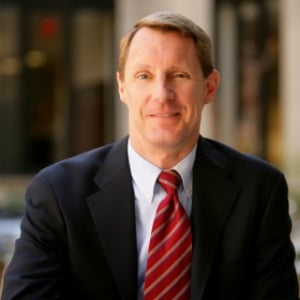
Director, International Legal Studies Program, Vanderbilt Law School
Michael Newton is an expert on terrorism, accountability, transnational justice, and conduct of hostilities issues. Over the course of his career, he has published more than 90 books, articles, op-eds and book chapters. He has been an expert witness in terrorism related trials and is admitted to the counsel list of the International Criminal Court, where, in 2018, he helped prepare the appeal of Jean-Pierre Bemba and participated in oral arguments in the Appeals Chamber. At Vanderbilt, he developed and teaches the innovative International Law Practice Lab, which provides expert assistance to judges, lawyers, legislatures, governments, and policy makers around the world. Professor Newton is most recently the editor of The United States Department of Defense Law of War Manual: Commentary and Critique, forthcoming from Cambridge University Press.
An authority on the law of armed conflict, Professor Newton served as the senior adviser to the Ambassador-at-Large for War Crimes Issues in the U.S. State Department from January 1999 to August 2002, during which he implemented a wide range of policy positions, including U.S. support to accountability mechanisms worldwide. He negotiated the “Elements of Crimes” for the International Criminal Court, and was the senior member of the team teaching international law to the first group of Iraqis who began to think about accountability mechanisms and a constitutional structure in November 2000. He shuttled to Baghdad repeatedly to aid international and Iraqi lawyers and jurists in drafting the Statute of the Iraqi High Tribunal while serving as the International Law Adviser to the Judicial Chambers from 2006 to 2008. He began assisting Iraqi officials, victims and civil society groups on legal issues associated with documentation and investigation of crimes committed by Da’esh on Iraqi soil days after Yazidi victims fled towards Mount Sinjar. He was the U.S. representative on the U.N. Planning Mission for the Sierra Leone Special Court and a founding member of its academic consortium. He is an elected member of the International Institute of Humanitarian Law and on the expert roster of Justice Rapid Response. In addition to teaching the Practice Lab, he develops and coordinates externships and educational opportunities for students interested in international legal issues, having supervised more than 150 such opportunities.
Professor Newton has served on the executive council of the American Society of International Law and as an invited expert for the Genocide Prevention Task Force established by the U.S. Holocaust Memorial Museum and the U.S. Institute of Peace. He is currently on the Advisory Board of the ABA International Criminal Court Project.
Professor Newton served in the U.S. Army more than 21 years, beginning with his commission from the U.S. Military Academy in May 1984 as an armor officer in the 4th Battalion, 68th Armor at Fort Carson, Colorado. After his selection for the Funded Legal Education Program, Newton served as chief of operational law with the Army Special Forces Command (Airborne) during Operation Desert Storm, and as the group judge advocate for the 7th Special Forces Group (Airborne). His deployments include Northern Iraq on Operation Provide Comfort to assist Kurdish civilians, and Haiti with 194th Armored Brigade (Separate), where he organized and led human rights and rules of engagement education for multinational forces, including police. He has taught international and operational law at the Judge Advocate General's School and Center in Charlottesville, Virginia, and taught international law at the United States Military Academy at West Point.
Judge, United States Court of Appeals, Third Circuit
Stephanos Bibas is a judge on the U.S. Court of Appeals for the Third Circuit. Judge Bibas was previously a professor of law and criminology at the University of Pennsylvania Law School. As director of the Penn Law Supreme Court Clinic, he argued six cases before the Supreme Court of the United States and filed briefs in dozens of others. He graduated summa cum laude and Phi Beta Kappa from Columbia University in 1989 with a B.A. in political theory and from Oxford University in 1991 with a B.A. in jurisprudence. He then earned his J.D. from Yale Law School in 1994.
After graduating from Yale Law, Judge Bibas clerked for Judge Patrick Higginbotham of the U.S. Court of Appeals for the Fifth Circuit and Justice Anthony Kennedy on the Supreme Court and was a litigation associate at Covington & Burling LLP in Washington, D.C. Thereafter, Judge Bibas served as an Assistant U.S. Attorney in the Southern District of New York, where he successfully prosecuted the world’s leading expert in Tiffany stained glass for hiring a grave robber to steal priceless Tiffany windows from cemeteries. Before his tenure at Penn Law, Judge Bibas taught at the University of Chicago Law School and the University of Iowa College of Law and was a research fellow at Yale Law School. He has published two books and seventy scholarly articles.
Laurence A. Tisch Professor of Law and Director, Classical Liberal Institute, New York University School of Law; Director, Classical Liberal Institute, Civitas Institute University of Texas at Austin
Richard A. Epstein is the Laurence A. Tisch Professor of Law, at New York University, a senior research fellow at the Civitas Institute at the University of Texas Austin, and a senior Lecturer, the University of Chicago. He received an LL.D., h.c . from the University of Ghent, 2003 , and an LLD h.c . from the University of Siegen in 2018 and the Bradley Prize in 2011. He has been a member of the American Academy of Arts and Sciences since 1985. He has edited both the Journal of Legal Studies (1981-1991) and the Journal of Law and Economics (1991-2001). He is also a founder and director of the Classical Liberal Institute at NYU Law School. His most recent book is The Classical Liberal Constitution: The Uncertain Quest for Limited Government (2014). His other books include Takings: Private Property and the Power of Eminent Domain ( 1985); Bargaining with the State (1993); Simple Rules for a Complex World (1995); Principles for a Free Society: Reconciling Individual Liberty and the Common Good (1998); Skepticism and Freedom: A Modern Theory of Classical Liberalism (2003); Design for Liberty: Private Property, Public Administration and the Rule of Law (2011), and most recently, The Myth of Birthright citizenship—and Beyond (2026). He has taught courses in , administrative law, antitrust, constitutional, contracts, environmental law, land use planning; real property, torts and water law. He has written and spoken extensively on a wide range of topics, and is writes a regular column for Defining Ideas.
Judge, Iran-United States Claims Tribunal and Arbitrator Member, Twenty Essex Chambers
Charles’s 55-year career in the law has combined extensive practice at the bar with distinguished public service, both national and international. For nearly 40 years he has focused on public international law and international dispute resolution.
As counsel or arbitrator he has handled cases on all six continents, principally under the rules of the ICC, UNCITRAL, LCIA, AAA, United Nations Compensation Commission, ICSID, Stockholm Chamber of Commerce, Insurance and Reinsurance Arbitration Society and LMAA. These cases have involved a wide variety of commercial disputes as well as issues of public international law, particularly involving the oil and gas sector, major infrastructural projects, expropriations, and other investment disputes, including ones arising under both bilateral and multilateral investment treaties.
Charles started his career with White & Case LLP in New York, before serving for four years in the United States Department of State in Washington, DC, concluding as its Acting Legal Adviser. He then rejoined White & Case LLP, co-founding its Washington, DC office, where his practice came to be comprised almost exclusively of substantial international arbitrations.
He has served continuously since 1983 as a judge of the Iran-United States Claims Tribunal in The Hague, The Netherlands. That service was interrupted for some months in 1987 by White House service as Deputy Special Counsellor to President Reagan. Charles resumed partnership in White & Case LLP from 1988 until joining 20 Essex Street in 2001. Since 2014 he has also served as a Judge ad hoc at the International Court of Justice.
In 2015 Charles was only the fourth ever recipient of the Global Arbitration Review Lifetime Achievement Award.
Professor of Law and Global Affairs Faculty Director, LL.M. in International Human Rights Law; Global Director, Notre Dame Law School Global Human Rights Clinic, Notre Dame Law School
Diane A. Desierto joined the Law School in January 2021 as Professor of Law and LL.M. Faculty Director, with a joint appointment at the Keough School of Global Affairs. Desierto teaches, publishes, and practices in the areas of international law and human rights, international economic law and development, international arbitration, maritime security, Association of Southeast Asian Nations (ASEAN) Law, and comparative public law. At Notre Dame, Desierto is a Faculty Fellow at the Klau Institute for Civil Human Rights, Kellogg Institute of International Studies, Liu Institute for Asia and Asian Studies, Pulte Institute for Global Development, and Nanovic Institute of European Studies. She is also Co-Principal Investigator of the Notre Dame Reparations Design and Compliance Lab.
Desierto is a Member and former Chair-Rapporteur of the Expert Group of the United Nations Working Group on the Right to Development, Resource Expert for the Association of Southeast Asian Nations (ASEAN), former Director of Studies and Faculty of the Hague Academy of International Law, President of the Friends of the Hague Academy Foundation, and the Philippines Focal Point for the International Criminal Court Bar Association. She is active as international counsel at matters successfully litigated at the Permanent Court of Arbitration, the UN Human Rights Committee, the Philippine Supreme Court and Southeast Asian agencies, and was appointed by the Philippine Supreme Court as Professor of International Law and Human Rights at the Philippines Judicial Academy. Desierto is a Member of the Editorial Boards of the European Journal of International Law (and Editor of its leading international law blog EJIL:Talk!), Journal of World Investment and Trade, and the Global Community Yearbook of International Law and Jurisprudence, and the Kluwer Law monograph series on Human Society and International Law, and also serves on the Scientific Advisory Boards of international journals such as International Law Studies, the Revista Chilena de Derecho, and the Indonesian Journal of International and Comparative Law. Desierto previously taught as tenure-track/tenured law faculty at the University of the Philippines, Peking University School of Transnational Law in China, and the University of Hawaii Richardson School of Law. She is a recipient of faculty fellowships awarded by Stanford University's Center for Advanced Studies in the Behavioral Sciences (CASBS) and the Stanford Center for Human Rights and International Justice, the Max Planck Institute for Comparative Public Law and International Law in Heidelberg, the Humboldt-Potsdam-Berlin Senior Fellowship, the East-West Center in Honolulu, the Grotius Fellowship at University of Michigan Law School, and the National University of Singapore's Asian Law Institute Fellowship. Desierto has served Visiting Professor appointments at the University of Paris-Nanterre X Faculty of Law, University of the Philippines College of Law Graduate Program at Bonifacio Global City, the University of Navarre Faculty of Law in Spain, and Universidad Panamericana Faculty of Law in Mexico City.
Desierto holds JSD and LLM degrees from Yale Law School, as well as JD cum laude class salutatorian and BSc Economics summa cum laude class valedictorian degrees from the University of the Philippines, and was a former Yale Law clerk at the International Court of Justice for H.E. Judges Bruno Simma and Bernardo Sepulveda-Amor. She authored and/or edited several books, such as Necessity and National Emergency Clauses: Sovereignty in Modern Treaty Interpretation (Martinus Nijhoff, 2012, recipient of the Ambrose Gherini Prize in International Law at Yale Law), Public Policy in International Economic Law: The ICESCR in Trade, Investment and Finance (Oxford University Press, 2015), ASEAN Law and Regional Integration: Governance and the Rule of Law in Southeast Asia's Single Market (with D. Cohen, Routledge, 2020), The International Legal System: Cases and Materials (8th Edition, with M.E. O'Connell, N. Roht-Arriaza, and D. Bradlow, 2022), as well as, to date, around 180 law review articles, book chapters, essays, and book reviews with leading international law journals and publishers in the United States, Europe, and Asia. She is a member of the Institute of Transnational Arbitration Academic Council, the UNCITRAL Academic Forum on Investor-State Dispute Settlement Reform, the 2019 Hague Rules on Business and Human Rights Arbitration Drafting Team, Co-Chair of the Oxford Investment Claims Summer Academy, and has been recognized repeatedly by Who's Who Legal as one of the Future Leaders in Arbitration. The 2020 ND Women Lead featured Desierto here.
Director, International Legal Studies Program, Vanderbilt Law School
Michael Newton is an expert on terrorism, accountability, transnational justice, and conduct of hostilities issues. Over the course of his career, he has published more than 90 books, articles, op-eds and book chapters. He has been an expert witness in terrorism related trials and is admitted to the counsel list of the International Criminal Court, where, in 2018, he helped prepare the appeal of Jean-Pierre Bemba and participated in oral arguments in the Appeals Chamber. At Vanderbilt, he developed and teaches the innovative International Law Practice Lab, which provides expert assistance to judges, lawyers, legislatures, governments, and policy makers around the world. Professor Newton is most recently the editor of The United States Department of Defense Law of War Manual: Commentary and Critique, forthcoming from Cambridge University Press.
An authority on the law of armed conflict, Professor Newton served as the senior adviser to the Ambassador-at-Large for War Crimes Issues in the U.S. State Department from January 1999 to August 2002, during which he implemented a wide range of policy positions, including U.S. support to accountability mechanisms worldwide. He negotiated the “Elements of Crimes” for the International Criminal Court, and was the senior member of the team teaching international law to the first group of Iraqis who began to think about accountability mechanisms and a constitutional structure in November 2000. He shuttled to Baghdad repeatedly to aid international and Iraqi lawyers and jurists in drafting the Statute of the Iraqi High Tribunal while serving as the International Law Adviser to the Judicial Chambers from 2006 to 2008. He began assisting Iraqi officials, victims and civil society groups on legal issues associated with documentation and investigation of crimes committed by Da’esh on Iraqi soil days after Yazidi victims fled towards Mount Sinjar. He was the U.S. representative on the U.N. Planning Mission for the Sierra Leone Special Court and a founding member of its academic consortium. He is an elected member of the International Institute of Humanitarian Law and on the expert roster of Justice Rapid Response. In addition to teaching the Practice Lab, he develops and coordinates externships and educational opportunities for students interested in international legal issues, having supervised more than 150 such opportunities.
Professor Newton has served on the executive council of the American Society of International Law and as an invited expert for the Genocide Prevention Task Force established by the U.S. Holocaust Memorial Museum and the U.S. Institute of Peace. He is currently on the Advisory Board of the ABA International Criminal Court Project.
Professor Newton served in the U.S. Army more than 21 years, beginning with his commission from the U.S. Military Academy in May 1984 as an armor officer in the 4th Battalion, 68th Armor at Fort Carson, Colorado. After his selection for the Funded Legal Education Program, Newton served as chief of operational law with the Army Special Forces Command (Airborne) during Operation Desert Storm, and as the group judge advocate for the 7th Special Forces Group (Airborne). His deployments include Northern Iraq on Operation Provide Comfort to assist Kurdish civilians, and Haiti with 194th Armored Brigade (Separate), where he organized and led human rights and rules of engagement education for multinational forces, including police. He has taught international and operational law at the Judge Advocate General's School and Center in Charlottesville, Virginia, and taught international law at the United States Military Academy at West Point.
Judge, United States Court of Appeals, Third Circuit
Stephanos Bibas is a judge on the U.S. Court of Appeals for the Third Circuit. Judge Bibas was previously a professor of law and criminology at the University of Pennsylvania Law School. As director of the Penn Law Supreme Court Clinic, he argued six cases before the Supreme Court of the United States and filed briefs in dozens of others. He graduated summa cum laude and Phi Beta Kappa from Columbia University in 1989 with a B.A. in political theory and from Oxford University in 1991 with a B.A. in jurisprudence. He then earned his J.D. from Yale Law School in 1994.
After graduating from Yale Law, Judge Bibas clerked for Judge Patrick Higginbotham of the U.S. Court of Appeals for the Fifth Circuit and Justice Anthony Kennedy on the Supreme Court and was a litigation associate at Covington & Burling LLP in Washington, D.C. Thereafter, Judge Bibas served as an Assistant U.S. Attorney in the Southern District of New York, where he successfully prosecuted the world’s leading expert in Tiffany stained glass for hiring a grave robber to steal priceless Tiffany windows from cemeteries. Before his tenure at Penn Law, Judge Bibas taught at the University of Chicago Law School and the University of Iowa College of Law and was a research fellow at Yale Law School. He has published two books and seventy scholarly articles.
Judge, Iran-United States Claims Tribunal and Arbitrator Member, Twenty Essex Chambers
Charles’s 55-year career in the law has combined extensive practice at the bar with distinguished public service, both national and international. For nearly 40 years he has focused on public international law and international dispute resolution.
As counsel or arbitrator he has handled cases on all six continents, principally under the rules of the ICC, UNCITRAL, LCIA, AAA, United Nations Compensation Commission, ICSID, Stockholm Chamber of Commerce, Insurance and Reinsurance Arbitration Society and LMAA. These cases have involved a wide variety of commercial disputes as well as issues of public international law, particularly involving the oil and gas sector, major infrastructural projects, expropriations, and other investment disputes, including ones arising under both bilateral and multilateral investment treaties.
Charles started his career with White & Case LLP in New York, before serving for four years in the United States Department of State in Washington, DC, concluding as its Acting Legal Adviser. He then rejoined White & Case LLP, co-founding its Washington, DC office, where his practice came to be comprised almost exclusively of substantial international arbitrations.
He has served continuously since 1983 as a judge of the Iran-United States Claims Tribunal in The Hague, The Netherlands. That service was interrupted for some months in 1987 by White House service as Deputy Special Counsellor to President Reagan. Charles resumed partnership in White & Case LLP from 1988 until joining 20 Essex Street in 2001. Since 2014 he has also served as a Judge ad hoc at the International Court of Justice.
In 2015 Charles was only the fourth ever recipient of the Global Arbitration Review Lifetime Achievement Award.
Professor of Law and Global Affairs Faculty Director, LL.M. in International Human Rights Law; Global Director, Notre Dame Law School Global Human Rights Clinic, Notre Dame Law School
Diane A. Desierto joined the Law School in January 2021 as Professor of Law and LL.M. Faculty Director, with a joint appointment at the Keough School of Global Affairs. Desierto teaches, publishes, and practices in the areas of international law and human rights, international economic law and development, international arbitration, maritime security, Association of Southeast Asian Nations (ASEAN) Law, and comparative public law. At Notre Dame, Desierto is a Faculty Fellow at the Klau Institute for Civil Human Rights, Kellogg Institute of International Studies, Liu Institute for Asia and Asian Studies, Pulte Institute for Global Development, and Nanovic Institute of European Studies. She is also Co-Principal Investigator of the Notre Dame Reparations Design and Compliance Lab.
Desierto is a Member and former Chair-Rapporteur of the Expert Group of the United Nations Working Group on the Right to Development, Resource Expert for the Association of Southeast Asian Nations (ASEAN), former Director of Studies and Faculty of the Hague Academy of International Law, President of the Friends of the Hague Academy Foundation, and the Philippines Focal Point for the International Criminal Court Bar Association. She is active as international counsel at matters successfully litigated at the Permanent Court of Arbitration, the UN Human Rights Committee, the Philippine Supreme Court and Southeast Asian agencies, and was appointed by the Philippine Supreme Court as Professor of International Law and Human Rights at the Philippines Judicial Academy. Desierto is a Member of the Editorial Boards of the European Journal of International Law (and Editor of its leading international law blog EJIL:Talk!), Journal of World Investment and Trade, and the Global Community Yearbook of International Law and Jurisprudence, and the Kluwer Law monograph series on Human Society and International Law, and also serves on the Scientific Advisory Boards of international journals such as International Law Studies, the Revista Chilena de Derecho, and the Indonesian Journal of International and Comparative Law. Desierto previously taught as tenure-track/tenured law faculty at the University of the Philippines, Peking University School of Transnational Law in China, and the University of Hawaii Richardson School of Law. She is a recipient of faculty fellowships awarded by Stanford University's Center for Advanced Studies in the Behavioral Sciences (CASBS) and the Stanford Center for Human Rights and International Justice, the Max Planck Institute for Comparative Public Law and International Law in Heidelberg, the Humboldt-Potsdam-Berlin Senior Fellowship, the East-West Center in Honolulu, the Grotius Fellowship at University of Michigan Law School, and the National University of Singapore's Asian Law Institute Fellowship. Desierto has served Visiting Professor appointments at the University of Paris-Nanterre X Faculty of Law, University of the Philippines College of Law Graduate Program at Bonifacio Global City, the University of Navarre Faculty of Law in Spain, and Universidad Panamericana Faculty of Law in Mexico City.
Desierto holds JSD and LLM degrees from Yale Law School, as well as JD cum laude class salutatorian and BSc Economics summa cum laude class valedictorian degrees from the University of the Philippines, and was a former Yale Law clerk at the International Court of Justice for H.E. Judges Bruno Simma and Bernardo Sepulveda-Amor. She authored and/or edited several books, such as Necessity and National Emergency Clauses: Sovereignty in Modern Treaty Interpretation (Martinus Nijhoff, 2012, recipient of the Ambrose Gherini Prize in International Law at Yale Law), Public Policy in International Economic Law: The ICESCR in Trade, Investment and Finance (Oxford University Press, 2015), ASEAN Law and Regional Integration: Governance and the Rule of Law in Southeast Asia's Single Market (with D. Cohen, Routledge, 2020), The International Legal System: Cases and Materials (8th Edition, with M.E. O'Connell, N. Roht-Arriaza, and D. Bradlow, 2022), as well as, to date, around 180 law review articles, book chapters, essays, and book reviews with leading international law journals and publishers in the United States, Europe, and Asia. She is a member of the Institute of Transnational Arbitration Academic Council, the UNCITRAL Academic Forum on Investor-State Dispute Settlement Reform, the 2019 Hague Rules on Business and Human Rights Arbitration Drafting Team, Co-Chair of the Oxford Investment Claims Summer Academy, and has been recognized repeatedly by Who's Who Legal as one of the Future Leaders in Arbitration. The 2020 ND Women Lead featured Desierto here.
Laurence A. Tisch Professor of Law and Director, Classical Liberal Institute, New York University School of Law; Director, Classical Liberal Institute, Civitas Institute University of Texas at Austin
Richard A. Epstein is the Laurence A. Tisch Professor of Law, at New York University, a senior research fellow at the Civitas Institute at the University of Texas Austin, and a senior Lecturer, the University of Chicago. He received an LL.D., h.c . from the University of Ghent, 2003 , and an LLD h.c . from the University of Siegen in 2018 and the Bradley Prize in 2011. He has been a member of the American Academy of Arts and Sciences since 1985. He has edited both the Journal of Legal Studies (1981-1991) and the Journal of Law and Economics (1991-2001). He is also a founder and director of the Classical Liberal Institute at NYU Law School. His most recent book is The Classical Liberal Constitution: The Uncertain Quest for Limited Government (2014). His other books include Takings: Private Property and the Power of Eminent Domain ( 1985); Bargaining with the State (1993); Simple Rules for a Complex World (1995); Principles for a Free Society: Reconciling Individual Liberty and the Common Good (1998); Skepticism and Freedom: A Modern Theory of Classical Liberalism (2003); Design for Liberty: Private Property, Public Administration and the Rule of Law (2011), and most recently, The Myth of Birthright citizenship—and Beyond (2026). He has taught courses in , administrative law, antitrust, constitutional, contracts, environmental law, land use planning; real property, torts and water law. He has written and spoken extensively on a wide range of topics, and is writes a regular column for Defining Ideas.
Director, International Legal Studies Program, Vanderbilt Law School
Michael Newton is an expert on terrorism, accountability, transnational justice, and conduct of hostilities issues. Over the course of his career, he has published more than 90 books, articles, op-eds and book chapters. He has been an expert witness in terrorism related trials and is admitted to the counsel list of the International Criminal Court, where, in 2018, he helped prepare the appeal of Jean-Pierre Bemba and participated in oral arguments in the Appeals Chamber. At Vanderbilt, he developed and teaches the innovative International Law Practice Lab, which provides expert assistance to judges, lawyers, legislatures, governments, and policy makers around the world. Professor Newton is most recently the editor of The United States Department of Defense Law of War Manual: Commentary and Critique, forthcoming from Cambridge University Press.
An authority on the law of armed conflict, Professor Newton served as the senior adviser to the Ambassador-at-Large for War Crimes Issues in the U.S. State Department from January 1999 to August 2002, during which he implemented a wide range of policy positions, including U.S. support to accountability mechanisms worldwide. He negotiated the “Elements of Crimes” for the International Criminal Court, and was the senior member of the team teaching international law to the first group of Iraqis who began to think about accountability mechanisms and a constitutional structure in November 2000. He shuttled to Baghdad repeatedly to aid international and Iraqi lawyers and jurists in drafting the Statute of the Iraqi High Tribunal while serving as the International Law Adviser to the Judicial Chambers from 2006 to 2008. He began assisting Iraqi officials, victims and civil society groups on legal issues associated with documentation and investigation of crimes committed by Da’esh on Iraqi soil days after Yazidi victims fled towards Mount Sinjar. He was the U.S. representative on the U.N. Planning Mission for the Sierra Leone Special Court and a founding member of its academic consortium. He is an elected member of the International Institute of Humanitarian Law and on the expert roster of Justice Rapid Response. In addition to teaching the Practice Lab, he develops and coordinates externships and educational opportunities for students interested in international legal issues, having supervised more than 150 such opportunities.
Professor Newton has served on the executive council of the American Society of International Law and as an invited expert for the Genocide Prevention Task Force established by the U.S. Holocaust Memorial Museum and the U.S. Institute of Peace. He is currently on the Advisory Board of the ABA International Criminal Court Project.
Professor Newton served in the U.S. Army more than 21 years, beginning with his commission from the U.S. Military Academy in May 1984 as an armor officer in the 4th Battalion, 68th Armor at Fort Carson, Colorado. After his selection for the Funded Legal Education Program, Newton served as chief of operational law with the Army Special Forces Command (Airborne) during Operation Desert Storm, and as the group judge advocate for the 7th Special Forces Group (Airborne). His deployments include Northern Iraq on Operation Provide Comfort to assist Kurdish civilians, and Haiti with 194th Armored Brigade (Separate), where he organized and led human rights and rules of engagement education for multinational forces, including police. He has taught international and operational law at the Judge Advocate General's School and Center in Charlottesville, Virginia, and taught international law at the United States Military Academy at West Point.
Managing Director, Beacon Global Strategies LLC
From 2011-2013, Mr. Allen served as the Majority Staff Director of the House Permanent Select Committee on Intelligence (HPSCI). Under Chairman Mike Rogers’ (R-MI) direction, the HPSCI restored the process of an annual intelligence authorization bill to fund and give direction to the seventeen elements of the intelligence community, enacting measures for fiscal years 2011, 2012, and 2013. The HPSCI also led the House of Representatives’ consideration of cyber security legislation, passing the Cyber Information Sharing Protection Act (CISPA) with bipartisan majorities in 2012 and 2013.
Prior to joining the HPSCI, he was director for the Bipartisan Policy Center’s successor to the 9/11 Commission, the National Security Preparedness Group, co-chaired by former Congressman Lee Hamilton and former Governor Tom Kean.
Previously, Mr. Allen served in the White House for seven years in a variety of national security policy and legislative roles. At the National Security Council (NSC), he served as Special Assistant to the President and Senior Director for Counter-proliferation Strategy from June 2007 to January 2009 under National Security Advisor Steve Hadley. As Senior Director, he contributed to the development of the U.S. government’s policy on counter-proliferation issues, including on the Iranian, Syrian, and North Korean nuclear files; missile defense; civilian nuclear cooperation including the U.S.-India Civilian Nuclear Cooperation Agreement; U.S. exports controls; bio-defense; and WMD and terrorism.
As the Special Assistant to the President and Senior Director for Legislative Affairs from March 2005 to June 2007, Mr. Allen was the NSC’s chief liaison with the national security committees of Congress and led the confirmation teams of DNI nominees Negroponte and McConnell and CIA Director General Michael Hayden.
From December 2001 to February 2005, Mr. Allen worked in the legislative affairs office of the White House’s Homeland Security Council. As Special Assistant to the President for Legislative Affairs, Mr. Allen was part of team that managed the White House effort to enact the Intelligence Reform and Terrorism Prevention Act of 2004, which created the Office of the Director of National Intelligence.
At the beginning of the Bush Administration, Mr. Allen worked in the Bureau of Legislative Affairs at the Department of State. Mr. Allen received his L.L.M. with distinction in International Law from the Georgetown University Law Center, his J.D. from the University of Alabama (cum laude), and his B.A. from Vanderbilt University.
In addition to his work at the Bipartisan Policy Center, in 2009, Mr. Allen taught National Security Policymaking at the George Washington University Elliott School of International Affairs and served as an advisor for the congressionally-created Commission on WMD and Terrorism co-chaired by Senators Bob Graham and Jim Talent. Mr. Allen was the Intelligence Team Lead for the Romney for President Transition Team.
Mr. Allen is the author of Blinking Red: Crisis and Compromise in American Intelligence After 9/11. (Potomac Books, September 2013).

Executive Director, Foundation for Defense of Democracies (FDD)
Mark Dubowitz is the executive director of the Foundation for Defense of Democracies (FDD), a Washington, D.C.-based nonpartisan policy institute, where he leads projects on Iran, sanctions, countering threat finance, and nonproliferation.
He is an expert on Iran’s global network including the regime's nuclear, terrorist, missile and cyber threats to the United States and other allies, and is widely recognized as one of the key influencers in shaping sanctions policies to counter the threats emanating from Iran and its surrogates.
Mark was featured as one of the key “financial warriors” against Iran by The Wall Street Journal's Jay Solomon in his 2016 book The Iran Wars. Politico magazine featured Mr. Dubowitz as one of Washington’s leading policy experts challenging Iran’s illicit behavior, observing that he is “...constantly thinking up—and promoting—new ways to squeeze the regime...”
Mr. Dubowitz has advised the Obama and Bush administrations and lawmakers on both sides of the aisle and testified more than twenty times before the U.S. Congress and foreign legislatures.
A former venture capitalist and technology executive, Mark heads FDD’s Center on Sanctions and Illicit Finance and is the author or co-author of over twenty studies on economic sanctions and Iran's nuclear program. He is widely published and cited in U.S. and international media. He teaches courses on sanctions and international negotiations at the University of Toronto's Munk School of Global Affairs, where he is a senior fellow.
Mark has a master’s degree in international public policy from Johns Hopkins University's School of Advanced International Studies, and law and MBA degrees from the University of Toronto.
Raised in Toronto, he is a proud American citizen, and has lived in Washington, D.C.
Founder and Executive Director, National Security Institute; Assistant Professor of Law, Antonin Scalia Law School, George Mason University
Jamil N. Jaffer is the Founder and Executive Director of the National Security Institute at the Antonin Scalia Law School at George Mason University where he also serves as an Assistant Professor of Law, Director of the National Security Law and Policy Program, and Director of the Cyber, Intelligence, and National Security LLM Program. Jamil also teaches classes on counterterrorism, intelligence, surveillance, cybersecurity, and other national security matters, as well as a summer course held abroad with U.S. Supreme Court Justice Neil M. Gorsuch. Jamil is also affiliated with Stanford University’s Center for International Security and Cooperation and previously served as a Visiting Fellow at the Hoover Institution from 2016 to 2019.
Jamil is also a Venture Partner with Paladin Capital Group, where he assists the firm with investments across the full range of its themes and theses, including a focus on dual-use national security technologies. Jamil also serves on the board of directors of RangeForce, a cybersecurity training and readiness platform startup and Tozny, a digital identity startup, and on the advisory boards of U.S. Strategic Metals, North America’s largest primary producer of cobalt, a critical mineral used in EV batteries, aerospace, and other national security applications; and Constella Intelligence, a deep and dark web intelligence startup. Jamil also serves as an advisor to Beacon Global Strategies, a strategic advisory firm and Duco, a technology platform startup that connects corporations with geopolitical and international business experts. Jamil is also the managing director of Trigraph Caveat Capital, a private investment vehicle.
Among other things, Jamil currently serves on the Board of Directors for the Greater Washington Board of Trade, the Board of Advisors for the Global Cyber Alliance, and the Advisory Board of the Foundation for the Defense of Democracies’ Center on Cyber and Tech Innovation, the Executive Committee of the Reagan Institute Strategy Group. Jamil is also a Fellow at the Academy for Judaic, Christian, and Islamic Studies, an advisor to the Concordia Summit, and is a member of the Board of Directors for the Center for Intelligence Policy, the Board of Directors of Speech First, and the Executive Committee of the International Law and National Security Practice Group of the Federalist Society.
Immediately prior to his current positions, from 2015-2021, Jamil served as a senior business leader at IronNet Cybersecurity, helping take the company from a bootstrapped first-year technology products startup through two rounds of venture capital fundraising, growing from 40 employees to over 300, and through its listing on New York Stock Exchange. In his role as IronNet's Senior Vice President for Strategy, Partnerships & Corporate Development, Jamil worked directly for the co-CEOs of the company, Gen (ret.) Keith B. Alexander, the former Director of the National Security Agency and Founding Commander of U.S. Cyber Command, and Bill Welch, the former COO of Zscaler and Duo; in that role, Jamil led all of the company’s strategic and technology partnership efforts, including developing go-to-market and technology integration plans with some of the largest cloud platforms and cybersecurity companies in the market, evaluating potential acquisition targets, and developing overall corporate strategy and thought leadership around collective security and collaborative defense in the cyber arena.
Prior to his time at IronNet, Jamil served on the leadership team of the Senate Foreign Relations Committee as Chief Counsel and Senior Advisor under Chairman Bob Corker (R-TN), where he worked on key national security and foreign policy issues, including leading the drafting of the proposed Authorization for the Use of Military Force against ISIS in 2014 and 2015, the AUMF against Syria in 2013, and revisions to the 9/11 AUMF against al Qaeda. Jamil was also the lead architect of the Iran Nuclear Agreement Review Act and two sanctions laws against Russia for its first intervention in Ukraine.
Prior to joining SFRC, Jamil served as Senior Counsel to the House Permanent Select Committee on Intelligence under Chairman Mike Rogers (R-MI) where he led the committee’s oversight of NSA surveillance, NRO intelligence issues, and NGA analytic and collection matters, as well as intelligence community-wide counterterrorism issues. Jamil was also the lead architect of the Cyber Intelligence Sharing and Protection Act, the nation’s first cyber threat intelligence sharing legislation that was signed into law in 2015.
In the Bush Administration, Jamil served in the White House as an Associate Counsel to the President, handling Defense Department, State Department, and intelligence community matters, and serving as one of the White House Counsel’s primary representatives to the National Security Council Deputies Committee.
Prior to the White House, Jamil served on the leadership team of the Justice Department’s National Security Division as Counsel to the Assistant Attorney General for National Security, where he focused on counterterrorism and intelligence matters. At NSD, Jamil helped lead the division’s work on In re: Directives, the first ever two-party litigated matter in the FISA Court and the second case before the FISA Court of Review in its 30-year history. Jamil also led NSD’s efforts on the President’s Comprehensive National Cybersecurity Initiative (CNCI), including the drafting of NSPD-54/HSPD-23, and related classified matters, and advised the National Security Agency (NSA) and U.S. Cyber Command’s predecessor organization, the Joint Function Component Command for Network Warfare (JFCC-NW), on matters related to cyber intelligence collection and offensive cyber activities. For his work on these matters, Jamil was awarded the Assistant Attorney General’s Award for Special Initiative and was among the group of lawyers awarded the Director of National Intelligence’s 2008 Legal Award (Team of the Year – Cyber Legal).
Jamil also served in other positions in the Justice Department, including in the Office of Legal Policy, where he worked on the confirmations of Chief Justice John G. Roberts, Jr. and Justice Samuel A. Alito, Jr. to the United States Supreme Court.
Jamil also served as a lawyer in private practice at Kellogg Huber, a Washington, DC-based litigation boutique, as a policy advisor to Congressman Bob Goodlatte (R-VA), and as a staff member or senior advisor on a number of political campaigns, including two presidential campaigns and a presidential transition team. While in law school, Jamil was a member of the University of Chicago Law Review, managing editor of the Chicago Journal of International Law, and National Symposium Editor of the Harvard Journal of Law & Public Policy. Following law school, Jamil served as a law clerk to Judge Edith H. Jones of the United States Court of Appeals for the Fifth Circuit and, later in his career, as a law clerk to then-Judge Neil M. Gorsuch when he first joined the United States Court of Appeals for the Tenth Circuit as well as a law clerk to Justice Neil Gorsuch when he joined the U.S. Supreme Court.
Jamil has published multiple op-eds and academic articles on national security, foreign policy, cybersecurity, counterterrorism, encryption, and intelligence matters, and is the co-author of a book chapter with former NSA Director Gen. (Ret.) Keith B. Alexander on national security and the press in National Security, Leaks, and the Freedom of the Press: The Pentagon Papers Fifty Years On (2021) and a book chapter with former CIA Director Gen. (ret.) Mike Hayden on ISIS, al Qaeda, and other international terrorist groups in Choosing to Lead: American Foreign Policy for a Disordered World (2015). Jamil has also written book chapters on cybersecurity and surveillance, as well as op-eds and policy papers with former Attorney General Michael B. Mukasey, former National Counterterrorism Center Director Matt Olsen, and Congressman Mike Waltz (R-FL), among others.
Jamil has previously taught graduate-level courses in intelligence law and policy at George Washington University’s Elliott School of International Affairs and the National Intelligence University, served an outside advisor to the Cyberspace Solarium Commission, and has recently testified before committees of the U.S. Senate and House of Representatives on China, cybersecurity, counterterrorism, and other national security matters. Jamil has also recently appeared on a range of national television and radio outlets including CNN, Fox News, Fox Business, MSNBC, Bloomberg, PBS, Voice of America, and National Public Radio, and in various print and online publications, including the Wall Street Journal, New York Times, and the Washington Post on a range of national security matters including cybersecurity, counterterrorism, surveillance, encryption, privacy, and foreign policy issues.
Jamil holds degrees from UCLA (BA, cum laude), the University of Chicago Law School (JD, with honors), and the United States Naval War College (MA, with distinction).
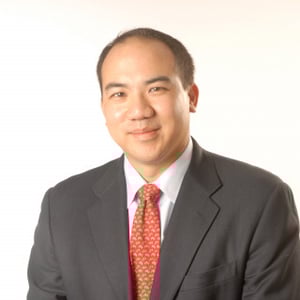
Maurice A. Deane Distinguished Professor of Constitutional Law and Faculty Director of International Programs, Hofstra University School of Law
Professor Ku’s primary research interest is the relationship of international law to constitutional law. He has also conducted academic research on a wide range of topics including international dispute resolution, international criminal law, and China’s relationship with international law. He teaches courses such as U.S. constitutional law, U.S. foreign affairs law, transnational law, and international trade and business law. Since 2014, he has served as the faculty director of international programs, overseeing Hofstra Law’s study abroad, exchange and LL.M. programs. Professor Ku also teaches Constitutional Law in our online degree programs: Master of Laws in American Law and Master of Arts in American Legal Studies. He has also been selected as the John DeWitt Gregory Research Scholar and as a Hofstra Law Research Fellow. He is a member of the American Law Institute.
He is the co-author, with John Yoo, of Taming Globalization: International Law, the U.S. Constitution, and the New World Order (Oxford University Press 2012). He also has published more than 40 law review articles, book chapters and symposia essays. He has given dozens of academic lectures and workshops at major universities and conferences in the United States, Europe and Asia.
He co-founded the leading international law weblog Opinio Juris, which is read daily by thousands worldwide. His essays and op-eds have been published in major news publications such as the Wall Street Journal, the Los Angeles Times, and the NYTimes.com. He has been frequently interviewed for television news programs and quoted in print and electronic media. He has also signed or submitted amicus briefs to national and international courts and served as an expert witness in both domestic and international proceedings.
Before joining the Hofstra Law faculty, Professor Ku served as a law clerk to the Honorable Jerry E. Smith of the U.S. Court of Appeals for the Fifth Circuit and as an Olin Fellow and Lecturer in Law at the University of Virginia Law School. Professor Ku also practiced as an associate at the New York City law firm of Debevoise & Plimpton, specializing in litigation and arbitration arising out of international disputes. He has been a visiting professor at the College of William & Mary Marshall- Wythe School of Law in Williamsburg, Virginia; a Fulbright Distinguished Lecturer in Law at East China University of Political Science and Law in Shanghai, China; and a Taiwan Fellow at National Taiwan University in Taipei, Taiwan. He is a member of the New York Bar and a graduate of Yale College and Yale Law School.
Managing Director, Beacon Global Strategies LLC
From 2011-2013, Mr. Allen served as the Majority Staff Director of the House Permanent Select Committee on Intelligence (HPSCI). Under Chairman Mike Rogers’ (R-MI) direction, the HPSCI restored the process of an annual intelligence authorization bill to fund and give direction to the seventeen elements of the intelligence community, enacting measures for fiscal years 2011, 2012, and 2013. The HPSCI also led the House of Representatives’ consideration of cyber security legislation, passing the Cyber Information Sharing Protection Act (CISPA) with bipartisan majorities in 2012 and 2013.
Prior to joining the HPSCI, he was director for the Bipartisan Policy Center’s successor to the 9/11 Commission, the National Security Preparedness Group, co-chaired by former Congressman Lee Hamilton and former Governor Tom Kean.
Previously, Mr. Allen served in the White House for seven years in a variety of national security policy and legislative roles. At the National Security Council (NSC), he served as Special Assistant to the President and Senior Director for Counter-proliferation Strategy from June 2007 to January 2009 under National Security Advisor Steve Hadley. As Senior Director, he contributed to the development of the U.S. government’s policy on counter-proliferation issues, including on the Iranian, Syrian, and North Korean nuclear files; missile defense; civilian nuclear cooperation including the U.S.-India Civilian Nuclear Cooperation Agreement; U.S. exports controls; bio-defense; and WMD and terrorism.
As the Special Assistant to the President and Senior Director for Legislative Affairs from March 2005 to June 2007, Mr. Allen was the NSC’s chief liaison with the national security committees of Congress and led the confirmation teams of DNI nominees Negroponte and McConnell and CIA Director General Michael Hayden.
From December 2001 to February 2005, Mr. Allen worked in the legislative affairs office of the White House’s Homeland Security Council. As Special Assistant to the President for Legislative Affairs, Mr. Allen was part of team that managed the White House effort to enact the Intelligence Reform and Terrorism Prevention Act of 2004, which created the Office of the Director of National Intelligence.
At the beginning of the Bush Administration, Mr. Allen worked in the Bureau of Legislative Affairs at the Department of State. Mr. Allen received his L.L.M. with distinction in International Law from the Georgetown University Law Center, his J.D. from the University of Alabama (cum laude), and his B.A. from Vanderbilt University.
In addition to his work at the Bipartisan Policy Center, in 2009, Mr. Allen taught National Security Policymaking at the George Washington University Elliott School of International Affairs and served as an advisor for the congressionally-created Commission on WMD and Terrorism co-chaired by Senators Bob Graham and Jim Talent. Mr. Allen was the Intelligence Team Lead for the Romney for President Transition Team.
Mr. Allen is the author of Blinking Red: Crisis and Compromise in American Intelligence After 9/11. (Potomac Books, September 2013).
Executive Director, Foundation for Defense of Democracies (FDD)
Mark Dubowitz is the executive director of the Foundation for Defense of Democracies (FDD), a Washington, D.C.-based nonpartisan policy institute, where he leads projects on Iran, sanctions, countering threat finance, and nonproliferation.
He is an expert on Iran’s global network including the regime's nuclear, terrorist, missile and cyber threats to the United States and other allies, and is widely recognized as one of the key influencers in shaping sanctions policies to counter the threats emanating from Iran and its surrogates.
Mark was featured as one of the key “financial warriors” against Iran by The Wall Street Journal's Jay Solomon in his 2016 book The Iran Wars. Politico magazine featured Mr. Dubowitz as one of Washington’s leading policy experts challenging Iran’s illicit behavior, observing that he is “...constantly thinking up—and promoting—new ways to squeeze the regime...”
Mr. Dubowitz has advised the Obama and Bush administrations and lawmakers on both sides of the aisle and testified more than twenty times before the U.S. Congress and foreign legislatures.
A former venture capitalist and technology executive, Mark heads FDD’s Center on Sanctions and Illicit Finance and is the author or co-author of over twenty studies on economic sanctions and Iran's nuclear program. He is widely published and cited in U.S. and international media. He teaches courses on sanctions and international negotiations at the University of Toronto's Munk School of Global Affairs, where he is a senior fellow.
Mark has a master’s degree in international public policy from Johns Hopkins University's School of Advanced International Studies, and law and MBA degrees from the University of Toronto.
Raised in Toronto, he is a proud American citizen, and has lived in Washington, D.C.
Founder and Executive Director, National Security Institute; Assistant Professor of Law, Antonin Scalia Law School, George Mason University
Jamil N. Jaffer is the Founder and Executive Director of the National Security Institute at the Antonin Scalia Law School at George Mason University where he also serves as an Assistant Professor of Law, Director of the National Security Law and Policy Program, and Director of the Cyber, Intelligence, and National Security LLM Program. Jamil also teaches classes on counterterrorism, intelligence, surveillance, cybersecurity, and other national security matters, as well as a summer course held abroad with U.S. Supreme Court Justice Neil M. Gorsuch. Jamil is also affiliated with Stanford University’s Center for International Security and Cooperation and previously served as a Visiting Fellow at the Hoover Institution from 2016 to 2019.
Jamil is also a Venture Partner with Paladin Capital Group, where he assists the firm with investments across the full range of its themes and theses, including a focus on dual-use national security technologies. Jamil also serves on the board of directors of RangeForce, a cybersecurity training and readiness platform startup and Tozny, a digital identity startup, and on the advisory boards of U.S. Strategic Metals, North America’s largest primary producer of cobalt, a critical mineral used in EV batteries, aerospace, and other national security applications; and Constella Intelligence, a deep and dark web intelligence startup. Jamil also serves as an advisor to Beacon Global Strategies, a strategic advisory firm and Duco, a technology platform startup that connects corporations with geopolitical and international business experts. Jamil is also the managing director of Trigraph Caveat Capital, a private investment vehicle.
Among other things, Jamil currently serves on the Board of Directors for the Greater Washington Board of Trade, the Board of Advisors for the Global Cyber Alliance, and the Advisory Board of the Foundation for the Defense of Democracies’ Center on Cyber and Tech Innovation, the Executive Committee of the Reagan Institute Strategy Group. Jamil is also a Fellow at the Academy for Judaic, Christian, and Islamic Studies, an advisor to the Concordia Summit, and is a member of the Board of Directors for the Center for Intelligence Policy, the Board of Directors of Speech First, and the Executive Committee of the International Law and National Security Practice Group of the Federalist Society.
Immediately prior to his current positions, from 2015-2021, Jamil served as a senior business leader at IronNet Cybersecurity, helping take the company from a bootstrapped first-year technology products startup through two rounds of venture capital fundraising, growing from 40 employees to over 300, and through its listing on New York Stock Exchange. In his role as IronNet's Senior Vice President for Strategy, Partnerships & Corporate Development, Jamil worked directly for the co-CEOs of the company, Gen (ret.) Keith B. Alexander, the former Director of the National Security Agency and Founding Commander of U.S. Cyber Command, and Bill Welch, the former COO of Zscaler and Duo; in that role, Jamil led all of the company’s strategic and technology partnership efforts, including developing go-to-market and technology integration plans with some of the largest cloud platforms and cybersecurity companies in the market, evaluating potential acquisition targets, and developing overall corporate strategy and thought leadership around collective security and collaborative defense in the cyber arena.
Prior to his time at IronNet, Jamil served on the leadership team of the Senate Foreign Relations Committee as Chief Counsel and Senior Advisor under Chairman Bob Corker (R-TN), where he worked on key national security and foreign policy issues, including leading the drafting of the proposed Authorization for the Use of Military Force against ISIS in 2014 and 2015, the AUMF against Syria in 2013, and revisions to the 9/11 AUMF against al Qaeda. Jamil was also the lead architect of the Iran Nuclear Agreement Review Act and two sanctions laws against Russia for its first intervention in Ukraine.
Prior to joining SFRC, Jamil served as Senior Counsel to the House Permanent Select Committee on Intelligence under Chairman Mike Rogers (R-MI) where he led the committee’s oversight of NSA surveillance, NRO intelligence issues, and NGA analytic and collection matters, as well as intelligence community-wide counterterrorism issues. Jamil was also the lead architect of the Cyber Intelligence Sharing and Protection Act, the nation’s first cyber threat intelligence sharing legislation that was signed into law in 2015.
In the Bush Administration, Jamil served in the White House as an Associate Counsel to the President, handling Defense Department, State Department, and intelligence community matters, and serving as one of the White House Counsel’s primary representatives to the National Security Council Deputies Committee.
Prior to the White House, Jamil served on the leadership team of the Justice Department’s National Security Division as Counsel to the Assistant Attorney General for National Security, where he focused on counterterrorism and intelligence matters. At NSD, Jamil helped lead the division’s work on In re: Directives, the first ever two-party litigated matter in the FISA Court and the second case before the FISA Court of Review in its 30-year history. Jamil also led NSD’s efforts on the President’s Comprehensive National Cybersecurity Initiative (CNCI), including the drafting of NSPD-54/HSPD-23, and related classified matters, and advised the National Security Agency (NSA) and U.S. Cyber Command’s predecessor organization, the Joint Function Component Command for Network Warfare (JFCC-NW), on matters related to cyber intelligence collection and offensive cyber activities. For his work on these matters, Jamil was awarded the Assistant Attorney General’s Award for Special Initiative and was among the group of lawyers awarded the Director of National Intelligence’s 2008 Legal Award (Team of the Year – Cyber Legal).
Jamil also served in other positions in the Justice Department, including in the Office of Legal Policy, where he worked on the confirmations of Chief Justice John G. Roberts, Jr. and Justice Samuel A. Alito, Jr. to the United States Supreme Court.
Jamil also served as a lawyer in private practice at Kellogg Huber, a Washington, DC-based litigation boutique, as a policy advisor to Congressman Bob Goodlatte (R-VA), and as a staff member or senior advisor on a number of political campaigns, including two presidential campaigns and a presidential transition team. While in law school, Jamil was a member of the University of Chicago Law Review, managing editor of the Chicago Journal of International Law, and National Symposium Editor of the Harvard Journal of Law & Public Policy. Following law school, Jamil served as a law clerk to Judge Edith H. Jones of the United States Court of Appeals for the Fifth Circuit and, later in his career, as a law clerk to then-Judge Neil M. Gorsuch when he first joined the United States Court of Appeals for the Tenth Circuit as well as a law clerk to Justice Neil Gorsuch when he joined the U.S. Supreme Court.
Jamil has published multiple op-eds and academic articles on national security, foreign policy, cybersecurity, counterterrorism, encryption, and intelligence matters, and is the co-author of a book chapter with former NSA Director Gen. (Ret.) Keith B. Alexander on national security and the press in National Security, Leaks, and the Freedom of the Press: The Pentagon Papers Fifty Years On (2021) and a book chapter with former CIA Director Gen. (ret.) Mike Hayden on ISIS, al Qaeda, and other international terrorist groups in Choosing to Lead: American Foreign Policy for a Disordered World (2015). Jamil has also written book chapters on cybersecurity and surveillance, as well as op-eds and policy papers with former Attorney General Michael B. Mukasey, former National Counterterrorism Center Director Matt Olsen, and Congressman Mike Waltz (R-FL), among others.
Jamil has previously taught graduate-level courses in intelligence law and policy at George Washington University’s Elliott School of International Affairs and the National Intelligence University, served an outside advisor to the Cyberspace Solarium Commission, and has recently testified before committees of the U.S. Senate and House of Representatives on China, cybersecurity, counterterrorism, and other national security matters. Jamil has also recently appeared on a range of national television and radio outlets including CNN, Fox News, Fox Business, MSNBC, Bloomberg, PBS, Voice of America, and National Public Radio, and in various print and online publications, including the Wall Street Journal, New York Times, and the Washington Post on a range of national security matters including cybersecurity, counterterrorism, surveillance, encryption, privacy, and foreign policy issues.
Jamil holds degrees from UCLA (BA, cum laude), the University of Chicago Law School (JD, with honors), and the United States Naval War College (MA, with distinction).
Maurice A. Deane Distinguished Professor of Constitutional Law and Faculty Director of International Programs, Hofstra University School of Law
Professor Ku’s primary research interest is the relationship of international law to constitutional law. He has also conducted academic research on a wide range of topics including international dispute resolution, international criminal law, and China’s relationship with international law. He teaches courses such as U.S. constitutional law, U.S. foreign affairs law, transnational law, and international trade and business law. Since 2014, he has served as the faculty director of international programs, overseeing Hofstra Law’s study abroad, exchange and LL.M. programs. Professor Ku also teaches Constitutional Law in our online degree programs: Master of Laws in American Law and Master of Arts in American Legal Studies. He has also been selected as the John DeWitt Gregory Research Scholar and as a Hofstra Law Research Fellow. He is a member of the American Law Institute.
He is the co-author, with John Yoo, of Taming Globalization: International Law, the U.S. Constitution, and the New World Order (Oxford University Press 2012). He also has published more than 40 law review articles, book chapters and symposia essays. He has given dozens of academic lectures and workshops at major universities and conferences in the United States, Europe and Asia.
He co-founded the leading international law weblog Opinio Juris, which is read daily by thousands worldwide. His essays and op-eds have been published in major news publications such as the Wall Street Journal, the Los Angeles Times, and the NYTimes.com. He has been frequently interviewed for television news programs and quoted in print and electronic media. He has also signed or submitted amicus briefs to national and international courts and served as an expert witness in both domestic and international proceedings.
Before joining the Hofstra Law faculty, Professor Ku served as a law clerk to the Honorable Jerry E. Smith of the U.S. Court of Appeals for the Fifth Circuit and as an Olin Fellow and Lecturer in Law at the University of Virginia Law School. Professor Ku also practiced as an associate at the New York City law firm of Debevoise & Plimpton, specializing in litigation and arbitration arising out of international disputes. He has been a visiting professor at the College of William & Mary Marshall- Wythe School of Law in Williamsburg, Virginia; a Fulbright Distinguished Lecturer in Law at East China University of Political Science and Law in Shanghai, China; and a Taiwan Fellow at National Taiwan University in Taipei, Taiwan. He is a member of the New York Bar and a graduate of Yale College and Yale Law School.
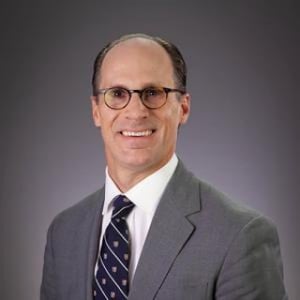
Senior Counsel, Alliance Defending Freedom
Andrew D. Graham is senior counsel for academic and professional affairs at Alliance Defending Freedom. He develops ADF’s academic initiatives and training programs, including the Blackstone Legal Fellowship. He also regularly speaks at academic gatherings, universities, and think tanks on law, politics, and culture, and creates professional opportunities for ADF’s Blackstone Fellows.
Previously, Graham was a partner at Jackson Walker LLP, a more than 130-year-old law firm with more than 400 lawyers across Texas, where he achieved an extensive record of success in high-stakes litigation in both trial and appellate courts and was named a “Super Lawyers—Rising Star” multiple times.
Graham is an elected member and trustee of The Philadelphia Society, an elected member of The Mont Pelerin Society, and a member of The Federalist Society and the Society for Classical Learning. Additionally, he is a senior fellow at the Religious Freedom Institute, a member of the board of governors of the John Jay Institute, and a member of the advisory council for the Dallas Forum on Law, Politics, and Culture.
Graham earned his bachelor’s degree summa cum laude at Southern Methodist University (SMU), where he was inducted into Phi Beta Kappa and the Hyer Society. He then earned master’s degrees at Oxford University, where he was a member of Oriel College, and The University of Chicago before returning home to Texas to earn his law degree at The University of Texas at Austin School of Law.
He is a member of the State Bar of Texas and is admitted to practice before the U.S. Court of Appeals for the Fifth Circuit and the U.S. Supreme Court.
Graham is the first person in his family to go to college and is a first-generation American who holds dual American–Australian citizenship. He and his wife, Molly (a classical Christian school educator), have three children and live in Dallas, Texas.

The Future of U.S.-Iran Policy
Topics
This Land Is (Not) Your Land: The Effort to Divest Foreign State Ownership of American Land
In February 2023, the U.S. Air Force shot down a high-altitude surveillance balloon that had...
Topics
Are NDAAs a Model for Revitalizing Article I?
For over six decades, Congress has passed a National Defense Authorization Act (NDAA) every year....
International and National Security Law: Engage or Disengage: How Should the Next United States Administration Interact with the International Criminal Court and International Court of Justice?
Stephanos Bibas, Richard A. Epstein, Charles Nelson Brower, Diane A. Desierto, Michael A. Newton
As international courts have addressed issues arising from the Ukraine-Russia and Israel-Hamas wars, we will...
International and National Security Law: Engage or Disengage: How Should the Next United States Administration Interact with the International Criminal Court and International Court of Justice?
Stephanos Bibas, Charles Nelson Brower, Diane A. Desierto, Richard A. Epstein, Michael A. Newton
As international courts have addressed issues arising from the Ukraine-Russia and Israel-Hamas wars, we will...
International and National Security Law: Engage or Disengage: How Should the Next United States Administration Interact with the International Criminal Court and International Court of Justice?
2024 National Lawyers Convention
Washington, DCTopics
AUKUS Nuclear Information Safeguards – More Than Just Export Controls
The Australia-United Kingdom-United States (AUKUS) trilateral agreement has real potential to be a force multiplier...
Panel I: Regional Strategy & Competing Conflicts
Michael Allen, Mark Dubowitz, Jamil N. Jaffer, Julian Ku
Over the past two years, a series of regional conflicts has resulted in diplomatic tensions...
Panel I: Regional Strategy & Competing Conflicts
Michael Allen, Mark Dubowitz, Jamil N. Jaffer, Julian Ku
Over the past two years, a series of regional conflicts has resulted in diplomatic tensions...
The Wisdom of Our Ancestors
Andrew D. Graham
A review of Graham James McAleer & Alexander S. Rosenthal-Pubul, The Wisdom of Our Ancestors:...