
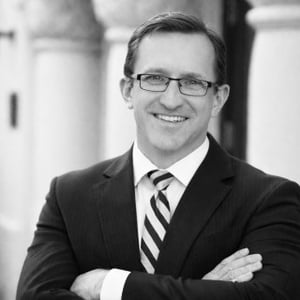
VP and Senior Counsel, Becket Fund
Eric Baxter joined The Becket Fund as Senior Counsel in 2011. Since then he has represented religious organizations and individuals in a wide array of religious liberty disputes at both the trial and appellate level. Recent victories including a Ninth Circuit ruling upholding the “Big Mountain Jesus” statue that has stood on Forest Service land near Kalispell, Montana, for more than sixty years, and a rare Pentagon decision allowing a Sikh soldier to maintain his full beard and turban while serving in the Army. Mr. Baxter has extensive experience fighting efforts under state Blaine amendments to exclude religious organizations and individuals from participating on equal terms in the public square. He also regularly advises religious institutions of higher education in defending their religious missions against government encroachment.
Mr. Baxter has frequently appeared in the national media to discuss religious liberty issues, including appearances on Fox News (Kelly File, Fox & Friends), WSJ Live, CBS New York, Christian Broadcasting Network, Newsmax TV, and Al Jazeera. He has also written op-eds and been quoted in many major newspapers and other print media, including the New York Times, Washington Post, LA Times, Fox News, New York Post, Washington Times, and New Boston Post.
Before joining the Becket Fund, Mr. Baxter was a partner at Arent Fox LLP in Washington, DC, where he maintained a commercial complex litigation practice representing clients primarily in employment, intellectual property, and biotechnology disputes. He also served for many years as outside counsel to a DC church and its affiliated school. In 2007, he was awarded the Albert E. Arent Pro Bono Award for his work representing several parents adopting a total of seven children from foster care.
From 2000 to 2002, Mr. Baxter clerked for the Honorable Robert H. Cleland in the United States District Court for the Eastern District of Michigan (Detroit). Mr. Baxter received a B.A. in Russian Literature and Linguistics from Brigham Young University and graduated magna cum laude from the J. Reuben Clark Law School at BYU, where he served as Executive Editor of the Law Review and was elected to the Order of the Coif. Eric speaks Russian and some Spanish. He and his wife have seven children and an amateur family bluegrass band.
Mr. Baxter has been featured on the Kelly File, Al Jazeera, WSJ Video, and NewsmaxTV.

Vice President, Edwin Meese III Institute for the Rule of Law, Advancing American Freedom
John G. Malcolm oversees Advancing American Freedom’s work to increase understanding of the Constitution and the rule of law as Vice President of the organization’s Edwin Meese III Institute for the Rule of Law. Malcolm brings to the challenge a wealth of legal expertise and experience in both the public and private sectors.
Prior to joining Advancing American Freedom in 2025, Malcolm was the Vice President of the Institute for Constitutional Government and the Director of the Meese Center for Legal and Judicial Studies at the Heritage Foundation. Prior to joining Heritage in 2012, Malcolm was general counsel at the U.S. Commission on International Religious Freedom, as well as a distinguished practitioner in residence at Pepperdine Law School. From 2004 to 2009, Malcolm was executive vice president and director of worldwide anti-piracy operations for the Motion Picture Association.
Malcolm served as a deputy assistant attorney general in the Department of Justice’s Criminal Division from 2001 to 2004, where he oversaw sections on computer crime and intellectual property, domestic security, child exploitation and obscenity, and special investigations. Immediately prior to that, he was a founding partner in the Atlanta law firm of Malcolm & Schroeder, LLP.
From 1990 to 1997, Malcolm was an assistant U.S. attorney in Atlanta, assigned to the fraud and public corruption section, and also an associate independent counsel, investigating fraud and abuse in the Department of Housing and Urban Development. He was honored with the Director’s Award for Superior Performance for his work in connection with the successful prosecution of Walter Leroy Moody Jr., who assassinated an 11th Circuit judge and the head of the Savannah chapter of the NAACP.
A graduate of Harvard Law School and Columbia College, Malcolm began his career as a law clerk to a federal district court judge and a federal appellate court judge, and as an associate at the Atlanta-based law firm of Sutherland, Asbill & Brennan (new Eversheds Sutherland).
Malcolm, who resides in Washington, D.C., serves on the Board of Trustees of the Washington National Opera and is a Senate-confirmed member of the Board of Directors of the Legal Services Corporation, the largest funder of civil legal aid in the United States.
Publius comes from the pen name Alexander Hamilton, James Madison, and John Jay used when they wrote 85 publicly printed letters now known as the Federalist Papers. Hamilton chose “Publius” as a name that would represent friends of the newly proposed American republic - Publius Valeria Publicola was a Roman general who helped to found the Roman Republic. The Federalist Society continues the tradition of publishing things under the name Publius in celebration of our constitutional roots and recognition that author credit is not always necessary.

Will the Supreme Court Revisit Employment Division v. Smith?
Eric Baxter
In 1990, the Supreme Court startled the nation with a decision in Employment Division v....
The Problem with the Proliferation of Collateral Consequences
John G. Malcolm
Note from the Editor: This article discusses collateral consequences of criminal convictions and argues that...
Washington Supreme Court: Laws Suspending Licenses & Regulating Ergonomics Upheld
Publius
In Amunrud v. Board of Appeals (Wash. 2006), the Washington Supreme Court upheld (6 to...