
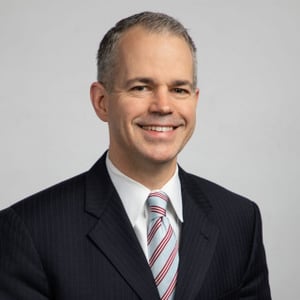
Senior Attorney, Institute for Justice
Michael Bindas is a senior attorney with the Institute for Justice (IJ) and leads IJ’s educational choice team. In this role, he oversees a talented group of IJ attorneys who help policymakers design constitutionally defensible educational choice programs and who defend educational choice programs in courtrooms nationwide. He joined IJ in 2005.
Michael was part of IJ’s litigation team in Espinoza v. Montana Department of Revenue, in which the U.S. Supreme Court held the exclusion of religious options from Montana’s educational choice program unconstitutional, and he led IJ’s defense of the Choice Scholarship Program for elementary and secondary students in Douglas County, Colorado. He also successfully challenged Washington’s denial of special education services to children in religious schools, as well as the state’s exclusion of sectarian options from its state work study program. Currently, he leads IJ’s team in Carson v. Makin, challenging Maine’s exclusion of religious options from its educational choice program.
Prior to leading IJ’s educational choice team, Michael litigated extensively to secure economic liberty, property rights, and freedom of speech throughout the nation. He was counsel of record at the U.S. Supreme Court for Kimbrough Fine Wine & Spirits in Tennessee Wine and Spirits Retailers Association v. Thomas, a successful challenge to Tennessee’s durational residency requirements for retail liquor licenses. He also led successful challenges to the municipal sign codes of St. Louis, Mo. and Norfolk, Va., after those cities attempted to silence protests of their abusive eminent domain practices.
Prior to joining IJ, Michael spent three years as an attorney with Perkins Coie LLP. He is a former law clerk to Judge Rhesa Hawkins Barksdale of the U.S. Court of Appeals for the Fifth Circuit and served as an engineer officer in the United States Army and Pennsylvania Army National Guard before beginning his legal career.
Michael received his law degree cum laude from the University of Pennsylvania Law School in 2001, where he served as Articles Editor for the Journal of Constitutional Law and was elected to the Order of the Coif. He received his undergraduate degree from the United States Military Academy at West Point in 1995.

Director, Commercial Freedom; Senior Fellow, R Street Institute
C. Jarrett Dieterle researches and writes on regulatory affairs, alcohol policy, occupational licensing and other commercial freedom issues. He also oversees the Institute’s postal, labor and disintermediation policy programs.
Jarrett previously worked as a regulatory attorney at a Washington law firm. In that role, he advised private companies on how to navigate complex regulatory regimes and helped them challenge overreaching regulations. He also practiced appellate advocacy, co-authoring several Supreme Court amicus briefs. He previously clerked for a federal judge on the U.S. Court of Federal Claims, and has worked and written for numerous policy organizations and think tanks such as the Reason Foundation, Manhattan Institute, Mackinac Center, Federalist Society, Institute for Justice, Atlantic Legal Foundation and the Washington Legal Foundation.
Jarrett earned his bachelor’s from the University of Richmond, with a major in political science and minor in economics. He received his juris doctor from Georgetown University Law Center.
Jarrett currently lives in Richmond, Virginia with his wife, Maria, and their Australian shepherd, Pepper.

Senior Fellow and Director of Constitutional Studies, Manhattan Institute
Ilya Shapiro is a senior fellow and director of constitutional studies at the Manhattan Institute and a contributing editor of City Journal. Previously he was executive director and senior lecturer at the Georgetown Center for the Constitution, and before that a vice president of the Cato Institute.
Shapiro is the author of Lawless: The Miseducation of America’s Elites (2025) and Supreme Disorder: Judicial Nominations and the Politics of America’s Highest Court (2020), coauthor of Religious Liberties for Corporations? (2014), and editor of 11 volumes of the Cato Supreme Court Review (2008-18). He has contributed to a variety of academic, popular, and professional publications, including the Wall Street Journal, Harvard Journal of Law & Public Policy, Washington Post, Los Angeles Times, USA Today, National Review, and Newsweek. He also regularly provides commentary for various media outlets, writes the Shapiro’s Gavel newsletter on Substack, and once appeared on the Colbert Report.
Shapiro has testified many times before Congress and state legislatures and has filed more than 500 amicus curiae “friend of the court” briefs in the Supreme Court. He lectures regularly on behalf of the Federalist Society, is a member of the board of fellows of the Jewish Policy Center, was an inaugural Washington Fellow at the National Review Institute, and has been an adjunct law professor at the George Washington University and University of Mississippi. He is also the chairman of the board of advisers of the Mississippi Justice Institute, a barrister in the Edward Coke Appellate Inn of Court, and a former member of the Virginia Advisory Committee to the U.S. Commission on Civil Rights.
Earlier in his career, Shapiro was a special assistant/adviser to the Multi-National Force in Iraq on rule-of-law issues and practiced at Patton Boggs and Cleary Gottlieb. Before entering private practice, he clerked for Judge E. Grady Jolly of the U.S. Court of Appeals for the Fifth Circuit. He holds an AB from Princeton University, an MSc from the London School of Economics, and a JD from the University of Chicago Law School.

George Mason University Foundation Professor of Law, Antonin Scalia Law School, George Mason University
TODD J. ZYWICKI is George Mason University Foundation Professor of Law at Antonin Scalia Law School at George Mason University and Research Fellow of the George Mason Law and Economics Center. During the Fall 2023 semester he served as the Visiting Scholar in Conservative Thought and Policy for the Bruce Benson Center for the Study of Western Civilization at the University of Colorado-Boulder. From 2020-2021 he was Chair of the Consumer Financial Protection Bureau Taskforce on Federal Consumer Financial Law. In 2021 he was inducted to the American College of Consumer Financial Services Lawyers. He is also a Senior Fellow of the F.A. Hayek Program for the Advanced Study of Politics, Philosophy, and Economics at George Mason University and a former Senior Fellow of the Cato Institute. From 2015-2017 he was Executive Director of the George Mason Law and Economics Center. He served as Co-Editor of the Supreme Court Economic Review from 2006-2017. From 2003-2004, Professor Zywicki served as the Director of the Office of Policy Planning at the Federal Trade Commission. He has also taught at Vanderbilt University Law School, Georgetown University Law Center, Boston College Law School, Mississippi College School of Law, and China University of Political Science and Law.
Professor Zywicki clerked for Judge Jerry E. Smith of the U.S. Court of Appeals for the Fifth Circuit and worked as an associate at Alston & Bird in Atlanta, Georgia, where he practiced bankruptcy and commercial law. He received his J.D. from the University of Virginia, where he was executive editor of the Virginia Tax Review and John M. Olin Scholar in Law and Economics. Professor Zywicki also received an M.A. in Economics from Clemson University and an A.B. cum Laude with high honors in his major from Dartmouth College.
Professor Zywicki is also a Lone Mountain Fellow of the Property and Environment Research Center, a Fellow of the International Centre for Economic Research in Turin, Italy, and a former Senior Fellow of the Goldwater Institute. During the Fall 2008 Semester Professor Zywicki was the Searle Fellow of the George Mason University School of Law and was a 2008-09 W. Glenn Campbell and Rita Ricardo-Campbell National Fellow and the Arch W. Shaw National Fellow at the Hoover Institution on War, Revolution and Peace. He has lectured and consulted with government officials around the world, including Iceland, Italy, Japan, and Guatemala. In 2006 Professor Zywicki served as a Member of the United States Department of Justice Study Group on “Identifying Fraud, Abuse and Errors in the United States Bankruptcy System.”
Professor Zywicki is the author of more than 130 articles in leading law reviews and peer-reviewed economics journals. He is one of the Top 10 most-cited law professors in the field of Commercial Law and one of the Top 25 law professors on Twitter as measured by engagement levels. He is one of the Top 50 Most Downloaded Law Authors at the Social Science Research Network. He has testified multiple times before Congress on issues of consumer bankruptcy law and consumer credit and is a frequent commentator on legal issues in the print and broadcast media, including the Wall Street Journal, New York Times, The Washington Post, The Washington Times, Nightline, The Newshour with Jim Lehrer, Neil Cavuto Show, Fox & Friends, Smerconish, Fox News @ Night with Shannon Bream, Fox Business, CNN, CNBC, Bloomberg News, BBC, The Diane Rehm Show, Lou Dobbs Show, Jerry Doyle Show, and The Laura Ingraham Show.
Professor Zywicki is former Chairman and a current member of the Board of Directors of the Competitive Enterprise Institute, and is a member of the Board of Directors of the Institute for Humane Studies, Bill of Rights Institute, the Executive Committee for the Federalist Society's Financial Institutions and E-Commerce Practice Group, the Board of Trustees of the Foundation for Research on Economics and the Environment. He formerly served on the Governing Board and the Advisory Council for the Financial Services Research Program at George Washington University School of Business. He is currently the Chair of the Academic Advisory Council for the following organizations: The Bill of Rights Institute, the film “We the People in IMAX,” and the McCormick-Tribune Foundation “Freedom Museum” in Chicago, Illinois. He is a member of the Board of Visitors of Ralston College and was a member of the Board of Trustees of Yorktown University. From 2005-2009 he served as an elected Alumni Trustee of the Dartmouth College Board of Trustees.
Journalist/Author
Trevor W. Coleman is a national award-winning journalist and author who served s Chief Speechwriter to Michigan Gov. Jennifer M. Granholm and as Director of Communications for the Michigan Department of Civil Rights and the Governor’s Southeast Michigan office. Coleman was also a long time member of the editorial board of the Detroit Free Press where he won numerous awards for editorial and column writing prior to his appointment to the Granholm administration. He is currently working fulltime on the authorized biography of legendary federal Judge Damon J. Keith. Its working title is “Crusader for Justice: The Life and Amazing Times of Federal Judge Damon J. Keith.”
As the Director of Communications for the Michigan Department of Civil Rights, he was responsible for crafting a global communications strategy which included developing all internal and external communications policies, managing media relations and executive speechwriting responsibilities. Because of his unique joint appointment, he was also required to establish an effective external communications strategy for the Governor’s Office for SE Michigan. In that position he also served as the official liaison to the Governor’s Advisory Council on Arab and Chaldean Affairs and the Governor’s Advisory Council on Asian and Pacific Islander Affairs.
As Chief Speechwriter for Governor Granholm, Coleman wrote or contributed to all major public policy speeches including in the areas of international relations, automotive industry, education, economics, budgetary, race relations, and health, poverty and gender issues. He wrote major commencement addresses and contributed to State of the State address. Coleman also wrote the Governor’s guest OPEDS for state and regional newspapers as well as articles for public policy and other niche magazines. This included the Detroit News, Detroit Free Press, Detroit Crain’s Business, Detroit Magazine, the Michigan Chronicle and others. He also helped develop the Governor’s communication strategy for her “One Michigan” tour and campaign to unite citizens.
As a member of the editorial board of the Detroit Free Press, Coleman specialized in writing on education, health care and urban policy. He also frequently wrote on civil rights, civil liberties and the U.S. criminal justice system. He was the editorial board’s senior foreign affairs writer for three years. Prior to joining the Free Press, Coleman was an urban affairs and civil rights reporter for The Detroit News, an editorial writer for the Cincinnati Enquirer, reporter and columnist for the Hartford Courant and city desk reporter for the Times-Leader in Wilkes-Barre, Pennsylvania. He was also a contributing editor and writer for Emerge Magazine, Black Enterprise and the NAACP Crisis Magazine. Coleman also wrote a Sunday column for several years for his hometown newspaper, The Hudson Register Star.
Among his many journalism awards are a 2001 American Diabetes Association Award of Merit for a series of editorials urging the state to expand medical coverage for diabetics; a 1999 Michigan Press Association Award for column writing; a 1999 National Association of Black Journalist Award for Commentary; the 1998 Detroit Press Foundation Michigan Journalism Award for Commentary; the 1993 Detroit Press Foundation Journalism Award for News Reporting, 1993 Best of Gannett Award for News Reporting and the 1993 and 1999 Lincoln University Unity Awards for coverage of minority and social issues. Coleman is listed in “Who’s Who among African-Americans,” and in 2010 was listed in the “Who’s Who of Black Detroiters.”
Among his many honors have been a 2009 Michigan Department of Civil Rights Dedicated Service Award, 2008 Brown Chapel AME Church Civil Rights Leadership Award, 2004 Macomb County NAACP Freedom Fund Leadership Award, 2004 Over Comers Ministries Inc. Leadership Award, 2002 Wayne Community College District Award for Community Service and the 1993 Distinguished Alumni Award, from the Kappa Chapter of Alpha Phi Alpha Fraternity at The Ohio State University.
He has been a guest speaker at many colleges and universities across the nation; among them Harvard Law School, The Ohio State University, the University of Michigan and University of Michigan School of Law, Michigan State University, Wayne State University, The University of Toledo Law School, Delaware State University, Schoolcraft College, Wayne Community College and many others. He has also appeared on numerous television and radio talk and public affairs programs.
A native of New York, he received his undergraduate degree in communications from The Ohio State University and is a fellow at the Knight Center for Specialized Journalism at the University of Maryland. He is also is a graduate of the American Press Institute in Reston, VA and Poynter Institute in Fla. Coleman resides in Bloomfield Hills and is the divorced father of two children Sydnie, a college junior and TJ, a high school junior.
Attorney (of counsel), Witte Law Offices
Matthew G. Davis practices in the areas of appellate law, civil rights (including alleged violations of the First and Second Amendments), election law, campaign finance, and defamation. Mr. Davis is also experienced in general civil litigation.
Mr. Davis graduated from the The Ohio State University with a bachelors of arts in journalism in 1990 and earned his juris doctorate from Thomas M. Cooley Law School in 2005. He started his legal career in the pre-hearing division of the Michigan Court of Appeals before becoming law clerk for Judge Brian K. Zahra. Following his clerkship, Mr. Davis joined Witte Law Offices as an associate.
Prior to his legal career, Mr. Davis spent approximately twelve years as a reporter for various daily newspapers, including the Columbus ( Ohio ) Dispatch, the St. Paul (Minn. ) Pioneer Press, and the Detroit Free Press, where he covered the state Legislature in Lansing. Mr. Davis left newspapers to attend the Thomas M. Cooley Law School and, concomitantly, serve as director of communications for the Michigan Department of Corrections and the Michigan Department of Attorney General. Mr. Davis led the creation and development of the Offender Tracking Information System at the MDOC, which allows Internet access of offender information.
Racial Justice Staff Attorney, ACLU of Michigan
Through his work as the attorney for the Racial Justice Project of the ACLU of Michigan, Mark P. Fancher addresses: racially disproportionate rates of incarceration; racial discrimination against public school students of color, racial profiling, public defender system reform, attacks on affirmative action and juvenile sentencing issues.
Fancher was formerly the Senior Staff Attorney for the Sugar Law Center for Economic and Social Justice where he specialized in workers' rights. He served on the staff of the State Bar of Michigan from 1998 to 2000 where he coordinated projects to encourage greater pro bono participation by Michigan's lawyers. He was a visiting assistant clinical professor at the University of Michigan Law School from 1996 through 1998.
Before moving to Michigan, Fancher was the Director of Litigation for Camden Regional Legal Services in New Jersey. He has also been in private practice where he specialized in employment discrimination and community economic development. Fancher is a graduate of Rutgers University School of Law - Camden. He received a Bachelor of Science Degree from the University of Tennessee.
Fancher has played a leadership role in the National Conference of Black Lawyers (NCBL) for numerous years. He is a past chair of the organization’s International Affairs Section, and he served as NCBL’s national co-chair from 1995-1998. He is also a member of the State Bar of Michigan Pro Bono Initiative.
Fancher has lectured across the country and written extensively on issues that include: self-determination for Africa and the African Diaspora; indigenous peoples’ land and resource rights; and political repression in the U.S.

Co-Founder, XIV Foundation
Jennifer Gratz is a modern-day civil rights leader. In 1997 she challenged race preferences (also known as affirmative action) at the University of Michigan and was victorious at the U.S. Supreme Court.
Ms. Gratz was the lead plaintiff in the landmark case Gratz v. Bollinger which challenged affirmative action at the University of Michigan. On June 23, 2003 the U.S. Supreme Court ruled that Ms. Gratz was discriminated against and U-M’s admission policy was unconstitutional. However, in a companion case decided the same day (Grutter v. Bollinger), the Supreme Court allowed race preferences to continue at U-M’s law school. Ms. Gratz called the split decision flawed and continued the fight for equality in her home state. She spearheaded the Michigan Civil Rights Initiative (MCRI), a state constitutional amendment that made race and gender preferences unconstitutional in public education, employment and contracting. In Nov 2006 Michigan voters approved MCRI by a 16-point landslide.
At CPAC following the Michigan vote, Ms. Gratz was honored with the prestigious Ronald Reagan Award from the American Conservative Union for leadership. Jennifer has spent many years working to end programs that grant preferential treatment based on race or sex and because of Ms. Gratz’s leadership eight states have now banned race and gender preferences.
Recently, Ms. Gratz co-founded the XIV Foundation (XIV) and Equal Protection Advocates (EPA). XIV, named after the 14th amendment, is a not-for-profit 501c3 dedicated to teaching the personal and societal advantages of fair and equal treatment. EPA is a 501c4 dedicated to advocating for fair and equal treatment without regard to race or gender for all Americans.
Ms. Gratz’s story and work has been featured in nearly every major media outlet – Fox News, CNN, MSNBC, Dateline, 60 Minutes, The Today Show, Wall Street Journal, NY Times, Washington Post, Washington Times, LA Times, Detroit Free Press, Detroit News, National Review, US News and World Report, Newsweek, Time Magazine, People Magazine, Glamour Magazine – to name a few.

Editorial Cartoonist, Editorial Writer, and Weekly Columnist, The Detroit News
Henry Payne is an editorial cartoonist, editorial writer, and weekly columnist The Detroit News.
A Pulitzer-Prize nominated cartoonist, Payne produces five local editorial cartoons a week for The News. He also writes and draws a weekly column, “Payne & Ink.” Additionally, Payne draws five cartoons a week on national and international subjects for United Feature Syndicate in Kansas City which distributes his cartoons to 40 newspaper clients worldwide. His work is reprinted in USA Today, National Review,Townhall.com and other publications.
Payne has been voted Best Editorial Cartoonist in Michigan by the Associated Press. He has been a runner-up for both the Pulitzer and Mencken awards.
As a writer, Payne reports regularly on economic, consumer and environmental issues. His articles have appeared in The Wall Street Journal, The Weekly Standard magazine, National Review, Reason, Scripps Howard News Service and newspapers around the country. He also is a correspondent for National Review’s popular “Planet Gore” blog.
Payne came to The Detroit News in 1999 after 13 years as an editorial cartoonist, writer, and editor forScripps Howard News Service in Washington, DC .
Payne published his first book, “Payne & Ink: The Cartoons and Commentary of Henry Payne, 2000-2001,” in 2002. He has also illustrated two children’s books for Random House: “Where did Daddy’s Hair Go?” (by Joe O’Connor) in 2006, and Dr. Seuss’ “The Ear Book” in 2007. In 1998, Payne created “Hub & Axel,” a comic panel distributed by the Tribune Company Syndicate about an American family and its very American passion for the automobile.
Born in 1962 in Charleston, West Virginia, Payne received a degree in history from Princeton University in 1984. As editorial cartoonist for two student newspapers, The Daily Princetonian and the Nassau Weekly, Payne won the College Media Advisers Cartoon Contest and the Tribune Company Syndicate’s National College Cartoonist’s Contest. Upon graduation from Princeton, Payne began his newspaper career as staff artist and editorial cartoonist with the Charleston (WV) Daily Mail. In 1986 he joined Scripps Howard News Service and began syndication with United Feature in 1987.
Payne is an active race car driver, tennis and squash player. He is the father of two boys and lives with wife, Talbot, in Bloomfield Hills, Michigan.

Senior Legal Fellow, Edwin Meese III Institute for the Rule of Law, Advancing American Freedom

President, Thomas M. Cooley Student Chapter
Penelope holds a Political Science and Pre-Law undergraduate degree from the University of Texas at El Paso. She also received a Master of Science degree in Intelligence and National Security Studies with focus on Latino Immigration from the University of Texas at El Paso. Penelope has worked in several projects within the Latino Community such the LSPI Pre-Law Institute at UTEP as an outreach minority coordinator for recruitment of young Latino and underrepresented minorities to participate in the pre-law institute and later access IVY league Law Schools all across the country. Under the Kauffman Initiative she worked as an outreach specialist for the Hispanic Entrepreneur Center at UTEP She is now a J.D Law candidate 2014 at Thomas M. Cooley Law School.
Partner, Goldstein & Russell PC
Thomas C. Goldstein has argued 28 cases before the Supreme Court, including matters involving federal patent law, class action practice, labor and employment, and disability law. In addition to practicing law, Tom teaches Supreme Court Litigation at Harvard Law School and taught at Stanford Law School as well from 2004-2012.
In the Supreme Court and elsewhere, Mr. Goldstein litigates and advises clients in a broad range of issues. For example, he regularly litigates and lectures on questions of federal patent law. Mr. Goldstein frequently advises clients, litigates, and consults on legislative matters relating to the First Amendment. And he regularly represents parties in questions relating to the game of poker, including its lawfulness as a matter of federal and state law. Tom's clients include plaintiffs, criminal defendants, and major corporations such as BG Group, Home Depot, Humana, IMS Health, Nike, PokerStars, POM Wonderful, and Pemex.
In addition to practicing law, Tom founded, and is the publisher of, SCOTUSblog, which in 2013 became the only weblog ever to receive the Peabody Award for excellence in electronic media. It also won the 2013 Society of Professional Journalists (Sigma Delta Chi) prize for deadline reporting for its coverage of the Supreme Court’s healthcare ruling. In 2010, it became the first blog to receive the American Bar Association’s Silver Gavel Award for fostering the American public’s understanding of law and the legal system.
Tom has been repeatedly recognized as a leading member of the bar. In 2010, The National Law Journal named him one of the 40 most influential lawyers of the decade; Tom notably was ten years younger than any other law firm partner listed. Legal Times named him one of the “90 Greatest Washington Lawyers of the Last 30 Years” and praised him for “transforming the practice” of law before the Supreme Court. He is also included in both of the National Law Journal’s most recent lists of the nation’s 100 most influential lawyers (2006 and 2013). He has been repeatedly recognized as one of the nation’s top appellate advocates. GQ Magazine named him one of the 50 most powerful people in Washington, D.C.
Tom is an elected Fellow of the American Academy of Appellate Lawyers, and a member of the American Law Institute. He is involved with a number of professional organizations. He serves as the vice chair of the Amicus Committee of the ABA’s Intellectual Property Section and previously served for two years on the ABA’s Standing Committee on Amicus Curiae Briefs. In those capacities, he has authored several Supreme Court amicus briefs for the ABA. In addition, Tom serves on the boards of advisors of the Washington Legal Foundation and the Georgetown University Supreme Court Institute.
Before founding Goldstein & Howe in 1999, Tom practiced law at Boies & Schiller, LLP and at Jones Day Reavis & Pogue. Tom left the firm he founded in 2006 to create the Supreme Court Practice at Akin, Gump, Strauss, Hauer & Feld, where he also was a partner and principal co-chair of the firmwide litigation practice. He returned to what is now Goldstein & Russell in 2011.
Tom clerked for the Honorable Patricia M. Wald of the U.S. Court of Appeals for the D.C. Circuit.

Associate Dean and Associate Professor of Law, University of Notre Dame Law School
William K. Kelley teaches constitutional law and administrative law, and focuses on public law issues in his scholarship. He serves as Associate Dean with responsibility for coordinating special projects. During Spring 2008 semester, he will act as Associate Dean for Faculty Research. From 2005-2007, he served in the White House as Deputy Counsel to the President. In that capacity, he was responsible for advising the President of the United States on all legal matters affecting the Executive Branch. He joined the faculty in 1995 after practicing with two major law firms, and serving from 1991-1994 as assistant to the solicitor general at the Department of Justice in Washington, D.C. Professor Kelley began his legal career by serving as law clerk to the Honorable Kenneth W. Starr on the U.S. Court of Appeals for the District of Columbia Circuit (1987-88), as well as for Chief Justice Warren E. Burger and Associate Justice Antonin Scalia (1988-89). He earned his B.A. from Marquette University in 1984, where he was a member of Phi Beta Kappa, and his J.D. from Harvard Law School in 1987, where he served as Supreme Court editor of the Harvard Law Review.

Judge, United States Court of Appeals, Eighth Circuit
David Stras became a judge on the United States Court of Appeals for the Eighth Circuit on January 31, 2018. Before serving on the Eighth Circuit, Judge Stras was an Associate Justice of the Minnesota Supreme Court, a position he occupied from July 1, 2010 until his appointment to the Eighth Circuit.
Prior to becoming a judge, Stras was a member of the faculty of the University of Minnesota Law School from 2004 through 2010. He taught and wrote in the areas of federal courts and jurisdiction, constitutional law, criminal law, and law and politics.
Judge Stras received his Bachelor of Arts degree, with highest distinction, in 1995 and his Master of Business Administration in 1999, both from the University of Kansas. He also received his law degree from the University of Kansas School of Law in 1999, where he served as Editor-in-Chief of the Criminal Procedure Edition of the Kansas Law Review.
Following law school, Stras clerked for The Honorable Melvin Brunetti of the United States Court of Appeals for the Ninth Circuit and then for The Honorable J. Michael Luttig of the United States Court of Appeals for the Fourth Circuit.
From 2001 to 2002, he practiced white-collar criminal and appellate litigation with the Washington, D.C., office of Sidley Austin Brown & Wood. Following his year in practice, he clerked for The Honorable Clarence Thomas of the Supreme Court of the United States.
Partner, Covington & Burling LLP
Sarah L. Wilson is a litigation partner at Covington & Burling and a former federal judge whose practice focuses on litigation and investigations. She has handled a broad range of civil and criminal disputes, including False Claims Act litigation, environmental and natural resources litigation, insurance litigation, pharmaceutical and consumer product company investigations, and arbitration.
Ms. Wilson co-chairs Covington & Burling's Advertising and Consumer Law Practice Group. She has represented the world’s largest automotive and consumer product companies in recall and post-recall investigations and disputes.
Ms. Wilson previously served as a Trial Attorney and Deputy Assistant Attorney General in the Department of Justice, as an Associate and Senior Counsel in the White House Counsel's Office, and as a Judge on the U.S. Court of Federal Claims.
Columbia Law School, 1990
Yale University, M.Phil., 1985
Yale University, M.A., 1984
Williams College, B.A., 1981

Executive Vice President of Global Governance, Chief Legal Officer and Corporate Secretary, Walmart Inc.
Rachel Brand is Walmart’s executive vice president of global governance, chief legal officer, and corporate secretary. She oversees the company’s global legal, compliance, ethics, corporate governance, digital citizenship, aviation, investigative, and corporate security functions, including Walmart’s Emergency Operations Center.
Immediately before joining Walmart, Rachel served as the United States Associate Attorney General and holds the distinction of being the first woman to serve in this role. She had previously served in the U.S. Department of Justice as the Assistant Attorney General for the Office of Legal Policy during President George W. Bush’s administration. Her other government service includes an appointment by President Obama to serve as a Member of the U.S. Privacy and Civil Liberties Oversight Board, service as an Associate Counsel to the President at the White House, and judicial clerkships with Justice Charles Fried of the Supreme Judicial Court of Massachusetts and Justice Anthony Kennedy at the Supreme Court of the United States. In the private sector, Rachel was a lawyer in private practice at two law firms in Washington, D.C. and served as the Vice President and Chief Counsel for Regulatory Litigation at the U.S. Chamber of Commerce Litigation Center.
Rachel serves on the board of directors for the Walmart Foundation and is the executive sponsor for Walmart’s Tribal Voices Associate Resource Group. Outside of Walmart, she serves on the board of directors for the International Justice Mission and is a member of The American Law Institute.
Rachel earned her Bachelor of Arts degree from the University of Minnesota-Morris and her J.D. from Harvard Law School.
Partner, Barr & Klein PLLC
Steve Klein, a partner at Barr & Klein PLLC, is an experienced free speech attorney who has successfully fought for the First Amendment rights of his clients against local, state and federal regulators. As a lobbyist, Steve’s advocacy has led to the successful amendment of state laws to respect political engagement and prevented the enactment of laws that burden it. Steve has published articles in several legal journals, and his commentary has appeared in The Wall Street Journal, The Washington Times, The Detroit News, and other outlets. Steve earned a bachelors degree in politics at Hillsdale College and a law degree from Ave Maria School of Law, where he served as Managing Editor of the Ave Maria Law Review. He is licensed to practice law in the District of Columbia, Illinois and Michigan.

Tazewell Taylor Professor of Law and William H. Cabell Research Professor, William & Mary Law School
Jonathan H. Adler joined the William & Mary law faculty as the Tazwell Taylor Professor of Law and William H. Cabell Research Professor in 2025. Prior to joining the faculty, he was the inaugural Johan Verheij Memorial Professor of Law and the founding Director of the Coleman P. Burke Center for Environmental Law at the Case Western Reserve University School of Law.
Professor Adler is the author or editor of seven books, including Climate Liberalism: Perspectives on Liberty, Property and Pollution (Palgrave, 2023), Marijuana Federalism: Uncle Sam and Mary Jane (Brookings Institution Press, 2020), Business and the Roberts Court (Oxford University Press, 2016) and Rebuilding the Ark: New Perspectives on Endangered Species Act Reform (AEI Press, 2011).
His articles have appeared in publications ranging from the Harvard Environmental Law Review and Yale Journal on Regulation to the Wall Street Journal, New York Times, and Washington Post. He has testified before Congress a dozen times, and his work has been cited in the U.S. Supreme Court. A 2024 study identified Professor Adler as the seventh most cited legal academic in administrative and environmental law from 2019 to 2023.
Professor Adler is a contributing editor to Civitas Outlook and a regular contributor to the popular legal blog, The Volokh Conspiracy. A regular commentator on constitutional and regulatory issues, he has appeared on numerous radio and television programs, ranging from the PBS Newshour and National Public Radio to the Fox News Channel and Entertainment Tonight.
Professor Adler is a senior fellow at the Property & Environment Research Center in Bozeman, Montana. In 2018, Professor Adler was elected to membership in the American Law Institute and helped co-found the organization Checks and Balances. In 2024, Professor Adler was appointed a public member of the Administrative Conference of the United States.
Professor Adler clerked for the Honorable David B. Sentelle on the U.S. Court of Appeals for the District of Columbia Circuit.
Senior Resident Scholar, Institute of Government Studies, UC Berkeley
Steven Hayward is currently senior resident scholar at the Institute of Governmental Studies at UC Berkeley, and a visiting lecturer at Berkeley Law School. He was previously the Ronald Reagan Distinguished Visiting Professor at Pepperdine University’s Graduate School of Public Policy, and was the inaugural visiting scholar in conservative thought and policy at the University of Colorado at Boulder in 2013-14. From 2002 to 2012 he was the F.K Weyerhaeuser Fellow in Law and Economics at the American Enterprise Institute in Washington DC, and has been senior fellow at the Pacific Research Institute in San Francisco since 1991.
He writes frequently for the New York Times, Washington Post, Wall Street Journal, National Review, the Weekly Standard, the Claremont Review of Books, and other publications. The author of six books including a two-volume chronicle of Reagan and his times entitled The Age of Reagan: The Fall of the Old Liberal Order, 1964-1980, and The Age of Reagan: The Conservative Counter-Revolution, 1980-1989, and the Almanac of Environmental Trends. His most recent book is Patriotism is Not Enough: Harry Jaffa, Walter Berns, and the Arguments That Redefined American Conservatism.

Professor Emeritus of Law, Antonin Scalia Law School, George Mason University
Jeremy A. Rabkin is a Professor Emeritus of Law at the Antonin Scalia Law School, George Mason University. Before joining the faculty in June 2007, he was for over two decades a professor in the Department of Government at Cornell University. Professor Rabkin serves on the board of directors of the Center for Individual Rights, a public interest law firm based in Washington, D.C. Previously he was a board member of the U.S. Institute of Peace and the board of academic advisors of the American Enterprise Institute.
Professor Rabkin’s books include Law Without Nations? (Princeton University Press, 2005). He authored “If You Need a Friend, Don’t Call a Cosmopolitan,” a chapter in Varieties of Sovereignty and Citizenship (Sigal R. Ben-Porath & Rogers M. Smith eds., University of Pennsylvania Press, 2012). His articles have appeared in major law reviews and political science journals and his journalistic contributions in a range of magazines and newspapers, including the Washington Post and the Wall Street Journal.

Chief Judge, United States Court of Appeals, Sixth Circuit
JEFFREY S. SUTTON is the Chief Judge of the United States Court of Appeals for the Sixth Circuit. He has served as Chair of the Federal Judicial Conference Committee on Rules of Practice and Procedure, Chair of the Advisory Committee on Appellate Rules, and Chair of the Supreme Court Fellows Commission. He currently serves as Chair of the Executive Committee of the Judicial Conference of the United States. Since 1993, Chief Judge Sutton has been an adjunct professor at The Ohio State University College of Law, where he teaches seminars on State Constitutional Law, the United States Supreme Court, and Appellate Advocacy. He also teaches a class on State Constitutional Law at Harvard Law School. Among other publications, he is the author of Who Decides? States as Laboratories of Constitutional Experimentation and 51 Imperfect Solutions: States and the Making of American Constitutional Law. He is the co-author of a casebook, State Constitutional Law: The Modern Experience, as well as The Law of Judicial Precedent. He is also the co-editor of The Essential Scalia: On the Constitution, the Courts, and the Rule of Law. In 2006, Chief Judge Sutton was elected to the American Law Institute, and in 2017 he was elected to its Council.

Topics
Cabinet Officials Descend on Congress
The 118th Congress has spent the last few days voting on a spending bill to fund...
Courthouse Steps Decision Teleforum: Tennessee Wine and Spirits Retailers Association v. Thomas
Michael Bindas
On June 26, 2019, the Supreme Court, by a vote of 7-2, declared that two-year...
Tennessee Wine & Spirits Retailers Association v. Blair [SCOTUSbrief]
Jarrett Dieterle
Tennessee’s liquor retail licenses require residency within the state, which favors in-state retailers over out-of-state...
Courthouse Steps Oral Argument: Tennessee Wine and Spirits Retailers Association v. Byrd
Ilya Shapiro, Todd J. Zywicki
For the first time in over a decade, the Supreme Court has taken a case...
Applying Heightened Scrutiny to Protectionist Alcohol Laws
Recently, the South Carolina Supreme Court issued a decision striking down a state law that...
The Twilight of Race-Based Preferences in College Admissions
Trevor W. Coleman, Matthew G. Davis, Mark Fancher, Jennifer Gratz, Henry Payne, Hans A. Von Spakovsky, Penelope S. Williams
The Michigan Lawyers Chapter hosted this event on February 12, 2014, at Thomas M. Cooley...
United States Supreme Court: Nomination and Confirmation Process
Thomas C. Goldstein, William K. Kelley, David R. Stras, Sarah L. Wilson, Rachel L. Brand
Justice Stevens has announced his resignation from the U.S. Supreme Court, and much of the...
Federalism v. Anti-Federalism in the American Founding
Mickey Craig, Patrick Gillen, Stephen R. Klein
The Ave Maria School of Law Student Chapter hosted this debate on February 17, 2009....
Environmental Law: The Policy Implications of the Reaction to Climate Change
Jonathan H. Adler, John C. Dernbach, Steven F. Hayward, Jeremy A. Rabkin, Jeffrey S. Sutton
The next presidential administration will undoubtedly usher in new policies concerning climate change and global...