
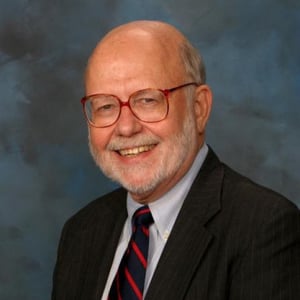
Principal, Ely & Company, Inc.
Bert Ely has specialized in deposit insurance and banking structure issues since 1981. In 1986, he became an early predictor of the S&L crisis and a taxpayer bailout of the FSLIC. In 1991, he was the first person to correctly predict the non-crisis in commercial banking; in 1992, he predicted an eventual taxpayer bailout of the Japanese banking system.
Bert continuously monitors conditions in the banking and S&L industries, monetary policy, and the growing federalization of credit risk. He has helped to draft legislation to enact the cross-guarantee concept for privatizing banking regulation and its related deposit insurance and systemic risks. He has testified on numerous occasions before congressional committees on banking issues and he often speaks on these matters to bankers and others.
Bert first established his consulting practice in 1972. Before that, he was the chief financial officer of a public company, a consultant with Touche, Ross & Company, and an auditor with Ernst & Ernst. He received his MBA from the Harvard Business School in 1968 and his Bachelor's degree in economics in 1964 from Case Western Reserve University.

Managing Director, Promontory Financial Group, LLC
Bill brings an exceptional blend of experience and insights to his work with clients, having been a banker, California’s Commissioner of Financial Institutions, and a member of the Financial Stability Oversight Council. He works with financial institutions on corporate governance and organizational design, compliance program design and implementation, anti-money laundering programs, senior management reviews, and strategic planning.
Bill’s financial services experience spans the corporate sector, the executive branches of both state and federal government, academia, and think tanks. He earned a reputation as an open, fair, and pragmatic regulator during four years as Commissioner of Financial Institutions in California, leading the agency through a period of economic upheaval both in the state and nationwide. His vast knowledge and understanding of the financial system led to his selection as the state banking supervisors’ representative on the Financial Stability Oversight Council, a federal agency created by the Dodd-Frank Act to foster coordination among financial regulators in order to identify systemic risks to the nation’s financial stability.
Before his appointment to state office, Bill was an independent consultant with Promontory while also serving as a visiting professor of economics and finance for the Graduate School of Management at the University of California-Davis. He worked on a wide array of client engagements at Promontory, in areas that included governance, due diligence, compliance, and strategy.
During nine years with Bank of America, Bill was managing director of Banc of America Securities and senior vice president of strategic policy development and planning for the bank. Earlier, he worked for five years as director of policy analysis for Citicorp.
Bill was J. Edward Lundy Scholar and director of the financial markets project at the American Enterprise Institute for Public Policy Research. He served under President Reagan as senior staff economist and special assistant to the chairman of the Council of Economic Advisors.

Vice President, Edwin Meese III Institute for the Rule of Law, Advancing American Freedom
John G. Malcolm oversees Advancing American Freedom’s work to increase understanding of the Constitution and the rule of law as Vice President of the organization’s Edwin Meese III Institute for the Rule of Law. Malcolm brings to the challenge a wealth of legal expertise and experience in both the public and private sectors.
Prior to joining Advancing American Freedom in 2025, Malcolm was the Vice President of the Institute for Constitutional Government and the Director of the Meese Center for Legal and Judicial Studies at the Heritage Foundation. Prior to joining Heritage in 2012, Malcolm was general counsel at the U.S. Commission on International Religious Freedom, as well as a distinguished practitioner in residence at Pepperdine Law School. From 2004 to 2009, Malcolm was executive vice president and director of worldwide anti-piracy operations for the Motion Picture Association.
Malcolm served as a deputy assistant attorney general in the Department of Justice’s Criminal Division from 2001 to 2004, where he oversaw sections on computer crime and intellectual property, domestic security, child exploitation and obscenity, and special investigations. Immediately prior to that, he was a founding partner in the Atlanta law firm of Malcolm & Schroeder, LLP.
From 1990 to 1997, Malcolm was an assistant U.S. attorney in Atlanta, assigned to the fraud and public corruption section, and also an associate independent counsel, investigating fraud and abuse in the Department of Housing and Urban Development. He was honored with the Director’s Award for Superior Performance for his work in connection with the successful prosecution of Walter Leroy Moody Jr., who assassinated an 11th Circuit judge and the head of the Savannah chapter of the NAACP.
A graduate of Harvard Law School and Columbia College, Malcolm began his career as a law clerk to a federal district court judge and a federal appellate court judge, and as an associate at the Atlanta-based law firm of Sutherland, Asbill & Brennan (new Eversheds Sutherland).
Malcolm, who resides in Washington, D.C., serves on the Board of Trustees of the Washington National Opera and is a Senate-confirmed member of the Board of Directors of the Legal Services Corporation, the largest funder of civil legal aid in the United States.
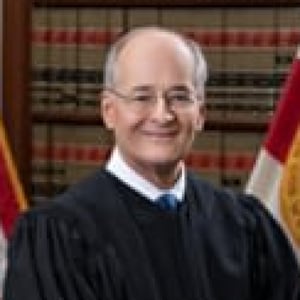
Chief Justice, Florida Supreme Court
Justice Charles Canady was born in Lakeland, Florida, in 1954. He is married to Jennifer Houghton, and they have two children. He received his B.A. from Haverford College in 1976 and his J.D. from the Yale Law School in 1979.
Justice Canady practiced law with the firm of Holland and Knight in Lakeland from 1979 through 1982. He practiced with the firm of Lane, Trohn, et al., from 1983 through 1992.
From November 1984 to November 1990, Justice Canady served three terms in the Florida House of Representatives, and from January 1993 to January 2001, he served four terms in the United States House of Representatives. Throughout his service in Congress, Justice Canady was a member of the House Judiciary Committee. For three terms, from January 1995 to January 2001, Justice Canady was the Chairman of the House Judiciary Subcommittee on the Constitution.
Upon leaving Congress, Justice Canady became General Counsel to Governor Jeb Bush. He was appointed by Governor Bush to the Second District Court of Appeal for a term beginning November 20, 2002.
On August 28, 2008, Justice Canady was appointed to the Florida Supreme Court by Governor Charlie Crist and took office on September 8, 2008. He served as Chief Justice from July 2010 through June 2012. In March 2018, he was elected by his colleagues to serve as Chief Justice for a second time, with his two-year term starting July 1, 2018, and a third time starting July 1, 2020.

International Monetary Policy: The Asian Crisis and Beyond
Ian Vasquez, William Lash, Bert Ely, William Haraf
A Panel Presented on November 12, 1998 at the Federalist Society's 1998 Lawyers Convention by...
Encryption Technology: I hear you knockin’, but you can’t come in
Robert F. Schroeder, John G. Malcolm
In these heady days of the Internet, other forms of global communication, and multinational corporations,...
Criminalizing From the Bench: The Expansion of Section 10(b) in United States v. O'Hagan
Jay V. Prabhu
One of the fundamental tenets of our Constitution is that the federal government may not...
The Civil Rights Act of 1997
Charles T. Canady
On June 17, 1997, I introduced the Civil Rights Act of 1997 (H.R. 1909) in...