

Patrick Hotung Professor of Constitutional Law, Georgetown University Law Center; Faculty Director, Georgetown Center for the Constitution
Randy E. Barnett is the Patrick Hotung Professor of Constitutional Law at the Georgetown University Law Center and is the Faculty Director of the Georgetown Center for the Constitution. After graduating from Northwestern University and Harvard Law School, he tried many felony cases as a prosecutor in the Cook County States’ Attorney’s Office in Chicago. A recipient of a Guggenheim Fellowship in Constitutional Studies and the Bradley Prize, Professor Barnett has been a visiting professor at Penn, Northwestern and Harvard Law School.
Professor Barnett’s publications includes thirteen books, more than one hundred articles and reviews, as well as numerous op-eds. His most recent book is Felony Review: Tales of True Crime and Corruption in Chicago (2026). His other books on the Constitution include: A Life for Liberty: The Making of an American Originalist (2024); The Original Meaning of the Fourteenth Amendment: Its Letter and Spirit (2021) (with Evan Bernick); An Introduction to Constitutional Law: 100 Supreme Court Cases Everyone Should Know (2019) (with Josh Blackman); Restoring the Lost Constitution: The Presumption of Liberty (2nd ed. 2013); Our Republican Constitution: Securing the Liberty and Sovereignty of We the People (2016); and Constitutional Law: Cases in Context (5th ed. forthcoming 2027) (with Josh Blackman). His books on contracts are The Oxford Introductions to U.S. Law: Contracts (2010) and Contracts: Cases and Doctrine (7th ed. 2021) (with Nate Oman). And he is the author of The Structure of Liberty: Justice and the Rule of Law (2nd ed. 2014).
In 2004, he argued the medical marijuana case of Gonzalez v. Raich before the U.S. Supreme Court. In 2012, he was one of the lawyers representing the National Federation of Independent Business in its constitutional challenge to the Affordable Care Act in NFIB v. Sebelius. He’s appeared in numerous documentaries and portrayed a prosecutor in the 2010 science-fiction feature film, InAlienable: The Movie. On X he is @RandyEBarnett

Senior Vice President for Legal Studies, Cato Institute
Clark Neily is senior vice president for legal studies at the Cato Institute. His areas of interest include constitutional law, overcriminalization, civil forfeiture, police accountability, and gun rights. Neily is the author of Terms of Engagement: How Our Courts Should Enforce the Constitution’s Promise of Limited Government. His writing has appeared in the Wall Street Journal, Forbes, and National Review Online, as well as various law reviews, including the Harvard Journal of Law and Public Policy, George Mason Law Review, Georgetown Journal of Law and Public Policy, NYU Journal of Law and Liberty, and Texas Review of Law and Politics. Neily is a frequent guest speaker and lecturer for the Federalist Society, Institute for Humane Studies, and American Constitution Society.
Before joining Cato in 2017, Neily was a senior attorney and constitutional litigator at the Institute for Justice and director of the Institute’s Center for Judicial Engagement. He is also an adjunct professor at the University of Texas School of Law, where he teaches constitutional litigation and public-interest law.
Neily served as co-counsel in District of Columbia v. Heller, the historic case in which the Supreme Court held for the first time that the Second Amendment protects an individual right to own a gun for self-defense.
Neily began his legal career as a law clerk to Judge Royce Lamberth on the U.S. District Court for the District of Columbia. After that he spent four years in the trial department of the Dallas-based firm Thompson & Knight. Neily received his undergraduate and law degrees from the University of Texas, where he was Chief Articles Editor of the Texas Law Review.
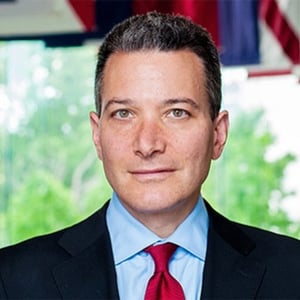
Senior Fellow, FIRE and CEO Emeritus, National Constitution Center
Jeffrey Rosen is a senior FIRE fellow as well as the host of “The Blessings of Liberty” podcast, presented by FIRE. He is also the CEO emeritus of the National Constitution Center, a professor of law at the George Washington University Law School, and a contributing editor of The Atlantic. He was previously the legal affairs editor of The New Republic and a staff writer for The New Yorker.
Rosen is the author of the New York Times bestsellers The Pursuit of Happiness and Conversations with RBG. His new book is The Pursuit of Liberty: How Hamilton vs. Jefferson Ignited the Lasting Battle Over Power in America.
Rosen is a graduate of Harvard College; Oxford University, where he was a Marshall Scholar; and Yale Law School. He is an elected member of the American Philosophical Society and the American Law Institute. In 2024, the French government recognized him as a Chevalier in the Ordre des Arts et des Lettres.
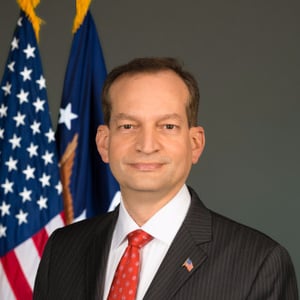
Former Secretary; U.S. Department of Labor
Rene Alexander Acosta is an American attorney and politician, who served as the 27th United States Secretary of Labor from 2017 to 2019.
Secretary Acosta is the son of Cuban refugees, a native of Miami, and first-generation college graduate. He earned his undergraduate and law degrees from Harvard University.
Following law school, he worked as a law clerk for Justice Samuel A. Alito, Jr., at the U.S. Court of Appeals for the Third Circuit. He then worked at the law firm of Kirkland & Ellis and went on to teach at George Mason University’s Antonin Scalia School of Law.
Secretary Acosta has served in three presidentially appointed, Senate-confirmed positions. In 2002, he was appointed to serve as a member of the National Labor Relations Board, where he participated in or authored more than 125 opinions. In 2003, he was appointed Assistant Attorney General for the Civil Rights Division of the U.S. Department of Justice, and from 2005 to 2009 he served as the U.S. Attorney for the Southern District of Florida.
Prior to his tenure at the Department of Labor, Secretary Acosta served as the dean of the FIU College of Law.
Secretary Acosta has twice been named one of the nation’s 50 most influential Hispanics by Hispanic Business magazine. He was also named to the list of 100 most influential individuals in business ethics in 2008. In 2013, the South Florida Hispanic Chamber of Commerce presented him with the Chairman’s Higher Education Award in recognition of his “outstanding achievements, leadership and determination throughout a lifetime of caring and giving back to the community.”
Secretary Acosta and his wife enjoy spending time together as a family, raising their two daughters.

Professor Emeritus, Paul M. Hebert Law Center, Louisiana State University
In memoriam
Dr. John Baker is Professor Emeritus of Law, and previously the Dale E. Bennett Professor of Law, at Louisiana State University Law School. He is currently Visiting Professor at Peking University School of Transnational Law (via Zoom) and has been Visiting Professor at The Center for the Constitution, Georgetown Law School (2013-2020). He has also been a Visiting Fellow at Oriel College, the University of Oxford (2012-2014) and taught at Blackfriars Hall, Oxford in 2014. Dr. Baker has also been an adjunct Fellow at the Heritage Foundation (Spring, 2008) and a Distinguished Scholar at the Catholic University of America Law School (2011-12). He has taught at Tulane Law School, George Mason Law School, Pepperdine Law School, New York Law School, Hong Kong University, and the University of Dallas, School of Management and also taught and/or lectured in 17 foreign countries. Notable among his foreign visits are the
following: Visiting Professor at the University of Lyon III (France) (1999-2011); Visiting Professor at the Universidad de los Andes, Chile (2012), as a Fulbright Specialist (2006); and a Fulbright Scholar at various universities in the Philippines. Dr. Baker received his J.D., with honors, from the University of Michigan Law School and his B.A., magna cum laude, from the University of Dallas. He also earned a Ph.D. in Political Thought from the University of London. Baker has taught over a dozen different subjects, mostly courses in public law. His main areas of interest are Constitutional Law (particularly federalism and separation of powers), Criminal Law, Anti-Terrorism Law, International Law, Health Care Law, Mediation, and Comparative Law.
In addition to law review articles and book chapters, Dr. Baker’s academic publications include Hall's Criminal Law: Cases and Materials (with Benson, Force and George; 5th ed. Michie, 1993); An Introduction to the Law of the United States (ed. with Levasseur; University Press of America, 1992). He has also published on Forbes.com, FoxNews.com, in The Washington Times, and a number of times in The Wall Street Journal. He argues in federal court, including two oral arguments in the U.S. Supreme Court. For many years, he co-taught courses for the Federalist Society on separation of powers with the late Supreme Court Justice Antonin Scalia. In September 2016, he co-taught a Supreme Court seminar in China with Justice Samuel Alito. Following law school, he served as a law clerk in federal district court and as an assistant district attorney in New Orleans before joining LSU in 1975. While a professor, he has been as a consultant to USAID, USIA (since rolled into the State Department), the Justice Department, the U.S. Senate Judiciary Subcommittee on Separation of Powers, and the Office of Planning in the White House. He served on an ABA Task Force which issued the report, The Federalization of Crime (1998) and later as a consultant to the “Bi-Partisan Task Force on the Over- federalization of Crime” (2012-2014) created by the U.S. House Judiciary Subcommittee on Crime. Dr. Baker was a co-founder of the first iteration (1995) of Stratfor Inc., a global intelligence agency. He co-authored its first book: The Intelligence Edge (with Friedman, Friedman and Chapman; Crown Books/Random House 1997). In 2022, he began a short, weekly video podcast available on YouTube and Rumble, The Baker Brief.

Professor of Law, Georgetown Law
After graduating from Cornell Law School summa cum laude, Professor O’Sullivan clerked for Chief Judge Levin Campbell of the United States Court of Appeals for the First Circuit and then for Justice Sandra Day O’Connor of the United States Supreme Court. She spent five years with Davis Polk & Wardwell in New York, where she worked on mergers and acquisitions litigation as well as white-collar criminal defense matters. Her experience at Davis Polk included work on U.S. v. REI, a lengthy and complex public corruption case, and the BCCI case, where she worked with Robert Fiske in the defense of First American Bank, Clark Clifford, and Robert Altman. In 1991, Professor O’Sullivan joined the Criminal Division of the United States Attorney’s Office for the Southern District of New York as an Assistant United States Attorney. There, she spent most of her time prosecuting major white-collar crimes. She and another AUSA successfully prosecuted the largest bank fraud case in the country at the time and the first to be brought under the financial kingpin statute. Professor O’Sullivan was then recruited by Robert Fiske, the newly appointed independent counsel for the Whitewater investigation, to join his staff in Little Rock, Arkansas, as associate counsel. She worked for Mr. Fiske, and briefly for Ken Starr, before commencing her teaching career at Georgetown in 1995. Also in 1995, on appointment by the Supreme Court, she successfully briefed and argued a case on behalf of an indigent petitioner in a case pending before that Court.
Professor O’Sullivan has written many articles and the leading casebook on white-collar crime and is a recognized expert on both the federal sentencing guidelines and white collar criminal law. Professor O’Sullivan is increasingly interested in the subject of cross-border criminality and law enforcement. With Professors David Luban and David Stewart, she published a casebook on International and Transnational Criminal Law. She has taught international criminal law in London and Dublin as well as Georgetown. In 2010, she served as a visiting professional at, and then a consultant for, the Office of the Prosecutor of the International Criminal Court.
Professor O’Sullivan is a member of the American Law Institute and has served as a member of, and reporter for, such projects as the ABA’s revision of the Standards for Criminal Justice on Guilty Pleas and the U.S. Sentencing Commission’s Ad Hoc Advisory Group on the Sentencing Guidelines applicable to Organizations.
Former Adjunct Professor of Law; former Special Counsel to the President; former federal prosecutor, Georgetown Law (ret.)
Bill Otis is a former Adjunct Professor of Law at Georgetown University, a one-time federal prosecutor, and a former Special White House Counsel for President George H. W. Bush. After graduating from Stanford Law School, he started his career in the Criminal Division of the Justice Department, then became chief of appeals for the US Attorney's Office for the Eastern District of Virginia. In the 1980's he served on the Department's "Train the Trainer" team, which taught US Attorneys Offices across the county how to implement the then-new Sentencing Reform Act. He has held several posts in the federal government, including Special Assistant to the Secretary of Energy and Counselor to the head of the Drug Enforcement Administration, in addition to the White House post. He has testified before Congress on issues in criminal procedure, illegal drugs, the US Sentencing Commission, and the death penalty, and has given numerous media interviews on those and other subjects. He currently teaches a seminar at Georgetown Law titled "Conservatism in Law in America" with his wife, Federalist Society co-founder Lee Liberman Otis.
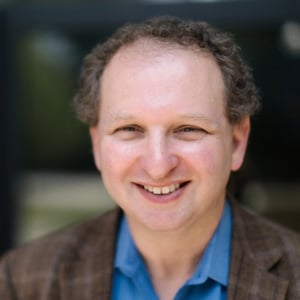
Assistant Professor of Law, Emory University School of Law
Alexander "Sasha" Volokh is an assistant professor of law, joining the Emory Law faculty in Fall 2009.
Professor Volokh earned his B.S. from UCLA and his J.D. and Ph.D. in economics from Harvard University. He clerked for Judge Alex Kozinski of the Ninth Circuit and for Supreme Court Justices Sandra Day O'Connor and Samuel Alito. Before coming to Emory, he was a visiting associate professor at Georgetown University Law Center and a visiting assistant professor at University of Houston Law Center.
His interests include law and economics, administrative law and the regulatory process, environmental law and policy, and legal history. His current research topics include the private management of government services, medieval law, judicial decisionmaking and statutory interpretation.
Former Adjunct Professor of Law; former Special Counsel to the President; former federal prosecutor, Georgetown Law (ret.)
Bill Otis is a former Adjunct Professor of Law at Georgetown University, a one-time federal prosecutor, and a former Special White House Counsel for President George H. W. Bush. After graduating from Stanford Law School, he started his career in the Criminal Division of the Justice Department, then became chief of appeals for the US Attorney's Office for the Eastern District of Virginia. In the 1980's he served on the Department's "Train the Trainer" team, which taught US Attorneys Offices across the county how to implement the then-new Sentencing Reform Act. He has held several posts in the federal government, including Special Assistant to the Secretary of Energy and Counselor to the head of the Drug Enforcement Administration, in addition to the White House post. He has testified before Congress on issues in criminal procedure, illegal drugs, the US Sentencing Commission, and the death penalty, and has given numerous media interviews on those and other subjects. He currently teaches a seminar at Georgetown Law titled "Conservatism in Law in America" with his wife, Federalist Society co-founder Lee Liberman Otis.
Gary R. Trombley Family White-Collar Crime Research Professor, Stetson University College of Law
A former deputy prosecutor and criminal defense attorney, Professor Ellen S. Podgor teaches in the areas of white collar crime, criminal law and international criminal law. She has previously taught other courses, such as professional responsibility, criminal procedure, law and sexual orientation seminar, and advocacy. She served as Stetson's inaugural Associate Dean of Faculty Development and Electronic Education and also served as a LeRoy Highbaugh Sr. Research Chair. She is the co-author of numerous books including White Collar Crime in a Nutshell,Understanding International Criminal Law, and Mastering Criminal Law. She has authored more than 50 law review articles and essays in the areas of computer crime, international criminal law, lawyer's ethics, criminal discovery, prosecutorial discretion, corporate criminality, and other white collar crime topics. These have been published in journals such as the Hastings Law Journal, Washington & Lee Law Review, Harvard Civil Rights-Civil Liberties Law Review, Yale Law Journal Pocket Part, Washington University Law Review, Fordham Law Review, Cardozo Law Review, U.C. Davis Law Review, American University Law Review, Georgetown Journal of Legal Ethics, American Criminal Law Review, Vanderbilt En Banc, Journal of Criminal Law and Criminology, and many others.
Podgor has been interviewed on National Public Radio and been quoted in newspapers across the country, including the New York Times, Wall Street Journal, Washington Post, LA Times, National Law Journal, Chicago Tribune, andBusiness Week. She is the editor of the highly ranked White Collar Crime Prof Blog. She is the chair of the Advisory Committee of the NACDL White-Collar Criminal Defense College at Stetson.
She has taught at other law schools including Georgia State University College of Law and St. Thomas University College of Law, and been a visiting professor at University of Georgia School of Law, George Washington University Law School and held a visiting endowed chair position at University of Alabama School of Law. She also was a visiting scholar at Yale Law School. Podgor served for six years as a member of the board of directors of the National Association of Criminal Defense Lawyers (NACDL) and presently serves on the board of directors of the International Society for the Reform of Criminal Law (ISRCL) and the board of trustees for the Southeastern Association of Law Schools (SEALS). She is a past chair of the Criminal Justice Section of the Association of American Law Schools (AALS) and is an honorary member of the American Board of Criminal Lawyers. Professor Podgor is a member of the American Law Institute.
In 2010, Podgor received the Robert C. Heeney Award, the highest honor given by the National Association of Criminal Defense Lawyers. She is also the recipient of the Dickerson-Brown Award for Excellence in Faculty Scholarship.
Patrick Hotung Professor of Constitutional Law, Georgetown University Law Center; Faculty Director, Georgetown Center for the Constitution
Randy E. Barnett is the Patrick Hotung Professor of Constitutional Law at the Georgetown University Law Center and is the Faculty Director of the Georgetown Center for the Constitution. After graduating from Northwestern University and Harvard Law School, he tried many felony cases as a prosecutor in the Cook County States’ Attorney’s Office in Chicago. A recipient of a Guggenheim Fellowship in Constitutional Studies and the Bradley Prize, Professor Barnett has been a visiting professor at Penn, Northwestern and Harvard Law School.
Professor Barnett’s publications includes thirteen books, more than one hundred articles and reviews, as well as numerous op-eds. His most recent book is Felony Review: Tales of True Crime and Corruption in Chicago (2026). His other books on the Constitution include: A Life for Liberty: The Making of an American Originalist (2024); The Original Meaning of the Fourteenth Amendment: Its Letter and Spirit (2021) (with Evan Bernick); An Introduction to Constitutional Law: 100 Supreme Court Cases Everyone Should Know (2019) (with Josh Blackman); Restoring the Lost Constitution: The Presumption of Liberty (2nd ed. 2013); Our Republican Constitution: Securing the Liberty and Sovereignty of We the People (2016); and Constitutional Law: Cases in Context (5th ed. forthcoming 2027) (with Josh Blackman). His books on contracts are The Oxford Introductions to U.S. Law: Contracts (2010) and Contracts: Cases and Doctrine (7th ed. 2021) (with Nate Oman). And he is the author of The Structure of Liberty: Justice and the Rule of Law (2nd ed. 2014).
In 2004, he argued the medical marijuana case of Gonzalez v. Raich before the U.S. Supreme Court. In 2012, he was one of the lawyers representing the National Federation of Independent Business in its constitutional challenge to the Affordable Care Act in NFIB v. Sebelius. He’s appeared in numerous documentaries and portrayed a prosecutor in the 2010 science-fiction feature film, InAlienable: The Movie. On X he is @RandyEBarnett
Patrick Hotung Professor of Constitutional Law, Georgetown University Law Center; Faculty Director, Georgetown Center for the Constitution
Randy E. Barnett is the Patrick Hotung Professor of Constitutional Law at the Georgetown University Law Center and is the Faculty Director of the Georgetown Center for the Constitution. After graduating from Northwestern University and Harvard Law School, he tried many felony cases as a prosecutor in the Cook County States’ Attorney’s Office in Chicago. A recipient of a Guggenheim Fellowship in Constitutional Studies and the Bradley Prize, Professor Barnett has been a visiting professor at Penn, Northwestern and Harvard Law School.
Professor Barnett’s publications includes thirteen books, more than one hundred articles and reviews, as well as numerous op-eds. His most recent book is Felony Review: Tales of True Crime and Corruption in Chicago (2026). His other books on the Constitution include: A Life for Liberty: The Making of an American Originalist (2024); The Original Meaning of the Fourteenth Amendment: Its Letter and Spirit (2021) (with Evan Bernick); An Introduction to Constitutional Law: 100 Supreme Court Cases Everyone Should Know (2019) (with Josh Blackman); Restoring the Lost Constitution: The Presumption of Liberty (2nd ed. 2013); Our Republican Constitution: Securing the Liberty and Sovereignty of We the People (2016); and Constitutional Law: Cases in Context (5th ed. forthcoming 2027) (with Josh Blackman). His books on contracts are The Oxford Introductions to U.S. Law: Contracts (2010) and Contracts: Cases and Doctrine (7th ed. 2021) (with Nate Oman). And he is the author of The Structure of Liberty: Justice and the Rule of Law (2nd ed. 2014).
In 2004, he argued the medical marijuana case of Gonzalez v. Raich before the U.S. Supreme Court. In 2012, he was one of the lawyers representing the National Federation of Independent Business in its constitutional challenge to the Affordable Care Act in NFIB v. Sebelius. He’s appeared in numerous documentaries and portrayed a prosecutor in the 2010 science-fiction feature film, InAlienable: The Movie. On X he is @RandyEBarnett

Partner, Clement & Murphy, PLLC
Paul served as the 43rd Solicitor General of the United States from June 2005 until June 2008. Before his confirmation as Solicitor General, he served as Acting Solicitor General for nearly a year and as Principal Deputy Solicitor General for over three years.
Paul has argued over 100 cases before the United States Supreme Court, including McConnell v. FEC, Tennessee v. Lane, United States v. Booker, MGM v. Grokster, Hobby Lobby v. Burwell, Epic Systems Corp. v. Lewis, Rucho v. Common Cause, Facebook v. Duguid, and TransUnion v. Ramirez. Paul has argued more Supreme Court cases since 2000 than any lawyer in or out of government. He has also argued many important cases in the lower courts, including Walker v. Cheney, United States v. Moussaoui and NFL v. Brady.
Paul’s practice focuses on appellate matters, constitutional litigation and strategic counseling. He represents a broad array of clients in the Supreme Court and in federal and state appellate courts. Last year, for example, he successfully argued Supreme Court cases involving significant issues of energy regulation, statutory interpretation, state sovereign immunity and Article III standing, and successfully argued a trademark appeal in the Fourth Circuit, and a constitutional appeal before the en banc Eleventh Circuit.
Paul focuses on high-stakes appeals. In recent years, he successfully defended a $1.2 billion jury verdict for clients in a Tenth Circuit case, while securing the reversal of an over $2 billion jury verdict for another client in the Seventh Circuit and the approval of a nearly $1 billion dollar class action settlement in the Third Circuit. He has initiated major administrative law challenges and constitutional litigation against the federal government, such as the successful challenge to the HHS drug-pricing rule and threatened challenges that led to the withdrawal of the Treasury Department’s proposed cryptocurrency regulations. He also counsels clients on a variety of strategic legal questions, whether arising from pending legislation, government inquiries or ongoing litigation.
Paul has undertaken substantial pro bono engagements in the Supreme Court, such as twice successfully representing the defendant in Bond v. United States and successfully representing the Omaha Tribe in Nebraska v. Parker, the guardian ad litem in Adoptive Couple v. Baby Girl, the defendant in Sekhar v. United States, a high school football coach in Kennedy v. Bremerton, and the Little Sisters of the Poor. Paul’s pro bono representation also precipitated the federal government’s confession of error in United States v. Rojas.
Following law school, Paul clerked for Judge Laurence H. Silberman of the U.S. Court of Appeals for the D.C. Circuit and for Associate Justice Antonin Scalia of the U.S. Supreme Court. After his clerkships, he went on to serve as Chief Counsel of the U.S. Senate Subcommittee on the Constitution, Federalism and Property Rights.
Paul is a Distinguished Lecturer in Law at the Georgetown University Law Center, where he has taught in various capacities since 1998. He also serves as a Senior Fellow of the Law Center’s Supreme Court Institute. He is the Justice Joseph Story Distinguished Practitioner in Residence at the Gray Center at Scalia Law School.
Partner, Goldstein & Russell
Tom Goldstein is an appellate advocate, best known as one of the nation’s most experienced Supreme Court practitioners. He has served as counsel to one of the parties in roughly 10% of all of the Court’s merits cases for the past 15 years (more than 100 in total), personally arguing 41. Only 3 lawyers in the Court's modern history have argued more cases in private practice. He has been counsel on more successful petitions for certiorari over the past decade than any other lawyer in private practice. Over the past fifteen years, the firm's petitions for certiorari have been granted at a higher rate than any private law firm or legal clinic.
Perhaps more than any other advocate in practice, Tom represents the complete spectrum of litigants before the Court; his work is not associated with any particular perspective or ideology. For example, as arguing counsel, Tom has prevailed on behalf of bond purchasers, corporate civil defendants (three times), corporate civil plaintiffs (three times), a debtor, employees (twice), a habeas petitioner (three times), an immigrant, investors, an individual civil defendant, an individual criminal defendant, a local government, persons with disabilities, and shareholders.
Tom’s representations span virtually all of federal law. For example, as arguing counsel in the Court, he has prevailed in cases involving arbitration, bankruptcy, civil procedure (twice), disability law, employment discrimination (twice), the Fourth Amendment (twice), free speech (three times), habeas corpus (three times), immigration, labor, securities (twice), and trademarks.
Tom also serves as counsel in particularly significant cases in the courts of appeals. For example, he successfully served as lead counsel for most of the nation's principal retailers in a Second Circuit appeal of the second-largest class action settlement in history. Tom also represents a number of different corporations in patent-related matters in the Federal Circuit.
In addition to practicing law, Tom has taught Supreme Court Litigation at Harvard Law School since 2004, and previously taught the same subject at Stanford Law School for nearly a decade. Tom is also the co-founder and publisher of SCOTUSblog – a web-site devoted to comprehensive coverage of the Court – which is the only weblog ever to receive the Peabody Award.
Tom has received a variety of recognitions for his practice before the Supreme Court and for his appellate advocacy generally. For example, in 2010, the National Law Journal named him one of the nation’s 40 most influential lawyers of the decade. The same publication included him in both of its most recent lists (2006 and 2013) of the nation’s 100 most influential attorneys. Legal Times named him one of the “90 Greatest Washington Lawyers of the Last 30 Years.” GQ named him (erroneously) one of the 50 most powerful people in Washington, D.C.
Tom is involved in a variety of professional organizations. Among other things, he is a member of the American Law Institute, Secretary-Elect of the ABA Labor and Employment Section, Vice Chair of the Amicus Committee of the ABA Intellectual Property Section, and an elected Fellow of the Academy of Appellate Lawyers.
Tom previously practiced at Akin, Gump, Strauss, Hauer & Feld, where for a time he served as the principal co-chair of the firmwide litigation practice. Early in his career he was an associate at both Boies Schiller and Jones Day Reavis & Pogue. He clerked for Judge Patricia Wald of the D.C. Circuit.

Reporter, SCOTUSblog
Amy Howe is the co-founder of SCOTUSblog, a news site devoted to coverage of the U.S. Supreme Court, and its primary reporter. She was part of the blog team that won a Peabody Award in 2013, as well as a National Press Club Journalism Award for Breaking News. Since the spring of 2025, she has also served as the Supreme Court analyst for the PBS NewsHour. In the fall of 2025, she is a fellow in Georgetown University's Institute of Politics.
Before turning to full-time journalism, Amy was a practicing lawyer and served as a lawyer in over two dozen cases at the Supreme Court, on issues ranging from international child custody to the death penalty, and argued two cases there. She has taught or co-taught courses on Supreme Court litigation at Vanderbilt Law School, Stanford Law School, and Harvard Law School. Amy is a graduate of the University of North Carolina at Chapel Hill and holds a master's in Arab Studies and a law degree from Georgetown University.
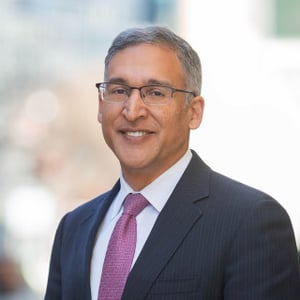
Partner, Millbank LLP
Mr. Katyal, the former Acting Solicitor General of the United States, focuses on appellate and complex litigation. He has argued 54 cases before the Supreme Court of the United States.
He has extensive experience in matters of antitrust, corporate, constitutional, securities, technology, criminal, patent, copyright, trademark, ERISA, products liability, labor, employment and tribal law. In the 2022-23 Supreme Court term, he argued five separate cases (nearly 10% of the docket), including winning the landmark voting case Moore v. Harper, which Judge Michael Luttig described as “the most important case for American democracy in the almost two and a half centuries since America’s founding.” Judge Luttig also said Mr. Katyal’s argument “was the single best oral argument I have ever heard made in the Supreme Court of the United States.” His cases include successfully striking down the Guantanamo military tribunals, successfully defending the constitutionality of the Voting Rights Act and successfully defending the Peace Cross in Maryland. His 2017 win in Bristol Myers Squibb v. Superior Court was a landmark victory for personal jurisdiction law and his 2006 win in Hamdan v. Rumsfeld was described by former Acting Solicitor General Walter Dellinger as “simply the most important decision on presidential power and the rule of law ever. Ever.”
From 2010 to 2011, Mr. Katyal served as Acting Solicitor General of the United States, where he argued several major Supreme Court cases involving a variety of issues, such as his successful defense of the constitutionality of the Voting Rights Act of 1965, his victorious defense of former Attorney General John Ashcroft for alleged abuses in the war on terror, his unanimous victory against eight states who sued the nation's leading power plants for contributing to global warming, and a variety of other matters. As Acting Solicitor General, he was responsible for representing the federal government of the United States in all appellate matters before the US Supreme Court and the Courts of Appeals throughout the nation. He served as Counsel of Record hundreds of times in the US Supreme Court. He was also the only head of the Solicitor General's office to argue a case in the US Court of Appeals for the Federal Circuit, on the important question of whether certain aspects of the human genome were patentable.
After graduating from Yale Law School, Mr. Katyal clerked for The Honorable Guido Calabresi of the US Court of Appeals for the Second Circuit as well as for The Honorable Justice Stephen G. Breyer of the US Supreme Court. He also served in the Deputy Attorney General's Office at the Justice Department as National Security Advisor and as Special Assistant to the Deputy Attorney General during 1998-1999.
Mr. Katyal is a best-selling New York Times author and has published dozens of scholarly articles in law journals (including several in the Harvard Law Review and Yale Law Journal), as well as many op-ed articles in publications such as the New York Times and the Washington Post. He has testified numerous times before various committees of both the US House of Representatives and the US Senate.
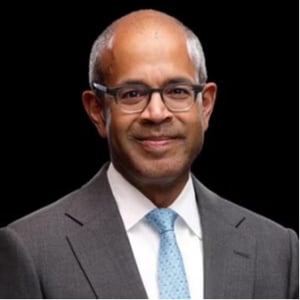
Partner, Davis Polk & Wardwell LLP
Kannon is the head of our Supreme Court & Appellate practice. He has argued 39 cases before the U.S. Supreme Court and has argued more than 150 appeals in courts across the country, including every federal court of appeals and numerous state courts.
Kannon is ranked as a “Star Individual” in appellate law by Chambers USA, where a client notes, “It’s hard to think of enough superlatives to describe his talent, his judgment, his ability, his experience – he is as good as it gets.” Legal 500 U.S. recognizes Kannon in its Hall of Fame for appellate work. A client shares, “His work is the best in the business, and he is a wonderful human being in addition to being a world-class appellate litigator.”
In 2024 and 2022, Kannon was a finalist for the American Lawyer’s “Litigator of the Year” award. He was named “Appellate Litigator of the Year” by Benchmark Litigation in 2021 and was a 2026 finalist for that recognition.
Before entering private practice, Kannon served as an Assistant to the Solicitor General at the U.S. Department of Justice.
Assistant Professor of Law, Emory University School of Law
Alexander "Sasha" Volokh is an assistant professor of law, joining the Emory Law faculty in Fall 2009.
Professor Volokh earned his B.S. from UCLA and his J.D. and Ph.D. in economics from Harvard University. He clerked for Judge Alex Kozinski of the Ninth Circuit and for Supreme Court Justices Sandra Day O'Connor and Samuel Alito. Before coming to Emory, he was a visiting associate professor at Georgetown University Law Center and a visiting assistant professor at University of Houston Law Center.
His interests include law and economics, administrative law and the regulatory process, environmental law and policy, and legal history. His current research topics include the private management of government services, medieval law, judicial decisionmaking and statutory interpretation.
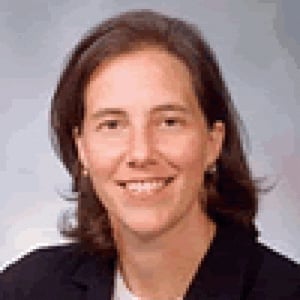
Executive Director and Executive Vice President, American Society of International Law
Elizabeth (Betsy) Andersen is Executive Director and Executive Vice President of the American Society of International Law (ASIL), a position she has held since 2006. Previously she served as the Executive Director of the American Bar Association's Central European and Eurasian Law Initiative (ABA CEELI), and as Executive Director of Human Rights Watch's Europe and Central Asia Division. Earlier in her career, she served as Legal Assistant to Judge Georges Abi-Saab of the International Criminal Tribunal for the former Yugoslavia and as a law clerk to Judge Kimba M. Wood of the U.S. District Court of the Southern District of New York.
Ms. Andersen is a graduate of Yale Law School, the Woodrow Wilson School of Public and International Affairs at Princeton University, and Williams College, from which she received the College’s Bicentennial Medal in 2006. Her area of expertise is international humanitarian, human rights, and refugee law. She serves as co-editor of the ASIL Studies in Transnational Legal Theory Series; as a member of the governing boards of the Washington Foreign Law Society and Friends of the Law Library of Congress; and as a member of the advisory committees of the American University Academy on Human Rights and Humanitarian Law, the International Senior Lawyers Project, and the Journal of International Humanitarian Legal Studies.
Sudler Family Professor of Constitutional Law, New York University School of Law
Richard H. Pildes is one of the nation’s leading scholars of constitutional law and a specialist in legal issues affecting democracy. He is a Member of the American Academy of Arts and Sciences and the American Law Institute, and has received recognition as a Guggenheim Fellow and a Carnegie Scholar. His acclaimed casebook, The Law of Democracy: Legal Structure of the Political Process (now in its fourth edition), helped create an entirely new field of study in the law schools. The Law of Democracy systematically explores legal and policy issues concerning the structure of democratic elections and institutions, such as the role of money in politics, the design of election districts, the regulation of political parties, the design of voting systems, the representation of minority interests in democratic institutions, and similar issues. He has written extensively on the rise of political polarization in the United States, the Voting Rights Act, the dysfunction of America’s political processes, the role of the Supreme Court in overseeing American democracy, the powers of the American President and Congress, and he has criticized excessively “romantic” understandings of democracy. In addition to his scholarship on these issues, he has written on national-security law, the design of the regulatory state, and American constitutional history and theory.
Respect for his expertise in these areas is reflected in frequent citations of his work in U.S. Supreme Court opinions, the translation of his work into many languages, and his frequent public lectures and appearances around the world, including his nomination with the NBC News Team for an Emmy Award for coverage of the 2000 Presidential election litigation.
His work has been translated and published in Chinese, French, Spanish, and Portuguese. In addition to his scholarship, Professor Pildes plays an active role litigating in these areas. He has won two cases before the United States Supreme Court, including a 2015 victory in Alabama Democratic Conference v. Alabama, a case involving race and redistricting. He served as counsel to a group of former chairmen of the Securities and Exchange Commission in litigation defending the constitutionality of the Sarbanes-Oxley Act; as counsel in election litigation to the Puerto Rico Electoral Commission; as counsel to the government of Puerto Rico; as a federal court-appointed independent expert on voting rights litigation; and as counsel in successful Supreme Court litigation that challenged the way the United States Tax Court operated. He was also a senior legal advisor to the 2008 and 2012 campaigns of President Obama.
Pildes received his A.B. in physical chemistry summa cum laude from Princeton, and his J.D. magna cum laude from Harvard, where he served as Supreme Court Note Editor on the Harvard Law Review. He clerked for Judge Abner J. Mikva of the U.S. Court of Appeals for the District of Columbia Circuit and for Justice Thurgood Marshall of the U.S. Supreme Court. After practicing law in Boston, he began his academic career at the University of Michigan Law School, before joining the NYU School of Law in 2001.

Professor of Law, Georgetown University Law Center
Nicholas Quinn Rosenkranz teaches constitutional law and federal jurisdiction, and he writes articles for the Harvard Law Review and the Stanford Law Review.
He is currently developing a new theory of constitutional interpretation and judicial review. The first installment, entitledThe Subjects of the Constitution, was published in the Stanford Law Review in May of 2010, and it is among the most downloaded articles about constitutional interpretation, judicial review, and/or federal courts in the history of SSRN. The second installment, The Objects of the Constitution, was published in May of 2011, also in the Stanford Law Review. And the comprehensive version is forthcoming as a book by Oxford University Press.
Rosenkranz has served and advised the federal government in a variety of capacities. He clerked for Judge Frank H. Easterbrook on the U.S. Court of Appeals for the Seventh Circuit (1999-2000) and for Justice Anthony M. Kennedy at the U.S. Supreme Court (October Term 2001). He served as an Attorney-Advisor at the Office of Legal Counsel in the U.S. Department of Justice (November 2002 - July 2004). He often testifies before Congress as a constitutional expert—most recently before the House Financial Services Oversight Subcommittee, regarding the Obama Administration's use of bank settlement agreements to circumvent the Appropriations Clause. He has also filed briefs and presented oral argument before the U.S. Supreme Court. His most recent Supreme Court brief, in Los Angeles v. Patel, was cited by Justice Alito in dissent.
Rosenkranz is a member of the New York Bar and the U.S. Supreme Court Bar. He is a Senior Fellow at the Cato Institute. He serves on the Board of Directors of the Foundation for Individual Rights in Education (FIRE). He is a founding member of Heterodox Academy and a member of its Executive Committee. He also serves on the Board of Directors of the Federalist Society and as the faculty advisor to the Georgetown chapter.
Executive Director and Executive Vice President, American Society of International Law
Elizabeth (Betsy) Andersen is Executive Director and Executive Vice President of the American Society of International Law (ASIL), a position she has held since 2006. Previously she served as the Executive Director of the American Bar Association's Central European and Eurasian Law Initiative (ABA CEELI), and as Executive Director of Human Rights Watch's Europe and Central Asia Division. Earlier in her career, she served as Legal Assistant to Judge Georges Abi-Saab of the International Criminal Tribunal for the former Yugoslavia and as a law clerk to Judge Kimba M. Wood of the U.S. District Court of the Southern District of New York.
Ms. Andersen is a graduate of Yale Law School, the Woodrow Wilson School of Public and International Affairs at Princeton University, and Williams College, from which she received the College’s Bicentennial Medal in 2006. Her area of expertise is international humanitarian, human rights, and refugee law. She serves as co-editor of the ASIL Studies in Transnational Legal Theory Series; as a member of the governing boards of the Washington Foreign Law Society and Friends of the Law Library of Congress; and as a member of the advisory committees of the American University Academy on Human Rights and Humanitarian Law, the International Senior Lawyers Project, and the Journal of International Humanitarian Legal Studies.
Sudler Family Professor of Constitutional Law, New York University School of Law
Richard H. Pildes is one of the nation’s leading scholars of constitutional law and a specialist in legal issues affecting democracy. He is a Member of the American Academy of Arts and Sciences and the American Law Institute, and has received recognition as a Guggenheim Fellow and a Carnegie Scholar. His acclaimed casebook, The Law of Democracy: Legal Structure of the Political Process (now in its fourth edition), helped create an entirely new field of study in the law schools. The Law of Democracy systematically explores legal and policy issues concerning the structure of democratic elections and institutions, such as the role of money in politics, the design of election districts, the regulation of political parties, the design of voting systems, the representation of minority interests in democratic institutions, and similar issues. He has written extensively on the rise of political polarization in the United States, the Voting Rights Act, the dysfunction of America’s political processes, the role of the Supreme Court in overseeing American democracy, the powers of the American President and Congress, and he has criticized excessively “romantic” understandings of democracy. In addition to his scholarship on these issues, he has written on national-security law, the design of the regulatory state, and American constitutional history and theory.
Respect for his expertise in these areas is reflected in frequent citations of his work in U.S. Supreme Court opinions, the translation of his work into many languages, and his frequent public lectures and appearances around the world, including his nomination with the NBC News Team for an Emmy Award for coverage of the 2000 Presidential election litigation.
His work has been translated and published in Chinese, French, Spanish, and Portuguese. In addition to his scholarship, Professor Pildes plays an active role litigating in these areas. He has won two cases before the United States Supreme Court, including a 2015 victory in Alabama Democratic Conference v. Alabama, a case involving race and redistricting. He served as counsel to a group of former chairmen of the Securities and Exchange Commission in litigation defending the constitutionality of the Sarbanes-Oxley Act; as counsel in election litigation to the Puerto Rico Electoral Commission; as counsel to the government of Puerto Rico; as a federal court-appointed independent expert on voting rights litigation; and as counsel in successful Supreme Court litigation that challenged the way the United States Tax Court operated. He was also a senior legal advisor to the 2008 and 2012 campaigns of President Obama.
Pildes received his A.B. in physical chemistry summa cum laude from Princeton, and his J.D. magna cum laude from Harvard, where he served as Supreme Court Note Editor on the Harvard Law Review. He clerked for Judge Abner J. Mikva of the U.S. Court of Appeals for the District of Columbia Circuit and for Justice Thurgood Marshall of the U.S. Supreme Court. After practicing law in Boston, he began his academic career at the University of Michigan Law School, before joining the NYU School of Law in 2001.
Professor of Law, Georgetown University Law Center
Nicholas Quinn Rosenkranz teaches constitutional law and federal jurisdiction, and he writes articles for the Harvard Law Review and the Stanford Law Review.
He is currently developing a new theory of constitutional interpretation and judicial review. The first installment, entitledThe Subjects of the Constitution, was published in the Stanford Law Review in May of 2010, and it is among the most downloaded articles about constitutional interpretation, judicial review, and/or federal courts in the history of SSRN. The second installment, The Objects of the Constitution, was published in May of 2011, also in the Stanford Law Review. And the comprehensive version is forthcoming as a book by Oxford University Press.
Rosenkranz has served and advised the federal government in a variety of capacities. He clerked for Judge Frank H. Easterbrook on the U.S. Court of Appeals for the Seventh Circuit (1999-2000) and for Justice Anthony M. Kennedy at the U.S. Supreme Court (October Term 2001). He served as an Attorney-Advisor at the Office of Legal Counsel in the U.S. Department of Justice (November 2002 - July 2004). He often testifies before Congress as a constitutional expert—most recently before the House Financial Services Oversight Subcommittee, regarding the Obama Administration's use of bank settlement agreements to circumvent the Appropriations Clause. He has also filed briefs and presented oral argument before the U.S. Supreme Court. His most recent Supreme Court brief, in Los Angeles v. Patel, was cited by Justice Alito in dissent.
Rosenkranz is a member of the New York Bar and the U.S. Supreme Court Bar. He is a Senior Fellow at the Cato Institute. He serves on the Board of Directors of the Foundation for Individual Rights in Education (FIRE). He is a founding member of Heterodox Academy and a member of its Executive Committee. He also serves on the Board of Directors of the Federalist Society and as the faculty advisor to the Georgetown chapter.

Judicial Engagement v. Judicial Restraint: The Future of the Conservative Legal Movement
Panel III: Federalization of Criminal Law
2013 National Student Symposium
Austin, TXMinneci v. Pollard and Constitutional Torts
Greenville, South CarolinaIs American Justice Blind, Or Blind To A "Prosecutocracy"?
Who Won the Health Care Challenge (and Why Did So Many Law Professors Miss the Boat)?
Richmond, VirginiaWho Won the Obamacare Case (and Why Did So Many Law Professors Miss the Boat)?
Supreme Court Term Preview: A Practitioner's Perspective
Georgetown Student Chapter
Washington, DCThe Limited Effect of Minneci v. Pollard on Inmate Litigants
Birmingham, AlabamaLuncheon Debate: Resolved: Congress's Enumerated Powers Cannot be Increased by Treaty
Elizabeth Andersen, Richard H. Pildes, Nicholas Quinn Rosenkranz
The Federalist Society's Facutly Division hosted this debate on Saturday, January 5, 2013, during the 15th...
Luncheon Debate: Resolved: Congress's Enumerated Powers Cannot be Increased by Treaty
Elizabeth Andersen, Richard H. Pildes, Nicholas Quinn Rosenkranz
The Federalist Society's Facutly Division hosted this debate on Saturday, January 5, 2013, during the 15th...