
I. Herman Stern Professor of Law
David Post is currently the I. Herman Stern Professor of Law at the Beasley School of Law at Temple University, where he teaches intellectual property law and the law of cyberspace. Professor Post is also an Adjunct Scholar at the Cato Institute, a Fellow at the Institute for Information Law and Policy at New York Law School, and a contributor to the influential Volokh Conspiracy blog. [More detail on Professor Post's research and writings can be found here.]
Trained originally as a physical anthropologist, Professor Post spent two years studying the feeding ecology of yellow baboons in Kenya's Amboseli National Park, and he taught at the Columbia University Department of Anthropology from 1976 through 1981. He then attended Georgetown Law Center, from which he graduated summa cum laude in 1986. After clerking with then-Judge Ruth Bader Ginsburg on the DC Circuit Court of Appeals, he spent 6 years at the Washington D.C. law firm of Wilmer, Cutler & Pickering, practicing in the areas of intellectual property law and high technology commercial transactions. He then clerked again for Justice Ginsburg during her first term on the Supreme Court before joining the faculty of, first, the Georgetown University Law Center (1994-1997) and then the Temple University Law School (1997-present).
Professor Post is the author of Cyberlaw: Problems of Policy and Jurisprudence in the Information Age (3d Edition, West, 2007) (co-authored with Paul Schiff Berman and Patricia Bellia), and In Search of Jefferson's Moose: Notes on the State of Cyberspace (Oxford U. Press, forthcoming 2008), as well as numerous articles on intellectual property, the law of cyberspace, and the application of complexity theory to Internet legal questions that have appeared in the Stanford Law Review, Journal of Legal Studies, Berkeley Technology Law Journal, Esther Dyson's Release 1.0, Journal of Online Law, University of Chicago Legal Forum, Vanderbilt Law Review, Georgetown Law Journal, and numerous other publications. For four years (1994-1998) he wrote a monthly column on law and technology ("Plugging In") for the American Lawyer, and from 1998-2004 he wrote the "On the Horizon" column for InformationWeek (with Bradford Brown). He has appeared as a commentator on the Lehrer News Hour, Court TV's Supreme Court Preview, NPR's All Things Considered, BBC's World, and other television and radio shows, and recently was featured in the PBS documentary The Supreme Court. During 1996-1997 he conducted, along with two colleagues (Professors Larry Lessig and Eugene Volokh) the first Internet-wide e-mail course on "Cyberspace Law for Non-Lawyers" which attracted over 20,000 subscribers. He also sings and plays guitar, piano, banjo, and harmonica in the bands "Bad Dog," "The Dwights," and "The Zen Cohens."
Professor Post's writings can be accessed online via his publications page and personal site (http://www.davidpost.com).
J.D., Georgetown University
Ph.D. (Anthropology), Yale University
B.A., Yale University

Professor of Law, Southern Illinois University School of Law
Professor Mark F. Schultz joined the faculty in 2003. He teaches and writes primarily in the area of intellectual property.
Professor Schultz is a frequent author and speaker known for his work on the law and economics of the global intellectual property system. In one of his most influential projects, he worked with the Organization for Economic Cooperation and Development (OECD) to construct a groundbreaking global trade secret protection index (the TSPI). The TSPI is influencing policy discussions on this cutting-edge topic in capitals around the world. Other recent projects have included an empirical study that quantified for the first time the backlogs in patent offices worldwide, a report on how patented innovation is meeting global health challenges, and the construction of a new global index of copyright strength.
Professor Schultz is an influential voice in public policy debates regarding intellectual property. He has testified before the U.S. Congress on copyright law at the invitation of the House Judiciary Committee and has briefed the staff of the U.S. Senate Judiciary Committee on trade secret legislation. He speaks frequently around the world about the connection between secure and effective intellectual property rights and flourishing national economies and individual lives, with invitations from the U.S. Patent and Trademark Office, the U.S. Trade Representative, and the U.S. Copyright Office, as well as numerous academic institutions, think tanks, and industry groups. He served as an NGO delegate to the World Intellectual Property Organization (WIPO) for several years during the WIPO Development Agenda talks. He is also one of the organizers of an ongoing multilateral diplomatic dialogue on best practices in national trade secret laws, and is co-founder of the Center for Protection of Intellectual Property (CPIP) at George Mason University in Washington, D.C.
Among the awards and recognition he has received for his scholarship was the School of Law's Outstanding Scholar of the Year award in 2008. He has been a distinguished visiting scholar at the University of Botswana and a visiting professor at DePaul University College of Law.
Professor Schultz graduated with honors from the George Washington University School of Law. Following law school, he was a judicial clerk for the Hon. Daniel M. Friedman of the United States Court of Appeals for the Federal Circuit in Washington, D.C., and the Hon. Eric G. Bruggink of the United States Court of Federal Claims. Prior to joining academia, he practiced law for a decade, serving as outside general counsel to several tech startups and helping technology companies to expand their businesses and commercialize their intellectual property in dozens of countries. He holds a B.A. in International Economics from George Washington University and has done PhD level coursework in development economics at Southern Illinois University.
He is active in leadership roles in local and national organizations. He has served as chair of the Federalist Society's Intellectual Property Practice Group and the AALS Section on Internet and Computer Law. He is an officer of the American Bar Association's International IP Committee of the International Law Section and the American Intellectual Property Law Association’s Trade Secret Law Committee. He currently is chair of the Academic Advisory Board of the Copyright Alliance.
Professor Schultz teaches Copyright Law, Trade Secret Law, Trademark Law, and a senior seminar on Intellectual Property and Global Development. He established and directs both the Specialization in Intellectual Property Law and the IP Semester in Practice Externship Program. He also co-founded a Legal Globalization Class, offered every other year, that takes students to South Africa and Botswana after spending a semester learning about the legal system, culture, history, and politics of southern Africa. The popular course is a once-in-a-lifetime experience that introduces students to leading lawyers, judges, government officials, and human rights advocates, taking them from Cape Town to Johannesburg to Gaborone as well as many popular destinations including game reserves, national parks, the Cape of Good Hope, and the Cradle of Humankind.

Professor Emeritus of Law, Antonin Scalia Law School, George Mason University
Jeremy A. Rabkin is a Professor Emeritus of Law at the Antonin Scalia Law School, George Mason University. Before joining the faculty in June 2007, he was for over two decades a professor in the Department of Government at Cornell University. Professor Rabkin serves on the board of directors of the Center for Individual Rights, a public interest law firm based in Washington, D.C. Previously he was a board member of the U.S. Institute of Peace and the board of academic advisors of the American Enterprise Institute.
Professor Rabkin’s books include Law Without Nations? (Princeton University Press, 2005). He authored “If You Need a Friend, Don’t Call a Cosmopolitan,” a chapter in Varieties of Sovereignty and Citizenship (Sigal R. Ben-Porath & Rogers M. Smith eds., University of Pennsylvania Press, 2012). His articles have appeared in major law reviews and political science journals and his journalistic contributions in a range of magazines and newspapers, including the Washington Post and the Wall Street Journal.
United States Court of Appeals, Second Circuit
Dennis Jacobs is the Chief Judge of the United States Court of Appeals for the Second Circuit. He became Chief Judge on October 1, 2006. At the time of his appointment in 1992, he was a partner in the New York law firm of Simpson Thacher & Bartlett.
Judge Jacobs received his B.A. degree from Queens College of the City University of New York in 1964; his M.A. degree from New York University in 1965; and his J.D. degree from the New York University School of Law in 1973.
Judge Jacobs was a lecturer in the English Department of Queens College of the City University of New York from 1967 until 1969. He was in private practice from 1973 with the New York law firm of Simpson, Thacher & Bartlett, serving as a partner there from 1980 until his judicial appointment.
In 1997-2004, Judge Jacobs was a member of the Committee on Judicial Resources of the Judicial Conference of the United States; starting in 1999 he was chair of that committee.
Judge Jacobs is a native of New York City.
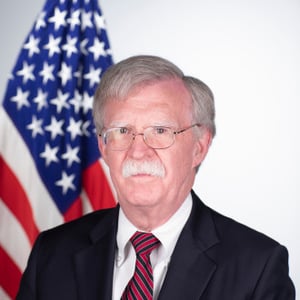
Former United States National Security Advisor
John R. Bolton served as Assistant to the President and National Security Advisor from April 2018 to September 2019.
Prior to his appointment, Ambassador Bolton served as a senior fellow at the American Enterprise Institute (AEI); of counsel at Kirkland & Ellis; a contributor to FOX News Channel and FOX Business Network; and his op-ed articles were regularly featured in major media publications.
Ambassador Bolton was appointed as United States Permanent Representative to the United Nations on August 1, 2005 and served until his resignation in December 2006. Prior to his appointment, Ambassador Bolton served as Under Secretary of State for Arms Control and International Security from May 2001 to May 2005.
Other positions he has previously held include Assistant Secretary for International Organization Affairs at the Department of State, 1989-1993; Assistant Attorney General, Department of Justice, 1985-1989; Assistant Administrator for Program and Policy Coordination, U.S. Agency for International Development, 1982-1983 and General Counsel, U.S. Agency for International Development, 1981-1982.
Ambassador Bolton is the author of Surrender is Not an Option: Defending America at the U.N. and Abroad, published by Simon and Shuster (November 2007) and How Barack Obama is Endangering our National Sovereignty, published by Encounter Books (April 2010).
Ambassador Bolton was born in Baltimore, Maryland. He graduated with a Bachelor of Arts degree, summa cum laude, Phi Beta Kappa, from Yale College in 1970, and received his Juris Doctor from Yale Law School in 1974. He currently resides in Maryland with his wife, Gretchen. They have one daughter, Jennifer Sarah, who also graduated from Yale College, and received her MBA and SM degrees from MIT in 2014 and is currently a senior manager at Nissan’s facility in Nashville.
Principal, Ely & Company, Inc.
Bert Ely has specialized in deposit insurance and banking structure issues since 1981. In 1986, he became an early predictor of the S&L crisis and a taxpayer bailout of the FSLIC. In 1991, he was the first person to correctly predict the non-crisis in commercial banking; in 1992, he predicted an eventual taxpayer bailout of the Japanese banking system.
Bert continuously monitors conditions in the banking and S&L industries, monetary policy, and the growing federalization of credit risk. He has helped to draft legislation to enact the cross-guarantee concept for privatizing banking regulation and its related deposit insurance and systemic risks. He has testified on numerous occasions before congressional committees on banking issues and he often speaks on these matters to bankers and others.
Bert first established his consulting practice in 1972. Before that, he was the chief financial officer of a public company, a consultant with Touche, Ross & Company, and an auditor with Ernst & Ernst. He received his MBA from the Harvard Business School in 1968 and his Bachelor's degree in economics in 1964 from Case Western Reserve University.

Managing Director, Promontory Financial Group, LLC
Bill brings an exceptional blend of experience and insights to his work with clients, having been a banker, California’s Commissioner of Financial Institutions, and a member of the Financial Stability Oversight Council. He works with financial institutions on corporate governance and organizational design, compliance program design and implementation, anti-money laundering programs, senior management reviews, and strategic planning.
Bill’s financial services experience spans the corporate sector, the executive branches of both state and federal government, academia, and think tanks. He earned a reputation as an open, fair, and pragmatic regulator during four years as Commissioner of Financial Institutions in California, leading the agency through a period of economic upheaval both in the state and nationwide. His vast knowledge and understanding of the financial system led to his selection as the state banking supervisors’ representative on the Financial Stability Oversight Council, a federal agency created by the Dodd-Frank Act to foster coordination among financial regulators in order to identify systemic risks to the nation’s financial stability.
Before his appointment to state office, Bill was an independent consultant with Promontory while also serving as a visiting professor of economics and finance for the Graduate School of Management at the University of California-Davis. He worked on a wide array of client engagements at Promontory, in areas that included governance, due diligence, compliance, and strategy.
During nine years with Bank of America, Bill was managing director of Banc of America Securities and senior vice president of strategic policy development and planning for the bank. Earlier, he worked for five years as director of policy analysis for Citicorp.
Bill was J. Edward Lundy Scholar and director of the financial markets project at the American Enterprise Institute for Public Policy Research. He served under President Reagan as senior staff economist and special assistant to the chairman of the Council of Economic Advisors.
John Adams is a pseudonym. The author is a veteran attorney in the government arms control community. His opinions are purely his own, and do not reflect any official position or policy of the United States, the Conference on Disarmament, or the Organization for the Prohibition of Chemical Weapons.
Chief Judge (ret.), U.S. Court of Appeals for the Federal Circuit, and Honorary Professor, Tsinghua University
Randall R. Rader was appointed to the United States Court of Appeals for the Federal Circuit by President George H. W. Bush in 1990 and served as Chief Judge from June 2010 to June 2014. He was appointed to the United States Claims Court (now the U. S. Court of Federal Claims) by President Ronald W. Reagan in 1988. Judge Rader's most prized title may well be "Professor Rader."
As Professor, Judge Rader has taught courses on patent law and other advanced intellectual property courses at The George Washington University Law School,University of Virginia School of Law, Georgetown University Law Center, the Munich Intellectual Property Law Center, and other university programs in Tokyo, Taipei, New Delhi, and Beijing. Due to the size and diversity of his classes, Judge Rader may have taught patent law to more students than anyone else. Judge Rader has also co-authored several texts including the most widely used textbook on U. S. patent law, "Cases and Materials on Patent Law," (St. Paul, Minn.: Thomson/West 3d ed. 2009) and "Patent Law in a Nutshell," (St. Paul, Minn.: Thomson/West 2007) (translated into Chinese and Japanese). Judge Rader has won acclaim for leading dozens of government and educational delegations to every continent (except Antarctica), teaching rule of law and intellectual property law principles.
Judge Rader has received many awards, including the Sedona Lifetime Achievement Award for Intellectual Property Law, 2009; Distinguished Teaching Awards from George Washington University Law School, 2003 and 2008 (by election of the students); the Jefferson Medal from the New Jersey Intellectual Property Law Association, 2003; the Distinguished Service Award from the Berkeley Center for Law and Technology, 2003; the J. William Fulbright Award for Distinguished Public Service from George Washington University Law School, 2000; and the Younger Federal Lawyer Award from the Federal Bar Association, 1983. Before appointment to the Court of Federal Claims, Judge Rader served as Minority and Majority Chief Counsel to Subcommittees of the U.S. Senate Committee on the Judiciary. From 1975 to 1980, he served as Counsel in the House of Representatives for representatives serving on the Interior, Appropriations, and Ways and Means Committees. He received a B.A. in English from Brigham Young University in 1974 and a J.D. from George Washington University Law School in 1978.

Bringing Law to New Frontiers: Cyberspace
David G. Post, Andrew Shapiro, Mark F. Schultz
THURSDAY, NOVEMBER 12, 1998 PROCEEDINGS Following are excerpts from one of the Intellectual Property Practice...
Panel Proceedings: The Pinochet Case & Head of State Immunity
Kenneth Roth, Jeffrey Greenbaum, Jeremy A. Rabkin, Dennis Jacobs, John R. Bolton
Editor's Note: This issue is dedicated to a panel discussion on International Law and Head...
International Monetary Policy: The Asian Crisis and Beyond
Ian Vasquez, William Lash, Bert Ely, William Haraf
A Panel Presented on November 12, 1998 at the Federalist Society's 1998 Lawyers Convention by...
The Board of Directors: Succeeding in the Future
James Melican
The subject that I would like to address today is the role of the board...
Global Warming is Nothing More than an Educated Guess
Linda Bowles
The Global Warming Treaty negotiated in Kyoto, Japan by the Clinton-Gore Administration is a scam....
Book Review: Money Meltdown: Restoring Order to the Global Currency System by Judy Shelton
Aaron A. Goach
Money Meltdown: Restoring Order to the Global Currency Systemby Judy SheltonFree Press/Macmillan 1994 (399 pages) If...
The Chemical Weapons Convention: Legal and Juridical Observations
John Adams
Introduction It is the inherent contradiction of the Twentieth Century that the same era that...
Book Review: Bretton Woods and Dumbarton Oaks: American Economic and Political Postwar Planning in the Summer of 1944 by Georg Schild
John Pickering
Bretton Woods and Dumbarton Oaks: American Economic and Political Postwar Planning in the Summer of...
Intellectual Property Protection in China
Randall R. Rader
China recognized the significance of intellectual property as early as the Tang Dynasty (A.D. 617-906]....
Extra-Terrestrial Sanctions in an Interdependent World
Gregory Husisian
U.S. Unilateral Sanctions in the Post-World War Era It is almost a law of nature:...