
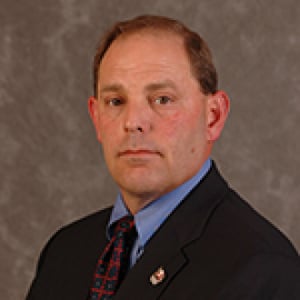
President, Fraternal Order of Police
Chuck Canterbury began serving as President of the Fraternal Order of Police in January 2003 after the death of President Steve Young. He has been reelected seven times.
President Canterbury joined the Fraternal Order of Police in 1984 when he, along with eleven other officers, chartered their Local Lodge. He served as Local Lodge President for 13 years, during which time he was instrumental in starting the Lodge Legal Defense Plan, purchasing the first lodge building, and starting the Lodge insurance program.
He went on to serve as State Lodge President from 1990 to 1998. During his tenure he was instrumental in establishing the State Lodge lobbying program, initiating the political endorsement program and implementing the State Lodge Legal Defense Plan. He led the effort to hire a full time Executive Director for the State Lodge to manage these programs.
He began his service on the Grand Lodge Executive Board in 1995 when he was elected to the first of three terms as the Second Vice President. In 2001, he was elected Vice President. During this time, he has worked to expand the police labor movement in the areas of our country who do not have collective bargaining rights. Improving the quality of life for police officers has been his foremost goal. During his tenure he has brought a best business practice model to the FOP.
President Canterbury retired in January 2004 from the Horry County Police Department, Conway, South Carolina, where he most recently had oversight of the Operations Bureau. He began his police career in 1978 and over his 26-year career he worked in the Patrol Division, the Criminal Investigations Division and served as the Training Division Supervisor, during which he was certified as an Instructor in basic law enforcement, firearms, chemical weapons, and pursuit driving.
He has been appointed by President George Bush to serve on the Medal of Valor Board and also serves on our Nation's Homeland Security Council. Chuck has also been appointed to the Congressional Badge of Bravery Awards committee. Chuck is also on the Board of Directors of the National Center for Missing and Exploited Children. He also serves as Treasurer of the International Council of Police Representatives Association. This group represents over 1.4 million of our world's law enforcement officers.
He earned a Bachelor of Arts degree from Coastal Carolina University.
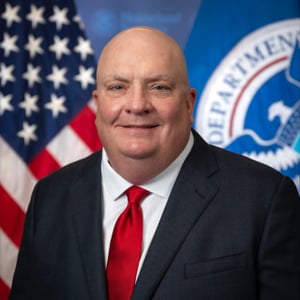
Acting Assistant Commissioner of Customs and Border Protection, Office of Professional Responsibility, U.S. Department of Homeland Security
Brian M. Fish is currently the Senior Advisor to the General Counsel at the Department of Homeland Security where he works on immigration and law enforcement issues. Previously, he was a trial attorney with the United States Immigration and Customs Enforcement, where he represented the Department of Homeland Security in removal hearings before the U.S. Immigration Court. Additionally, he was a Special Assistant United States Attorney and a Baltimore City homicide prosecutor. He is a member of the Federalist Society's Criminal Law & Procedure Practice Group Executive Committee and the President of its Baltimore Lawyers Chapter. He earned his B.A. from LaSalle University in 1992 and his J.D. from Loyola University New Orleans School of Law in 1998.
President, Leadership Conference on Civil and Human Rights
Vanita Gupta is the President of The Leadership Conference on Civil and Human Rights. She previously served as the acting Principal Deputy Assistant Attorney General for the Civil Rights Division and the top civil rights prosecutor for the United States Department of Justice. Before her work at the DOJ she was a civil rights lawyer and the Deputy Legal Director of the American Civil Liberties Union (ACLU), where she oversaw the ACLU's national criminal justice reform efforts. She is a graduate of Yale and New York University Law School.

Senior Fellow and Director of Constitutional Studies, Manhattan Institute
Ilya Shapiro is a senior fellow and director of constitutional studies at the Manhattan Institute and a contributing editor of City Journal. Previously he was executive director and senior lecturer at the Georgetown Center for the Constitution, and before that a vice president of the Cato Institute.
Shapiro is the author of Lawless: The Miseducation of America’s Elites (2025) and Supreme Disorder: Judicial Nominations and the Politics of America’s Highest Court (2020), coauthor of Religious Liberties for Corporations? (2014), and editor of 11 volumes of the Cato Supreme Court Review (2008-18). He has contributed to a variety of academic, popular, and professional publications, including the Wall Street Journal, Harvard Journal of Law & Public Policy, Washington Post, Los Angeles Times, USA Today, National Review, and Newsweek. He also regularly provides commentary for various media outlets, writes the Shapiro’s Gavel newsletter on Substack, and once appeared on the Colbert Report.
Shapiro has testified many times before Congress and state legislatures and has filed more than 500 amicus curiae “friend of the court” briefs in the Supreme Court. He lectures regularly on behalf of the Federalist Society, is a member of the board of fellows of the Jewish Policy Center, was an inaugural Washington Fellow at the National Review Institute, and has been an adjunct law professor at the George Washington University and University of Mississippi. He is also the chairman of the board of advisers of the Mississippi Justice Institute, a barrister in the Edward Coke Appellate Inn of Court, and a former member of the Virginia Advisory Committee to the U.S. Commission on Civil Rights.
Earlier in his career, Shapiro was a special assistant/adviser to the Multi-National Force in Iraq on rule-of-law issues and practiced at Patton Boggs and Cleary Gottlieb. Before entering private practice, he clerked for Judge E. Grady Jolly of the U.S. Court of Appeals for the Fifth Circuit. He holds an AB from Princeton University, an MSc from the London School of Economics, and a JD from the University of Chicago Law School.

Patrick Hotung Professor of Constitutional Law, Georgetown University Law Center
Randy Barnett is the Patrick Hotung Professor of Constitutional Law at Georgetown University Law Center. He has argued before the United States Supreme Court, tried murder cases to juries as a prosecutor in Chicago, and appeared as a prosecutor in the feature film Inalienable. He is the author of numerous books, including Restoring the Lost Constitution, The Structure of Liberty, Our Republican Constitution, and The Original Meaning of the Fourteenth Amendment. He has published two memoirs, A Life for Liberty: The Making of an American Originalist, and Felony Review: Tales of True Crime and Corruption in Chicago. He is currently working on a new book, Freedom and Flourishing: Libertarianism for the Real World.

Vice President, Edwin Meese III Institute for the Rule of Law, Advancing American Freedom
John G. Malcolm oversees Advancing American Freedom’s work to increase understanding of the Constitution and the rule of law as Vice President of the organization’s Edwin Meese III Institute for the Rule of Law. Malcolm brings to the challenge a wealth of legal expertise and experience in both the public and private sectors.
Prior to joining Advancing American Freedom in 2025, Malcolm was the Vice President of the Institute for Constitutional Government and the Director of the Meese Center for Legal and Judicial Studies at the Heritage Foundation. Prior to joining Heritage in 2012, Malcolm was general counsel at the U.S. Commission on International Religious Freedom, as well as a distinguished practitioner in residence at Pepperdine Law School. From 2004 to 2009, Malcolm was executive vice president and director of worldwide anti-piracy operations for the Motion Picture Association.
Malcolm served as a deputy assistant attorney general in the Department of Justice’s Criminal Division from 2001 to 2004, where he oversaw sections on computer crime and intellectual property, domestic security, child exploitation and obscenity, and special investigations. Immediately prior to that, he was a founding partner in the Atlanta law firm of Malcolm & Schroeder, LLP.
From 1990 to 1997, Malcolm was an assistant U.S. attorney in Atlanta, assigned to the fraud and public corruption section, and also an associate independent counsel, investigating fraud and abuse in the Department of Housing and Urban Development. He was honored with the Director’s Award for Superior Performance for his work in connection with the successful prosecution of Walter Leroy Moody Jr., who assassinated an 11th Circuit judge and the head of the Savannah chapter of the NAACP.
A graduate of Harvard Law School and Columbia College, Malcolm began his career as a law clerk to a federal district court judge and a federal appellate court judge, and as an associate at the Atlanta-based law firm of Sutherland, Asbill & Brennan (new Eversheds Sutherland).
Malcolm, who resides in Washington, D.C., serves on the Board of Trustees of the Washington National Opera and is a Senate-confirmed member of the Board of Directors of the Legal Services Corporation, the largest funder of civil legal aid in the United States.
Adjunct Professor, George Washington University
Howard W. Cox is a former federal prosecutor, criminal investigator and Senior Intelligence Service officer. After almost 40 years of federal service, he retired as the Assistant Inspector General for Investigations of the Central Intelligence Agency. In this capacity, Mr. Cox supervised criminal, civil and administrative investigations conducted by the Office of Inspector General (OIG). Prior to his employment with the CIA, Mr. Cox was the Assistant Deputy Chief of the Computer Crime and Intellectual Property Section of the Department of Justice, where he was responsible for supervising criminal prosecutions of federal hacking and identity theft cases. While at the Department of Justice, Mr. Cox received the Attorney General’s Distinguished Service Award.
Prior to his service with the Department of Justice, Mr. Cox served as a manager, attorney and criminal investigator at OIG offices at the US Postal Service, the Department of Defense, and the General Services Administration. He also served as Staff Counsel for the US Senate Permanent Subcommittee on Investigations. Prior to his federal civilian service, Mr. Cox was also a Captain and trial attorney in the US Army’s Judge Advocate General’s Corps. Mr. Cox also served as Law Secretary to the Hon. Sherwin D. Lester, NJ Superior Court.
Mr. Cox is an adjunct professor at George Washington University, where he teaches graduate level courses in computer forensics. He is also an instructor with the Graduate School USA, and the Federal Law Enforcement Training Center, where he teaches courses related to procurement fraud and electronic search and seizure. Mr. Cox received his AB degree from Seton Hall University, South Orange, NJ. He received his law degree from Georgetown University Law Center, Washington, DC.

The Left's Attack On Speech-And What To Do About It
Baltimore, MarylandFederal Oversight of Local Police Departments
TeleforumTopics
Racial Impact Statement Laws in New Jersey and Elsewhere
On February 27, 2017, the New Jersey Assembly Law and Public Safety Committee reported favorably on Senate Bill...
Compliance Nightmare Looms for Baltimore Police Department
In my January 4, 2017 post titled “Will Trump Have the First Numerate Administration?,” I...
Will Trump Have the First Numerate Administration?
On November 28, 2016, the Department of Justice (DOJ) filed an amicus curiae brief urging the Supreme...
Misunderstanding of Statistics Confounds Analyses of Criminal Justice Issues in Baltimore and Voter ID Issues in Texas and North Carolina
I have written here before, most recently in “Things the President Doesn’t Know About Racial Disparities” (Aug....
Book Review: The War on Cops
John G. Malcolm
Note from the Editor: This book review supports the basic contentions of Heather Mac Donald’s...
2016 Supreme Court Round-Up
Baltimore, MarylandOur Republican Constitution: Securing the Sovereignty of the People
Baltimore, MarylandStingRay Technology and Reasonable Expectations of Privacy in the Internet of Everything
Howard W. Cox
Note from the Editor: This article discusses cell site simulators, also known as StingRays, and...