Delafield, WI
This event is not open to the Press.


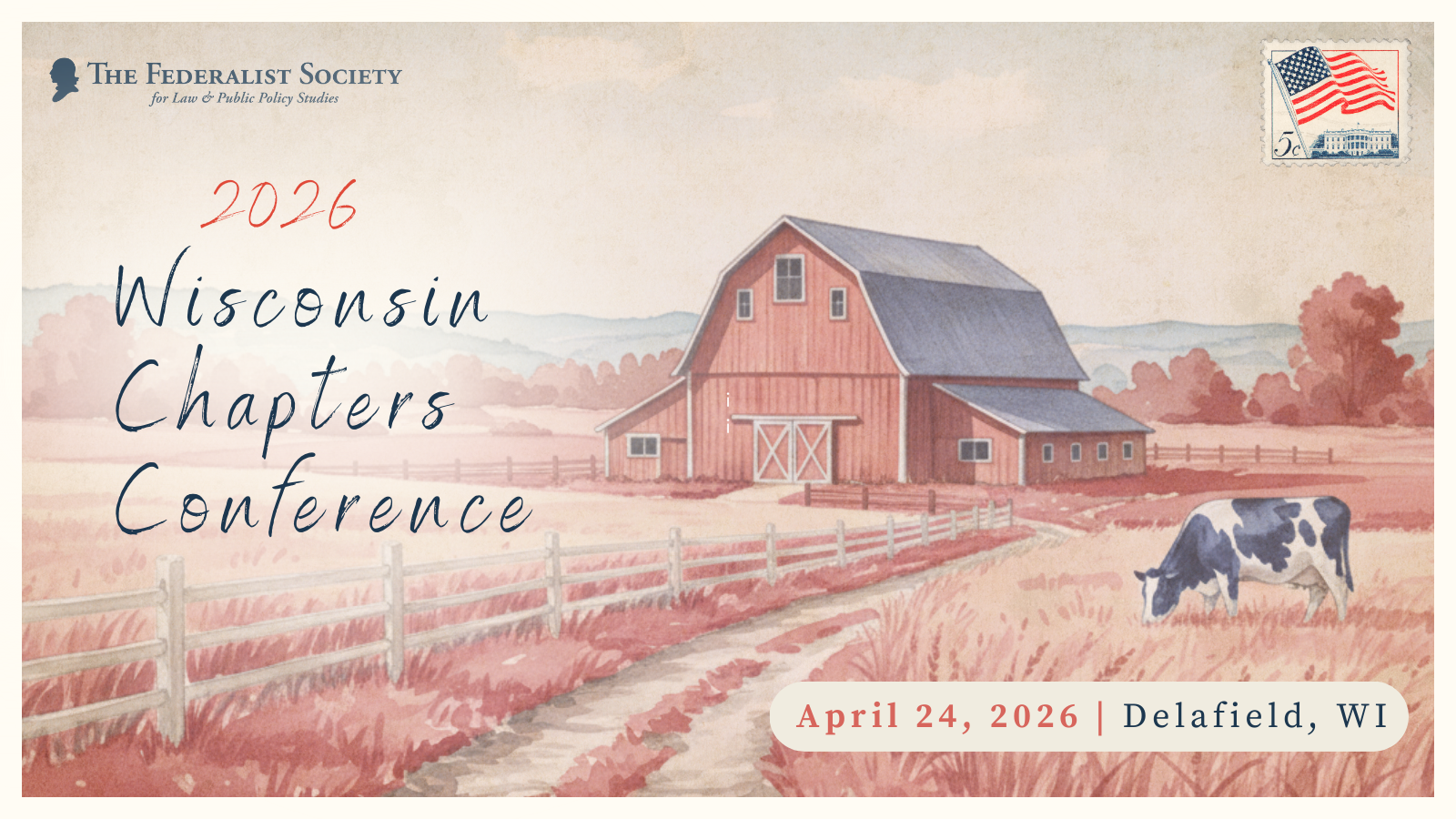
Please join the Wisconsin Lawyer Chapters for our annual statewide conference!
The Delafield Hotel
415 Genesee Street
Delafield, WI 53018
Student Member: $10
Member: $40
Non-Member: $60
Judicial/Government Employee: $40
This event has been approved by the Wisconsin Board of Bar Examiners for
4.0 Total Credit Hours
Equivalent to 3.33 hours in 60-minute jurisdictions
Attendees must sign in at the event to receive CLE credit.
Registration will close at 5:00 p.m. on Monday, April 20, 2026. This is also the deadline to receive a refund for a cancellation. No refunds will be given after the deadline has passed.
Back to top
2026 Wisconsin Chapters Conference
2026 Wisconsin Chapters Conference
Featuring:
2026 Wisconsin Chapters Conference
Featuring:
2026 Wisconsin Chapters Conference
In the modern regulatory framework, administrative agencies exercise significant authority, but that authority originates with the legislature. Legislative oversight serves as a key mechanism for ensuring that agencies remain faithful to legislative intent and operate within the bounds established by the people’s elected representatives.
This panel will explore the range of mechanisms available to the Wisconsin Legislature to oversee executive and independent agencies. The discussion will also consider how recent court decisions, including Evers v. Marklein, interact with these tools, and what actions the legislature may undertake within this new framework. This panel will also analyze political and institutional realities that often shape how oversight operates in practice.
Featuring:
2026 Wisconsin Chapters Conference
In a 6-3 decision issued on February 20, 2026, the Supreme Court held that the International Emergency Economic Powers Act (IEEPA) does not authorize the President to impose tariffs. The ruling consolidated challenges brought by small businesses—including educational-products manufacturer Learning Resources, Inc.—and others against “reciprocal” and “fentanyl/trafficking” tariffs imposed via national-emergency declarations.
Chief Justice Roberts’s majority opinion emphasized that tariffs are duties and imposts falling squarely within Congress’s Article I taxing power, that IEEPA’s text authorizing the President to “regulate . . . importation” contains no clear statement conveying tariff authority, and that the absence of any historical precedent for such use over IEEPA’s nearly fifty-year existence confirmed the statute’s limited scope. Concurring opinions further invoked the major questions doctrine and related interpretive principles to reinforce limits on broad delegations of economic authority.
Three dissenting Justices—Thomas, Kavanaugh, and Alito—argued for greater executive flexibility in foreign-affairs and national-emergency contexts. They contended that IEEPA’s broad language, combined with the President’s traditional role in international economic relations and emergency response, should encompass tariff measures as a form of regulating importation to address declared threats like drug trafficking and persistent trade deficits.
This presentation will feature diverse viewpoints from a panel of experts who have directly dealt with these issues in practice. The panel will examine the interplay between the major questions doctrine, non-delegation, and historical practice — and discuss what the decision means for separation of powers going forward, including any potential impacts beyond tariffs.
Featuring: