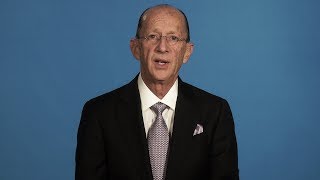
Antitrust & Big Tech
Documentary short from FedSoc Films and the Regulatory Transparency Project

Documentary short from FedSoc Films and the Regulatory Transparency Project
A conversation about the history of antitrust law, the consumer welfare standard, and the tech giants.
Facebook, Amazon, Apple, Netflix, and Google provide extremely valuable products and services, but their size, market share, and other concerns such as user privacy have led to concerns that they are wielding too much power.
Proponents of “populist” or “hipster” antitrust advocate for limiting the size of firms. This would require changing the Consumer Welfare Standard, which has been in place since the 1970’s.
Mark Zuckerburg’s testimony before Congress in April 2018 ignited a public debate about whether and how tech companies should be regulated. That debate continues and shows no signs of resolution.
Is it time to revisit the standards used in antitrust law? Our experts explore.
* * * * *
As always, the Federalist Society takes no position on particular legal or public policy issues; all expressions of opinion are those of the speaker.
Related links:
Robert H. Bork, The Antitrust Paradox
https://www.amazon.com/Antitrust-Paradox-Robert-H-Bork/dp/0029044561
Antitrust Was Defined By Robert Bork I Cannot Overstate His Influence
https://www.washingtonpost.com/news/wonk/wp/2012/12/20/antitrust-was-defined-by-robert-bork-i-cannot-overstate-his-influence/
With Amazon Probe, EU Takes Cue From 'Hipster' Antitrust
https://www.bloomberg.com/news/articles/2018-09-19/with-amazon-probe-eu-takes-cue-from-hipster-antitrust
Antitrust Cops Look to Retool as Washington Flays Tech Firms
https://www.bloomberg.com/news/articles/2018-09-13/antitrust-cops-look-to-retool-as-washington-flays-big-tech-firms
Europe can’t rely on the US to regulate tech giants like Google and Facebook
https://www.independent.co.uk/voices/tech-regulation-privacy-data-google-facebook-europe-a8837081.html
Most now say government won't do enough to regulate big tech: poll
https://thehill.com/policy/technology/417383-most-now-say-government-wont-do-enough-to-regulate-big-tech-firms-poll
In the U.S, Many Complaints About Big Tech, Little Action
https://www.bloomberg.com/news/articles/2018-12-10/in-u-s-many-complaints-about-big-tech-little-action-quicktake
Big Tech’s Reckoning May Be Imminent After All
https://newrepublic.com/article/152640/big-techs-reckoning-may-imminent
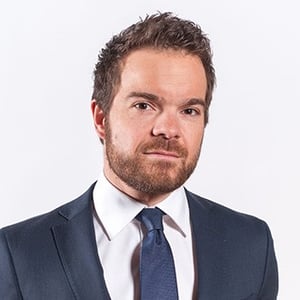
Professor of Law, University of Liege (Belgium)
Professor Nicolas Petit is Professor of Law at Liege University, Belgium and a Research Professor at the School of Law of the University of South Australia in Adelaide (UniSA).
Professor Nicolas Petit’s research focuses on antitrust law, intellectual property, and law in a context of technological change. His recent written works deal with the legal challenges created by the introduction of artificial intelligence and robotics in society. He is also working on a book on technology platforms’ competition.
Professor Petit holds a PhD from the University of Liege (Belgium), an LL.M from the College of Europe (Bruges), a Master’s degree from the University of Paris II and an LLB from the University of Paris V. He practiced law with a leading US law firm in Brussels and he also served as a Clerk at the Commercial Chamber of the French Supreme Court. In 2005 he attended Harvard Law School’s Visiting Researchers Programme.
Professor Petit is the co-author of EU Competition Law and Economics (Oxford University Press, 2012) and the author of Droit européen de la concurrence (Domat Montchrestien, 2013), a monograph which was awarded the prize for the best law book of the year at the Constitutionnal Court in France. In 2017, he received the GCR award for academic excellence.
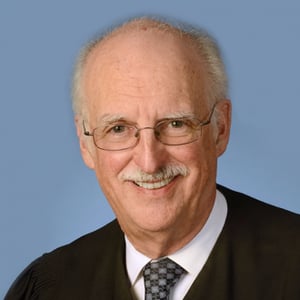
Senior Judge, United States Court of Appeals, District of Columbia Circuit
Circuit Judge Douglas H. Ginsburg was appointed to the United States Court of Appeals for the District of Columbia in 1986. After receiving his B.S. from Cornell University in 1970, and his J.D. from the University of Chicago Law School in 1973, he clerked on the D.C. Circuit and for Justice Thurgood Marshall on the United States Supreme Court. Thereafter, Judge Ginsburg was a professor at the Harvard Law School, the Deputy Assistant and then Assistant Attorney General for the Antitrust Division of the Department of Justice, as well as the Administrator of the Office of Information and Regulatory Affairs in the Office of Management and Budget. Concurrent with his service as a federal judge, Judge Ginsburg has taught at the University of Chicago Law School and the New York University School of Law. Judge Ginsburg is currently a Professor of Law at the George Mason University and a visiting professor at University College London, Faculty of Laws.
Judge Ginsburg is the Chairman of the International Advisory Board of the Global Antitrust Institute at the Law and Economics Center of the George Mason University School of Law. He also serves on the Advisory Boards of: Competition Policy International; the Harvard Journal of Law and Public Policy; the Journal of Competition Law and Economics; the Journal of Law, Economics & Policy; the Supreme Court Economic Review; the University of Chicago Law Review; the New York University Journal of Law and Liberty; and, at University College London, both the Centre for Law, Economics and Society and the Jevons Institute for Competition Law and Economics.
In 2020, Judge Ginsburg was the 11th recipient of the John Sherman Award, presented by the Antitrust Division of the Department of Justice in recognition of the awardee’s Lifetime Contributions to Antitrust Law and Policy.
In 2014, Judge Ginsburg received the Lifetime Achievement Award given annually by the Global Competition Review.
He is the author or co-author of several books and more than 100 articles on competition and regulation, including, most recently, Growing Convergence: The Limited Role of Antitrust in Standard Essential Patent Disputes, in CPI Antitrust Chronicle, Summer 2021, Vol. 1, No. 2.
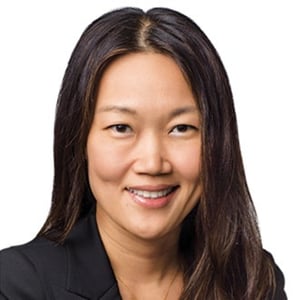
Vice President, Charles River Associates
Joanna Tsai is vice president in the Antitrust & Competition Economics Practice of Charles River Associates in Washington, DC. She has over 15 years of experience in antitrust and intellectual property matters, and has held positions in private practice, academia, and government. Dr. Tsai’s consulting practice includes advising clients on the competitive and economic implications of mergers and acquisitions in a variety of industries, and evaluating and analyzing the economic aspects of antitrust claims. While serving as economic advisor at the Federal Trade Commission from 2013-2015, she advised on a broad range of competition, intellectual property, and consumer protection issues. She is a frequent speaker at academic and industry conferences and has published articles in the Antitrust Source, Antitrust Magazine, Antitrust Law Journal, Antitrust Bulletin, and CPI Antitrust.
Dr. Tsai has also served as faculty at Stanford University’s Hoover IP Squared Summer Institute, visiting professor at the University of Puerto Rico School of Law, and is currently adjunct professor at the Scalia Law School of George Mason University. Dr. Tsai holds a PhD and MA in Economics from Cornell University, and is Co-Chair of the Mergers and Acquisitions Committee of the American Bar Association's Section of Antitrust Law.
GCR’s Who’s Who Legal recognized Dr. Tsai as a Future Leader (under 45 years old) in the Competition Economist category in 2017, 2018 and 2019. In particular, in 2018, she ranked #1 as the “most highly regarded” competition economist in North America. One of the sources GCR interviewed noted that “Joanna offers a great balance of being insightful in her analysis, practical in her dealings with clients and clear in her advocacy.”