Association for Molecular Pathology v. Myriad Genetics, Inc. - Post-Decision SCOTUScast
SCOTUScast 6-19-13 featuring Gregory Dolin


On June 13, 2013, the Supreme Court announced its decision in Association for Molecular Pathology v. Myriad Genetics, Inc. The issue in this case was whether human genes are patentable.
In an opinion delivered by Justice Thomas, the Court held by a vote of 9-0 that a naturally occurring DNA segment is not patentable merely because it has been isolated, but that “complementary” DNA, which is synthetic and does not occur in nature, is patent-eligible. Justice Scalia filed an opinion concurring in part and in the judgment.
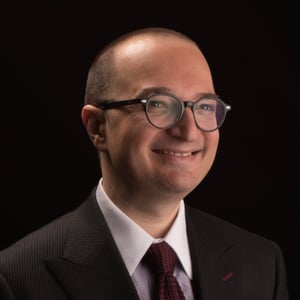
To discuss the case, we have Gregory Dolin, who is Associate Professor and Co-Director of the Center for Medicine and Law at the University of Baltimore School of Law.
[Return to the SCOTUScast menu]
Professor of Law, University of Baltimore School of Law (on leave); Senior Counsel, U.S. Department of Justice
Professor Dolin’s scholarship centers on patent law with a specific focus on how the patent regime affects innovation, especially in bio-pharmaceutical areas. His work in these areas includes a number of scholarly articles, presentations, amicus briefs, and congressional testimony.
Dr. Dolin is currently on leave from his academic duties while he serves as Senior Counsel in the Civil Rights Division of the United States Department of Justice.
From January 2020 to January 2022, Professor Dolin served as a resident Associate Justice of the Supreme Court of the Republic of Palau. In this role, he (together with other members of the Court) heard appeals in civil, criminal, administrative, and constitutional law matters.
Prior to joining the University of Baltimore School of Law, Professor Dolin held visiting appointments in other law schools. He also served as a law clerk to the Hon. Pauline Newman, of the U.S. Court of Appeals for the Federal Circuit and the late Hon. H. Emory Widener Jr., of the U.S. Court of Appeals for the Fourth Circuit.
Rumors that he has a real Russian bear in his office are entirely true.