An Alumnus's Thoughts on the Antonin Scalia Law School
Note from the Editor: The Federalist Society takes no positions on particular legal and public policy matters. Any expressions of opinion are those of the author. We welcome responses to the views presented here. To join the debate, please email us at info@fedsoc.org.
At its best, law school teaches you how to think—not what to think. There is no place for received wisdom. There are no sacred cows. Law students, accordingly, should be consumed by doubt. Whether the field of study is the common law, statutory law, or constitutional law, each student must decide for himself whether the prevailing regime can claim the consent of the governed. Whether it is sensible. Whether it is just. The educator’s task is to challenge students to resolve these questions for themselves. That does not mean, however, that the student’s assertions will go unchallenged. Quite the opposite. Rigorous legal training requires the student to put himself in harm’s way. You have to bring it.
As a graduate of the George Mason University School of Law, I believe I was fortunate enough to receive such an education. That is one of many reasons why I was thrilled to learn of the decision to name the school in Justice Scalia’s honor. No Justice—indeed, no lawyer—better exemplifies this noble tradition. Antonin Scalia stood up for what he believed in without apology. From the outset of his legal career, to his time in the academy, through government service, and during his career on the bench, Justice Scalia challenged convention. Courts should interpret statutes for what they say—not for what the drafters meant for them to say. Separation of powers is essential to tripartite government. The People—not judges—should create new substantive rights. Justice Scalia won some of these battles. He lost some too. Others are being fought still. But that came with the territory. For him, it always seemed that the glory of the law was in the contest of ideas. In getting it right.
Justice Scalia’s opinions are the law student’s inheritance. That was the audience for whom he wrote. The case books are rightfully filled with his big majority decisions, the concurrences that rejuvenated an overlooked principle, and, of course, the memorable dissents. Students willing to engage his opinions may discover, as did I, the foundation for their own approach to the law. Others may find the well-articulated vision of the worthy opponent. In all events, students will be confronted with ideas that cannot be ignored. Yet it is unclear whether forcing students to confront bold ideas—especially unpopular ideas—remains the principle mission of modern legal education. Far too often, conformity rules the day. But not at Antonin Scalia Law School. We read the majorities and the dissents. And then we debate. Usually with civility. Raucously on occasion. But always candidly. And always on the merits. I hope that makes the Scalia family nearly as proud to be associated with us as we are to be associated with them.

Former Solicitor General of Texas
Jonathan F. Mitchell is Principal at Mitchell Law PLLC. He received his law degree with high honors from the University of Chicago Law School, where he was an articles editor of The University of Chicago Law Review and a member of the Order of the Coif.
After graduating from law school, Mr. Mitchell clerked for Judge J. Michael Luttig of the U.S. Court of Appeals for the Fourth Circuit and for Justice Antonin Scalia of the Supreme Court of the United States. He then served as an Attorney-Adviser in the Office of Legal Counsel of the United States Department of Justice from 2003 through 2006. After leaving the Department of Justice, Mr. Mitchell served as a Visiting Researcher at Georgetown University Law Center, a Visiting Assistant Professor at the University of Chicago Law School from 2006 through 2008, and an Assistant Professor of Law at George Mason University from 2008 through 2010.
In 2010, Mr. Mitchell was appointed Solicitor General of Texas, a position he held until January 2015. After leaving the Texas Solicitor General’s office, Mr. Mitchell served as the Searle Visiting Professor of Law at the University of Texas School of Law before joining the Hoover Institution as a Visiting Fellow from 2015 to 2016. Mr. Mitchell also served as a Visiting Professor of Law at Stanford Law School before opening his own law firm in 2018.
Mr. Mitchell has published numerous works of scholarship in top-10 law journals, and he has written articles on textualism, national-security law, criminal law and procedure, judicial review and judicial federalism, and the legality of stare decisis in constitutional adjudication.
Mr. Mitchell has argued eight times before the Supreme Court of the United States, and more than 20 times in the federal courts of appeals. He has also argued before Supreme Court of Texas and in numerous trial courts. Mr. Mitchell has authored the principal merits brief in 11 Supreme Court cases, and has written and submitted more than 20 amicus curiae briefs in the Supreme Court.
Mr. Mitchell devised the novel enforcement mechanism in the Texas Heartbeat Act, also known as Senate Bill 8, which avoids pre-enforcement judicial review by prohibiting government officials from enforcing the statute and empowering private citizens to bring lawsuits against those who violate it. This produced an end-run around Roe v. Wade and allowed Texas and other states to impose pre-viability abortion bans despite the continued existence of Roe.
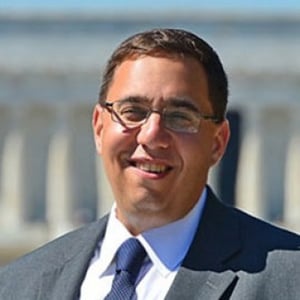
Partner, Consovoy McCarthy Park PLLC
Mr. Consovoy assists clients on a broad range of litigation and appellate issues primarily before the Supreme Court of the United States and federal appellate and district courts, as well as before federal agencies. Mr. Consovoy represents clients in cases involving constitutional issues, interpretation and enforcement of federal statutes, administrative law, civil rights disputes, and a variety of other civil litigation issues. Mr. Consovoy recently argued two cases—Spokeo v. Robbins and Evenwel v. Abbott—before the Supreme Court of the United States.
Mr. Consovoy is a former law clerk to Supreme Court Justice Clarence Thomas, Judge Edith H. Jones of the United States Court of Appeals for the Fifth Circuit, and the 17th Judicial Circuit of Virginia. Mr. Consovoy is a member of the Edward Coke Appellate Inn of Court and was named by Law360 as a “rising star” in appellate law for 2013. Since 2011, Mr. Consovoy has been the co-director of the Supreme Court Clinic at the Antonin Scalia Law School at George Mason University, where he also is the co-director of the Administrative Law Clinic.
Mr. Consovoy earned his B.A. from Monmouth University, and his J.D. magna cum laude from George Mason University School of Law. Mr. Consovoy is a member of the Virginia and District of Columbia bars.