Facts of the Case
Hamilton Bank of Johnson City owned of a tract of land in Williamson County Tennessee and intended to develop it into a residential subdivision. When Hamilton Bank attempted to get a layout of the subdivision approved, the Williamson County Regional Planning Commission denied it because the layout violated certain zoning regulations. Hamilton Bank sued the Commission alleging that the zoning laws constituted a "taking" under the Fifth Amendment. At trial, the jury awarded Hamilton Bank $350,000 as compensation for the taking. The court issued an injunction against the Commission and awarded judgment notwithstanding the verdict denying money damages because the "taking" was only temporary. The U.S. Court of Appeals for the Sixth Circuit reversed, holding that the zoning laws denied Hamilton Bank all "economically viable" use of the land and that damages were required to compensate for the temporary taking.
Questions
Is a property owner entitled to money damages for the time during which zoning laws affect a temporary taking of the property?
Conclusions
-
No decision. In a 7-1 decision, Justice Harry A. Blackmun wrote for the majority, reversing and remanding to the lower court. The Supreme Court held that even if there was a temporary taking, a decision on money damages was premature because Hamilton Bank had not obtained a final administrative decision on the subdivision layout. The claim was premature under the Due Process Clause of the Fourteenth Amendment for the same reason. Justice Byron R. White dissented from the holding that the issues in the case were not ripe for decision.
The Court in 2019 overturned this case in Knick v. Township of Scott, holding there that a government violates the Takings Clause when it takes property without compensation, and a property owner may bring a Fifth Amendment claim under 42 U.S.C. § 1983 at that time.
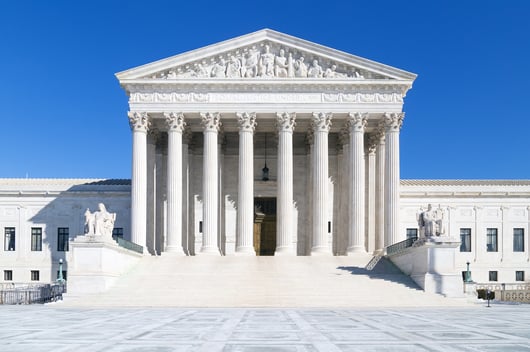
SCOTUS Passes on Opportunity to Limit or Overturn Kelo
In a disappointing move for property rights advocates, the U.S. Supreme Court denied certiorari yesterday...