Facts of the Case
In 1961, Florida enacted the Beach and Shore Preservation Act ("BSPA") to restore and maintain critically eroded beaches within the state. In 2003, under the BSPA, the Florida Department of Environmental Protection filed for an Application for a Joint Coastal Permit and Authorization to Use Sovereign Submerged Lands in order to dredge sand from a shoal to rebuild a beach. Stop the Beach Renourishment Inc. ("SBR"), an association of homeowners, subsequently challenged the issuance of the permit and the constitutionality of the BSPA. The Florida court of appeals rescinded the permit, holding that issuance would have resulted in an unconstitutional taking.
On appeal, the Supreme Court of Florida first rephrased the certified question to determine whether the BSPA was "on its face" constitutional. Then, the court held that the BSPA was not unconstitutional, reasoning that it did not deprive land owners of littoral rights without just compensation.
Questions
By reversing longstanding holdings that littoral (i.e., on or near the shore) rights are constitutionally protected, did the Florida Supreme Court cause a "judicial taking" proscribed by the Fifth and Fourteenth Amendments?
Conclusions
-
No. The Supreme Court held 8-0 that the Florida Supreme Court did not take property without just compensation in violation of the Fifth and Fourteenth Amendments. Justice Antonin Scalia announced the judgment of the Court, and authored an opinion in which he maintained that there could be no taking unless property owners could show that they had rights to future exposed land and to contact with the water superior to Florida's right to fill in its submerged land. Here, there could be no showing. Scalia drew from Florida-law principles that (1) the state, as owner of submerged land adjacent to beachfront property, has the right to fill that land and (2) the exposure of land previously submerged belongs to the state even if it interrupts the beachfront property owners' contact with the water. Justice Scalia, with a plurality of the Court including Chief Justice John G. Roberts and Justices Clarence Thomas and Samuel A. Alito, also noted in Parts II and III of the decision that if a court declares that what was once an established right of private property no longer exists, it has taken that property in violation of the Takings Clause.
Justice Anthony M. Kennedy, joined by Justice Sonia Sotomayor, concurred in part and concurred in the judgment. He agreed with the Court's holding, but disagreed that a plurality should reach the issue of whether or when a judicial decision determining property owners' rights can violate the Takings Clause. Justice Stephen G. Breyer, joined by Justice Ruth Bader Ginsburg, also concurred in part and concurred in the judgment. He agreed with the Court's holding, but, like Justice Kennedy, counseled that the Court should only address the issues before it.
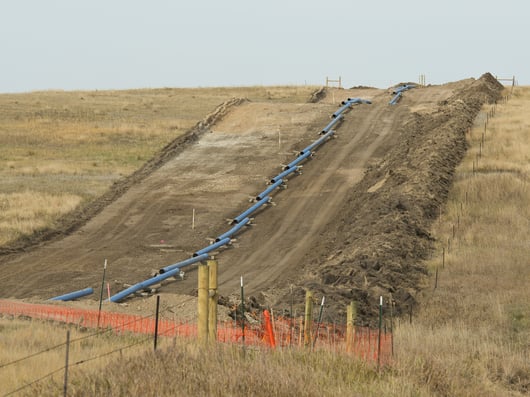
Is “Possess Now, Pay Later” Constitutional in Private Pipeline Takings?
The U.S. Supreme Court will soon consider the third of several petitions for certiorari asking...
Lucas v. South Carolina Coastal Council at 25 - Podcast
Environmental Law & Property Rights Practice Group Podcast
This spring marks the 25th anniversary of the U.S. Supreme Court's decision in Lucas v....
Environmental Law: New Directions in Takings Law
2013 National Lawyers Convention
This past year, the Supreme Court decided three important regulatory takings cases, including Arkansas Game &...
Arkansas Game and Fish: Property Rights in the Supreme Court - Podcast
Environmental Law & Property Rights Practice Group Podcast
In early October, the Supreme Court heard oral argument in Arkansas Game and Fish v....
PPL Montana, LLC v. Montana - Post-Decision SCOTUScast
SCOTUScast 03-12-12 featuring Thomas Merrill
On February 22, 2012, the Supreme Court announced its decision in PPL Montana, LLC v. Montana....
Individual Property Takings: Stop the Beach Renourishment v. Florida Department of Environmental Protection
Environmental Law Practice Group
In Stop the Beach Renourishment, the U.S. Supreme Court unanimously held that the Florida Supreme...
Stop the Beach Renourishment, Inc. v. Florida Department of Environmental Protection - Post-Decision SCOTUScast
SCOTUScast 07-12-10 featuring James S. Burling
On June 17, 2010, the Supreme Court announced its decision in Stop the Beach Renourishment,...
Federal Courts Standards for Ripeness and Takings Claims
Environmental Law & Property Rights Practice Group
Justiciability doctrines, particularly ripeness, have a particularly important role in takings challenges to permitting decisions. ...
Stop the Beach Renourishment, Inc. v. Florida Department of Environmental Protection – Post-Argument SCOTUScast
SCOTUScast 01-15-2010 featuring James S. Burling
On December 2, 2009, the Supreme Court heard oral argument in Stop the Beach Renourishment,...

The Supreme Court and the Judicial Takings Doctrine
This Fall, the United States Supreme Court will hear arguments in Stop the Beach Renourishment...